



Why Do Buffalo Herds Have Babysitters?
Buffalo herds genuinely organise a rotating creche of calves at the centre of the group, watched over by a handful of adult females while the rest of the herd grazes and moves at its own pace, a cooperative arrangement East African guides have long called “babysitting” for how closely it resembles shared childcare.
What Buffalo Babysitting Actually Looks Like in the Field
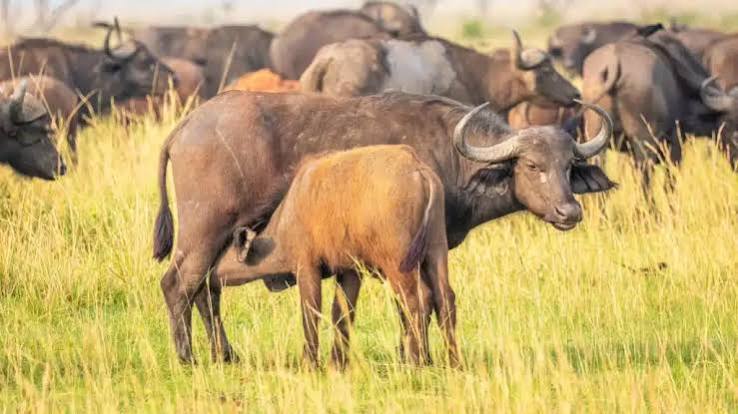
Within a large buffalo herd, calves of similar age genuinely cluster together at the herd’s core rather than staying paired one-to-one with their own mother throughout the day, and a rotating handful of adult females, not necessarily the calves’ own mothers, take on watch duty over the group while other females range further out to graze. A guide who’s watched a herd across several hours will often point out the same two or three cows repeatedly checking on the calf cluster while the mothers of those specific calves have moved genuinely some distance away to feed, direct evidence the arrangement isn’t simple individual maternal care.
Why This System Genuinely Improves Calf Survival
Concentrating calves at the herd’s centre, surrounded by a ring of adults, puts the most vulnerable herd members furthest from the edge where a lion or hyena would first make contact, meaning any predator attempting to reach a calf has to get through adult buffalo first, a considerable deterrent given how forcefully a buffalo herd reacts when a calf is genuinely threatened. Research on buffalo herd defence has documented adults, including individuals with no direct relation to the calf in danger, converging rapidly and aggressively enough to drive off attacking lion, behaviour that would be considerably harder to coordinate if calves were scattered individually alongside their mothers across the herd’s full width.
Why It’s Genuinely Cooperative Rather Than Purely Maternal
What makes this behaviour scientifically interesting is that the watching females aren’t simply guarding their own offspring, since a mother buffalo will often leave her calf within the creche and move off to graze, trusting other herd members to maintain the watch, an arrangement that only works if there’s a genuine, reliable expectation of reciprocity built up through the herd’s long-term social bonds. Female buffalo tend to remain within the same herd for life, meaning the cows sharing babysitting duty have typically known each other, and calved alongside each other, across many years, giving the cooperation a genuinely stable foundation rather than being a one-off arrangement between strangers.
How the Rotation Actually Works Through the Day
Watch duty within the creche isn’t fixed to specific individuals for an entire day but shifts as different females finish a grazing bout and return toward the herd’s centre, meaning the group of adults actively watching calves at any given moment genuinely changes composition every twenty minutes or so as different cows cycle between feeding and watching. This rotation lets every adult female get adequate grazing time across a full day while the calf creche itself is essentially never left unwatched, a genuinely efficient division of labour across the whole herd rather than a fixed babysitting roster.
Buffalo Herd Structure Beyond the Creche
Buffalo herds themselves can number into the hundreds on East Africa’s larger plains, organised loosely around related female lineages with a shifting hierarchy of dominant bulls, and the calf creche sits at the genuine social and physical centre of this wider structure, protected by concentric rings of increasingly peripheral adults and, at the outer edge, the bulls most likely to confront an approaching predator directly.
Where to Observe Buffalo Herd and Creche Behaviour
Large buffalo herds with visible calf creches are genuinely reliable sightings at Tarangire, the Serengeti, and Queen Elizabeth National Park, particularly during calving season when the concentration of similarly aged young makes the creche structure genuinely obvious even from a passing vehicle.
Best Time of Year to Observe This Behaviour
Buffalo calving is loosely tied to rainfall patterns and varies by region, but the resulting concentration of same-aged calves and visible creche behaviour is generally most pronounced a few months after the peak wet season in a given park. See our regional best-time guide for how East Africa’s broader seasonal patterns affect wider game viewing.
Photographing the Calf Creche
A wide shot capturing the full concentric structure, calves at centre, watching adults ringed around them, and grazing herd members further out, genuinely tells the cooperative story better than a close-up of a single calf alone. See our camera gear guide for broader equipment recommendations.
What to Pack for Buffalo-Focused Game Drives
Standard game drive gear – neutral clothing, sun protection, and binoculars – covers most of what buffalo viewing requires. If your wider itinerary includes gorilla trekking, our gorilla trekking packing list covers that portion separately.
Why This Detail Enriches a Standard Buffalo Sighting
Buffalo are frequently treated as a routine Big Five checklist item given how numerous they are, and pointing out an active creche and its rotating watch structure genuinely transforms a passing herd sighting into a considerably more behaviourally engaged encounter, especially for travelers who’ve already seen buffalo elsewhere and assume there’s little more to notice.
What Triggers the Herd’s Collective Defence Response
When a calf genuinely bellows in distress, whether from an approaching predator or simply becoming separated, the sound reliably triggers a rapid, coordinated response from nearby adults rather than just the calf’s own mother, with multiple buffalo converging on the source of the call within seconds. Documented cases of buffalo herds actually driving lion off an active kill, something researchers have filmed on several occasions in the Serengeti and Kruger ecosystems, typically begin exactly this way: a distress call from a captured calf drawing in a mob of adults large and committed enough to force even a successful pride to abandon the attempt.
Why Bulls Position Differently Than Cows During a Threat
While cows cluster protectively around the calf creche, adult bulls more often position at the herd’s outer edge or actively advance toward a spotted threat rather than retreating toward the centre, a genuinely distinct role reflecting their greater size and horn mass, which make them the herd members best equipped to physically confront a predator rather than simply shield calves from a distance. This division between defensive clustering, largely handled by cows, and forward confrontation, largely handled by bulls, means a single alarmed herd genuinely splits into two coordinated but differently tasked groups almost immediately.
Comparing Buffalo Creche Behaviour to Other Herd Animals
Similar calf-clustering behaviour appears among zebra and wildebeest during the migration’s calving season, though buffalo’s version is generally considered the most genuinely cooperative and best studied, given how consistently and deliberately non-related females rotate watch duty rather than each simply keeping her own calf nearby, which is closer to how zebra typically manage the same challenge.
How Guides Read Creche Behaviour to Anticipate Herd Movement
Experienced guides watching a herd with an active creche can often predict roughly when and where the group will next move, since a herd won’t relocate until enough of the watching adults have finished their grazing rotation and the calf cluster itself shows readiness to travel, a genuinely useful piece of behavioural reading that helps position a vehicle for the herd’s next stretch of open ground rather than waiting passively.
Getting to East Africa’s Best Buffalo Herd Destinations
Most itineraries reach Tanzania’s Northern Circuit or Uganda’s Queen Elizabeth via road or scheduled flight from their respective regional hubs, with the largest, most visible herds and clearest creche structure typically found on the more open plains sections of each park rather than denser woodland where herds fragment into smaller groups, as they do around parts of Lake Manyara’s more forested terrain.
A Detail Worth Asking Your Guide to Point Out
Requesting a guide specifically identify the current watching adults versus the grazing majority, rather than assuming every nearby cow is equally alert, turns a standard buffalo sighting into a genuinely more precise piece of behavioural observation.
Frequently Asked Questions
Do buffalo really babysit each other’s calves?
Yes, genuinely so – a rotating group of adult females watches over a shared calf creche at the herd’s centre while others graze.
Why do calves cluster at the centre of the herd?
It puts the most vulnerable herd members furthest from the edge a predator would first reach, protected by rings of adults.
Is the watch duty fixed to specific females?
No, it rotates roughly every twenty minutes as different cows cycle between grazing and watching duty.
Why does this cooperation work reliably between different mothers?
Female buffalo typically remain in the same herd for life, building long-term social bonds that make genuine reciprocal care possible.
Where can I see this behaviour on safari?
Tarangire, the Serengeti, and Queen Elizabeth National Park all offer genuine opportunities, especially during and after calving season.
Ready to Plan Your East Africa Safari?
Whether observing buffalo herd behaviour firsthand, the full Big Five, or a complete East Africa itinerary is your priority, our team can build a trip matched to your interests. Get in touch with our team below today and let’s start planning your complete safari itinerary together.

No comment