







Lion vs Leopard: Key Differences You Should Know
Lions and leopards differ across nearly every dimension beyond both belonging to the big cat family, from social structure and size to hunting strategy and habitat preference, differences that shape everything from where each species is found to how visitors should approach spotting them on safari.
This guide covers the genuine differences worth understanding before your trip, from social structure and physical build through to the specific behavioural cues that help distinguish one species’ activity from the other’s in the field.
Social Structure: the Most Fundamental Difference
Lions live in cooperative social prides, while leopards remain almost entirely solitary outside of mating and raising young, a fundamental behavioural divergence that shapes nearly every other difference between the two species. Our guide on how lion prides are structured covers this cooperative social system in depth, a structure leopards never developed given their considerably different ecological niche.
Size and Physical Build: Lions Hold a Considerable Advantage
Adult male lions weigh considerably more than leopards, with a noticeably bulkier, more muscular build suited to cooperative hunting of large prey and physical territorial combat. Leopards, by contrast, carry a leaner, more compact frame built for stealth, climbing, and solitary ambush hunting rather than raw size and strength, and pound for pound, a leopard’s relative strength is considered exceptional given its comparatively smaller overall size, since the species routinely hoists prey heavier than itself into a tree.
Hunting Strategy: Cooperative Ambush vs Solitary Stalk
Lions hunt cooperatively in coordinated groups, using numbers to bring down prey considerably larger than any single individual could manage alone. Leopards hunt entirely alone, relying on exceptional stealth and a powerful final pounce from extremely close range, a solitary strategy that demands considerably more individual precision than a lion’s group-based approach requires. Our guide on what lions eat and how they hunt covers the cooperative strategy in considerably more depth.
Why Leopards Hoist Kills Into Trees and Lions Don’t
Leopards drag kills up into trees specifically to protect them from lions and hyenas, both of which would otherwise steal a leopard’s kill on the ground given their size advantage, a behaviour lions have no need for given their own dominant position atop the local predator hierarchy. This tree-caching behaviour represents one of the clearest visible behavioural markers distinguishing leopard activity from lion activity in a shared ecosystem.
Habitat Preference: Open Plains vs Dense Cover
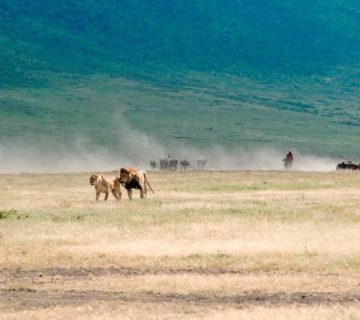
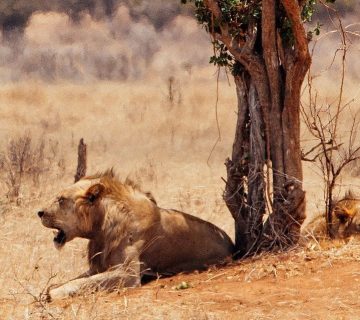
Lions favour open savanna and grassland, terrain suited to their cooperative hunting strategy and reliant on clear sightlines for coordinating a pride-based approach. Leopards prefer considerably denser cover, riverine woodland, rocky outcrops, and thicker bush, terrain that supports the close-range stealth their solitary hunting strategy depends on. This habitat divide means the two species, despite sharing much of the same broader ecosystem, often occupy noticeably different specific terrain within it.

Activity Pattern: Why Leopards Are Harder to Spot
Leopards lean considerably more nocturnal than lions, and their solitary, secretive nature combined with dense habitat preference makes them one of the harder Big Five species to reliably spot on safari, in sharp contrast to lions’ comparatively more visible daytime resting behaviour within open terrain. Our guide on how long lions sleep each day covers lions’ own daily activity pattern, a useful point of comparison against leopards’ considerably more elusive daily rhythm. A night game drive offers noticeably better leopard-spotting odds than standard daytime drives, given how much more active leopards typically become after dark.
Vocalisation: Roaring vs a Distinctive Rasping Call
Lions possess the flexible throat ligament enabling their famous extended roar, while leopards produce a considerably different, shorter rasping call sometimes described as sounding like a saw cutting wood, a sound distinct enough that experienced guides can identify which species is calling from the sound alone, even at considerable distance and without any visual confirmation. Our guide on essential lion facts for safari-goers covers more about the roar’s specific range and purpose.
Coat Pattern: Solid Colour vs Distinctive Rosettes
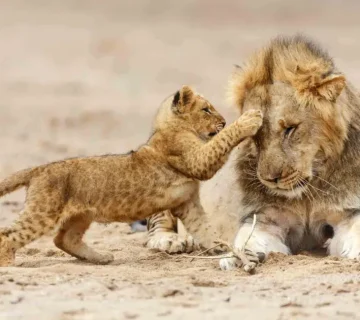
Lions display a largely uniform tawny coat with minimal patterning as adults, aside from faint cub-stage spotting that fades with age, while leopards retain their distinctive dark rosette pattern throughout adulthood, a patterning that provides considerably more effective camouflage within the leopard’s preferred dense, dappled-light habitat than a lion’s more uniform coat would offer in that same terrain. Our roundup of male versus female lion differences covers more about this cub-stage spotting and how it fades with age.
Territorial Behaviour: Group Defence vs Solitary Marking
Lion prides defend territory collectively, with resident males patrolling and scent-marking shared boundaries as a coordinated group effort. Leopards mark and defend a considerably more individual territory alone, without any coalition-based support, a higher-risk proposition against rival leopards or encroaching lions that leopards manage primarily through avoidance and stealth rather than direct confrontation. Our guide on whether lions are dangerous to safari vehicles touches on this same territorial vigilance from a visitor-safety perspective.
Where to See Both Species on the Same Safari
Ecosystems with strong resident populations of both species offer visitors the chance to observe this contrast firsthand within a single trip. Our guide on the best parks to see lions in East Africa covers several destinations where both predators maintain healthy, well-documented populations within overlapping territory, though spotting a leopard still requires considerably more patience and luck than a typical lion sighting given the species’ inherently more elusive nature.
Genetic Lineage: How Closely Related Are Lions and Leopards?
Both species belong to the Panthera genus alongside tigers and jaguars, sharing a common ancestor considerably further back than their superficial similarity as big cats might suggest, and despite both roaring, unlike smaller cats such as cheetahs, the two species diverged onto separate evolutionary paths millions of years ago, developing the fundamentally different social structures and hunting strategies covered throughout this guide.
This shared roaring ability sets both species apart from smaller cats within the same broader family, since the specialised throat anatomy enabling a true roar evolved specifically within the Panthera lineage, meaning despite their many behavioural differences, lions and leopards share this one distinctive vocal trait that neither cheetahs nor smaller wild cats possess.
Why Leopards Avoid Direct Conflict With Lions
Given lions’ considerable size advantage, leopards go to considerable lengths to avoid direct confrontation entirely, relying on their tree-climbing ability and preference for denser cover to simply stay out of a lion’s way rather than risk a confrontation they would very likely lose. This avoidance strategy represents one of the clearest practical illustrations of how these two species, despite sharing much of the same territory across East Africa, have evolved fundamentally different survival approaches.
Leopard cubs face a particularly acute version of this risk, since both lions and hyenas will kill leopard cubs given the opportunity, meaning leopard mothers invest heavily in choosing well-concealed denning sites and keeping cubs hidden for a considerably longer period relative to lion cubs, who benefit from an entire pride’s collective protection that a solitary leopard mother simply cannot match.
Reproduction and Cub-Rearing: Solo Motherhood vs Communal Care
Leopard mothers raise cubs entirely alone, without any of the communal nursing and shared protection a lion pride’s cooperative structure provides, a considerably higher-risk arrangement that contributes to leopard cub mortality rates running even higher than the already substantial mortality lion cubs face during their first year. This fundamental difference in cub-rearing structure traces directly back to each species’ contrasting social system, solitary versus cooperative, discussed throughout this guide.
Leopard cubs also remain dependent on their mother for a considerably longer period than lion cubs typically do before becoming fully independent, since a young leopard must master solitary hunting entirely on its own before dispersing, a skill lion cubs get to practise and refine gradually within the relative safety of an established pride’s ongoing cooperative hunts.
Frequently Asked Questions
Which is bigger, a lion or a leopard?
Lions weigh considerably more than leopards, with a noticeably bulkier, more muscular build.
Do leopards live in groups like lions?
No – leopards remain solitary outside of mating and raising young, unlike lions’ cooperative pride structure.
Why do leopards drag kills into trees?
To protect the kill from lions and hyenas, both of which would otherwise steal it on the ground.
Which species is harder to spot on safari?
Leopards are, given their solitary, more nocturnal, and considerably more secretive nature.
Do lions and leopards sound different?
Yes – lions produce an extended roar, while leopards make a shorter, distinctive rasping call.
Ready to Plan Your African Safari?
Whether you’re hoping to see a cooperative lion pride in open grassland or spot an elusive leopard in denser cover, our team can build a trip matched to your interests. Get in touch with our team below today and let’s start planning your complete African safari itinerary together.


No comment