
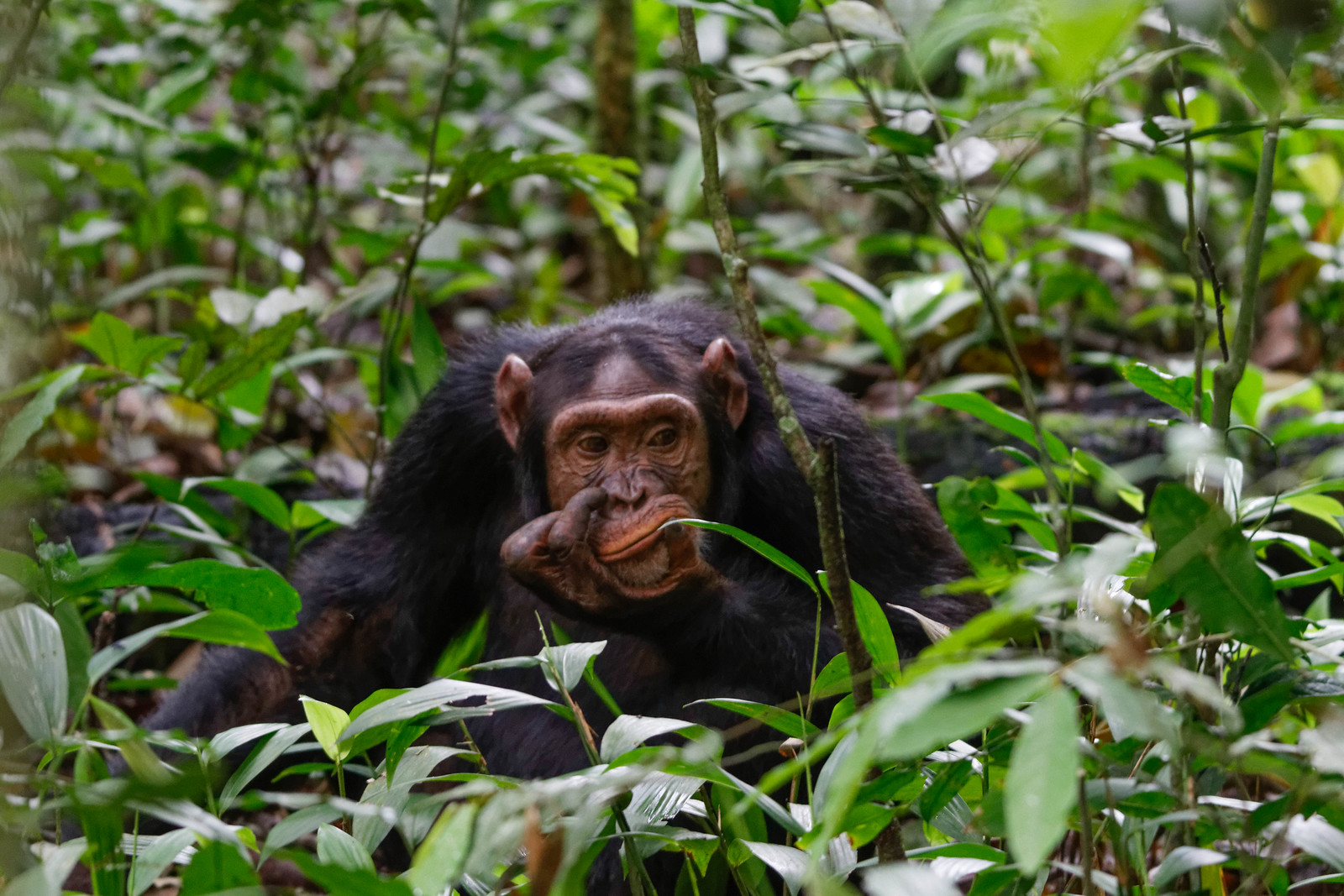

Chimpanzees in Uganda’s forests use a genuinely varied toolkit shaped from twigs, stems, and stone, from termite-fishing probes stripped of leaves and bark to nut-cracking hammers selected specifically for weight and hardness, behaviour so deliberate and locally distinct that researchers now describe it as culture rather than instinct.
Termite Fishing: The Tool Most Visitors Actually See
The most commonly documented chimpanzee tool is a termite-fishing probe, a thin stem or twig a chimp strips of leaves and side branches, sometimes chewing the end to fray it into a slightly wider brush, before inserting it carefully into a termite mound tunnel and withdrawing it coated in defending soldiers to eat. Jane Goodall’s original 1960 observation of this exact behaviour at Gombe in Tanzania overturned the assumption that toolmaking was uniquely human, and the same core technique, with local variations in stem length and preparation, has since been documented across most studied wild chimpanzee populations, including groups in Uganda’s Kibale Forest.
Nut-Cracking: Selecting the Right Hammer and Anvil
In West African populations, though genuinely rarer in East African chimps, individuals select a stone or hard piece of wood as a hammer and position a nut on a second stone or exposed tree root acting as an anvil, striking with enough calibrated force to crack the shell without pulverising the kernel inside. Researchers have found chimps genuinely testing several candidate stones by weight before settling on one, and juveniles can take several years of watching and failed attempts before mastering the technique well enough to reliably extract a kernel intact.
Sponging: Turning Leaves Into a Drinking Tool
Chimps also chew a wad of leaves into a genuinely absorbent sponge, then dip it into a tree hollow or other hard-to-reach water source and squeeze the liquid directly into the mouth, a technique that lets them access water pockets a hand or tongue simply can’t reach. Some populations have been observed refining this further, choosing leaf species specifically for their absorbency rather than whatever happens to be nearest.
Why Tool Use Genuinely Counts as Culture, Not Instinct
What makes chimpanzee tool use scientifically significant isn’t the tools themselves but the fact that technique varies meaningfully between neighbouring communities using the identical raw materials and facing the identical prey, meaning the differences are learned and passed down within a group rather than hardwired by genetics. A young chimp learns a specific community’s termite-fishing style, stem length, and preparation method by watching its mother over months or years, and a chimp transferred to a different community as an adult generally keeps its original technique rather than instinctively switching, direct evidence the behaviour is socially transmitted rather than innate.
Tool Use as a Marker of Social Learning and Patience
Mothers are consistently observed tolerating a juvenile’s clumsy, repeated attempts at termite fishing beside her own far more efficient probing, a genuinely extended apprenticeship that can run for several years before a young chimp’s technique matches an adult’s success rate. This patient, observation-based learning process is itself considered strong evidence of chimpanzee cognitive sophistication, distinct from and arguably more revealing than the tool use itself.
Where to Observe Tool-Using Chimpanzees in Uganda
Uganda’s Kibale Forest holds one of the country’s most habituated, closely studied chimpanzee communities, where tracked trekking groups regularly observe genuine termite-fishing and leaf-sponging behaviour, particularly during the drier months when termite mound activity is more predictable and accessible.
Best Time of Year for Chimpanzee Tool Use Observation
Chimp trekking runs year-round in Kibale, though the dry season, roughly December to February and June to August, offers somewhat easier forest walking conditions and more consistent termite mound activity. See our Uganda best-time guide for how the country’s broader dry and wet seasons affect wider trip planning.
Self-Drive vs Guided Chimpanzee Trekking
Chimp trekking is only available through licensed guided permits within Kibale, with rangers who track a specific habituated community daily and can position a group to observe active foraging or tool use rather than a passing glimpse, making the guided structure genuinely essential rather than optional here.
Photographing Tool-Using Chimpanzees
Termite-fishing and sponging happen at relatively close range within thick forest, so a versatile mid-range zoom with a fast aperture for the forest’s low light matters more than pure reach. See our camera gear guide for broader equipment recommendations suited to forest primate photography.
What to Pack for Chimpanzee Trekking
Standard forest trekking gear – sturdy shoes, rain protection, and neutral clothing – covers most of what Kibale requires. If your wider itinerary includes gorilla trekking, our gorilla trekking packing list covers similar essentials applicable to Kibale as well.
Combining Tool-Use Observation With the Wider Forest Ecosystem
A Kibale forest walk focused on chimpanzee behaviour often also passes colobus and red-tailed monkey troops, giving travelers genuine additional primate diversity within the same guided excursion beyond the chimp community itself.
Getting to Kibale Forest National Park
Kibale sits within Uganda’s western tourism circuit, commonly combined with Queen Elizabeth National Park and Bwindi gorilla trekking on a longer itinerary, making it a natural inclusion for travelers already planning a broader southwestern Uganda safari.
Beyond Termites: Ant-Dipping and Its Own Distinct Technique
Chimps use a genuinely different tool strategy for army and driver ants than for termites, selecting a longer, sturdier stick and either sweeping it across a swarming column to gather dozens of ants at once before running the stick through closed lips in one motion, or using a shorter stick dipped repeatedly and eaten a few ants at a time, depending on the specific ant species’ aggression and biting strength. Which of these two strategies a community favours is itself a local tradition, with neighbouring chimp groups sometimes preferring opposite techniques for handling the same ant species, another data point supporting tool use as learned culture rather than fixed instinct.
Tool Preparation Itself Is a Genuinely Skilled Multi-Step Process
Selecting a termite-fishing stem isn’t a single action but a short sequence: a chimp identifies a plant species with the right flexibility and diameter, breaks off a length of appropriate size, strips side leaves and bark with its teeth and fingers, and sometimes bites the tip to fray it into a slightly wider, brush-like end that collects more termites per dip. Researchers who’ve timed this preparation found experienced adults complete the whole sequence in under a minute, while juveniles can spend considerably longer fumbling through each step, another window into how much practice separates a competent adult forager from a still-learning youngster.
Do Chimps Plan Ahead When Making Tools?
Genuinely compelling evidence suggests some tool preparation happens away from the actual foraging site, with chimps observed selecting and preparing a probe stem before walking to a termite mound rather than improvising on arrival, behaviour researchers interpret as a form of forward planning rather than pure reactive instinct. This kind of anticipatory tool preparation, planning for a need not yet immediately present, was long considered a distinctly human cognitive trait before field observations of wild chimps genuinely challenged that assumption.
Regional Toolkits: Why Kibale’s Chimps Differ From West African Populations
The stone hammer-and-anvil nut-cracking documented extensively in West African populations, particularly in Côte d’Ivoire’s Taï Forest, is rarely if ever observed among East African chimps including those in Kibale, most likely because the specific hard-shelled nut species that make the behaviour worthwhile simply don’t grow in the same density across Uganda’s forests. This absence isn’t a cognitive limitation on the East African chimps’ part but a straightforward reflection of available raw material, underscoring how tightly local tool traditions track local ecology.
Guides Genuinely Improve What You Notice
An experienced Kibale ranger who’s watched the same community for years can point out preparation steps a first-time visitor would otherwise miss entirely, spotting a chimp selecting and stripping a probe stem well before it approaches a mound, the kind of detail that turns a brief termite-fishing glimpse into a genuinely fuller behavioural sequence, much as guides do when interpreting other subtle wildlife behaviour elsewhere on a broader itinerary.
Frequently Asked Questions
What tools do wild chimpanzees actually use?
Termite-fishing probes made from stripped twigs, leaf sponges for reaching water in tree hollows, and, in some populations, stone hammers and anvils for cracking nuts.
Is chimpanzee tool use instinctive or learned?
Genuinely learned – technique varies between neighbouring communities using identical materials, and a chimp moved to a new group typically keeps its original method rather than switching.
How long does it take a young chimp to learn termite fishing?
Often several years of watching and repeated attempts before technique matches an adult’s success rate.
Do Uganda’s chimpanzees use stone tools like West African populations?
Stone tool-assisted nut-cracking is rarer in East Africa; Uganda’s Kibale chimps are more reliably observed termite-fishing and leaf-sponging.
What’s the best time to see this behaviour in Kibale?
The dry season, roughly December to February and June to August, offers more consistent termite mound activity and easier trekking conditions.
Ready to Plan Your Kibale Forest Safari?
Whether observing chimpanzee tool use firsthand, the forest’s wider primate diversity, or a full Uganda itinerary is your priority, our team can build a trip matched to your interests. Get in touch with our team below today and let’s start planning your complete Uganda safari itinerary together.



No comment