
Red-Tailed Monkeys of Kibale Forest
Red-tailed monkeys move through Kibale Forest’s mid-canopy with genuinely quick, agile movement, their distinctive white nose spot and reddish tail marking them as one of the forest’s more visually charming, if smaller and less famous, primate species compared to Kibale’s headline chimpanzees.
Identifying Red-Tailed Monkeys
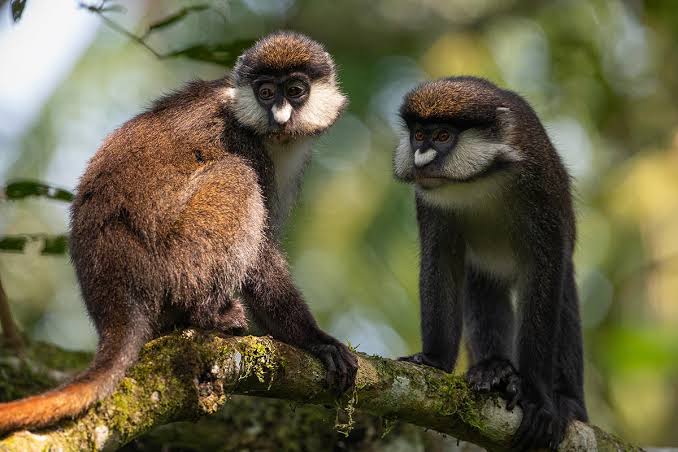
Red-tailed monkeys carry a genuinely distinctive white heart-shaped nose spot against an otherwise dark face, along with a coppery-red tail that gives the species its common name. This combination of features, along with their comparatively small size, makes red-tailed monkeys straightforward to identify once spotted moving through Kibale’s mid-canopy vegetation.
Where to Find Red-Tailed Monkeys in Kibale Forest
Red-tailed monkeys range throughout Kibale’s forest interior, favouring the mid-canopy layer between the forest floor and the uppermost canopy where colobus monkeys more typically range. This vertical habitat separation allows multiple primate species to share the same forest without direct competition for identical resources.
Red-Tailed Monkey Social Structure
Red-tailed monkeys typically live in groups led by a single dominant male alongside multiple females and their offspring, a social structure genuinely similar to several other African guenon species sharing forest habitat. Troops move together through the canopy, communicating through a range of calls to maintain group cohesion across dense vegetation.
Red-Tailed Monkeys and Mixed-Species Associations
Red-tailed monkeys frequently form genuinely close associations with other Kibale primate species, particularly blue monkeys, travelling and foraging together in mixed groups that likely offer improved collective predator vigilance compared to either species moving alone. This cooperative behaviour between different species is a genuinely interesting example of interspecies social dynamics within the forest.
Diet and Feeding Behaviour
Red-tailed monkeys are genuinely opportunistic omnivores, feeding on fruit, leaves, insects, and occasionally small vertebrates, a dietary flexibility well suited to their mid-canopy forest habitat. This adaptability allows them to exploit a genuinely wide range of forest food resources across seasonal availability changes throughout the year.
Red-Tailed Monkeys and Kibale’s Wider Primate Diversity
Beyond red-tailed monkeys, Kibale holds Uganda’s highest primate diversity, including chimpanzees and colobus, making the forest one of East Africa’s most genuinely rewarding single destinations for primate-focused travelers building a broader forest wildlife itinerary.
Best Time of Year for Red-Tailed Monkey Sightings
Red-tailed monkeys are visible in Kibale Forest year-round given their resident status, making seasonal timing genuinely less critical than for many other Uganda wildlife sightings. See our Uganda best-time guide for how the country’s broader dry and wet seasons still affect wider trip planning.
Self-Drive vs Guided Forest Walks
Red-tailed monkey viewing in Kibale is only available through guided forest walks, given the dense vegetation and specialised tracking knowledge required to locate active groups within the mid-canopy. Most visitors combine red-tailed monkey viewing with standard chimpanzee trekking permits on the same forest walk.
Photographing Kibale’s Red-Tailed Monkeys
A red-tailed monkey’s distinctive nose spot and tail colouring offer genuinely charming photographic detail when captured at close range through the forest canopy. A telephoto lens with a reasonably fast shutter speed helps freeze their characteristic quick movement, similar to the gear recommended in our camera gear guide.
What to Pack for a Kibale Forest Safari
Standard forest trekking gear – sturdy shoes, rain protection, and neutral clothing – covers most of what Kibale requires. If your wider itinerary includes gorilla trekking, our gorilla trekking packing list covers similar essentials applicable to Kibale as well.
Why Red-Tailed Monkeys Are Often Overlooked
Given Kibale’s genuinely famous chimpanzee population dominating most travelers’ attention, red-tailed monkeys frequently receive considerably less notice, an oversight experienced guides consistently push back against given how genuinely charming and visually distinctive the species actually is up close during a forest walk.
Combining Red-Tailed Monkey Viewing With Chimpanzee Trekking
Most Kibale itineraries combine standard chimpanzee trekking permits with broader forest walks that frequently encounter red-tailed monkeys and other primate species, giving travelers genuine value across a single, well-organised forest excursion.
Getting to Kibale Forest National Park
Kibale sits within Uganda’s western tourism circuit, commonly combined with Queen Elizabeth National Park and Bwindi gorilla trekking on a longer itinerary, making it a natural inclusion for travelers already planning a broader southwestern Uganda safari.
Red-Tailed Monkey Vocalisations
Red-tailed monkeys communicate through a genuinely wide range of calls, including specific alarm vocalisations used to warn troop members of approaching danger, whether an eagle overhead or a leopard moving through nearby cover. These calls, while less scientifically famous than vervet monkeys’ documented predator-specific alarm system, still convey genuinely meaningful information within the troop’s social structure.
Infant Development and Troop Care
Red-tailed monkey infants remain closely attached to their mothers for the first weeks of life, gradually gaining independence as they develop the coordination needed for the species’ characteristic quick, agile canopy movement. Mothers and other troop females often participate in cooperative vigilance, helping protect vulnerable young from the forest’s various predator threats.
Territorial Behaviour and Group Ranges
Red-tailed monkey troops maintain genuinely defined home ranges within Kibale’s forest, occasionally overlapping with neighbouring groups, with territorial disputes typically resolved through vocal displays and posturing rather than genuine physical confrontation. This relatively low-conflict territorial system reflects the species’ broader emphasis on avoidance and vigilance over direct confrontation.
Why Mixed-Species Groups Make Ecological Sense
The close association red-tailed monkeys form with other Kibale primate species reflects a genuinely sound evolutionary strategy, since combined group vigilance across multiple species with slightly different sensory strengths and predator-detection capabilities improves overall safety for all participants compared to any single species foraging alone.
Comparing Red-Tailed Monkeys to Uganda’s Other Guenon Species
Uganda hosts several genuinely related guenon monkey species beyond red-tailed monkeys, each occupying slightly different forest niches and displaying distinct colouring, offering primate-focused travelers genuine variety when exploring East Africa’s wider forest ecosystems across multiple countries.
Best Lodges for Primate-Focused Kibale Visits
Properties positioned near Kibale’s main trailheads genuinely simplify logistics for travelers specifically prioritising red-tailed monkey and wider primate viewing, cutting down on transfer time before guided forest walks. Discussing current group activity directly with your operator is genuinely worth doing before finalising your complete Kibale itinerary.
Red-Tailed Monkey Predators Within Kibale
Red-tailed monkeys face genuine predation risk from Kibale’s resident crowned eagle population, one of Africa’s most powerful forest raptors, capable of taking young or unwary individuals directly from the canopy. This predation pressure has shaped red-tailed monkey vigilance behaviour and their preference for staying within denser, more protective mid-canopy cover rather than more exposed upper branches.
Getting to Kibale From Other Uganda Destinations
Kibale sits within a comfortable connecting drive of Queen Elizabeth National Park and its famous Kazinga Channel, making it a natural inclusion on longer itineraries covering both savannah wildlife and forest primates within a single well-planned western Uganda circuit.
Why First-Time Visitors Are Often Surprised
Many travelers arrive at Kibale focused entirely on chimpanzee trekking and are genuinely surprised by how visually striking and behaviourally engaging red-tailed monkey sightings turn out to be, often becoming an unexpected highlight of the same forest walk rather than a secondary afterthought.
What to Expect From a Combined Primate Walk
A single Kibale forest walk often produces sightings of red-tailed monkeys alongside several other species, giving travelers a genuinely efficient, rewarding overview of the park’s primate diversity within just a few hours of guided walking, well beyond the standard chimpanzee trekking permit alone.
What to Pack Specifically for a Primate Walk
Beyond standard forest gear, binoculars genuinely improve mid-canopy red-tailed monkey viewing given how much time is spent looking upward through dense foliage rather than at eye level, making them a genuinely worthwhile addition even on a short guided walk.
Kibale’s Forest Soundscape
Beyond visual sightings, Kibale’s forest mornings carry a genuinely rich soundscape of overlapping primate calls, from red-tailed monkeys to colobus and chimpanzees, offering experienced guides a genuinely useful auditory tool for locating active groups well before any actual visual confirmation is possible.
A Genuinely Rewarding Forest Highlight
Even travelers arriving with no specific primate interest beyond chimpanzee trekking consistently report red-tailed monkeys as a genuinely pleasant, unexpected discovery worth remembering long after the trip itself has ended.
Frequently Asked Questions
How can I identify a red-tailed monkey?
Look for a distinctive white heart-shaped nose spot and a coppery-red tail, genuinely straightforward to identify once spotted in the canopy.
Do red-tailed monkeys associate with other species?
Yes, genuinely often – they frequently form mixed groups with blue monkeys, likely improving collective predator vigilance for both species.
Can I see red-tailed monkeys during chimpanzee trekking?
Yes, genuinely often – they frequent the same forest trail networks used for chimp trekking within Kibale Forest.
What’s the best time of year to see red-tailed monkeys in Kibale?
Year-round given their resident status, making seasonal timing genuinely less critical than for other Uganda wildlife.
Is Kibale good for primates beyond chimpanzees?
Genuinely yes – it holds Uganda’s highest primate diversity, including red-tailed monkeys and numerous other species.
Ready to Plan Your Kibale Forest Safari?
Whether the forest’s charming red-tailed monkeys, chimpanzee trekking, or a full Uganda itinerary is your priority, our team can build a trip matched to your interests. Get in touch with our team below today and let’s start planning your complete Uganda safari itinerary together.


No comment