

How Do Leopards Hoist Prey Into Trees?
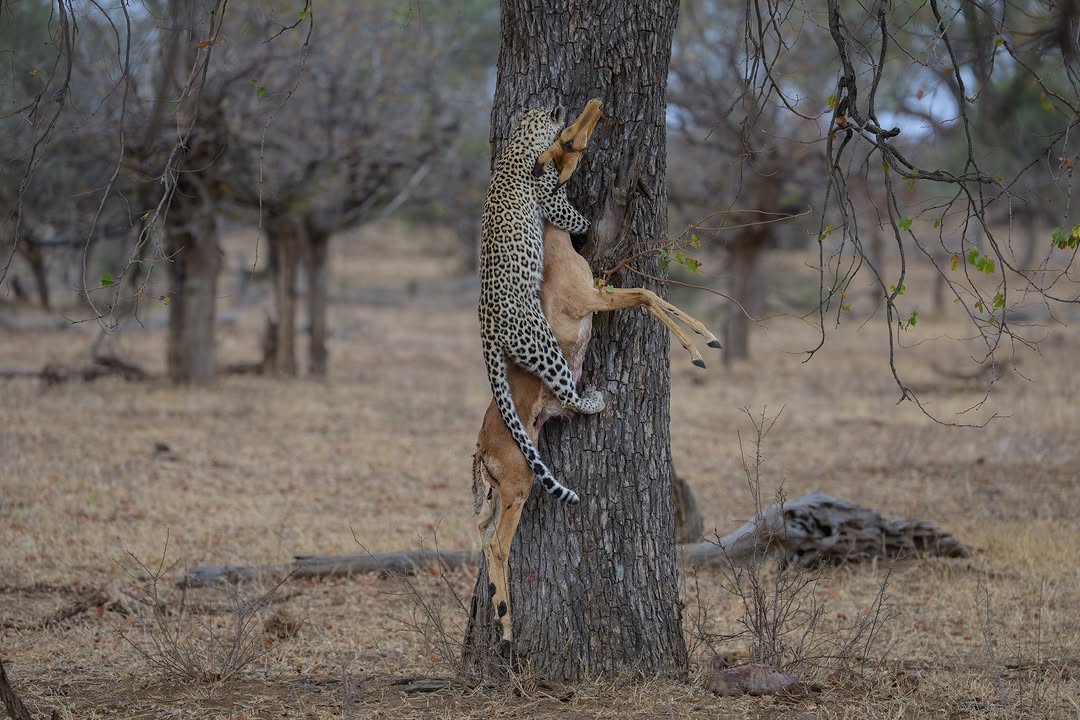
A leopard can genuinely haul a carcass weighing more than its own body straight up a tree trunk using nothing but jaw strength and neck muscle, a feat of raw power that lets it store a kill safely out of reach of lion and hyena, the two competitors most likely to steal a hard-won meal on open ground.
The Genuine Mechanics Behind the Climb
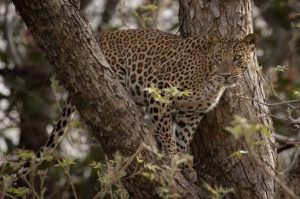
A leopard grips a carcass by the neck or shoulder, sinking its canines deep enough to get a secure hold, then climbs the trunk using its powerful forelimbs while the carcass’s weight hangs directly from the jaw, meaning the neck and jaw muscles are doing the vast majority of the lifting work rather than the limbs, which are occupied with the climb itself. Researchers who’ve measured leopard bite force and neck muscle mass relative to body size have found the species genuinely disproportionately strong in this specific combination compared to lion or cheetah, a targeted adaptation rather than simply leopards being strong overall.
Why Leopards Can Carry More Than Their Own Body Weight
Documented cases include leopards hoisting impala, young giraffe, and even young buffalo carcasses considerably heavier than the leopard itself, sometimes exceeding one and a half times the cat’s own body mass, up several metres of vertical trunk. This is possible because the climb itself distributes effort across repeated short muscular contractions rather than a single continuous lift, similar in principle to how a person might haul a heavy load up a rope hand over hand rather than attempting to lift the entire weight in one motion.
Why Leopards Bother With the Effort at All
Storing a kill in a tree genuinely solves leopard’s single biggest vulnerability as a solitary hunter: unlike lion, which hunt and defend kills in a pride, or hyena, which forage and scavenge in cooperative clans, a lone leopard has no backup if a hyena clan or a lion pride discovers a fresh kill on open ground, and would typically lose the meal entirely in a direct confrontation. A carcass wedged into a tree fork several metres up is genuinely inaccessible to both competitors, letting the leopard return to feed across several days rather than losing the entire kill within hours of making it.
Choosing the Right Tree Genuinely Matters
Leopards show a real preference for trees with a solid lower fork or horizontal branch capable of actually supporting the carcass’s weight once wedged in place, and guides who track individual leopards over time notice the same cats returning repeatedly to specific favoured trees within their territory rather than choosing randomly, suggesting leopards genuinely remember which trees have worked well for storage in the past.
How Long a Stored Kill Actually Lasts
A carcass hoisted into a tree can sustain a leopard for several days depending on prey size, with the cat returning to feed intermittently while resting nearby between visits, a genuinely efficient use of a single successful hunt compared to the immediate, one-time consumption typical of species without a comparable storage strategy. This extended feeding window also means a single kill is more likely to attract vultures circling above the tree, which experienced guides use as an indirect clue that a leopard kill may be stored somewhere in the canopy below.
Cubs Learning the Technique
Young leopards genuinely take considerable time to master hoisting, with early attempts on small prey often clumsy and inefficient compared to an adult’s practiced technique, and cubs typically don’t attempt hoisting anything close to their own body weight until they’re considerably closer to full adult size and strength, meaning the skill develops gradually alongside physical maturity rather than appearing fully formed.
Where to Observe This Behaviour in East Africa
Leopard kills stored in trees can genuinely be spotted across most of East Africa’s major leopard destinations, including the Serengeti, Tarangire, and Queen Elizabeth National Park, though actually witnessing the hoisting itself, rather than finding an already-stored carcass, is genuinely rare given how quickly and privately the behaviour typically happens.
Best Time of Year for Leopard Sightings
Leopard are visible year-round given resident territories across East Africa’s major parks. See our regional best-time guide for how East Africa’s seasonal patterns generally affect wider game viewing.
Photographing a Stored Kill
A carcass wedged in a tree fork, with the leopard resting on a nearby branch, offers a genuinely compelling photographic composition distinct from a standard ground-level sighting. See our camera gear guide for broader equipment recommendations.
What to Pack for Leopard-Focused Game Drives
Standard game drive gear – neutral clothing, sun protection, and binoculars – covers most of what leopard viewing requires. If your wider itinerary includes gorilla trekking, our gorilla trekking packing list covers that portion separately.
Why Leopard Skull and Jaw Anatomy Are Built Differently Than Lion’s
A leopard’s skull carries genuinely large attachment points for the temporalis and masseter jaw muscles relative to overall body size, proportionally larger than the equivalent attachment area on a lion’s skull, giving leopard a considerably stronger bite force per kilogram of body weight than its larger relative. Combined with a genuinely muscular neck built to resist twisting and downward pull, this anatomy is specifically suited to sustained, weight-bearing carrying rather than the short, explosive takedown bite lion and cheetah rely on during an actual kill.
The Descent Is Genuinely as Difficult as the Climb
Getting a carcass down from a tree to actually feed requires almost as much control as hoisting it up, since a leopard must manage the weight while descending backward or navigating around branches without simply dropping the kill, and cats have been observed genuinely repositioning a carcass mid-tree, wedging it more securely into a fork rather than leaving it balanced precariously, behaviour suggesting real deliberate judgment about stability rather than pure instinct.
Why Some Leopard Territories Show Far More Stored Kills Than Others
Researchers tracking individual leopards have found storage behaviour genuinely varies by local competition pressure, with leopards sharing territory overlap with dense hyena clan activity storing kills considerably more consistently than leopards in areas where hyena density is lower, direct evidence the behaviour is a responsive strategy to actual competitive pressure rather than a fixed, universal habit performed regardless of local risk.
What Happens When the Wrong Tree Is Chosen
Not every hoisting attempt succeeds, and guides have documented cases of a carcass slipping from an unstable fork or a branch too thin to hold the weight, resulting in the kill falling back to ground level where it becomes genuinely vulnerable to exactly the competitors the leopard was trying to avoid, a real cost that likely reinforces why experienced adult leopards show such consistent preference for previously proven, sturdy trees within their territory.
Comparing Leopard Storage Behaviour to Other Cats
No other African big cat routinely stores kills in trees the way leopard does, since cheetah generally consume a kill quickly on the ground given their own vulnerability to losing it to larger predators regardless of storage, and lion’s pride-based social structure means group defence of a kill is a more viable strategy than solitary storage, making tree-hoisting a genuinely unique adaptation specifically suited to leopard’s solitary hunting lifestyle.
How Guides Actually Find a Stored Kill
Beyond circling vultures, guides watch for dangling limbs or a visible tail hanging from a canopy fork against the skyline, and for leopard themselves resting in a low branch nearby, a combination of cues considerably more reliable than searching trees at random across a territory the size of a typical Queen Elizabeth leopard range.
Why This Behaviour Fascinates First-Time Visitors
Many travelers arrive expecting leopard sightings to resemble lion’s, but discovering a carcass genuinely wedged metres up a trunk, evidence of raw strength most people never associate with a cat this size, often becomes the more memorable story from a leopard-focused game drive.
Frequently Asked Questions
How much weight can a leopard actually carry up a tree?
Documented cases include carcasses exceeding one and a half times the leopard’s own body weight, carried several metres up a trunk.
Why do leopards store kills in trees rather than eating on the ground?
It protects the kill from lion and hyena, which would otherwise steal it from a solitary leopard within hours.
How long does a stored kill actually last?
Often several days, with the leopard returning intermittently to feed rather than consuming everything at once.
Do young leopards know how to hoist prey right away?
No, genuinely not – the technique develops gradually with practice and physical maturity rather than appearing fully formed.
Where can I see this behaviour on safari?
The Serengeti, Tarangire, and Queen Elizabeth National Park all offer genuine opportunities, though witnessing the actual hoisting is rare.
Ready to Plan Your East Africa Safari?
Whether observing leopard hunting and storage behaviour firsthand, the full Big Five, or a complete East Africa itinerary is your priority, our team can build a trip matched to your interests. Get in touch with our team below today and let’s start planning your complete safari itinerary together.

No comment