
Buffalo of Murchison Falls National Park
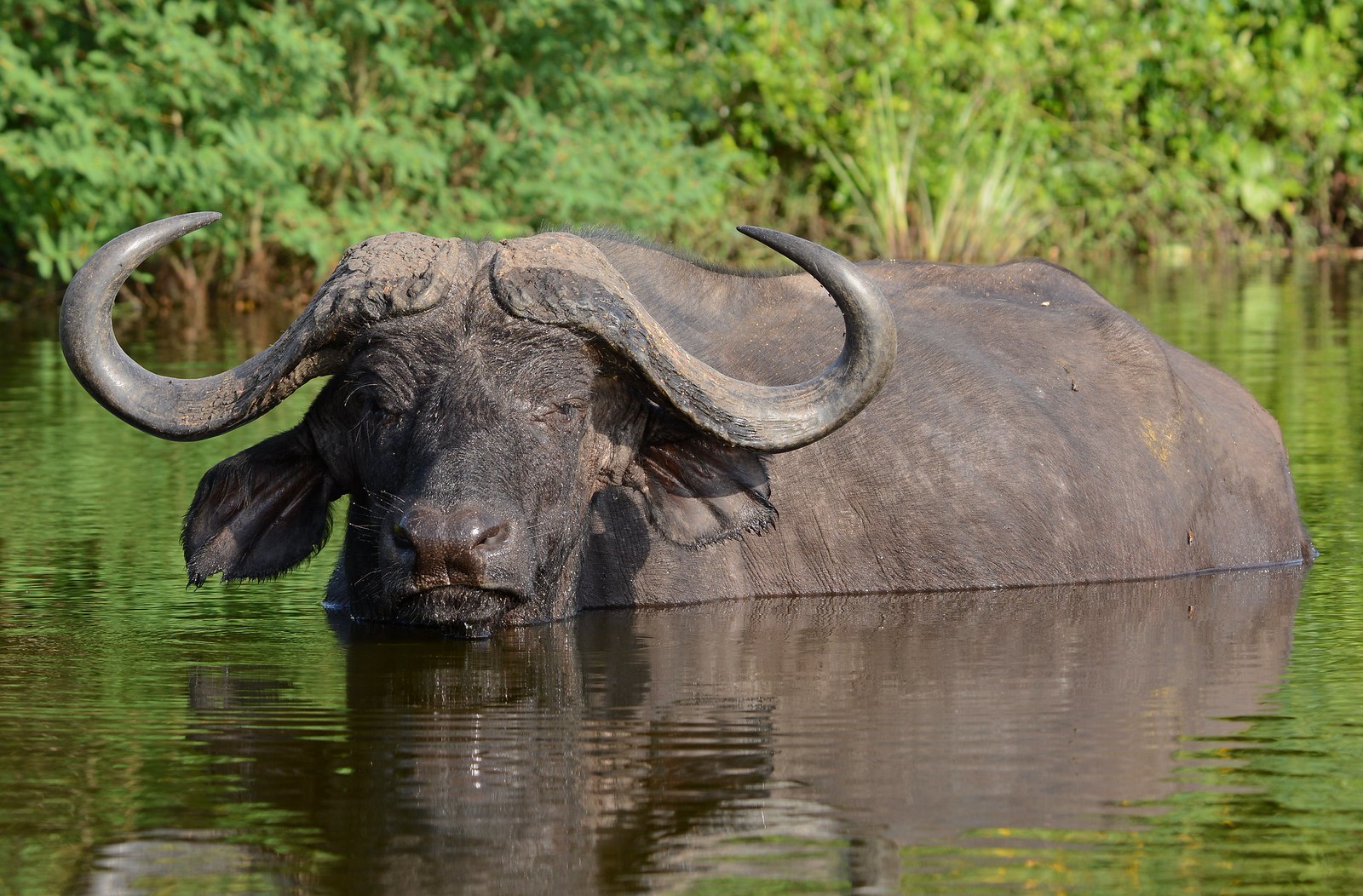
Cape buffalo are one of the most consistently sighted animals in Murchison Falls National Park, moving across the northern savannah in herds that can number in the hundreds – and, despite their unassuming grazing habits, they’re statistically responsible for more safari injuries across Africa than any other member of the Big Five, a fact most first-time visitors find genuinely surprising given how calm a grazing herd typically appears from a distance.
Where to Find Buffalo in Murchison Falls
Buffalo herds graze widely across the Buligi Peninsula, the open savannah between the Nile and Lake Albert that forms the core of Murchison’s northern game-viewing sector, rarely straying far from water during the dry months. Unlike more elusive predators, buffalo herds are large, slow-moving, and relatively easy to spot at a distance, making them one of the more reliable sightings on almost any Murchison game drive, often visible from the main game-viewing tracks within the first hour of setting out.
Herd Structure and Size
Murchison’s buffalo herds are organised loosely around dominant males, related females, and calves of varying ages, with herd size fluctuating seasonally as smaller groups merge around remaining water sources during the dry season. It’s not unusual to encounter herds of several hundred individuals moving together across the open savannah, a genuinely impressive sight that photographs well against Murchison’s wide, flat terrain. Within these larger aggregations, smaller family clusters still tend to stay loosely together, and careful observation over an extended sighting often reveals the underlying social structure beneath what first looks like one undifferentiated mass of animals.
Why Buffalo Are Considered So Dangerous
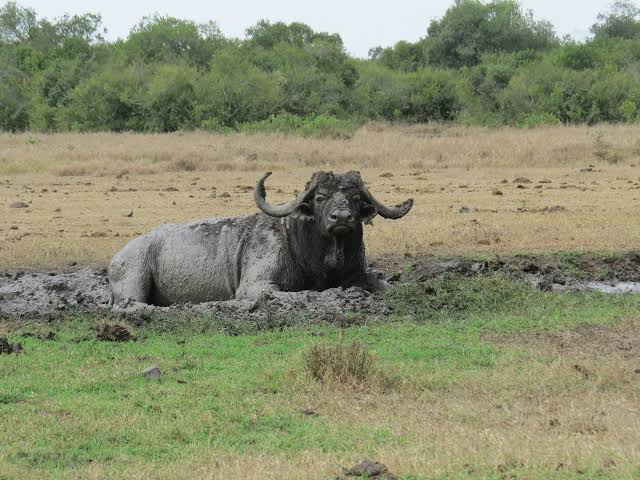
Old solitary bulls, pushed out of the main herd by younger, stronger males, are widely considered the most dangerous individual animals on safari – unpredictable, short-tempered, and powerful enough to kill a lion in a direct confrontation. Herd buffalo are generally calmer and more predictable in their behaviour than these lone bulls, but guides still treat every buffalo encounter with real caution, maintaining safe vehicle distances rather than assuming a large, slow-moving herd is inherently passive, since a herd startled all at once can move surprisingly fast in a coordinated direction.
Buffalo vs Lion: A Genuine Rivalry
Murchison’s buffalo herds and its resident lion prides share the same savannah, and the relationship between the two is one of the more dramatic dynamics to witness on a longer safari – a buffalo herd will often collectively mob and drive off a lone lion or even a small pride threatening a calf, using sheer numbers and weight to overwhelm what would otherwise be a formidable predator. Lions generally target only the very old, young, or sick within a herd, precisely because a healthy adult buffalo, backed by its herd, is a genuinely dangerous adversary even for Africa’s apex predator.
Best Time of Year for Buffalo Sightings
Buffalo are visible in Murchison year-round, but the dry seasons, roughly December to February and June to August, concentrate herds more predictably around the Nile and remaining inland water sources, improving overall visibility. The wet season disperses herds more widely across the savannah, which can mean slightly more searching, but rewards visitors with lush, dramatically green scenery and considerably fewer vehicles at each sighting.
Buffalo and the Boat Cruise
Beyond standard game drives, buffalo are also regularly spotted from the launch cruise to the base of Murchison Falls, particularly herds coming down to drink along the riverbank in the cooler hours of morning and late afternoon. Combined with the cruise’s near-guaranteed hippo and Nile crocodile sightings, it adds another reliable buffalo-viewing opportunity beyond the standard vehicle-based game drive.
Buffalo and Murchison’s Wider Big Five Picture
Buffalo is one of four Big Five species reliably found in Murchison, alongside lion, elephant, and leopard, with rhino requiring a separate stop at Ziwa Rhino Sanctuary to complete the set. See our Uganda Big Five guide for how Murchison’s wildlife density compares to the country’s other savanna parks.
Buffalo Safety on Walking Safaris
Murchison offers limited guided walking opportunities in specific areas, always with an armed ranger escort, and buffalo encounters are treated with particular caution on foot given how quickly a startled herd or lone bull can close distance. Rangers brief walkers thoroughly beforehand on how to behave if a buffalo is encountered at close range – standing still, avoiding sudden movement, and never attempting to run, since buffalo can outrun a human easily over short distances, closing what looks like a safe gap in only a few seconds.
Photographing Murchison’s Buffalo Herds
Large herds moving across the Buligi Peninsula’s open terrain photograph particularly well in the golden light of early morning or late afternoon, when long shadows and warm tones add real depth to what might otherwise be a fairly flat, uniform scene. A wider-angle lens captures the scale of a large herd more effectively than a telephoto, which is better suited to isolating individual animals, particularly old bulls with heavily worn, distinctively shaped horns.
What to Pack for a Buffalo-Focused Safari
Standard game drive gear – neutral clothing, sun protection, binoculars, and a versatile camera lens – covers most of what a Murchison buffalo safari requires. If your wider itinerary includes gorilla trekking, our gorilla trekking packing list covers the additional forest-specific gear for that portion of the trip, and it’s worth reviewing Uganda’s visa requirements well ahead of travel.
Buffalo Behaviour Guides Watch Closely
Experienced guides read a buffalo herd’s body language carefully before approaching – raised heads and a herd turning to face a vehicle in unison are signs of alertness worth respecting with extra distance, while heads down and continued grazing generally indicate a calm, unbothered group. Old bulls in particular are watched for specific warning signs, including a lowered head and pawing at the ground, both classic precursors to a defensive charge that experienced drivers know to avoid provoking.
How Murchison’s Buffalo Compare to Other Uganda Parks
Buffalo are widespread across most of Uganda’s savanna parks, but Murchison’s sheer size and lower visitor density compared to Queen Elizabeth National Park often make for larger, less habituated herds and a genuinely wilder encounter. Queen Elizabeth’s Ishasha sector, better known for tree-climbing lions, also holds strong buffalo numbers, giving travelers combining both parks a useful point of comparison between the two experiences.
Self-Drive vs Guided Buffalo Game Drives
Self-driving is technically possible in Murchison, but a guided safari remains the more practical choice for most visitors, particularly given how much local knowledge affects finding the larger, more photogenic herds rather than a handful of scattered stragglers. An experienced driver-guide also reads herd behaviour more reliably than a first-time visitor, adding a genuine safety margin during closer encounters.
Buffalo Horns: Reading a Bull’s Age and Status
A mature bull’s horns fuse across the top of the skull into a solid, helmet-like structure called a “boss,” which thickens and hardens with age – a feature guides use to estimate roughly how old a particular bull is, and one of the more distinctive visual details worth pointing your camera at during a close sighting. Younger bulls and females have thinner, less fused horns, giving a herd a genuinely varied silhouette once you know what to look for.
Buffalo and Oxpecker Birds
Look closely at almost any Murchison buffalo herd and you’ll likely spot red-billed or yellow-billed oxpeckers perched along their backs and necks, picking off ticks and other parasites in a mutually beneficial relationship that’s become one of the more charming small details of an East African game drive. Egrets, too, often follow grazing herds closely, snapping up insects disturbed by the buffalo’s movement through the grass, adding yet another layer of activity to what can otherwise look like a static, slow-moving scene from a distance.
Frequently Asked Questions
Are buffalo more dangerous than lions in Murchison Falls?
Statistically, solitary old bulls are considered more unpredictable and dangerous to encounter at close range than lions, which is why guides treat every buffalo sighting with genuine caution rather than assuming safety in a herd’s apparent calm.
How large are Murchison’s buffalo herds?
Herds commonly number in the dozens and can swell to several hundred individuals during the dry season, when smaller groups merge around the most reliable remaining water sources across the Buligi Peninsula.
Can I see buffalo on the boat cruise as well as game drives?
Yes – buffalo regularly come down to drink along the riverbank near the falls, making the launch cruise a genuine second opportunity for sightings beyond the standard vehicle-based game drive.
Can I combine a Murchison buffalo safari with gorilla trekking?
Yes, though it requires a long drive or short domestic flight south to Bwindi or Mgahinga – see our gorilla trekking FAQ for how to sequence a combined Uganda itinerary without feeling rushed.
Ready to Plan Your Murchison Falls Safari?
Whether buffalo, the falls themselves, or a full Big Five circuit with a Ziwa rhino stop is your priority, our team can build a Murchison Falls itinerary matched to your interests, time available, and budget. Get in touch below and let’s start planning your Uganda safari today.

No comment