
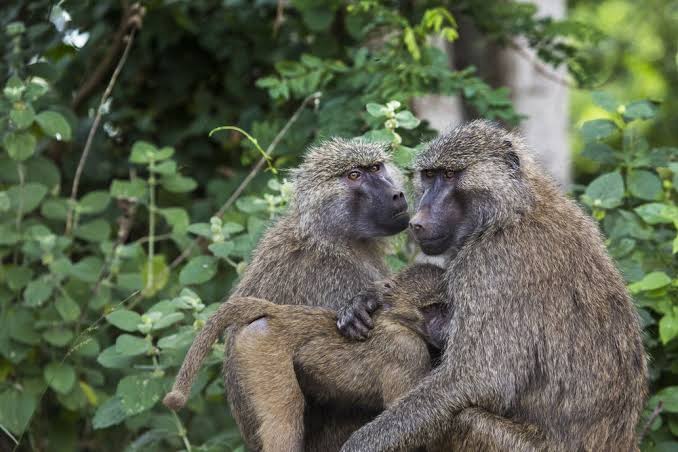
Olive baboon troops move through Lake Manyara National Park’s groundwater forest in genuinely large, highly social groups, their complex troop dynamics and near-constant activity making them one of the park’s most consistently entertaining, if sometimes overlooked, wildlife sightings alongside its famous tree-climbing lions.
Lake Manyara’s Notably Large Baboon Troops
Lake Manyara holds one of the denser olive baboon populations in northern Tanzania, with troops sometimes numbering in the dozens moving together through the park’s groundwater forest and adjacent grassland. This concentration, supported by the forest’s genuinely abundant year-round food resources, makes baboon sightings here reliably frequent throughout a standard game drive.
Where to Find Baboons in Lake Manyara
Baboon troops range throughout the park’s groundwater forest, often visible along the main entrance road and forest trails where the dense canopy and understory provide both food and shelter. Troops frequently forage at ground level while also moving through lower tree branches, giving sightings a genuinely dynamic, three-dimensional quality distinct from more ground-bound antelope encounters.
Baboon Social Structure and Troop Dynamics
Olive baboon troops maintain a genuinely complex social hierarchy, with a clear dominance structure among both males and females that shapes feeding order, grooming relationships, and access to preferred resting spots within the group. This social complexity, involving shifting alliances and occasional conflict, gives baboon troops a level of behavioural richness that rewards closer, patient observation rather than a passing glance.
Baboons and Lake Manyara’s Tree-Climbing Lions
Baboon troops share much of the same groundwater forest habitat as the park’s famous tree-climbing lions, and baboon alarm calls are frequently used by guides and other wildlife alike as an early indicator of a predator moving through the forest, given how quickly and loudly a troop reacts to a perceived threat.
Baboon Diet and Foraging Behaviour
Baboons are genuinely opportunistic omnivores, feeding on fruit, leaves, insects, small vertebrates, and occasionally scavenged material, a dietary flexibility that allows troops to thrive across Lake Manyara’s varied habitat types. This adaptability is part of why baboon populations remain so consistently robust compared to more specialised feeders facing greater seasonal food pressure.
Best Time of Year for Baboon Sightings
Baboons are visible in Lake Manyara year-round given their resident status and the groundwater forest’s consistent food availability, making seasonal timing genuinely less important here than for species dependent on more variable seasonal resources. See our regional best-time guide for how East Africa’s broader seasonal patterns still affect wider trip planning.
Self-Drive vs Guided Safaris for Baboon Viewing
Baboons are among the more straightforward Lake Manyara species to locate independently given their large troop size and frequent presence along main park roads, though a guided safari still adds real value in interpreting troop behaviour and social dynamics for a fuller appreciation of what’s being observed. Most visitors combine Lake Manyara with a wider guided Northern Circuit itinerary.
Photographing Lake Manyara’s Baboons
Baboon troops offer genuinely dynamic, behaviourally rich photographic opportunities, particularly grooming interactions and playful young baboons, distinct from the more static poses typical of larger, less socially complex mammals. A mid-range zoom covers most sightings comfortably, similar to the gear recommended in our camera gear guide.
What to Pack for a Lake Manyara Safari
Standard game drive gear – neutral clothing, sun protection, and binoculars – covers most of what the park requires, and a scarf for the sometimes dusty groundwater forest trails adds real comfort. If your wider itinerary includes gorilla trekking, our gorilla trekking packing list covers that portion separately.
Baboon Alarm Calls and Forest Communication
Baboon troops use a genuinely sophisticated range of vocalisations to communicate everything from predator alerts to social status disputes, with distinct alarm calls varying depending on whether the perceived threat is a ground predator like lion or an aerial threat like eagle. Guides familiar with these calls often use them as a genuinely useful indicator of nearby predator activity elsewhere in the forest.
Combining Baboon Viewing With a Wider Northern Circuit
Lake Manyara is commonly included as a stop between Arusha and the Ngorongoro Crater or Serengeti, giving travelers genuine additional primate-viewing opportunities within a single well-planned Tanzania trip.
Getting to Lake Manyara National Park
Lake Manyara sits within roughly two hours of Arusha by road, making it one of the more accessible parks on a standard Northern Circuit itinerary and a natural first or last stop given its proximity to Kilimanjaro International Airport.
Grooming and Social Bonding
Grooming plays a genuinely central role in baboon troop life, serving not just a hygienic function but reinforcing social bonds and alliances between individuals, with higher-ranking troop members generally receiving more grooming attention than lower-ranking ones. Watching a grooming session unfold offers a genuinely compelling window into the complex social politics underlying troop life, often revealing relationships and hierarchies not immediately obvious from casual observation.
Infant Care and Troop Cooperation
Baboon infants are carried closely by their mothers for the first weeks of life, first clinging to the belly before graduating to riding on the mother’s back as they grow stronger, and other troop members, particularly related females, often participate in cooperative infant care and protection. This communal support structure genuinely improves infant survival odds within the troop, reflecting baboons’ broader reputation as one of Africa’s more socially sophisticated primate species.
Male Dominance Hierarchies and Troop Politics
Male baboons compete for dominance rank through a combination of physical size, fighting ability, and genuinely strategic alliance-building with other males and influential females within the troop, with rank directly affecting access to mating opportunities and preferred feeding areas. These dominance hierarchies are genuinely fluid, shifting periodically as younger, stronger males challenge established leaders, producing an ongoing social drama worth appreciating beyond a baboon’s simple presence in a sighting.
Baboons and the Wider Groundwater Forest Ecosystem
As opportunistic omnivores moving constantly through Lake Manyara’s groundwater forest, baboons play a genuinely useful ecological role in seed dispersal, spreading fruit tree seeds across the forest through their droppings as troops range widely in search of food. This dispersal function contributes meaningfully to maintaining the forest’s plant diversity, an ecological contribution easy to overlook given how much attention baboon sightings typically focus on behaviour rather than ecosystem function.
Comparing Lake Manyara’s Baboons to Other Tanzania Parks
While baboons are widespread across most of Tanzania’s national parks, Lake Manyara’s dense groundwater forest habitat supports a genuinely higher concentration than the more open plains typical of Tarangire or the Serengeti, making Lake Manyara a particularly strong destination for travelers specifically interested in observing baboon troop behaviour up close.
Baboons Alongside Lake Manyara’s Other Wildlife
Baboon troops frequently share the same groundwater forest terrain as the park’s elephant and buffalo populations, and a single game drive often produces sightings of all three species within a compact stretch of forest road, adding genuine variety to a Lake Manyara visit beyond the park’s famous tree-climbing lions.
Best Lodges for Baboon-Focused Visits
Properties positioned near the park’s main entrance gate or forest trail network genuinely simplify logistics for travelers specifically prioritising baboon and wider primate viewing, cutting down on drive time before and after game drives. Discussing lodge location directly with your operator, alongside current information on recent troop activity, is genuinely worth doing before finalising your complete Lake Manyara itinerary.
Why First-Time Visitors Are Often Surprised by Baboon Behaviour
Many travelers arrive expecting a fairly passive primate sighting and are genuinely surprised by how active, vocal, and socially dynamic a baboon troop actually is up close, with constant grooming, play, and occasional squabbling offering considerably more genuine entertainment value than a brief, passing glance from a moving vehicle would ever typically suggest to a first-time visitor.
Getting to Lake Manyara From Other Northern Circuit Parks
Beyond the standard Arusha connection, travelers arriving from the Serengeti or Ngorongoro Crater can also reach Lake Manyara via a reasonably convenient connecting drive, making it a flexible addition regardless of which direction a broader Northern Circuit itinerary happens to be travelling.
Frequently Asked Questions
Why does Lake Manyara have so many baboons?
The park’s groundwater forest provides genuinely abundant, year-round food resources that support one of northern Tanzania’s denser olive baboon populations.
Are baboons dangerous to encounter?
Generally not from within a vehicle, though visitors should never feed or approach troops closely, given their genuinely strong, sometimes assertive social behaviour.
What’s the best time of year to see baboons in Lake Manyara?
Year-round given their resident status and the forest’s consistent food availability, making seasonal timing genuinely less critical than elsewhere.
Can baboon alarm calls help spot other wildlife?
Yes, genuinely so – guides often use baboon alarm calls as an early indicator of nearby predator activity within the forest.
What do baboons eat?
A genuinely wide range of fruit, leaves, insects, and small vertebrates, a dietary flexibility that supports their consistently strong population numbers.
Ready to Plan Your Lake Manyara Safari?
Whether the park’s socially complex baboon troops, its famous tree-climbing lions, or a full Northern Circuit itinerary is your priority, our team can build a Tanzania trip matched to your time and interests. Get in touch with our team below today and let’s start planning your complete Tanzania safari itinerary together.

No comment