
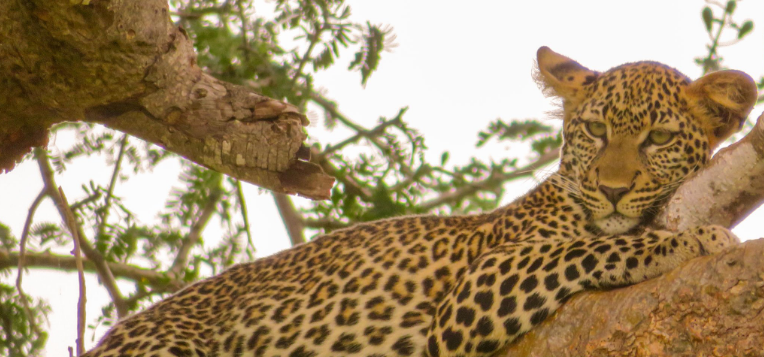

Leopards in Lake Nakuru National Park are the park’s most elusive Big Five member, favouring the wooded escarpment and denser acacia stands rather than the open lakeshore grassland where lion, buffalo, and rhino are more easily, reliably spotted within this compact, fully fenced sanctuary.
Where to Find Leopards in Lake Nakuru
Leopards favour Lake Nakuru’s wooded escarpment and denser acacia woodland away from the lakeshore, avoiding the open grassland that the park’s other Big Five species prefer. Experienced guides know specific trees and cover worth checking on any given drive, and the park’s compact size means a knowledgeable driver can cover multiple likely spots within a single outing.
Why Lake Nakuru’s Small Size Doesn’t Guarantee Leopard Sightings
Despite Lake Nakuru’s relatively compact overall area compared to Kenya’s larger reserves, leopards remain genuinely elusive here just as everywhere else, given their solitary, largely nocturnal habits and preference for dense cover over open terrain. The park’s fenced boundary does concentrate the limited wooded habitat leopards favour, which can work in visitors’ favour with the right guide knowledge and patience.
Best Time of Day for Leopard Sightings
Leopards are most active around dawn, dusk, and after dark, making early morning and late afternoon game drives the strongest windows for a sighting in Lake Nakuru, much as in any other leopard destination. Guides who work the park regularly know to check specific escarpment areas during these low-light windows when leopards are most likely to be resting visibly.
Lake Nakuru’s Full Big Five Picture
Leopard is one of the Big Five species found within Lake Nakuru’s fenced boundaries, alongside rhino, lion, and buffalo, with elephant notably absent from the park given its more limited overall space.
Leopard Hunting Behaviour at Lake Nakuru
Lake Nakuru’s leopards hunt primarily at night, targeting antelope and smaller mammals across the park’s varied terrain, before typically hoisting larger kills into tree branches to protect them from lions and hyenas competing for the same prey base. This kill-caching behaviour, when spotted, offers one of the more reliable indirect signs of leopard presence even when the leopard itself isn’t currently visible anywhere nearby.
How Lake Nakuru Compares to Other Leopard Destinations
Kenya’s Masai Mara generally offers higher overall leopard density given its more extensively studied population and richer riverine forest cover, but Lake Nakuru’s compact, fenced setting concentrates the limited wooded habitat leopards favour within a smaller, more efficiently covered area.
Self-Drive vs Guided Safaris for Leopard Viewing
Given how elusive leopards are anywhere, a guided safari makes a genuine difference here more than for almost any other Lake Nakuru species, since local knowledge of current sightings and specific escarpment areas worth checking meaningfully improves the odds of a rare encounter. Most visitors combine guided game drives with the park’s other Big Five highlights for the most efficient use of a limited visit.
Photographing Lake Nakuru’s Leopards
Leopard sightings tend to be brief and often partially obscured by dense acacia cover, so a fast telephoto lens and quick reflexes make a genuine difference to capturing a usable shot when the opportunity arises. Early morning and late afternoon light, when leopards are most active, also happens to offer the most flattering conditions for photography generally across the park’s varied terrain and escarpment views, rewarding patient photographers willing to work around the animal’s naturally cautious, secretive habits.
Leopard Conservation Within a Fenced Sanctuary
Leopards face less direct poaching pressure than species valued for ivory or horn, and Lake Nakuru’s broader conservation infrastructure, including the perimeter fence and close ranger monitoring, benefits leopard habitat alongside the rest of the park’s protected wildlife. This overlapping conservation effort supports leopard populations even without species-specific research comparable to the park’s famous rhino monitoring programme, which remains the park’s primary conservation focus and funding priority overall.
What to Pack for a Lake Nakuru Safari
Standard game drive gear – neutral clothing, sun protection, and binoculars – covers most of what the park requires, and given the lake’s alkaline, sometimes pungent shoreline, comfortable closed shoes are worth prioritising for any short walks near the water. If your wider itinerary includes gorilla trekking, our gorilla trekking packing list covers that portion separately.
Why Patience Matters More for Leopard Sightings
Unlike lion or buffalo, where a single sighting often means an easy, extended viewing opportunity, leopard encounters in Lake Nakuru are frequently brief, sometimes lasting only seconds before the animal melts back into cover. Guides who work the park regularly recommend building in extra time and setting realistic expectations specifically around leopard sightings, treating any encounter as a genuine bonus.
Combining Leopard Viewing With a Wider Kenya Circuit
Many longer Kenya itineraries pair Lake Nakuru with the Masai Mara or Amboseli, giving travelers a genuinely varied picture of Kenya’s different leopard populations and landscapes within a single well-sequenced trip. See our Big Five guide for how operators typically build multi-park Kenya itineraries.
Getting to Lake Nakuru National Park
Lake Nakuru sits roughly three hours’ drive from Nairobi, making it one of the more accessible parks on a standard Kenya circuit and a popular stop on longer itineraries combining it with the Masai Mara further west. This convenient positioning is part of why so many multi-park Kenya trips include a Lake Nakuru stop along the route.
Leopard Territorial Behaviour Within a Fenced Boundary
Leopards are fiercely territorial, and individual leopards in Lake Nakuru likely maintain smaller home ranges than their counterparts in larger, open ecosystems, given the constraints of the park’s fenced boundary and limited wooded habitat. This territorial spacing, combined with the genuinely small area of suitable cover within the park, is part of why leopard density here stays naturally, consistently lower than social species like lion.
Leopard Cubs and Breeding in Lake Nakuru
Female leopards raise cubs alone, without support from a mate, keeping them hidden in dense cover for the first several weeks of life before gradually introducing them to short hunting excursions. Sightings of a mother with cubs are considerably rarer than adult sightings alone, given how carefully females protect young cubs from the very real, ongoing threat posed by the park’s lion population sharing the same compact territory.
Lake Nakuru’s Escarpment as Leopard Habitat
The park’s wooded escarpment, rising above the lakeshore, provides exactly the dense cover and elevated vantage points leopards favour for both concealment and hunting, distinct from the open grassland closer to the water where the park’s other Big Five species concentrate. This topographic variety gives Lake Nakuru a genuinely useful mix of habitat types within a surprisingly compact overall area.
Best Lodges for Leopard-Focused Visits
Properties positioned along the park’s escarpment generally offer more convenient access to Lake Nakuru’s strongest leopard habitat than lakeshore-facing lodges, cutting down on drive time before and after game drives. Discussing lodge location and any available night-drive options directly with your operator is genuinely worth doing if leopard sightings are a real priority for your visit.
Human-Wildlife Conflict and the Perimeter Fence
Before the perimeter fence was completed, Lake Nakuru’s proximity to the growing town of Nakuru created genuine human-wildlife conflict challenges affecting the park’s predators, leopard included, as animals occasionally moved beyond park boundaries into populated areas. The fence has significantly reduced these incidents, allowing the park’s wildlife and neighbouring communities to coexist with considerably less friction than in the park’s earlier history.
Setting Realistic Expectations for a Leopard Sighting
Given how rare leopard sightings genuinely are even in well-studied parks, Lake Nakuru visitors specifically hoping for a leopard encounter should treat any sighting as a genuine bonus rather than a guaranteed part of the itinerary, while still enjoying the park’s considerably more reliable lion, buffalo, and rhino viewing. Guides who work the park regularly are usually upfront about this trade-off from the outset, helping set realistic expectations before the drive even begins.
Frequently Asked Questions
Are leopards common in Lake Nakuru?
They’re present but genuinely elusive, given their solitary, largely nocturnal habits, making sightings rarer than lion, buffalo, or rhino.
What’s the best time of day to see a leopard here?
Early morning and late afternoon, when leopards are most active, offer the strongest odds, though sightings remain unpredictable regardless of timing.
Is Lake Nakuru or the Masai Mara better for leopard sightings?
The Mara generally offers higher density, but Lake Nakuru’s compact, fenced setting makes covering the limited leopard habitat genuinely efficient.
Does Lake Nakuru have elephants alongside leopard?
No, elephant are notably absent from the park given its more limited overall space, unlike Kenya’s larger Big Five destinations.
Can I combine leopard viewing with a rhino sighting?
Yes, this is one of Lake Nakuru’s genuine advantages, offering both species within a single, compact, easily covered game drive route.
Ready to Plan Your Lake Nakuru Safari?
Whether Lake Nakuru’s elusive leopards, its significant rhino population, or a full Kenya Big Five circuit is your priority, our team can build an itinerary matched to your interests. Get in touch with our team below and let’s start planning your complete Kenya safari itinerary together.

No comment