
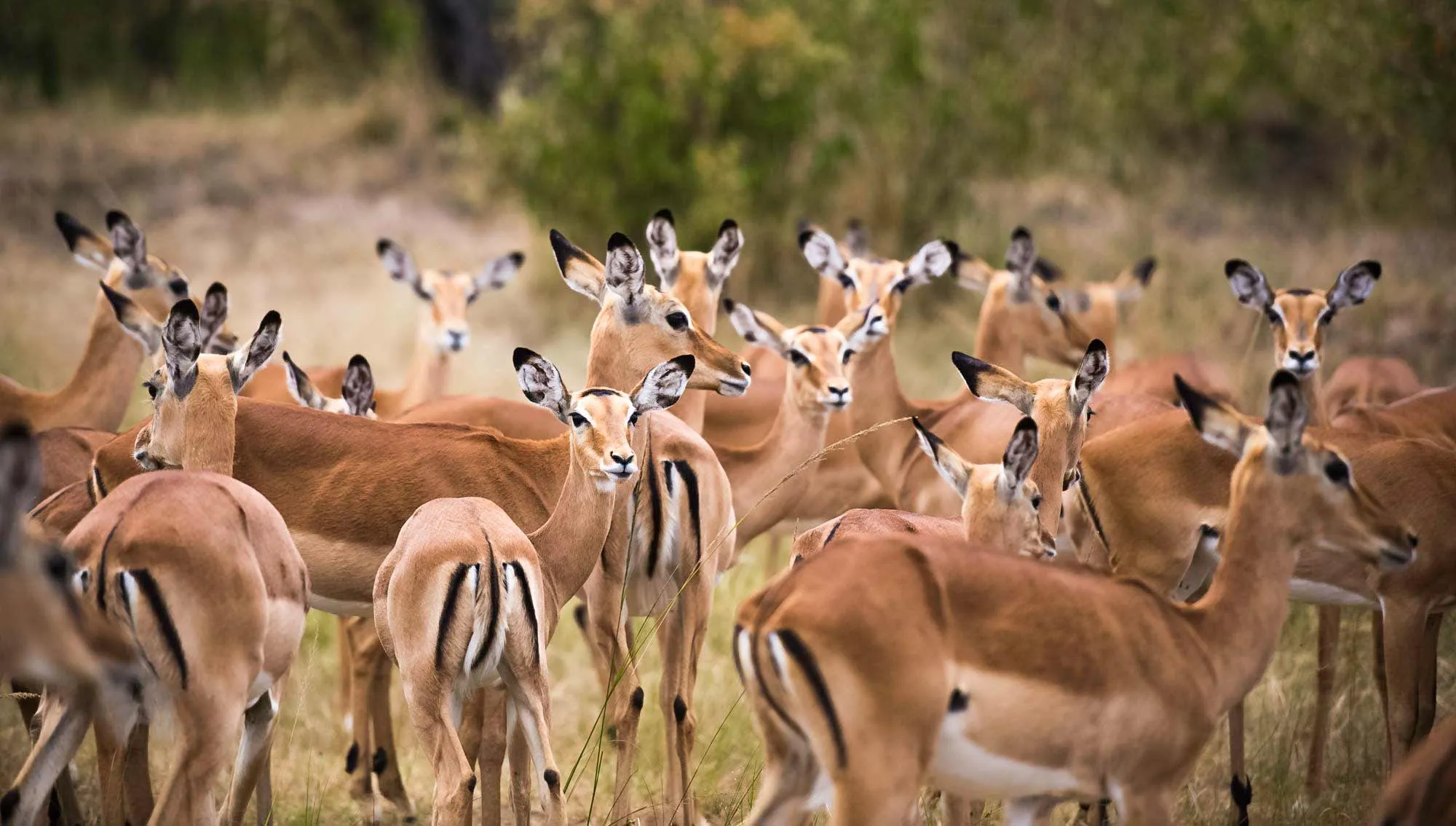
Thomson’s Gazelles and Topi
Thomson’s Gazelles and Topi: Who Else Moves With the Herds?
The Thomson’s gazelles and topi of the Great Migration are often overlooked by travellers concentrating on wildebeest and zebras. Every year, enormous herds move across Tanzania’s Serengeti National Park and Kenya’s Maasai Mara ecosystem, following seasonal changes in rainfall, grass growth and water availability. Although wildebeest dominate the migration in numbers, other grazing animals also benefit from the changing vegetation across these extensive grasslands.
Thomson’s gazelles, topi, plains zebras and several other antelope species share parts of the migration landscape. However, they do not all follow the same routes or travel in one enormous herd. Some undertake seasonal movements, while others remain within established ranges and take advantage of grazing conditions when migrating wildebeest arrive.
Understanding these differences makes a Great Migration safari more interesting. Travellers can observe how different herbivores select food, respond to predators and use habitats throughout the year. From small, fast-moving gazelles to the distinctive reddish-brown topi, each species contributes to the diversity of the Serengeti–Mara ecosystem.
Is the Great Migration Only About Wildebeest?
The Great Migration is best known for the seasonal movement of approximately 1.2–1.5 million wildebeest across the Serengeti–Mara ecosystem, although population estimates vary.
Hundreds of thousands of plains zebras and large numbers of Thomson’s gazelles also use this landscape.
The animals respond to changing environmental conditions, particularly the availability of suitable grazing.
However, the expression Great Migration sometimes creates the impression that all grazing animals travel together.
In reality, different species follow overlapping but distinct movement patterns.
Wildebeest undertake the best-known large-scale seasonal circuit. Many zebras also migrate, while Thomson’s gazelles show seasonal movements influenced by vegetation conditions.
Topi populations may make local or seasonal movements, but they are not generally part of the same continuous migration circuit followed by wildebeest.
Animals Associated With the Migration
| Animal | Main feeding habits | Movement pattern |
|---|---|---|
| Wildebeest | Short, nutritious grass | Extensive seasonal migration |
| Plains zebra | Taller and more fibrous grasses | Seasonal migration |
| Thomson’s gazelle | Short grasses and selected plant material | Seasonal and local movements |
| Topi | Grasses of suitable quality | Resident and seasonal movements |
| Grant’s gazelle | Grasses and browse | Variable local movements |
| Eland | Grasses, leaves and other vegetation | Seasonal and local movements |
These differences help explain why wildlife concentrations change across the Serengeti and Maasai Mara throughout the year.
1. Thomson’s Gazelles: Small Antelopes of the Migration Plains
Thomson’s gazelles are among the most recognisable antelopes of East Africa.
Their scientific name is Eudorcas thomsonii.
They have light brown upper bodies, white underparts and a distinctive dark stripe running along each side.
Both males and females normally have horns, although those of females are generally thinner and shorter.
Thomson’s gazelles are much smaller than wildebeest and zebras, making them particularly vulnerable to several predators.
Why Thomson’s Gazelles Follow Seasonal Grazing
Thomson’s gazelles are selective feeders.
They often favour short, nutritious vegetation and may feed on grasses as well as other suitable plant material.
When large herbivores graze an area, they can change the height and structure of the vegetation.
This sometimes creates feeding opportunities for smaller animals.
For example, grazing by wildebeest may leave behind short vegetation that Thomson’s gazelles can use.
However, gazelles do not depend entirely on wildebeest to prepare their feeding areas.
Their movements also respond to rainfall, vegetation quality and other environmental factors.
2. How Thomson’s Gazelles Benefit From Wildebeest Grazing
Large grazing animals can influence the feeding opportunities available to smaller herbivores.
Wildebeest consume substantial quantities of grass as they move across the plains.
In suitable conditions, this grazing helps maintain shorter vegetation.
Thomson’s gazelles may benefit from access to fresh shoots and nutritious plant material.
Do Gazelles Always Follow Behind Wildebeest?
No. Thomson’s gazelles do not consistently travel immediately behind wildebeest herds.
They may remain in favourable grazing areas after larger animals have moved away.
Some groups occupy neighbouring grasslands rather than mixing directly with wildebeest.
Researchers have found that interactions between grazing species can involve both competition and facilitation.
This means large herbivores may sometimes improve feeding conditions for smaller animals, while also competing with them for limited resources.
3. Topi: The Distinctive Antelopes of the Savannah
Topi are medium-to-large African antelopes commonly encountered in the Serengeti and Maasai Mara.
The topi is generally classified as Damaliscus lunatus jimela, a subspecies within the broader Damaliscus lunatus group, although antelope classifications vary between authorities.
Topi have reddish-brown coats with darker patches on the shoulders and upper legs.
Their elongated faces, ridged horns and athletic bodies make them easy to recognise.
They often occupy open grasslands, floodplains and lightly wooded savannah.
Why Topi Are Common Around Migration Areas
Topi depend primarily on grasses and prefer habitats providing suitable grazing.
The Serengeti and Maasai Mara contain extensive grasslands that support both resident and seasonally moving topi populations.
During favourable conditions, topi may graze near wildebeest and zebras.
However, they do not necessarily accompany these animals over the entire migration circuit.
Some topi remain within established territories or seasonal home ranges.
4. Do Topi Migrate Like Wildebeest?
Topi can undertake seasonal movements in response to changing grazing conditions.
However, their movements vary between populations and landscapes.
In parts of East Africa, topi populations undertake substantial seasonal migrations.
Within the Serengeti–Mara ecosystem, many topi are more locally distributed than wildebeest.
Some move between seasonal feeding areas, while others occupy relatively stable territories.
Topi Territorial Behaviour
Male topi may establish territories in suitable grasslands.
They sometimes stand on termite mounds or other raised ground, allowing them to observe surrounding animals.
During breeding periods, males may defend territories and compete for access to females.
This behaviour differs from the large, mobile herd structure commonly associated with migrating wildebeest.
Travellers may therefore observe topi standing individually on elevated ground while wildebeest graze nearby.
5. Why Different Herbivores Share the Same Grasslands
The Serengeti–Mara ecosystem supports several grazing species because they use vegetation differently.
Zebras can process relatively fibrous grasses through their hindgut digestive systems.
Wildebeest generally favour short, nutritious grasses.
Thomson’s gazelles select smaller quantities of highly suitable vegetation.
Topi also graze selectively but differ in body size, habitat use and movement patterns.
These differences can reduce direct competition under favourable conditions.
However, feeding overlap still occurs, especially during periods when grass becomes scarce.
6. How Rainfall Influences Gazelles and Topi
Seasonal rainfall affects the growth and nutritional quality of grasses throughout the Serengeti.
When rain encourages new vegetation, grazing animals may concentrate around productive areas.
Thomson’s gazelles respond to the availability of suitable short vegetation.
Topi may also move towards grasslands offering favourable feeding conditions.
However, rainfall does not affect every species identically.
Differences in diet, digestive systems, water requirements and habitat preferences influence their responses.
Why Herds Spread Out After Rain
Fresh grass may develop across large areas after widespread rainfall.
When suitable feeding conditions become available in several locations, grazing animals can spread across the landscape.
During drier periods, wildlife may become more concentrated in areas retaining suitable vegetation.
This explains why animal distribution can change significantly between safari seasons.
7. Predators That Hunt Gazelles and Topi
The presence of large herbivore populations attracts predators throughout the Serengeti–Mara ecosystem.
Thomson’s gazelles are important prey for cheetahs.
Their smaller body size makes them suitable targets for these fast-moving cats.
However, gazelles are exceptionally quick and agile, making successful hunts difficult.
Lions, leopards, spotted hyenas and African wild dogs may also hunt gazelles.
Topi face threats from lions and spotted hyenas, which are capable of capturing larger antelopes.
Does Travelling Near Wildebeest Improve Safety?
Living or feeding near numerous herbivores may provide some advantages, including additional opportunities to detect approaching predators.
However, large animal concentrations can also attract carnivores.
Scientific studies suggest that gazelle grouping patterns reflect a balance between feeding opportunities and predation risks.
Travelling near wildebeest therefore does not guarantee greater safety.
8. What Happens During the Calving Season?
The southern Serengeti and Ndutu region become particularly important during the wildebeest calving season, generally between January and March.
Large numbers of wildebeest gather on nutrient-rich short-grass plains.
Thomson’s gazelles also use suitable habitats in southern Serengeti during favourable rainfall conditions.
Their reproductive cycles differ from those of wildebeest, and gazelle births are not concentrated into precisely the same short period.
Topi may occur in nearby habitats, although their distribution is influenced by local grazing conditions and territorial behaviour.
Why the Calving Plains Attract Different Animals
Fresh grass provides food for several herbivore species.
The open plains also offer opportunities for detecting predators.
However, different animals use these habitats according to their dietary requirements and seasonal movements.
The calving season therefore creates an opportunity to observe several grazing species within the same landscape.
9. Do Thomson’s Gazelles Cross the Mara River?
Thomson’s gazelles undertake seasonal movements across parts of the Serengeti–Mara ecosystem.
Some may cross rivers and other natural obstacles as they move between habitats.
However, the spectacular mass crossings associated with the Great Migration mainly involve wildebeest and, at times, zebras.
Thomson’s gazelles are not generally observed crossing the Mara River in the same enormous concentrations as wildebeest.
Their movements may occur at different locations or times.
Topi may also cross waterways during local or seasonal movements, but they are not major participants in the famous mass wildebeest river crossings.
10. How to Tell Thomson’s Gazelles and Topi Apart
These two antelopes differ considerably in appearance.
Thomson’s gazelles are small, slender animals with distinctive dark side stripes.
Topi are much larger, with reddish-brown coats, darker legs and long faces.
Identification Guide
| Feature | Thomson’s gazelle | Topi |
|---|---|---|
| Body size | Small antelope | Medium-to-large antelope |
| Coat colour | Light brown with white underparts | Reddish-brown with dark patches |
| Distinctive marking | Dark stripe along each side | Dark shoulders, upper legs and face |
| Horns | Slender, ringed horns | Strong, ridged horns curving backwards and upwards |
| Common habitat | Open short-grass plains | Open grasslands and floodplains |
| Typical behaviour | Agile movement and selective feeding | Territorial vigilance and grazing |
Travellers can use these differences to identify the animals during game drives.
11. Best Places to See Gazelles and Topi
Southern Serengeti and Ndutu
The southern Serengeti plains are particularly suitable for observing Thomson’s gazelles during favourable seasonal conditions.
Visitors may encounter gazelles feeding near wildebeest herds and zebras.
Cheetahs also use these open grasslands, creating opportunities to observe predator behaviour.
Central Serengeti
Central Serengeti supports several antelope species, including topi and Thomson’s gazelles.
The Seronera region contains grassland and woodland habitats that attract different animals throughout the year.
Topi may be observed standing on raised ground or grazing in suitable open areas.
Maasai Mara National Reserve
The Maasai Mara provides opportunities to observe topi, gazelles, wildebeest and zebras.
Topi are particularly noticeable on open grasslands, where they may stand on termite mounds.
Thomson’s gazelles are also common in suitable habitats.
Mara Triangle
The Mara Triangle contains extensive grazing areas supporting a variety of herbivores.
Visitors may observe migrating wildebeest alongside resident and seasonally moving antelopes.
Wildlife distribution changes throughout the year.
12. When Is the Best Time to See These Animals?
Thomson’s gazelles and topi can be observed in suitable parts of the Serengeti–Mara ecosystem throughout the year.
However, their distribution changes with rainfall and grazing conditions.
For visitors interested in large wildebeest concentrations and gazelles, the southern Serengeti during the wet season can be particularly rewarding.
For travellers hoping to combine topi sightings with the northern migration, the Maasai Mara during the dry season offers good opportunities.
Seasonal Wildlife Viewing
| Period | Main region | Wildlife highlights |
|---|---|---|
| January–March | Southern Serengeti and Ndutu | Wildebeest calving, gazelles and predators |
| April–June | Central and western Serengeti | Moving herds and resident antelopes |
| July–October | Northern Serengeti and Maasai Mara | Wildebeest migration, zebras and topi |
| November–December | Central and southern Serengeti | Seasonal grazing movements |
These patterns are approximate. Actual wildlife locations depend on rainfall and habitat conditions.
13. Photography Tips for Gazelles and Topi
Both species provide excellent photography opportunities.
Thomson’s gazelles are particularly attractive subjects because of their small size, distinctive markings and rapid movements.
A telephoto lens of approximately 100–400 mm is useful for photographing these animals from a safari vehicle.
For running gazelles, a shutter speed around 1/1600–1/2500 second can help freeze movement when lighting conditions permit.
Topi often stand in open areas, allowing photographers to capture their distinctive horns and body shape.
Photographing Topi on Termite Mounds
Topi sometimes stand on elevated ground while observing their surroundings.
This behaviour provides opportunities for photographs showing the animal against an open sky or distant grassland.
Early morning and late afternoon lighting can create attractive colours.
Photographers should avoid approaching too closely or disturbing animals displaying territorial behaviour.
14. Why These Antelopes Matter to the Ecosystem
Thomson’s gazelles and topi contribute to the Serengeti–Mara ecosystem in several ways.
Their grazing influences vegetation structure and creates interactions with other herbivore species.
They also provide prey for large carnivores.
Gazelles are especially important to cheetahs, while topi are valuable prey for lions and spotted hyenas.
These feeding relationships help support the wider predator community.
Different herbivores also distribute grazing pressure across different habitats.
This contributes to the ecological diversity of the grasslands.
15. Conservation Challenges Facing Gazelles and Topi
Although both species occur within major protected areas, their populations can be affected by environmental and human pressures.
Habitat fragmentation can restrict seasonal movements between grazing areas.
Fencing and expanding settlements may interfere with access to important habitats.
Livestock grazing can also influence vegetation conditions and competition for food.
Predation is a natural ecological process, but habitat loss and restricted movement can create additional challenges.
Protecting connected grasslands helps maintain suitable conditions for wildebeest, zebras, gazelles and topi.
Responsible tourism can support conservation by encouraging the protection of wildlife habitats.
Why Thomson’s Gazelles and Topi Deserve Attention
Thomson’s gazelles and topi provide an important reminder that the Great Migration involves more than wildebeest and zebras.
Gazelles undertake seasonal movements and respond to nutritious grass growth, sometimes benefiting from grazing changes created by larger animals.
Topi occupy suitable grasslands across the Serengeti–Mara ecosystem and may undertake local seasonal movements, although many populations are more resident than wildebeest.
Both species contribute to the diversity of East Africa’s savannah and support important predator-prey relationships.
For travellers visiting Tanzania’s Serengeti or Kenya’s Maasai Mara, observing these animals adds depth to the safari experience.
Watching a Thomson’s gazelle escape a cheetah or a topi standing alert on a termite mound can be just as memorable as seeing enormous wildebeest herds moving across the plains.
Understanding the different roles of these grazing animals makes the Great Migration a richer wildlife experience.


No comment