
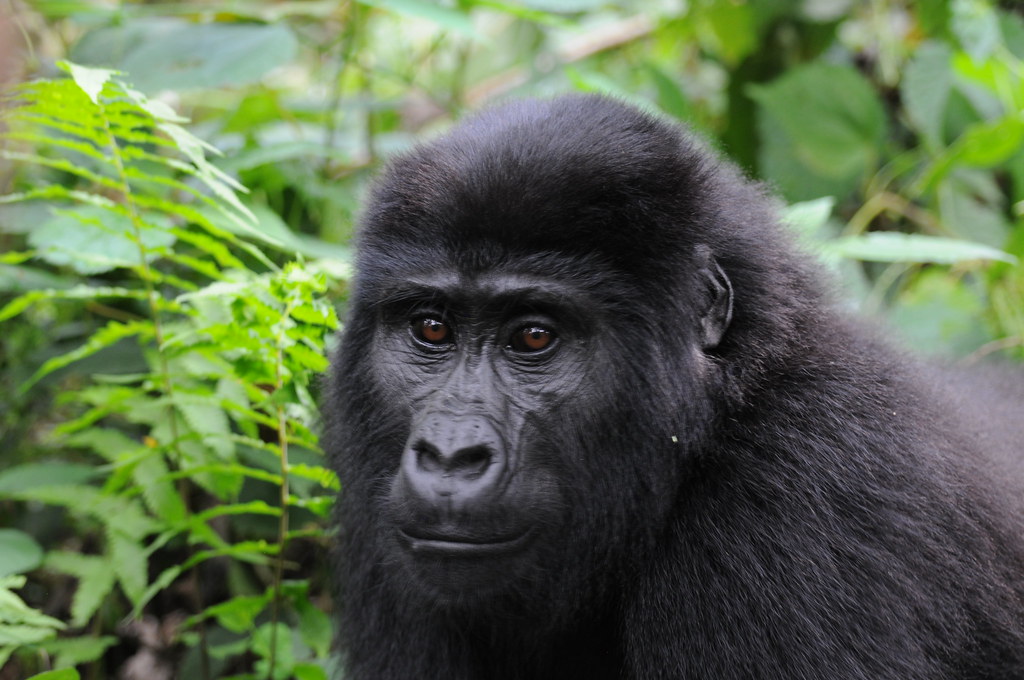
How Many Gorillas Are Left in Uganda?
Uganda is one of the most important countries in the world for mountain gorilla conservation. Deep within the forests of southwestern Uganda, mountain gorillas continue to live in their natural habitat, forming close social families and raising their young. For travellers planning a gorilla trekking safari, one of the most common questions is, how many gorillas are left in Uganda?
The answer requires some explanation because Uganda is connected to two of the world’s remaining mountain gorilla populations. One population is found in the Bwindi-Sarambwe ecosystem, while another forms part of the larger Virunga Massif, which extends across Uganda, Rwanda and the Democratic Republic of Congo.
The latest completed census of the Bwindi-Sarambwe ecosystem recorded 459 mountain gorillas in 2018. This remains the latest confirmed census figure for the Bwindi population. A new census was conducted in Bwindi during 2025, but the final results are still being analysed and have not yet provided a new official population figure. Therefore, it would not be accurate to claim that Uganda currently has exactly 459 gorillas. The number has naturally changed since the 2018 census as gorillas have been born, died and moved between social groups.
Uganda and the World’s Remaining Mountain Gorillas
Mountain gorillas are among the rarest great apes on Earth. Their natural habitat is extremely limited, and they survive in only two major ecosystems in East-Central Africa. The first is the Bwindi-Sarambwe ecosystem, which includes Bwindi Impenetrable National Park in Uganda and the neighbouring Sarambwe area in the Democratic Republic of Congo.
The second is the Virunga Massif, a chain of volcanic mountains and forests shared by Uganda, Rwanda and the Democratic Republic of Congo. Uganda’s Mgahinga Gorilla National Park forms part of this ecosystem.
This makes Uganda particularly important in global mountain gorilla conservation. The country protects habitat belonging to both of the remaining mountain gorilla populations. When travellers visit Uganda to see these animals, they are therefore visiting one of the most important remaining strongholds of the species.
The 459 Gorillas Recorded in Bwindi
The figure of 459 comes from the 2018 Bwindi-Sarambwe mountain gorilla census. The census was a major conservation milestone because it showed that the population had increased compared with earlier surveys.
The number was particularly significant when compared with the historical population estimates for Bwindi. Earlier surveys had placed the population at around 300 individuals, while the 2011 census estimated approximately 400 gorillas. By 2018, the population had reached 459.
This increase demonstrated the positive results of decades of conservation work. Protecting the forest, monitoring gorilla families, supporting local communities, managing tourism and conducting scientific research all contributed to creating better conditions for the population.
However, 459 should not be treated as a permanent number. A wildlife population is constantly changing. Since the 2018 census, new gorillas have been born, some animals have died naturally, young males have matured and individuals have changed social groups.
Why the Number Changes
Mountain gorillas live in complex social communities, and their population changes naturally over time. A family can contain a dominant silverback, other adult males, females, juveniles and infants. As the animals grow older, their relationships can change.
Young males may eventually leave their original family. Females can move between groups. A dominant silverback can die and another male can take over leadership. Sometimes a large family can divide into smaller groups.
At the same time, new infants are continuously being born. These births are particularly important because they contribute to the future growth of the population.
For this reason, conservationists periodically conduct detailed censuses rather than relying on an old population figure indefinitely.
The 2025 Bwindi Gorilla Census
Uganda conducted another major mountain gorilla census in the Bwindi-Sarambwe ecosystem during 2025. The purpose of this census was to determine how the population had changed since the previous survey.
Counting mountain gorillas is a difficult scientific exercise. Bwindi is a dense rainforest with steep slopes, thick vegetation, deep valleys and challenging terrain. Gorillas are constantly moving through the forest, and researchers cannot simply drive around and count them as they might count animals in an open savannah.
Research teams have to follow evidence left by the gorillas. Nesting sites, feeding signs, footprints and other indications can help researchers understand where gorilla groups have been moving.
Modern conservation research can also use genetic information to identify individual gorillas. This helps researchers avoid counting the same animal more than once and provides a more accurate picture of the population.
Although the 2025 census has been conducted, the complete results require careful analysis before an official new population figure can be announced. Until that happens, the 2018 figure of 459 remains the latest confirmed census number for Bwindi.
What About Mgahinga Gorilla National Park?
When discussing Uganda’s gorilla population, it is important not to forget Mgahinga Gorilla National Park.
Mgahinga is located in southwestern Uganda within the Virunga Mountains. Its forests are connected to the larger Virunga ecosystem, which continues across Rwanda and the Democratic Republic of Congo.
The mountain gorillas living in this region do not recognise international borders. They move according to their natural behaviour, food availability, social relationships and environmental conditions.
This means that the gorillas found in Mgahinga are part of a wider transboundary population rather than a completely isolated Ugandan population.
A census of the Virunga Massif conducted in 2015 recorded 604 mountain gorillas across the entire ecosystem. Those animals were spread across Uganda, Rwanda and the Democratic Republic of Congo, so the figure cannot be described as Uganda’s population alone.
Understanding the Famous 1,063 Figure
Many people researching mountain gorillas come across the number 1,063. This figure represents the combined population estimate from the two major mountain gorilla ecosystems at the time of the relevant censuses.
The Bwindi-Sarambwe census recorded 459 gorillas in 2018, while the Virunga Massif census recorded 604 gorillas in 2015. When those figures were combined, the total was 1,063 mountain gorillas.
This became an important milestone in mountain gorilla conservation because it demonstrated that the global population had recovered significantly from earlier estimates.
However, 1,063 does not mean that Uganda has 1,063 gorillas. The 604 Virunga gorillas were distributed among three countries, while the Bwindi-Sarambwe ecosystem also extends beyond Uganda.
Understanding this distinction is important when writing accurate information about mountain gorillas.
Mountain Gorilla Families
The gorillas counted during population censuses are not living together as one enormous group. They are distributed among different social families.
A gorilla family is a complex community with its own social relationships. The dominant silverback normally has an important leadership and protective role, while females play central roles in raising young and maintaining the social structure.
Young gorillas spend much of their early lives learning from other members of their family. They develop physical and social skills through interaction with adults and other juveniles.
The composition of these families can change naturally over time. This is another reason why population monitoring is so important.
A family that contains a certain number of gorillas today may have a completely different composition several years later.
The Importance of Gorilla Births
The birth of every mountain gorilla is important because the species has such a small global population.
A newborn gorilla represents another potential member of the next generation. As the young animal grows, it becomes part of the social life of its family and eventually contributes to the future population if it survives to adulthood and reproduces.
Gorilla births in Bwindi have provided encouragement to conservationists. However, population growth depends on more than births alone. Young gorillas must survive, their habitat must remain protected and threats such as disease and human disturbance must be carefully managed.
The presence of healthy infants and juveniles is therefore one of the positive signs that conservationists monitor closely.
Why Gorilla Conservation Has Been Successful in Uganda
Uganda’s mountain gorilla population did not recover by accident. The improvement has been the result of many years of conservation work.
Bwindi and Mgahinga are protected areas, allowing conservation authorities to control activities that could threaten the gorillas and their habitat. Rangers monitor the forests, while researchers study the gorillas and their environment.
Veterinary teams and conservation organisations also play an important role in protecting the health of the population.
Another important factor is the involvement of communities living around the protected forests. Conservation cannot succeed if the people living near wildlife habitats are excluded from the benefits of tourism and conservation.
Tourism has therefore become an important part of Uganda’s conservation model.
How Gorilla Tourism Supports Conservation
Thousands of travellers visit Uganda because they want to experience mountain gorillas in their natural environment. Gorilla trekking has become one of the country’s most valuable wildlife tourism experiences.
The revenue generated by gorilla trekking contributes to protected-area management and the wider tourism economy. It also creates employment for guides, trackers, drivers, lodge workers, porters and many other people.
Communities around gorilla habitats can benefit from tourism-related employment and development programmes.
This creates an important connection between tourism and conservation. When the gorillas remain protected and the forest remains healthy, tourism can continue providing economic opportunities.
For this reason, gorilla trekking is not simply about taking tourists into the forest. It is part of a wider conservation system.
Why Local Communities Are Important
The people living around Bwindi and Mgahinga are an important part of Uganda’s conservation story.
Protected areas exist within landscapes where people live, work and operate businesses. Conservation therefore needs to consider both wildlife and human communities.
Tourism can provide employment and opportunities for local businesses. Community programmes can also contribute to development around protected areas.
When communities see meaningful benefits from conservation, they have greater reasons to support the protection of forests and wildlife.
This relationship is particularly important for mountain gorillas because their habitat is limited and surrounded by areas where human populations live.
Why Mountain Gorillas Are Still Endangered
Despite the growth in their population, mountain gorillas remain endangered.
The species is vulnerable because its habitat is extremely restricted. Unlike animals such as wildebeest, zebras or elephants that occupy enormous areas of savannah, mountain gorillas survive within a relatively small area of highland forest.
This means that protecting their remaining habitat is absolutely essential.
Disease is another concern. Because humans and gorillas are closely related biologically, certain human illnesses can potentially affect gorillas. This is one reason why visitors who are unwell may be advised not to take part in gorilla trekking.
The strict rules surrounding gorilla tourism are therefore designed to protect the animals as well as the visitors.
Why Gorilla Trekking Rules Are So Important
When tourists enter Bwindi or Mgahinga, they are entering the habitat of an endangered species.
Visitors are therefore expected to follow the instructions of their guides and trackers. They must maintain the required distance from the gorillas and avoid behaviour that could cause unnecessary stress or disturbance.
The number of visitors allowed to interact with each habituated gorilla family is controlled, helping to reduce pressure on individual groups.
These rules may seem strict to someone experiencing gorilla trekking for the first time, but they are essential to maintaining a balance between tourism and conservation.
The objective is to allow people to observe the gorillas while keeping the animals as safe and comfortable as possible.
Why Bwindi Is So Important
Bwindi Impenetrable National Park is one of the most important forests in Africa for mountain gorilla conservation.
The forest is ancient, dense and biologically rich. It provides habitat not only for mountain gorillas but also for many other species of mammals, birds, reptiles, amphibians and plants.
For the gorillas, however, Bwindi is home.
They depend on the vegetation of the forest for food and use the landscape for movement, resting and social activities.
Protecting Bwindi therefore means protecting an entire ecosystem.
The success of mountain gorilla conservation depends on maintaining the health of this forest for future generations.
Why Mgahinga Is Equally Significant
Mgahinga may be smaller than Bwindi, but its importance cannot be measured simply by size.
The park protects part of the Virunga Mountains and provides an essential link within the larger transboundary ecosystem.
The volcanic landscape gives the region a dramatic character, with forested slopes rising toward the volcanic peaks.
The protection of Mgahinga contributes to the wider conservation of the Virunga mountain gorilla population.
Uganda’s role in protecting both Bwindi and Mgahinga therefore gives the country a particularly important position in global mountain gorilla conservation.
Uganda, Rwanda and the Democratic Republic of Congo
The survival of mountain gorillas is a regional responsibility.
Uganda, Rwanda and the Democratic Republic of Congo share the Virunga ecosystem, which means conservation authorities must cooperate to protect the animals effectively.
A gorilla does not know when it has crossed an international boundary. It follows the forest and its social group.
This makes cooperation between countries extremely important.
Researchers and conservation authorities can share information about gorilla populations, movements and threats, helping to create a more effective regional conservation system.
The Future of Uganda’s Gorillas
The future of Uganda’s mountain gorillas is more hopeful than it was several decades ago.
The increase in the Bwindi population from historical estimates of around 300 individuals to 459 in the 2018 census is a major conservation achievement.
The results of the 2025 census will provide an important update once they are officially released.
If the population has continued to increase, it will provide further evidence of successful conservation. If it has remained stable, that would also represent an important achievement because maintaining a stable population of an endangered species requires considerable effort.
The most important thing is that conservation continues.
The forests must remain protected, tourism must remain responsible, communities must continue benefiting from conservation and scientists must continue monitoring the population.
What Does This Mean for Travellers?
For someone planning a Uganda gorilla safari, the population figures provide an important perspective.
You are not visiting a destination where thousands of gorillas are spread across a huge open landscape.
You are entering one of the last remaining habitats of a rare and endangered great ape.
The gorillas you encounter represent a very small global population that has survived decades of conservation challenges.
This makes a gorilla trekking experience much more significant than simply seeing another wildlife species.
It is an opportunity to observe one of our closest living relatives in its natural environment while contributing to an industry that supports the continued protection of its habitat.
So, How Many Gorillas Are Left in Uganda?
The most accurate answer is that the latest confirmed census recorded 459 mountain gorillas in the Bwindi-Sarambwe ecosystem in 2018.
Uganda also has mountain gorillas in Mgahinga Gorilla National Park, which forms part of the larger Virunga Massif shared with Rwanda and the Democratic Republic of Congo.
The Virunga Massif was recorded at 604 gorillas during the 2015 census, but those animals were distributed across all three countries and therefore cannot all be counted as Ugandan gorillas.
A new census was conducted in Bwindi during 2025, but the final results are still being analysed. Until those results are officially released, 459 remains the latest confirmed population figure for the Bwindi-Sarambwe ecosystem.
The exact current number of mountain gorillas in Uganda will therefore become clearer when the new census results are officially announced.
The story of Uganda’s mountain gorillas is one of survival, conservation and hope.
For decades, these extraordinary animals faced serious threats from habitat pressure, disease, human activity and other challenges. Yet through the combined efforts of conservation authorities, researchers, rangers, local communities and responsible tourism, their numbers have increased significantly.
The 459 gorillas recorded in the 2018 Bwindi-Sarambwe census represent an important chapter in that story, while the new census conducted in 2025 is expected to provide the next major picture of the population.
But the real importance of the number is what it represents.
Uganda is therefore not simply a place where travellers can see mountain gorillas. It is one of the world’s most important strongholds for their survival.
The forests of Bwindi and Mgahinga remain essential to the future of mountain gorillas, and protecting these forests today will help determine whether future generations will still have the opportunity to encounter these remarkable animals in the wild.
