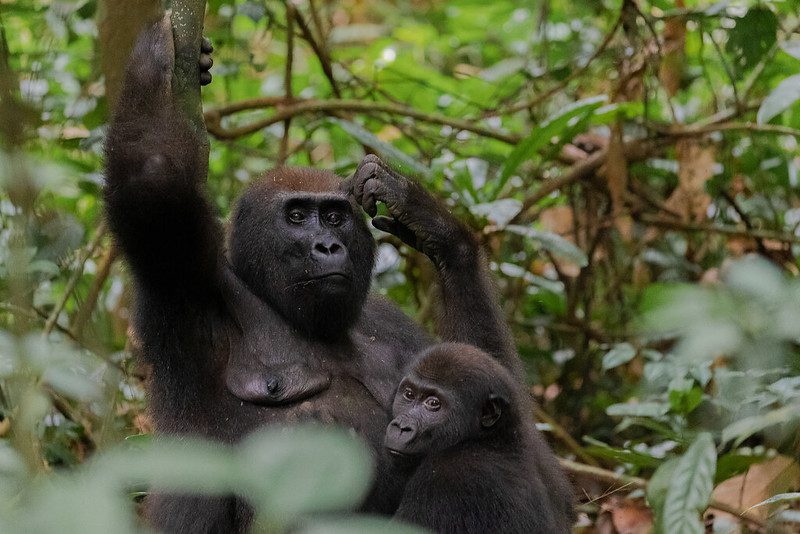
Facts About the Eastern Lowland Gorillas: A Complete Guide to Grauer’s Gorillas
The Eastern Lowland Gorilla, commonly known as Grauer’s Gorilla, is one of Africa’s most fascinating great apes. Found naturally in the forests of the Democratic Republic of the Congo, these remarkable primates are known for their enormous size, impressive strength, complex family relationships, intelligence and distinctive social behavior. They are closely related to the famous mountain gorillas of Uganda and Rwanda, but their lifestyle, habitat and physical characteristics make them a unique gorilla population worth understanding.
Scientifically known as Gorilla beringei graueri, the Eastern Lowland Gorilla is a subspecies of the eastern gorilla. It occupies a variety of forest environments in eastern Democratic Republic of the Congo, including lowland rainforest and forests extending into mountainous areas. Among the places most strongly associated with these gorillas is Kahuzi-Biéga National Park, a protected area famous for its Grauer’s gorillas and one of the important destinations for gorilla trekking in the Democratic Republic of the Congo.
For travelers interested in African wildlife, gorilla trekking, conservation and primate safaris, learning about Eastern Lowland Gorillas provides an opportunity to appreciate how diverse Africa’s gorilla populations really are. Although all gorillas share many characteristics, Grauer’s gorillas have developed their own adaptations and behaviors that reflect the forests where they live.
What Is an Eastern Lowland Gorilla?
The Eastern Lowland Gorilla is a member of the great ape family and is the largest of the four recognized gorilla taxa. Its scientific name is Gorilla beringei graueri. The subspecies belongs to the eastern gorilla species, Gorilla beringei, alongside the mountain gorilla, Gorilla beringei beringei.
The name “Eastern Lowland Gorilla” comes from its historical association with the lowland forests of eastern Congo. The name “Grauer’s Gorilla” honors the Austrian zoologist Rudolf Grauer, who collected specimens during an expedition to the region in the early twentieth century.
Despite the name, these gorillas are not restricted exclusively to very low elevations. Their habitat extends through different types of forests and includes areas where the landscape rises considerably. This flexibility in habitat distinguishes them from mountain gorillas, which are strongly associated with high-altitude forests.
Grauer’s gorillas are wild animals that have never been domesticated. Their powerful bodies, intelligence and social complexity are adaptations to life in the forests of Central Africa.
Where Do Eastern Lowland Gorillas Live?
Eastern Lowland Gorillas are found only in the Democratic Republic of the Congo. Their historical distribution was much larger than the range they occupy today, but habitat destruction, hunting and other human pressures have contributed to a reduction and fragmentation of their habitat.
Their remaining populations are concentrated in forests in the eastern and central parts of the country. One of the most important protected areas for the species is Kahuzi-Biéga National Park, located in South Kivu Province.
Kahuzi-Biéga is particularly famous because it protects important populations of Grauer’s gorillas. The park contains extensive areas of tropical forest and provides habitat for a remarkable variety of wildlife.
The forest environment is essential to the survival of these gorillas. They depend on vegetation for food, forest cover for shelter and large territories that allow family groups to move between feeding and resting areas.
The destruction or fragmentation of these forests can therefore have consequences far beyond simply reducing the number of trees. When forests disappear, gorillas lose food sources, sleeping areas and safe routes through their habitat.
How Big Are Eastern Lowland Gorillas?
Eastern Lowland Gorillas are exceptionally large primates. Mature males, known as silverbacks, can become enormous and extremely muscular.
Their physical strength is one of their most obvious characteristics. Adult males have broad chests, powerful arms, thick necks and strong hands. Their bodies are designed for moving through dense vegetation, feeding, climbing when necessary and protecting their groups.
Females are considerably smaller than adult males, although they are still powerful animals compared with most other primates.
The size of a gorilla can make it appear intimidating, especially when encountered at close range. However, physical strength should not be confused with constant aggression. Gorillas generally prefer to avoid unnecessary conflict. Their social lives involve feeding, resting, grooming, playing, communicating and caring for young animals.
The silverback’s size becomes particularly important when the group encounters a potential threat. Rather than immediately attacking, he may use displays, vocalizations and body language to communicate his strength and discourage the threat from approaching.
Why Are Male Gorillas Called Silverbacks?
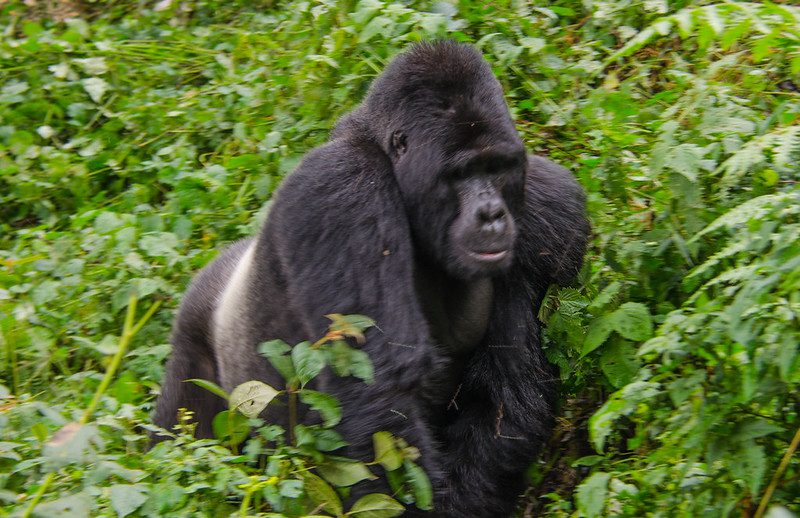
One of the most recognizable features of an adult male gorilla is the silver-colored hair that develops across his back as he matures.
This is why mature males are called silverbacks.
The silver coloration is a natural part of the aging process. It helps observers distinguish mature males from younger males, which do not have the same distinctive silver back.
The silverback is often the dominant male in a gorilla family. He has an important leadership and protective role and can influence where the group travels, feeds and rests.
However, gorilla society is more complex than simply having one male in charge. Family groups contain individuals with different relationships, and females play critical roles in maintaining the social structure of the group.
Eastern Lowland Gorillas Live in Family Groups
Gorillas are highly social animals. Eastern Lowland Gorillas generally live in groups that can include an adult silverback, several females, juveniles, infants and sometimes younger males.
The composition of groups varies. Some males eventually leave their birth groups and may live alone for a period before establishing their own group or joining another group.
Life within the family is based on strong social relationships. Members remain in contact with one another as they travel through the forest, feed and rest.
Young gorillas learn many behaviors through observation and interaction. They watch adults, copy their actions and gradually develop the skills they will need as they mature.
This makes the gorilla family much more than a collection of animals living in the same area. It is a social community where individuals learn from one another.
The Role of the Silverback
The silverback has one of the most important roles within a gorilla family.
He can determine when the group moves from one feeding area to another, where the group rests and how the family responds to potential danger. He also plays an important protective role.
When a threat approaches, the silverback may position himself between the threat and the rest of the group. He may stand upright, beat his chest, vocalize, display his size or even make a short charge.
These displays are often intended to communicate rather than immediately cause physical confrontation.
A silverback also contributes to the stability of the group. His presence can help maintain relationships among females and younger animals and provide a sense of security for infants and juveniles.
In some situations, groups may contain more than one adult male, creating more complicated social relationships. Not every adult male necessarily becomes the dominant leader.
Gorilla Communication Is Remarkably Complex
One of the most fascinating facts about Eastern Lowland Gorillas is their ability to communicate.
Gorillas communicate using vocalizations, facial expressions, body posture, gestures and physical contact. Different sounds can convey different messages, including contact calls, expressions of excitement, alarm or reassurance.
Body language is particularly important.
A gorilla can change its posture depending on its emotional state. A relaxed animal behaves differently from an animal that feels threatened. Young gorillas also use body language extensively during play.
Chest beating is perhaps the most famous gorilla behavior.
When a gorilla beats its chest, it may be communicating strength, excitement, dominance or responding to another animal. The sound can travel through dense forest and may help gorillas communicate when visibility is limited.
Contrary to popular images in movies and cartoons, chest beating does not automatically mean that a gorilla is about to attack.
What Do Eastern Lowland Gorillas Eat?
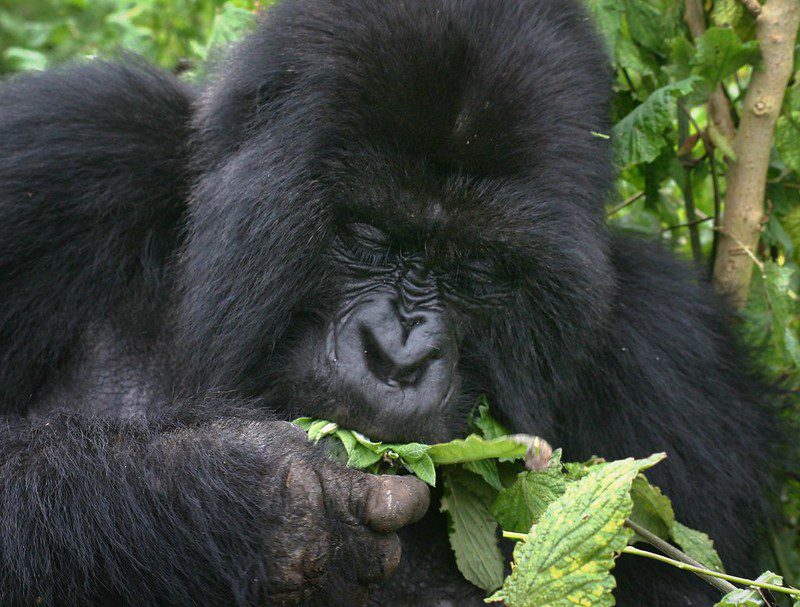
Eastern Lowland Gorillas are primarily herbivorous animals. Their diet consists mainly of vegetation, although the exact foods they consume vary according to season and habitat.
They eat leaves, stems, shoots, fruits, bark and other plant materials. Their large bodies require substantial amounts of food, so feeding occupies a major part of their daily activity.
The availability of food can influence how far a group travels. When vegetation is abundant, gorillas may spend less time moving. When food becomes more dispersed, they may travel greater distances.
Fruit can become particularly important when it is seasonally available. However, Grauer’s gorillas consume a wide variety of vegetation and are capable of adapting their diet to the plants available in their environment.
Their feeding behavior also has ecological importance. As gorillas move through forests and consume plants and fruits, they participate in natural processes that influence vegetation and seed dispersal.
Do Eastern Lowland Gorillas Eat Meat?
Eastern Lowland Gorillas are primarily herbivorous and do not normally hunt large animals for food.
Their diet is dominated by plants and other vegetation. They may occasionally consume small invertebrates or other animal matter incidentally, but they are not predators in the way that lions, leopards or other carnivorous wildlife are.
Their large size can sometimes create the mistaken impression that they require a meat-based diet. In reality, their powerful bodies are supported by their ability to consume large amounts of plant material.
How Do Gorillas Move Through the Forest?
Eastern Lowland Gorillas are primarily terrestrial. They spend much of their time moving on the ground through the forest, although they are capable of climbing when necessary.
They commonly use a form of movement called knuckle-walking, in which they support part of their weight on the knuckles of their hands while moving on all fours.
Their powerful arms are well suited to this form of movement.
Despite their size, gorillas can move surprisingly quickly when they need to. A silverback responding to a perceived threat can move rapidly through dense vegetation.
During normal activities, however, gorillas tend to move at a much calmer pace, stopping frequently to feed, rest or interact with other members of their group.
Baby Eastern Lowland Gorillas
Few wildlife experiences are as fascinating as watching a young gorilla interact with its family.
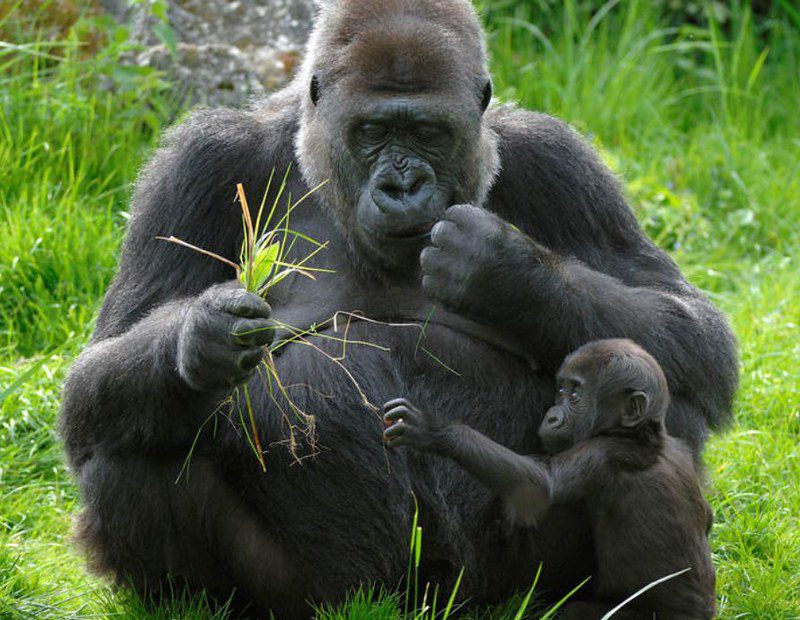
Baby gorillas are born highly dependent on their mothers. During their early months, they spend much of their time close to the mother and may be carried as the family moves through the forest.
As they become stronger, young gorillas begin exploring their surroundings.
Play becomes increasingly important. Youngsters may wrestle, chase one another, climb, roll around and interact with adults. These activities help them develop coordination, strength and social skills.
The mother remains an important source of protection and guidance, while other members of the group can also influence the young gorilla’s development.
Through observation and experience, young gorillas learn how to move through the forest, identify food, interact with other gorillas and respond to different situations.
Gorilla Mothers Form Strong Bonds With Their Young
The relationship between a mother and her infant is one of the strongest social bonds within a gorilla group.
A mother provides protection, care and nourishment during the infant’s early life. She keeps the young gorilla close and gradually allows it more freedom as it becomes stronger and more independent.
The infant’s dependence decreases slowly.
Even after a young gorilla becomes capable of moving independently, the relationship with its mother remains important. Young animals may stay within their family group for years while continuing to learn from adults.
This long period of development is one reason gorilla populations are vulnerable to rapid declines. Gorillas reproduce relatively slowly, meaning that populations cannot quickly replace individuals lost through hunting or other threats.
Eastern Lowland Gorillas Are Intelligent
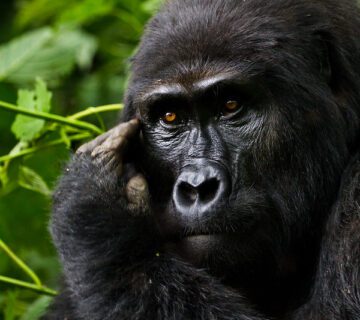
Gorillas are among the most intelligent animals on Earth.
Their intelligence can be seen in their ability to learn, remember individuals, solve problems, communicate and adapt to different situations.
They also have strong memories of their social environment. Individuals recognize other members of their group and develop relationships over time.
Young gorillas are particularly observant. Much of their learning occurs through watching adults and experimenting with behaviors themselves.
Their intelligence also makes responsible tourism especially important. Gorillas are capable of noticing human behavior, responding to disturbances and remembering experiences.
For this reason, visitors must follow strict rules when encountering gorillas in the wild.
Eastern Lowland Gorillas and Mountain Gorillas
Eastern Lowland Gorillas and mountain gorillas are closely related, but they are not the same subspecies.
Mountain gorillas are classified as Gorilla beringei beringei, while Grauer’s gorillas are classified as Gorilla beringei graueri.
Mountain gorillas are associated primarily with high-altitude forests in the Virunga region and Bwindi region of East-Central Africa. Grauer’s gorillas are found only in the Democratic Republic of the Congo and occupy a broader range of forest habitats.
There are also differences in body proportions, habitat use, diet and behavior.
For travelers planning a gorilla trekking safari, this distinction is important. A gorilla trek in Uganda or Rwanda generally focuses on mountain gorillas, while trekking in Kahuzi-Biéga National Park is associated with Grauer’s gorillas.
Both experiences offer extraordinary opportunities to observe gorillas in their natural environment, but they take place in different ecosystems and involve different gorilla populations.
Their Natural Habitat Is Extremely Important
The forests of eastern Congo are among Africa’s most biologically important ecosystems.
They provide habitat for gorillas as well as numerous other mammals, birds, reptiles, amphibians, insects and plant species.
When forests are destroyed, the consequences extend beyond gorillas. Entire ecological systems can be disrupted.
Grauer’s gorillas therefore serve as an important symbol of forest conservation. Protecting their habitat can also help protect many other species that share the same environment.
Large areas of intact forest are especially valuable because they allow wildlife populations to move, feed and reproduce without becoming isolated.
Why Are Eastern Lowland Gorillas Critically Endangered?
The Eastern Lowland Gorilla is classified as Critically Endangered, reflecting the serious threats facing the species.
One of the major problems is habitat loss.
Agricultural expansion, mining, logging, settlement and other human activities can reduce and fragment forests. In regions where communities depend heavily on land and natural resources, conservation becomes a complicated challenge.
Another major threat is hunting.
Gorillas reproduce slowly, so the loss of adults can have a significant effect on population recovery. Removing even a relatively small number of animals can have serious long-term consequences when reproduction is slow.
Political instability and insecurity in parts of eastern Congo have also made conservation difficult at different times.
Protecting these gorillas therefore requires much more than simply establishing protected areas. It requires cooperation among governments, conservation organizations, researchers, rangers and local communities.
The Importance of Kahuzi-Biéga National Park
Kahuzi-Biéga National Park is one of the most important places associated with Grauer’s gorilla conservation.
Located in eastern Democratic Republic of the Congo, the park protects a large and diverse forest ecosystem. It is named after Mount Kahuzi and Mount Biéga, two prominent volcanic mountains in the region.
The park’s importance extends beyond gorillas. Its forests provide habitat for numerous species and represent an important part of the Congo Basin’s biological heritage.
Gorilla tourism in the park can contribute to conservation while providing employment and economic opportunities for people involved in guiding, tracking, transportation, accommodation and other tourism services.
However, tourism must always be carefully managed to protect the animals and their environment.
Gorilla Trekking and Responsible Tourism
Gorilla trekking provides travelers with an opportunity to observe these remarkable animals in their natural environment.
Unlike visiting animals in captivity, trekking requires visitors to enter the forest and follow experienced trackers who understand the behavior and movements of gorilla groups.
The experience can be physically demanding because forests are often steep, wet and covered by dense vegetation. Finding a gorilla family is part of the adventure.
Once the gorillas are located, visitors may have the opportunity to observe feeding, resting, grooming, playing and social interaction.
However, responsible behavior is essential.
Visitors should follow the instructions of rangers and guides, maintain the required distance from the animals, avoid sudden movements and refrain from disturbing the group.
Gorillas are susceptible to certain human diseases, making health and hygiene particularly important during encounters.
Why Gorillas Need Protection From Human Diseases
Humans and gorillas are closely related biologically. This close relationship means that some diseases affecting humans can potentially affect gorillas as well.
A common illness among people can therefore become a serious threat to a wild gorilla population.
This is one reason why gorilla trekking regulations include measures designed to reduce disease transmission.
Visitors who are unwell may be advised not to participate in a gorilla trek. Travelers are also expected to follow hygiene and distancing rules established by park authorities.
These regulations protect both visitors and gorillas.
Eastern Lowland Gorillas Have Individual Personalities
Although it is easy to think of a gorilla family as a single unit, each animal has its own personality.
Some individuals may be more confident and curious, while others are quieter and more cautious.
Young gorillas are often energetic and playful. Adults may spend more time feeding or resting.
A silverback may appear calm and relaxed for long periods before suddenly becoming highly alert when something catches his attention.
Experienced trackers can often recognize individual gorillas based on physical characteristics, behavior and social relationships.
This individuality is one of the reasons that gorilla trekking can be such a memorable wildlife experience. Visitors are not simply watching “gorillas”; they are observing a complex family of individual animals.
Gorillas Build Sleeping Nests
Eastern Lowland Gorillas construct nests where they sleep.
The nests are generally made from vegetation gathered from their surroundings. Depending on circumstances, gorillas may construct nests on the ground or in vegetation.
Nest-building is an important part of their daily routine.
Researchers and trackers can also use nests as evidence of gorilla activity. Even when the animals themselves are hidden deep inside the forest, the presence of nests can provide information about where a group has recently been.
Young gorillas learn this behavior as part of growing up within the family.
How Gorillas Spend Their Day
A typical day for a gorilla involves a combination of feeding, resting and social interaction.
Much of the day can be spent searching for and consuming vegetation. After feeding, gorillas may rest in the forest while young animals play nearby.
Grooming and physical contact can help strengthen social relationships.
The group may gradually move through its territory as it searches for food. Toward evening, individuals construct sleeping nests.
The routine can change depending on weather, food availability, social events and other environmental factors.
What may appear to a visitor as a quiet day in the forest is actually filled with communication and social activity.
The Ecological Role of Eastern Lowland Gorillas
Gorillas are not simply inhabitants of the forest. They also influence the ecosystem around them.
As they consume fruits and vegetation, they interact with plant communities. Their movements can contribute to seed dispersal, while their feeding behavior can influence the structure of vegetation.
This means that protecting Grauer’s gorillas can contribute to maintaining healthy forest ecosystems.
The conservation of a flagship species such as the gorilla can also attract attention to the broader forest landscape and the many lesser-known species that depend on it.
Conservation Requires Local Communities
Protecting gorillas cannot succeed without considering the people who live around their habitat.
Communities near protected forests need opportunities to support their livelihoods. If conservation policies ignore local economic needs, protecting wildlife can become much more difficult.
Responsible tourism can provide employment and income through guiding, accommodation, transportation, cultural experiences and other tourism services.
Education can also play an important role by helping communities understand the ecological and economic value of protecting forests.
When communities benefit from conservation, they can become powerful partners in protecting wildlife.
Why the Survival of Grauer’s Gorillas Matters
The survival of Eastern Lowland Gorillas matters because they are a unique part of Africa’s natural heritage.
They are also one of humanity’s closest living relatives. Their social intelligence, family relationships and physical characteristics provide scientists with valuable insights into primate evolution and behavior.
But their importance extends beyond science.
Grauer’s gorillas are part of an ecosystem that supports countless other species. Protecting their habitat helps protect forests that store carbon, regulate water systems and support biodiversity.
The loss of these gorillas would therefore represent more than the disappearance of one animal population. It would be a warning about the health of one of Central Africa’s most important forest ecosystems.
Final Thoughts on Eastern Lowland Gorillas
The Eastern Lowland Gorilla, or Grauer’s Gorilla, is one of Africa’s most extraordinary great apes. From the enormous silverback that protects his family to the playful infants exploring the forest, these animals demonstrate remarkable intelligence, social complexity and adaptability.
They live exclusively in the forests of the Democratic Republic of the Congo, with important populations associated with protected areas such as Kahuzi-Biéga National Park. Their lives revolve around family, food, movement, communication and survival in one of Africa’s most important forest environments.
Yet their future remains fragile.
Habitat destruction, hunting, human pressure and insecurity have placed enormous challenges in front of conservation efforts. Because gorillas reproduce relatively slowly, protecting existing populations is particularly important.
Responsible gorilla tourism, effective protected-area management, scientific research and meaningful community involvement can all contribute to their long-term survival.
For anyone planning an African wildlife adventure, learning about Grauer’s gorillas offers a deeper appreciation of the diversity of gorilla experiences across Africa. Mountain gorillas may be the most internationally recognized, but the Eastern Lowland Gorilla is equally remarkable and represents an essential part of the Democratic Republic of the Congo’s extraordinary wildlife heritage.
Protecting these magnificent animals means protecting their families, their forests and the communities that share their environment. The story of the Eastern Lowland Gorilla is therefore not simply a story about a powerful ape. It is a story about wildlife, forests, conservation and the responsibility to preserve Africa’s natural heritage for future generations.