Mountain Gorilla Population Chart by Country: Uganda, Rwanda and the Democratic Republic of Congo
The mountain gorilla is one of Africa’s most remarkable and endangered great apes. Scientifically known as Gorilla beringei beringei, the mountain gorilla is found in only a small region of East-Central Africa, where its remaining habitat extends across Uganda, Rwanda and the Democratic Republic of the Congo. Unlike many African wildlife species that occupy enormous territories, mountain gorillas have an extremely restricted range, making every population and every individual important to the future of the species.
When people search for information about the mountain gorilla population, one of the most common questions is how many mountain gorillas live in Uganda, Rwanda and the Democratic Republic of the Congo. At first, this may seem like a simple question that can be answered with 3 separate numbers. However, mountain gorilla population statistics are more complicated because these animals live in transboundary ecosystems. The gorillas do not recognize international borders, and the populations are therefore generally counted according to their natural habitats rather than according to the countries in which they happen to be located.
The latest established comprehensive population figure is 1,063 mountain gorillas worldwide. This figure comes from 2 major populations. The Bwindi-Sarambwe population was estimated at 459 individuals, while the Virunga Massif population was estimated at 604 individuals. These figures come from different census periods, with the Bwindi-Sarambwe census taking place in 2018 and the Virunga census taking place in 2015–2016.
It is important to understand that the figure of 1,063 should not be described as an exact count of every mountain gorilla alive in 2026. A new census was conducted in the Bwindi-Sarambwe ecosystem in 2025, and updated results will provide a more recent picture of that population. Until those results are officially available, the established comprehensive figure remains 1,063.
Understanding the Two Mountain Gorilla Populations
The world’s mountain gorillas survive in 2 main populations. The first population is the Bwindi-Sarambwe population, which is found in and around Bwindi Impenetrable National Park in southwestern Uganda and extends into the Sarambwe area of the Democratic Republic of the Congo. The second population is the Virunga Massif population, which occupies the volcanic mountain forests shared by Uganda, Rwanda and the Democratic Republic of the Congo.
The Bwindi-Sarambwe population had an estimated 459 individuals in the 2018 census. The Virunga Massif population had an estimated 604 individuals in the 2015–2016 census. When these 2 populations are combined, the established global figure is 1,063 mountain gorillas.
This means that there are not really 3 completely separate national populations. Instead, Uganda, Rwanda and the Democratic Republic of the Congo share parts of the 2 remaining mountain gorilla ecosystems. This is why a proper mountain gorilla population article should explain the populations by ecosystem instead of simply assigning an exact number to each country.
Mountain Gorilla Population in Uganda
Uganda is one of the most important countries in the world for mountain gorilla conservation. The country contains habitat belonging to both of the remaining mountain gorilla populations. Mountain gorillas can be found in Bwindi Impenetrable National Park and Mgahinga Gorilla National Park.
Bwindi Impenetrable National Park forms part of the Bwindi-Sarambwe population, while Mgahinga Gorilla National Park forms part of the Virunga Massif population. This gives Uganda a unique position in mountain gorilla conservation because it contains representatives of both remaining populations.
The 2018 census recorded 459 mountain gorillas across the wider Bwindi-Sarambwe ecosystem. It would therefore be incorrect to state that Uganda had exactly 459 mountain gorillas because the ecosystem extends across the Uganda-DRC border. The 459 figure represents the population of that entire ecosystem rather than an exclusively Ugandan population.
A new census was conducted in the Bwindi-Sarambwe ecosystem in 2025. This census was designed to provide updated information about the population and determine how the number of gorillas has changed since the previous census. Because gorillas are born, die, move between social groups and change their social structures, regular population surveys are essential.
Bwindi Impenetrable National Park
Bwindi Impenetrable National Park is one of Uganda’s most famous wildlife destinations and is internationally recognized for its mountain gorillas. Located in southwestern Uganda, Bwindi contains an ancient tropical forest with steep hills, valleys, thick vegetation and a remarkable variety of wildlife.
The forest provides everything mountain gorillas need for survival, including food, shelter and vegetation for building sleeping nests. Gorillas spend much of their day moving through the forest in search of leaves, shoots, stems, fruits and other plant materials.
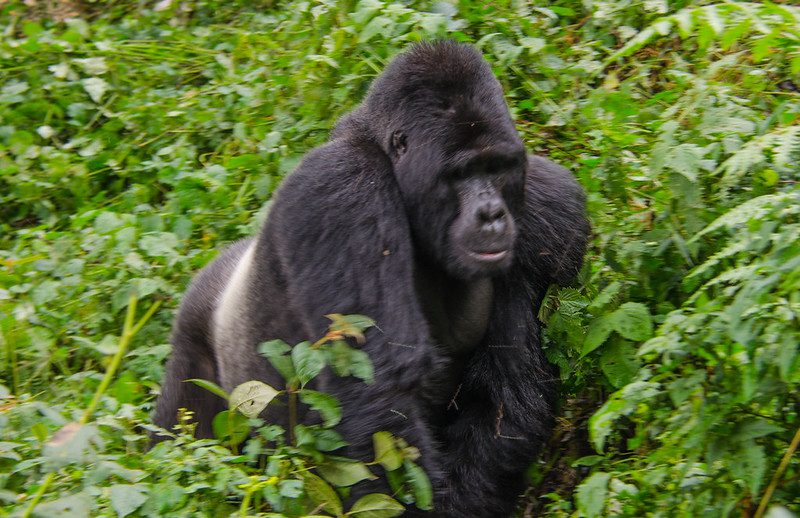
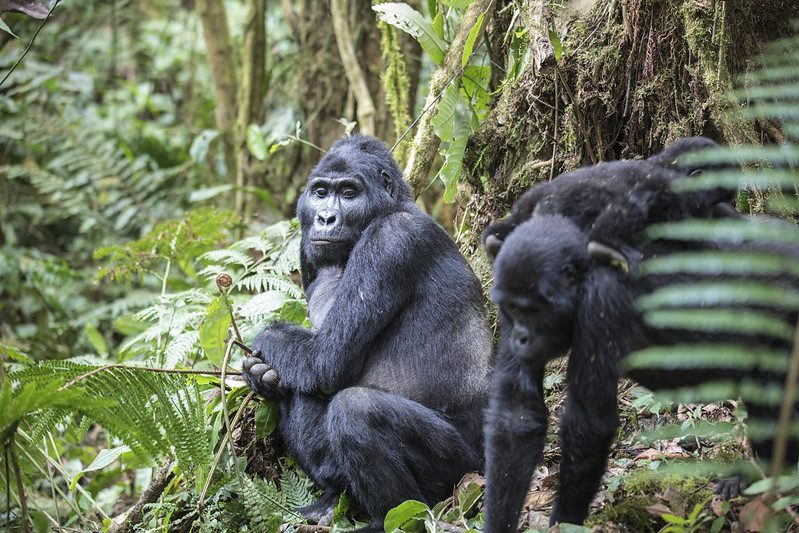
The mountain gorillas of Bwindi live in family groups. A group may contain a dominant silverback, adult females, younger males, juveniles and infants. Each family has its own social relationships and individual personalities.
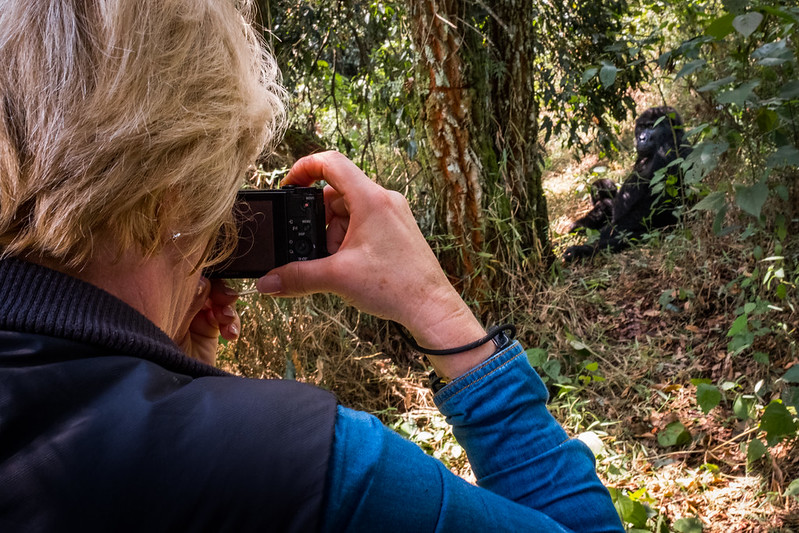
For tourists, Bwindi is one of the most rewarding destinations for gorilla trekking. Visitors can walk through the forest with trained guides and trackers in search of habituated gorilla families. The trek can involve steep slopes and dense vegetation, but the reward is the opportunity to spend time observing one of the world’s rarest great apes in its natural environment.
Mgahinga Gorilla National Park
Mgahinga Gorilla National Park is another important mountain gorilla destination in Uganda. Although the park is relatively small compared with some of Uganda’s other national parks, it is extremely important because it forms part of the Virunga Massif.
The Virunga Massif is a transboundary ecosystem shared by Uganda, Rwanda and the Democratic Republic of the Congo. The mountain gorillas living in Mgahinga are therefore part of the larger Virunga population.
The Virunga population was estimated at 604 individuals during the 2015–2016 census. This figure represents the entire Virunga Massif rather than only the gorillas living inside Uganda.
The landscape around Mgahinga is dominated by volcanic mountains and dense forest. The dramatic scenery makes gorilla trekking in the park a unique experience, particularly for travelers who enjoy combining wildlife encounters with mountain landscapes.
Mountain Gorilla Population in Rwanda
Rwanda is one of the world’s most famous mountain gorilla trekking destinations. The country’s mountain gorillas are found in Volcanoes National Park, which forms part of the Virunga Massif.
The Virunga Massif extends across 3 countries. In Uganda, it includes Mgahinga Gorilla National Park. In Rwanda, it includes Volcanoes National Park. In the Democratic Republic of the Congo, it includes Virunga National Park.
The established population figure for the entire Virunga Massif is 604 mountain gorillas. It is therefore not scientifically accurate to say that Rwanda has 604 mountain gorillas. The 604 individuals are distributed across the wider transboundary ecosystem.
Volcanoes National Park is particularly famous for its mountain gorillas because it combines gorilla habitat with spectacular volcanic scenery. The park contains several volcanoes and large areas of montane forest where gorilla families move, feed and rest.
Rwanda has also developed a strong international reputation for gorilla tourism. Visitors travel from around the world to trek through the forest and observe habituated gorilla families.
Volcanoes National Park
Volcanoes National Park is located in northwestern Rwanda and forms part of the Virunga mountain range. The park is characterized by steep forested slopes, bamboo zones and volcanic mountains.
The mountain gorillas living in the park are part of the larger Virunga Massif population. Their survival is therefore connected not only to conservation efforts in Rwanda but also to conservation work taking place in Uganda and the Democratic Republic of the Congo.
A gorilla trek in Volcanoes National Park can involve several hours of hiking through difficult terrain. Gorillas are wild animals and do not remain in one location simply because tourists are coming to see them. Guides and trackers search for the families each morning and follow their movements through the forest.
Once a family is located, visitors may observe a wide range of behaviors. Gorillas may be feeding, resting, grooming, playing or caring for infants. Sometimes a silverback may sit quietly while younger gorillas play around him. Other times the group may move through the forest searching for food.
Mountain Gorilla Population in the Democratic Republic of the Congo
The Democratic Republic of the Congo is extremely important to mountain gorilla conservation because it contains parts of both remaining mountain gorilla ecosystems.
The country’s Virunga National Park forms part of the Virunga Massif, while the Sarambwe area forms part of the wider Bwindi-Sarambwe ecosystem.
This means that DRC is connected to both major mountain gorilla populations.
The country also has an important role in protecting the wider Congo forest ecosystem. Eastern DRC contains some of Africa’s most remarkable wildlife landscapes, but conservation efforts have faced serious challenges because of insecurity, political instability, habitat pressure and other human activities.
Despite these challenges, conservation workers and rangers continue efforts to protect the remaining gorilla habitat.
Virunga National Park
Virunga National Park is one of Africa’s most biologically important protected areas. The park contains an extraordinary mixture of habitats, including forests, mountains, volcanoes, wetlands and savannah.
The park is home to mountain gorillas belonging to the Virunga Massif population.
The conservation story of Virunga is closely connected to the broader history of mountain gorilla protection. Rangers, researchers and conservation organizations have worked for decades to monitor and protect gorilla families.
The park is also home to many other species, meaning that protecting the gorillas can help protect a much wider ecosystem.
Why You Cannot Simply Divide the Population by Country
One of the biggest mistakes people make when discussing mountain gorilla numbers is attempting to divide the global population into Uganda, Rwanda and DRC.
For example, someone might see the figure of 1,063 and try to calculate how many belong to Uganda, how many belong to Rwanda and how many belong to DRC.
This does not work because the gorillas live in transboundary ecosystems.
The Virunga Massif crosses all 3 countries. A gorilla family can move through habitat that extends across an international boundary. The animals do not understand the political borders that humans have created.
The Bwindi-Sarambwe population is also shared between Uganda and DRC.
Therefore, the scientifically meaningful way to describe the population is by ecosystem rather than by country.
The 459 Bwindi-Sarambwe Gorillas
The Bwindi-Sarambwe population had an established census estimate of 459 gorillas in 2018. The census recorded social groups as well as solitary individuals.
This population is particularly important because it represents one of only 2 remaining mountain gorilla populations on Earth.
The majority of this population is associated with Bwindi in Uganda, while the wider ecosystem extends into DRC.
The 2025 census was conducted to obtain updated information. Once the results are officially released, they will provide a newer population figure and help conservationists understand how the population has changed since 2018.
Until then, 459 remains the latest established figure for this population.
The 604 Virunga Gorillas
The Virunga Massif had an established population estimate of 604 mountain gorillas during the 2015–2016 census.
This population is shared by Uganda, Rwanda and the Democratic Republic of the Congo.
The 604 individuals are not divided into 3 separate populations. Instead, they form one interconnected mountain gorilla population spread across the Virunga landscape.
The Virunga Massif is particularly important because it contains some of the most famous mountain gorilla habitats in Africa.
Why the Global Population Is 1,063
The established global population figure is calculated by combining the 2 population estimates.
The Bwindi-Sarambwe population was estimated at 459.
The Virunga Massif population was estimated at 604.
When the 2 numbers are combined, the result is 1,063.
Therefore, the commonly cited established global figure is 1,063 mountain gorillas.
However, this number should always be presented with context because the component censuses were conducted at different times.
The 459 figure comes from 2018, while the 604 figure comes from 2015–2016.
This means that the actual number of mountain gorillas living in the wild today may be different.
The 2025 Bwindi-Sarambwe Census
The 2025 Bwindi-Sarambwe census is an important development in the conservation of mountain gorillas.
Population censuses are not simple exercises. Researchers have to enter dense forests and locate gorilla groups, identify individuals and collect information that can be analyzed later.
Modern census techniques can include genetic analysis. Researchers can collect DNA from gorilla fecal samples and use this information to distinguish individuals.
This is especially useful because it reduces the possibility of counting the same gorilla multiple times.
The 2025 survey is expected to provide important information about population growth, group structure and the overall health of the Bwindi-Sarambwe population.
How Mountain Gorilla Numbers Have Increased
The increase in mountain gorilla numbers is one of the most encouraging conservation stories in Africa.
Mountain gorillas have faced serious threats for decades. Habitat destruction, hunting, human encroachment, disease and political instability have all created challenges.
However, conservation programs have gradually improved protection.
Rangers have increased patrols and monitoring. Researchers have improved population surveys. Veterinary teams have developed methods for monitoring and treating gorilla health problems. Governments and conservation organizations have worked to protect forest habitats.
Tourism has also provided an economic incentive for conservation.
As mountain gorillas became a major attraction for international travelers, their economic value became increasingly recognized. Gorilla trekking created employment and generated revenue that could support conservation and local communities.
From Critically Endangered to Endangered
Mountain gorillas were once classified as Critically Endangered.
Their extremely small population and limited habitat made them one of the world’s most threatened great apes.
However, their population recovery led to an important change in conservation status.
In 2018, mountain gorillas were reclassified from Critically Endangered to Endangered.
This was a major achievement.
It demonstrated that sustained conservation can produce meaningful results.
However, the change does not mean that mountain gorillas are safe.
Their population remains extremely small, and their entire wild range is restricted to a small region.
A major disease outbreak or serious environmental crisis could have significant consequences.
Why Every Mountain Gorilla Matters
When a species has only around one thousand individuals, every individual becomes important.
Mountain gorillas reproduce relatively slowly compared with many other mammals. Females invest significant time and energy in raising their young, meaning that populations cannot quickly replace animals lost through disease, hunting or other threats.
A healthy population therefore requires successful births, high infant survival and protection of adults.
Adult females are especially important because they contribute directly to future population growth.
Silverbacks are also important because they provide protection and maintain social stability within groups.
Young gorillas are the future of the population.
The Importance of Gorilla Families
Mountain gorillas are highly social animals.
They live in family groups where individuals interact with one another through grooming, playing, feeding, communication and physical contact.
A family can include a dominant silverback, several adult females, younger males, juveniles and infants.
The silverback often plays a protective role and helps determine where the group travels.
Females form important relationships within the group, while young gorillas learn by observing and interacting with older animals.
This social complexity is one of the reasons mountain gorillas are so fascinating to observe.
Baby Gorillas and Population Growth
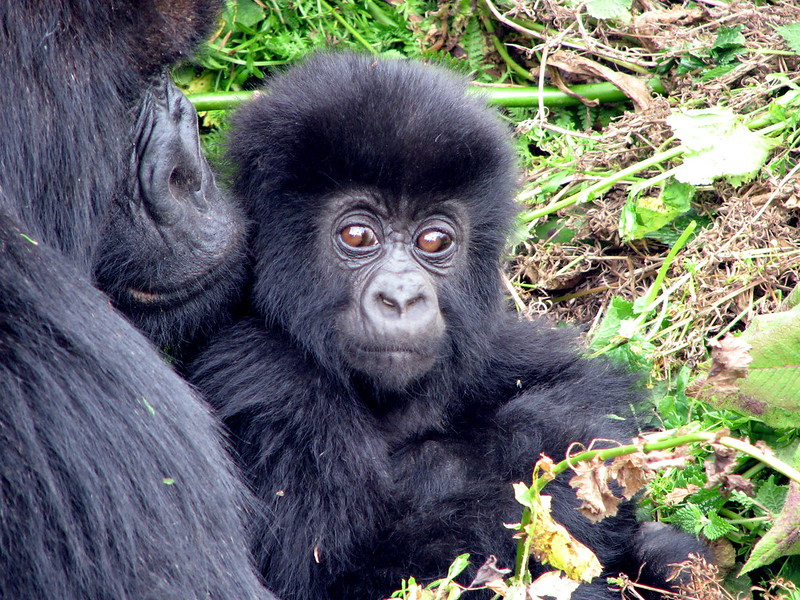
Baby gorillas represent hope for the future of the species.
When a mountain gorilla infant is born, it becomes another potential adult that can eventually reproduce and contribute to population growth.
However, the process takes years.
Young gorillas remain dependent on their mothers and gradually develop the skills they need to survive.
They learn how to move through the forest, identify food, communicate with other gorillas and interact socially.
The long period of development means that conservationists must protect gorillas throughout every stage of their lives.
The Importance of Forest Protection
Mountain gorillas cannot survive without their forests.
The forests provide food, shelter and places for sleeping.
They also provide space for family groups to move and establish territories.
If forest habitat becomes fragmented, gorillas may have difficulty moving between areas.
Fragmentation can also increase contact between wildlife and people, potentially creating additional disease and conflict risks.
For this reason, mountain gorilla conservation is fundamentally connected to forest conservation.
Protecting the trees and ecosystems where gorillas live is just as important as protecting individual gorillas.
Gorilla Tourism and Conservation
Gorilla tourism has become an important component of conservation in Uganda and Rwanda.
Visitors pay for gorilla trekking permits and spend money on accommodation, transportation, guides, porters and other tourism services.
This creates economic benefits around gorilla habitat.
Local people can find employment in tourism, while governments and protected-area authorities can generate revenue that contributes to conservation.
Tourism can also increase international awareness of mountain gorillas.
When visitors experience gorillas in their natural environment, they often develop a stronger appreciation for the importance of protecting them.
Responsible Gorilla Trekking
Gorilla trekking must always be carried out responsibly.
Mountain gorillas are wild animals, and close human contact can create risks.
One of the biggest concerns is disease transmission because humans and gorillas are biologically similar.
Visitors are therefore expected to follow rules established by park authorities and guides.
People should maintain the required distance, avoid touching gorillas and follow instructions during encounters.
Visitors who are sick may also be advised not to participate in trekking.
These precautions help protect both tourists and gorillas.
Mountain Gorilla Conservation Across Three Countries
Uganda, Rwanda and the Democratic Republic of the Congo all have important responsibilities in protecting mountain gorillas.
Uganda protects the Bwindi-Sarambwe ecosystem through Bwindi Impenetrable National Park and also protects part of the Virunga Massif through Mgahinga Gorilla National Park.
Rwanda protects the Rwandan section of the Virunga Massif through Volcanoes National Park.
The Democratic Republic of the Congo protects part of the Virunga Massif through Virunga National Park and part of the Bwindi-Sarambwe ecosystem through the Sarambwe area.
Because the ecosystems cross borders, cooperation between the countries is essential.
The Future of Mountain Gorilla Conservation
The future of mountain gorillas is more promising today than it was several decades ago, but conservation work cannot stop.
The population remains small.
Their habitat remains restricted.
Their reproduction is relatively slow.
They remain vulnerable to disease.
Human development continues to place pressure on natural habitats.
Political and security challenges can also affect conservation efforts, particularly in parts of eastern DRC.
The continued success of mountain gorilla conservation will depend on maintaining strong protection, supporting scientific research, involving local communities and ensuring that tourism remains responsible.
Mountain Gorilla Population Chart Explained
The simplest accurate population chart is based on the 2 remaining populations.
The Bwindi-Sarambwe population had an established figure of 459 mountain gorillas from the 2018 census. This population is associated mainly with Bwindi in Uganda and extends into the Democratic Republic of the Congo.
The Virunga Massif population had an established figure of 604 mountain gorillas from the 2015–2016 census. This population is shared by Uganda, Rwanda and the Democratic Republic of the Congo.
When these 2 populations are combined, the established global total is 1,063 mountain gorillas.
This is the figure that should be used when discussing the latest established comprehensive mountain gorilla population, while clearly explaining that newer census work is underway or has been completed for parts of the range.
Mountain Gorilla Population and Gorilla Trekking
The population numbers also help explain why gorilla trekking is such a special experience.
There are thousands of mountain gorillas in the imagination of many people because gorillas are so famous around the world. In reality, the wild population is extremely small.
When someone enters Bwindi, Mgahinga, Volcanoes or Virunga to see mountain gorillas, they are entering one of the last remaining habitats of a species that exists nowhere else in the world.
A gorilla trek is therefore not simply another wildlife activity.
It is an opportunity to observe an endangered great ape in its natural environment and to see behaviors that cannot be fully understood through photographs or documentaries.
Watching a silverback protect his family, observing a mother care for an infant or seeing young gorillas play in the forest can provide a powerful connection between travelers and wildlife conservation.
Uganda, Rwanda or Congo: Which Is Better?
There is no single answer to which country offers the best mountain gorilla experience.
Uganda provides opportunities in Bwindi and Mgahinga and allows travelers to combine gorilla trekking with a wide range of other safari experiences.
Rwanda offers gorilla trekking in Volcanoes National Park, a destination famous for its volcanic scenery and well-established tourism infrastructure.
The Democratic Republic of the Congo offers access to the Virunga landscape and is particularly significant for travelers interested in conservation and the wider natural environment of eastern Congo.
The best destination depends on the traveler’s interests, itinerary, budget and current travel conditions.
What matters most is that all 3 countries play an important role in protecting the world’s remaining mountain gorillas.
Final Thoughts
The mountain gorilla population is one of the most important wildlife conservation stories in Africa.
The latest established comprehensive census figure is 1,063 mountain gorillas, made up of approximately 459 gorillas in the Bwindi-Sarambwe population and 604 gorillas in the Virunga Massif population.
However, these numbers should never be presented as simple country-by-country totals.
Uganda, Rwanda and the Democratic Republic of the Congo share mountain gorilla ecosystems. Uganda contains Bwindi and part of the Virunga Massif. Rwanda contains part of the Virunga Massif through Volcanoes National Park. The Democratic Republic of the Congo contains parts of both major mountain gorilla ecosystems.
The gorillas themselves do not recognize national borders. Their lives are connected to the forests, mountains and ecosystems that cross those borders.
The story of the mountain gorilla is ultimately a story of survival and conservation. These animals have faced enormous threats, yet their population has increased enough for their conservation status to improve from Critically Endangered to Endangered.
The 2025 Bwindi-Sarambwe census is another important step toward understanding the current state of the species. Once the updated results are released, conservationists and wildlife enthusiasts will have a clearer picture of how the population has changed since the previous census.
For Uganda, Rwanda and the Democratic Republic of the Congo, protecting mountain gorillas is more than protecting a tourism attraction. These animals represent an irreplaceable part of Africa’s natural heritage.
Their forests are their homes. Their families are their social foundation. Their survival depends on conservation, responsible tourism, scientific research and cooperation between countries.
With only 2 remaining wild populations, the future of the mountain gorilla depends on continued commitment.
Every family matters. Every infant matters. Every forest matters. And every mountain gorilla matters.