
Where to see lions hunting: Best parks and times of year
Watching a lion hunt is one of the most exciting experiences on an African safari. A pride moving quietly through tall grass, lionesses coordinating their approach or a male lion charging after prey can reveal a side of wildlife that visitors rarely see when animals are resting.
However, finding lions is much easier than witnessing a successful hunt. Lions spend many hours resting, and even when they begin stalking prey, the hunt may end without a kill. Your chances depend on the park, season, prey movements, weather and time of day.
East Africa offers some of the continent’s strongest opportunities for observing lion hunting behaviour. The Maasai Mara in Kenya and Serengeti in Tanzania are particularly good because they support large lion populations and substantial herds of wildebeest, zebras and other prey. Ngorongoro Crater offers excellent opportunities to observe resident prides, while Queen Elizabeth National Park in Uganda provides a different experience around its open savannas and Ishasha woodland.
The best strategy is to spend several days in a productive wildlife area, go out early and late, and travel when prey is concentrated in suitable hunting grounds. Even with careful planning, a wild hunt is never guaranteed.
How lions hunt in the wild
Lions are social predators, and their hunting behaviour is closely connected to pride structure. Lionesses usually carry out much of the hunting, although males also hunt, particularly when they are alone, in small groups or targeting large animals.
A pride often contains related females, their cubs and one or more adult males. The females may cooperate when hunting, especially when targeting large prey such as buffalo or wildebeest. Working together can improve their chances of approaching an animal, although successful hunts still depend on timing, terrain and the prey’s ability to escape.
Lions use stealth rather than long-distance pursuit. They approach their target while staying low in the grass or using bushes, trees and uneven ground for cover. Once close enough, they launch a short, powerful charge.
Their bodies are built for strength and acceleration over short distances. They cannot maintain high speeds for long, so getting close before attacking is essential. A lion that begins its charge too far away can quickly lose the advantage.
Different hunting situations require different tactics. A pride may approach a herd from several directions, while a single lion may wait near a waterhole or game trail. Lions sometimes hunt at night, when darkness gives them an advantage over prey with weaker night vision.
The final attack is usually brief. A lion may seize an animal by the throat or muzzle, depending on its size and the circumstances. Larger prey can require several lions to bring it down.
Maasai Mara National Reserve, Kenya
<PRIVATE_PERSON> The Maasai Mara is one of the best places in Africa to look for lions hunting. Its open grasslands, seasonal river systems and abundant grazing animals support a large population of resident lions.
The Mara is particularly productive because it forms part of the greater Serengeti-Mara ecosystem. Wildebeest, zebras, Thomson’s gazelles and other herbivores move through the region, providing food for resident predators. During the Great Migration, large herds enter the reserve from Tanzania, creating additional hunting opportunities.
Lionesses often use tall grass, drainage lines and areas near riverbanks to approach prey. The open landscape can make it possible to follow a pride as it moves towards a herd, although vegetation sometimes hides the final stages of a hunt.
The Mara Triangle, Musiara area, Talek region and central reserve are among the areas known for lion activity. Sightings also occur in the surrounding conservancies, including Mara North, Naboisho, Olare Motorogi and Ol Kinyei.
The conservancies can offer an advantage because some permit off-road driving under controlled rules. This may help guides follow a hunt across suitable terrain without being restricted to established roads. However, access rules differ between properties, and off-road driving is not automatically permitted everywhere.
Best time of year: July to October is particularly interesting because the Great Migration brings large herds into the Mara. Lionesses may hunt wildebeest and zebras, especially where herds gather near grazing areas and river systems. January to March can also provide good predator viewing, with resident prey and young animals in the wider ecosystem.
Lions remain in the Mara throughout the year, so a visit outside migration season can still produce excellent sightings. The migration increases the availability of prey in particular areas, but it does not guarantee that you will witness a hunt.
Serengeti National Park, Tanzania
The Serengeti is another outstanding destination for observing lions. Its extensive savanna, woodland, rocky kopjes and seasonal grasslands support large populations of lions and their prey.
Central Serengeti, particularly the Seronera area, is one of the most reliable places to search for lions throughout the year. Permanent water sources and resident herbivores support established prides, while kopjes provide resting places and elevated viewpoints.
The southern Serengeti and Ndutu region are especially interesting during the wildebeest calving season. From roughly January to March, large numbers of wildebeest give birth across the southern plains and surrounding areas. Newborn calves attract predators, including lions, spotted hyenas and cheetahs.
Lionesses may hunt around the edges of the herds, taking advantage of young animals that are still developing their speed and coordination. The open plains can make predator activity easier to observe, although a hunt may happen far from the roads or behind vegetation.
The northern Serengeti becomes particularly interesting from around July to October, when migration herds move through the region. Lions living in the north may hunt wildebeest and zebras moving between grazing areas and the Mara River.
The western corridor and central woodlands also support resident prides. Their hunting patterns change with rainfall, vegetation and the movements of prey.
Best time of year: January to March is excellent for observing predator activity around the calving grounds in the south. June to October is a strong period for general lion viewing, while July to October offers additional opportunities in the northern Serengeti as migration herds move through the area.
The Serengeti is large, so choosing the right section matters. A lodge in central Seronera will not automatically provide easy access to the southern calving grounds or northern migration areas. Plan your accommodation around the seasonal wildlife movements.
Ngorongoro Crater, Tanzania
Ngorongoro Crater offers some of the most concentrated lion viewing in East Africa. Its grasslands, marshes, woodland and permanent water sources support a variety of prey animals, including zebras, wildebeest and buffaloes.
The crater’s enclosed landscape makes wildlife viewing different from the open Serengeti. Lions live within the wider conservation area, and visitors can often observe them without travelling long distances across vast plains.
Lion prides may hunt across open grassland or use vegetation near marshes and drainage channels for cover. The crater floor provides opportunities to watch lions moving between resting areas, feeding grounds and water sources.
Buffaloes are important prey, although hunting them can be dangerous. A pride may approach a herd cautiously before attempting to isolate a weak or young animal. Zebras and wildebeest are also potential targets.
The crater is particularly useful for travellers with limited time. A well-planned game drive can provide opportunities to see lions and several other large mammals within a relatively compact area.
Best time of year: Lion sightings are possible throughout the year. The dry season, broadly June to October, often provides good visibility as grass becomes shorter. The wetter months can produce lush scenery and good wildlife viewing, although vegetation may make it harder to follow animals.
A lion sighting in Ngorongoro is more predictable than witnessing a hunt. The presence of resident prides does not mean they will be hunting when you arrive.
Queen Elizabeth National Park, Uganda
Queen Elizabeth National Park is Uganda’s leading destination for lion viewing. Its combination of open savanna, woodland, wetlands and crater lakes supports lions alongside elephants, buffaloes, Uganda kobs and other herbivores.
The Kasenyi Plains are among the most important areas for lion viewing. Large numbers of Uganda kobs use the grasslands, providing a regular food source for resident predators. Lions may patrol the plains, rest near vegetation or approach herds when hunting.
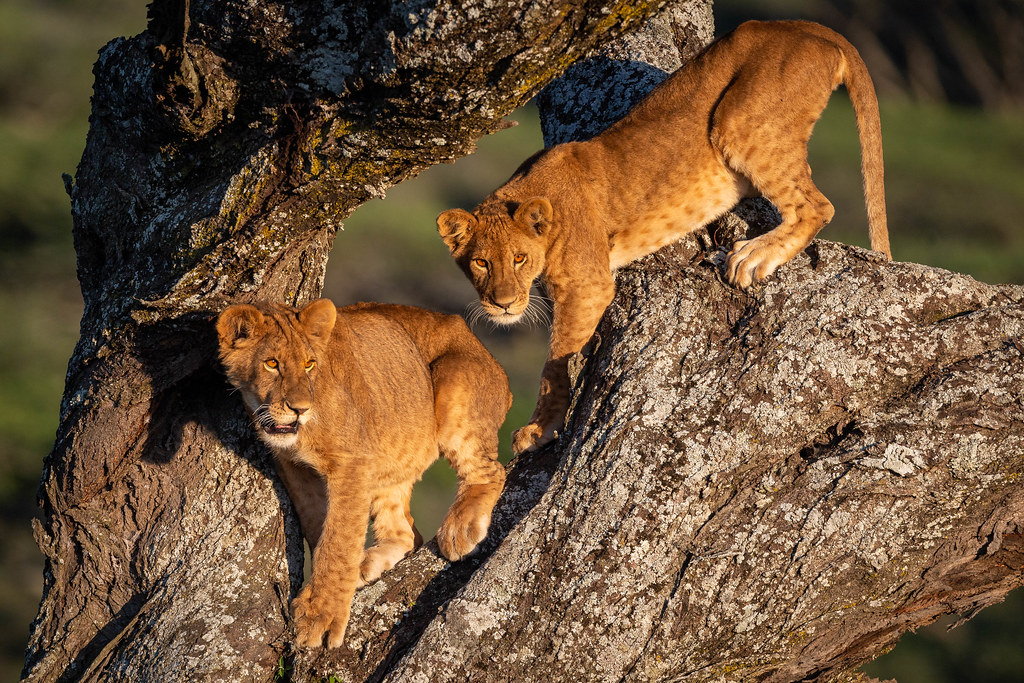
The Ishasha sector in the southern part of the park is famous for tree-climbing lions. Visitors sometimes find them resting in large fig trees, particularly during the hotter parts of the day. This behaviour is unusual and makes Ishasha one of Uganda’s most recognisable wildlife destinations.
Tree-climbing lions are not necessarily hunting from the branches. They often use trees to rest, escape insects, avoid heat or gain a better position above the surrounding vegetation. Their presence in trees should not be confused with a specific hunting technique.
Hunting may occur in the grasslands below, where lions target Uganda kob and other available prey. A morning game drive gives you a useful opportunity to search the Kasenyi Plains while animals are active.
Best time of year: June to September and December to February are generally useful periods for game viewing. Drier conditions can improve visibility and make some roads easier to navigate. Lion sightings are possible during the rainy seasons too, but thick grass may make predators harder to locate.
Queen Elizabeth is a good choice for visitors combining a wildlife safari with chimpanzee tracking in Kyambura Gorge or a boat cruise along the Kazinga Channel.
Kidepo Valley National Park, Uganda
Kidepo Valley National Park offers a more remote lion-watching experience than Queen Elizabeth. Located in northeastern Uganda near the borders with South Sudan and Kenya, it contains open plains, rocky hills, seasonal rivers and extensive savanna.
The Narus Valley is the park’s main wildlife-viewing area. Permanent and seasonal water sources attract buffaloes, zebras, giraffes and other herbivores, which in turn support predators.
Lions may be seen resting near rocky outcrops, moving through grassland or approaching prey around the valley’s open areas. The landscape provides excellent opportunities for observing predator behaviour without the level of vehicle traffic found in some better-known safari destinations.
Hunting opportunities depend on the availability and movement of prey. Buffaloes are important in the ecosystem, although taking down a healthy adult can be risky even for a group of lions. Smaller antelope and other animals may also be targeted.
Best time of year: December to March is generally a useful period for wildlife viewing in Kidepo. The grass is often shorter during the dry months, making animals easier to spot. The wet season can bring greener scenery and active wildlife, but some roads may become difficult.
Kidepo is particularly suitable for travellers who want a quieter safari and are willing to make the longer journey from Kampala or arrange a domestic flight.
Akagera National Park, Rwanda
Akagera National Park is Rwanda’s main savanna wildlife destination. It contains open plains, lakes, woodland and wetlands along the country’s eastern border with Tanzania.
Lions were reintroduced to Akagera in 2015 after being absent from the park for many years. The population has since established itself, and the park is now an important destination for visitors interested in seeing Rwanda’s recovering savanna wildlife.
Lions hunt a range of available prey, including antelopes and other medium-sized herbivores. The park’s open landscapes can provide useful visibility, although woodland and tall grass may conceal animals.
Akagera is also home to elephants, buffaloes, giraffes, zebras, rhinos and several antelope species. This variety makes it possible to combine predator viewing with a wider Big Five safari.
Best time of year: June to September is generally a good period for wildlife viewing because vegetation becomes less dense and animals gather around remaining water sources. The park can also be visited during the wetter months, although conditions may make some areas more difficult to explore.
Akagera is worth considering if you are planning a Rwanda trip that combines savanna wildlife with gorilla trekking in Volcanoes National Park. However, a lion hunt remains an unpredictable event.
Ruaha National Park, Tanzania
Ruaha National Park is one of Tanzania’s important lion strongholds. It is known for its large wilderness areas, river systems, baobab landscapes and substantial populations of elephants and other herbivores.
The Great Ruaha River and its surrounding habitats are particularly important during the dry season. As water becomes less widely available, animals concentrate around rivers and remaining water sources. Lions can use these areas to locate prey.
Ruaha is also known for large lion prides and challenging hunting situations involving buffaloes. Buffaloes are powerful animals that can injure or kill a lion, so hunts often require several predators working together.
The park’s remote character gives it a different atmosphere from the busier northern safari circuit. Visitors may spend long periods exploring large areas with relatively few other vehicles.
Best time of year: June to October is generally the strongest period for dry-season wildlife viewing. The concentration of animals around rivers can make predators easier to locate. The wet season, from roughly November to April, brings greener landscapes and dispersed wildlife, although the experience can be rewarding for birdwatchers.
Ruaha is a strong option for experienced safari travellers who want to explore a major lion ecosystem beyond the Serengeti and Ngorongoro.
Tarangire National Park, Tanzania
Tarangire is best known for elephants, baobab trees and seasonal concentrations of wildlife. It also supports lions that hunt in the park’s grasslands, woodland and riverine habitats.
The Tarangire River is particularly important during the dry season. As surrounding water sources disappear, wildlife moves towards the river, creating opportunities for predators to locate prey.
Lions may hunt zebras, wildebeest and other herbivores in open areas or use woodland cover to approach them. The landscape can make it possible to watch a pride moving between the river and nearby grazing grounds.
Tarangire is also an interesting destination for visitors who want to observe interactions between lions and elephants. However, such encounters do not always involve hunting. Lions may approach elephant calves in some circumstances, but healthy adult elephants are dangerous opponents.
Best time of year: July to October is generally the best period for concentrated wildlife viewing around the river. Lions can be seen at other times, but the dry-season movement of prey makes this period particularly attractive.
Tarangire is easy to combine with Lake Manyara, Ngorongoro and Serengeti on a northern Tanzania safari.
Maasai Mara versus Serengeti: Which is better for seeing a hunt?
The Maasai Mara and Serengeti form one connected ecological landscape, so both are excellent destinations for lion viewing. The better choice depends on the type of hunting behaviour you want to observe and the time of year you plan to travel.
The Serengeti offers a larger area and a longer sequence of seasonal wildlife movements. During the calving season, the southern plains provide opportunities to observe predators hunting around newborn wildebeest. Later in the year, the northern Serengeti attracts migration herds and resident lions.
The Maasai Mara offers excellent lion viewing during the migration season, particularly when wildebeest and zebras move into Kenya from Tanzania. Its private conservancies can provide additional flexibility for following predator activity, depending on their vehicle and off-road policies.
For January to March, the southern Serengeti and Ndutu region are usually the stronger choice because of the wildebeest calving season. For July to October, both the Maasai Mara and northern Serengeti offer strong opportunities.
If you have enough time, visiting both countries gives you a wider understanding of the ecosystem. However, you do not need to cross the border to enjoy excellent lion viewing.
Best times of day to see lions hunting
Lions can hunt at any time, but their activity often increases during cooler periods. Early morning and late afternoon are therefore the most useful times for a game drive.
Early morning: The period around sunrise is particularly productive. Lions may return from night hunting, move between resting places or begin approaching prey. Cooler temperatures allow them to move more comfortably, and the soft morning light is useful for photography.
Late afternoon: As temperatures fall, lions may become active again. Prides sometimes begin moving through their territories, calling to one another or searching for prey. A late-afternoon drive can reveal behaviour that is difficult to observe during the heat of the day.
Night-time: Lions are often active after dark, and many hunts take place at night. However, ordinary national park game drives usually operate within set daytime hours. Some private conservancies and authorised reserves offer night drives with trained guides, giving visitors a chance to observe nocturnal behaviour.
Midday: Lions commonly rest during the hottest hours. You may find them sleeping beneath trees, beside rocks or in shaded grass. Although this is usually a poor time to watch a hunt, it can be a good opportunity to observe pride relationships, cub behaviour and interactions between adults.
A full-day safari with a break during the hottest hours can give you more opportunities than a single short drive.
Best months for seeing lions hunt across East Africa
The dry season is often useful for lion viewing because grass becomes shorter and prey animals gather around reliable water sources. However, the best hunting opportunities also depend on seasonal movements and breeding cycles.
| Destination | Strong periods | Main hunting opportunity |
|---|---|---|
| Maasai Mara, Kenya | July to October; January to March | Hunts around migration herds and resident prey |
| Serengeti, Tanzania | January to March; June to October | Calving-season hunts and migration-related hunting |
| Ngorongoro, Tanzania | June to October | Hunts in open grassland and around resident prey |
| Queen Elizabeth, Uganda | June to September; December to February | Lions hunting Uganda kob and other antelope |
| Kidepo, Uganda | December to March | Predator activity around the Narus Valley |
| Akagera, Rwanda | June to September | Dry-season hunting around open grassland |
| Ruaha, Tanzania | June to October | Hunts around rivers and concentrated buffalo populations |
| Tarangire, Tanzania | July to October | Hunting near seasonal water sources |
These are useful planning periods rather than fixed hunting seasons. Lions do not stop hunting outside the recommended months, and rainfall can change prey movements from one year to another.
Which animals do lions hunt?
Lions are opportunistic predators and target different animals depending on their habitat, prey availability and the size of their pride.
In the Maasai Mara and Serengeti, wildebeest and zebras are important prey. Lions may also hunt Thomson’s gazelles, Grant’s gazelles, topi and other antelopes. During the calving season, young wildebeest can become vulnerable to predators.
In Uganda’s Queen Elizabeth National Park, Uganda kob are important prey. Lions also hunt buffaloes, warthogs and other animals when opportunities arise.
In Kidepo, lions encounter several antelope species, zebras, buffaloes and other herbivores. The availability of prey changes with rainfall and seasonal water conditions.
Buffalo hunting is particularly dramatic. Buffaloes are powerful animals that often defend one another when threatened. A pride may need several lions to isolate and overpower an individual. Even then, the outcome is not certain.
Lions also hunt giraffe calves, young elephants in rare circumstances and other large animals when conditions allow. Such hunts are risky and should not be treated as routine behaviour.
How often does a lion hunt succeed?
A lion hunt does not always end with a kill. The outcome depends on the target animal, distance, terrain, wind direction, the number of lions involved and the condition of the prey.
A pride may spend considerable time stalking a herd before launching an attack. If the prey detects the lions early, it may escape before the predators get close enough to make contact.
Young, injured or isolated animals are often more vulnerable than healthy adults. Herd animals also use warning calls, group defence and coordinated movement to reduce the risk of predation.
Lions may make several unsuccessful attempts before catching food. A failed hunt is a normal part of their behaviour and should not be viewed as an unusual event.
The success rate varies widely between habitats and research studies. It is therefore misleading to give one percentage as though it applies to every park or every pride.
How to improve your chances of witnessing a hunt
Choose a park with a strong lion population and abundant prey. The Maasai Mara, Serengeti and Ngorongoro are excellent starting points, while Queen Elizabeth and Kidepo offer good options in Uganda.
Spend at least three nights in the same wildlife area if possible. A longer stay gives your guide time to follow recent lion movements and search the areas where prey is concentrated.
Start game drives early. Ask your guide to check recent sightings and listen for information from other authorised guides. A pride seen resting in the morning may become active later in the day.
Look for signs of hunting behaviour. Lions moving in a line, crouching in grass, repeatedly watching a herd or separating from a resting group may be preparing to hunt. However, these signs do not always lead to an attack.
Pay attention to prey behaviour. Antelopes that suddenly stop feeding, stare in one direction or begin moving together may have detected a predator. Birds and other animals can also react to nearby activity, although these clues are not always reliable.
Use a guide who understands animal behaviour rather than focusing only on locating the largest number of species. Reading the movement of a pride and the response of nearby prey can make a major difference to your experience.
Photographing lions during a hunt
Photographing a lion hunt requires patience, a suitable camera and an understanding of wildlife behaviour. The action can happen suddenly, and the light may be poor during early morning or late afternoon.
A telephoto lens of around 300mm or longer is useful. A 400mm or 500mm lens gives you more reach when the action takes place across open grassland.
Use continuous autofocus to follow moving lions. A shutter speed of around 1/1600 second or faster is a useful starting point for a charging animal. You may need 1/2000 second or more when photographing rapid movement.
Set your camera to continuous shooting so you can capture a sequence of images. This is particularly helpful when a lion launches its attack or changes direction suddenly.
Keep an eye on exposure. Early morning and evening light can require higher ISO settings, especially when using a fast shutter speed. A sharp image with some digital noise is usually more useful than a blurred photograph.
Do not ask a driver to block the lions, move ahead of them or approach a prey animal. Keep the vehicle at a safe distance and follow the park’s viewing rules. A good photograph is never worth disturbing a hunt or changing its outcome.
Responsible viewing during a lion hunt
Predator sightings can attract several safari vehicles, particularly in popular parks. When a hunt begins, drivers should maintain appropriate distances and avoid surrounding the animals.
Never position a vehicle between a lion and its prey. This can interfere with the hunt and may prevent the animals from escaping or moving naturally.
Avoid shouting, standing in the vehicle or making sudden movements. Keep noise low and allow the animals to behave without unnecessary disturbance.
Do not pressure guides to drive off-road where it is prohibited. In areas where off-road viewing is allowed, operators should still follow local restrictions and avoid damaging vegetation or disturbing other wildlife.
If the hunt ends in a kill, remain respectful. Lions may feed for several hours, and other predators such as hyenas and vultures may arrive. The interaction can be fascinating, but vehicles should not crowd the animals.
Planning a lion-focused safari in East Africa
If your main goal is to witness lion hunting, the Maasai Mara and Serengeti are the strongest overall choices. Both support large lion populations and abundant prey, with seasonal opportunities around the Great Migration.
Choose the southern Serengeti and Ndutu between January and March if you are interested in predator activity during wildebeest calving. Consider the Maasai Mara or northern Serengeti between July and October when migration herds move through the region.
For a shorter Tanzania safari, Ngorongoro offers strong lion viewing in a relatively compact area. In Uganda, Queen Elizabeth National Park is a practical choice for lions hunting around the Kasenyi Plains, while Kidepo offers a more remote experience.
Ruaha and Tarangire are worth considering for travellers who want to explore Tanzania beyond the northern circuit. Akagera provides an option for combining Rwanda’s savanna wildlife with a wider visit to the country.
A lion hunt is one of the least predictable events on safari. You can choose the right park, travel during a productive season and spend several days with an experienced guide, but the animals decide when and where to hunt. Even when you do not witness a kill, watching a pride communicate, stalk prey, patrol its territory and interact with its cubs gives you a valuable view of lion behaviour in the wild.



No comment