
Safari tipping budget: How much to set aside for guides, drivers and staff
Tipping is an important part of planning an East African safari. Whether you are visiting Uganda, Kenya, Tanzania or Rwanda, you will meet several people who contribute to your experience. These may include your safari guide, driver, lodge staff, porters, park rangers, trackers and specialist activity guides.
Many travellers understand that tipping is customary but are unsure how much to give, who should receive it and when to hand it over. Some worry about carrying too little money, while others set aside more than necessary because they do not know the usual guidelines.
The first thing to understand is that safari tipping is generally voluntary. There is no single official tipping rate that applies across East Africa. The amounts recommended by safari companies and lodges are guidelines, and they vary according to the destination, property, service and type of safari.
For a practical budget, you can set aside approximately US$15 to US$30 per guest per day for general safari gratuities. This should cover many ordinary tipping situations, although longer private safaris, gorilla trekking and luxury lodge stays may require a larger allowance.
Your safari guide will usually receive an individual tip, while lodge and camp staff are often tipped through a shared staff box. Other service providers, such as porters and transfer drivers, may receive smaller tips for specific services.
Why tipping is customary on East African safaris
Safari workers provide services that often extend beyond ordinary hotel or transport duties. A driver-guide may spend several days travelling with you, organising game drives, explaining wildlife behaviour, checking road conditions and coordinating activities.
Lodge employees also work behind the scenes to keep remote properties running. Housekeepers prepare rooms, chefs organise meals, waiters serve guests and maintenance teams take care of facilities. You may not meet everyone who contributes to your stay, which is why many lodges use communal tip boxes.
Tipping provides a way to recognise good service. It can supplement workers’ earnings, particularly in tourism operations where staff serve visitors throughout long working days.
However, gratuities should remain a personal decision. You should consider the quality of service, the length of your stay and your available budget. You are not required to give a particular amount simply because someone suggests it.
How much should you tip your safari guide?
Your safari guide is usually the most important person to consider when preparing your tipping budget. On a private safari, the guide may accompany you from the beginning of the trip until the final transfer. They are responsible for driving, planning daily activities, sharing information and helping you enjoy wildlife sightings safely.
A common guideline across East African safari destinations is US$10 to US$20 per guest per day for a safari guide. You can use the lower end for satisfactory service and consider the higher end when the guide provides excellent service throughout the journey.
Some operators recommend calculating the tip per vehicle rather than per guest, particularly for private safaris. Always check the tipping guidance supplied by your tour operator so that you do not accidentally double the suggested amount.
For example, if two people travel privately with one guide for five days, a guideline of US$10 to US$20 per guest per day produces a combined tip of US$100 to US$200. This is a planning example, not a compulsory payment.
On a shared group safari, the passengers may agree to contribute towards one combined tip for the guide. The amount should reflect the number of guests, the length of the safari and the service provided.
It is generally convenient to give your guide the tip at the end of the safari. If the same guide accompanies you for the entire journey, you can present the gratuity on the final day rather than making daily payments.
Tipping a safari driver
Some safari arrangements use a separate driver and guide, while others employ one person who performs both roles. The distinction matters when preparing your budget.
A driver may handle airport transfers, hotel pickups, journeys between parks and other transport services. If the person is also your safari guide, you normally do not need to calculate two separate tips for the same work.
For a transfer driver who only takes you between the airport, hotel or another destination, US$5 to US$10 per transfer is a practical guideline for a private transfer. Shorter or shared transfers may call for a smaller amount.
If you have a separate driver accompanying you throughout the safari, ask your operator for the appropriate tipping arrangement. Some companies provide a combined guideline for the driver-guide, while others distinguish between the driving and guiding roles.
Avoid tipping twice for the same service. Confirm who is responsible for guiding and transport before deciding how much to set aside.
How much should you tip lodge and camp staff?
Lodge and camp staff include several employees who contribute to your stay. These may include receptionists, housekeepers, chefs, waiters, kitchen assistants, gardeners, maintenance workers and other support staff.
Most safari lodges have a communal tip box at reception or another designated location. Guests can leave a contribution when checking out, and management distributes the money among the eligible staff.
A common guideline is US$5 to US$15 per guest per night for the communal staff tip box. The recommended amount may be higher at some luxury properties, depending on their service arrangements.
For example, two guests staying at a lodge for three nights could budget US$30 to US$90 for the shared staff gratuity. You can adjust the amount according to the service and your budget.
Using the communal tip box is often easier than trying to tip every employee individually. It also allows people working behind the scenes, including kitchen and housekeeping staff, to receive a share.
Before leaving a gratuity, check whether the lodge has a service charge or a specific tipping policy. Some properties provide their own guidance in the guest information booklet or at reception.
Tipping porters during gorilla and chimpanzee trekking
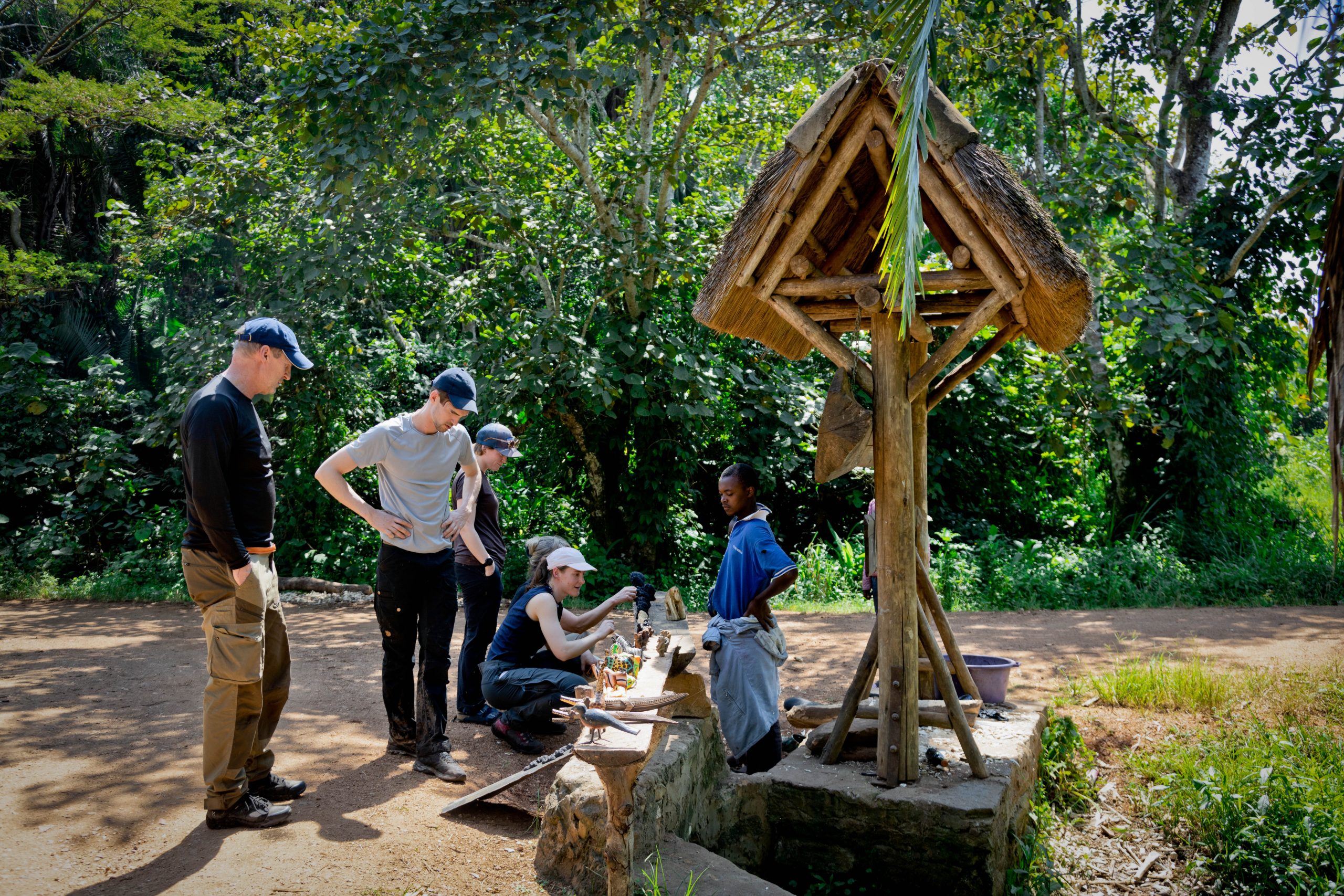
Porters are particularly useful during gorilla and chimpanzee trekking in Uganda and Rwanda. They can carry your backpack, assist you on difficult trails and provide support when the terrain becomes steep, muddy or slippery.
Hiring a porter is optional in many trekking locations, but it can make the experience more manageable. It also provides paid work for people living in communities surrounding protected areas.
A practical tipping guideline is US$5 to US$15 per porter per trek, depending on the service and local recommendations. Some trekking areas have higher suggested amounts, so ask your safari guide or trekking organiser before the activity.
Remember that the porter should receive payment for the agreed service. The tip is an additional expression of appreciation, not a replacement for the porter fee.
If you are travelling with a heavy backpack or camera equipment, hiring a porter can be useful even if you are physically fit. It allows you to concentrate on the trail and wildlife experience.
Tipping rangers and trackers
Gorilla trekking, chimpanzee tracking and some specialist wildlife activities involve rangers, trackers and other authorised personnel.
In gorilla trekking areas, trackers may enter the forest ahead of visitors to locate gorilla families and communicate their movements to the trekking teams. Rangers help manage the activity, enforce park rules and protect visitors and wildlife.
Chimpanzee tracking also involves trained personnel who understand the forest and the behaviour of the primates.
For specialist trekking guides, trackers or rangers, a general guideline is US$5 to US$20 per person per activity, where tipping is accepted and appropriate. The actual arrangement varies by park and operator.
You should ask your safari company whether the activity has a recommended gratuity and whether any staff payments are already covered through the permit or activity fee. Do not assume that every ranger or tracker expects a separate tip.
If several people are involved in one activity, your guide can explain the appropriate way to offer a gratuity without disrupting park procedures.
Tipping boat guides and specialist activity staff
East African safaris often include activities beyond traditional game drives. You may take a boat trip along the Kazinga Channel in Uganda, cruise along the Nile in Murchison Falls National Park or enjoy a specialist walking safari in Kenya or Tanzania.
These activities may involve separate guides, boat operators, naturalists or other staff.
For a specialist activity guide, US$5 to US$10 per guest is a reasonable general planning range for a short activity, although some longer or more specialised experiences may justify a different amount.
For a boat crew, you can ask whether tips are shared among the team or given to the main guide. A communal arrangement is often easier when several employees contribute to the same experience.
Hot-air balloon safaris in the Maasai Mara and Serengeti may also involve pilots and ground crews. These activities are usually booked separately, and the operator may provide its own gratuity recommendations.
How much should you tip hotel and airport staff?
Your safari may begin with an overnight stay in Kampala, Entebbe, Nairobi, Kigali, Arusha or another gateway city. You may also use airport transfer services and hotel porters before reaching the national parks.
Hotel porters who carry your luggage can receive around US$1 to US$2 per bag as a general guideline. You can give more for unusually heavy luggage or additional assistance.
For airport or hotel transfer drivers, US$5 to US$10 per private transfer is a useful starting point. The amount depends on the distance, service and number of passengers.
Restaurant staff may also receive a gratuity where appropriate. In some establishments, a service charge is already included in the bill. Check the receipt before adding another amount.
Tipping practices in city hotels and restaurants may differ from those at safari lodges. You do not need to use the same daily tipping budget for every type of service.
Safari tipping budget by country
Tipping practices are broadly similar across Uganda, Kenya, Tanzania and Rwanda, but individual safari companies and accommodation providers may recommend different amounts.
Uganda
Uganda’s safari industry uses gratuities for driver-guides, lodge staff, porters and specialist trekking personnel. Visitors travelling to Bwindi Impenetrable National Park or Mgahinga Gorilla National Park may want to budget separately for gorilla trekking porters and other authorised activity staff.
A practical planning guideline is US$10 to US$20 per guest per day for a safari guide and US$5 to US$15 per guest per night for lodge staff, subject to the property’s own recommendations.
Ugandan shillings are useful for local purchases and smaller gratuities. US dollars are also commonly accepted in tourism settings.
Kenya
Kenya has a well-established safari industry, and tipping is customary at many lodges, camps and wildlife reserves. Visitors to the Maasai Mara, Amboseli, Tsavo and other destinations commonly tip their driver-guides and lodge teams.
A general guideline is US$10 to US$20 per guest per day for the guide and US$5 to US$15 per guest per night for camp or lodge staff. Specialist activities may have separate recommendations.
Kenyan shillings are useful for local purchases, while US dollars are accepted for many tourism-related gratuities.
Tanzania
Tanzania has similar tipping arrangements, particularly in the northern safari circuit, which includes the Serengeti, Ngorongoro, Tarangire and Lake Manyara.
A practical guideline is US$10 to US$20 per guest per day for a private safari guide and US$10 to US$15 per guest per night for a lodge or camp staff tip box. Some operators recommend higher amounts, particularly at luxury camps.
Tanzanian shillings are useful for everyday purchases. Confirm accepted payment arrangements with your safari operator and accommodation provider before travelling.
Rwanda
Rwanda’s safari and gorilla trekking experiences also involve guides, rangers, trackers, porters and lodge staff. Visitors to Volcanoes National Park may need to budget for porter services and any appropriate gratuities for the trekking team.
A general planning guideline is US$10 to US$20 per guest per day for a safari guide and US$5 to US$15 per guest per night for lodge staff. Confirm the specific recommendations with your operator because properties may use different arrangements.
Rwandan francs are useful for local purchases, while US dollars are commonly used for some tourism-related payments and gratuities.
Safari tipping budget at a glance
The following table summarises practical guidelines for common safari services. These are suggested amounts, not official rates or compulsory charges.
| Person or service | Suggested tip |
|---|---|
| Private safari guide | US$10 to US$20 per guest per day |
| Transfer driver | US$5 to US$10 per private transfer |
| Lodge or camp staff tip box | US$5 to US$15 per guest per night |
| Gorilla or chimpanzee trekking porter | US$5 to US$15 per trek |
| Ranger or tracker | US$5 to US$20 per guest per activity |
| Specialist activity guide | US$5 to US$10 per guest per activity |
| Hotel luggage porter | US$1 to US$2 per bag |
These ranges can differ between operators. Some private safari companies calculate the guide’s tip per vehicle rather than per guest. Follow the specific instructions provided for your booking and avoid treating every figure as an additional payment.
Example: How much should two people budget for a seven-day safari?
A couple travelling privately for seven days can use the following example to prepare a tipping budget.
Assume the same guide accompanies both guests throughout the safari, and the couple stays at three lodges for a total of six nights.
| Tipping expense | Calculation | Estimated amount |
|---|---|---|
| Safari guide | 2 guests × 7 days × US$10 to US$20 | US$140 to US$280 |
| Lodge staff | 2 guests × 6 nights × US$5 to US$15 | US$60 to US$180 |
| Transfer drivers | Two transfers | US$10 to US$20 |
| Estimated total | US$210 to US$480 |
This example does not include porters, trackers, specialist activity guides or other optional services. If your itinerary includes gorilla trekking, you should add the relevant porter and activity gratuities.
The amount may also change if your guide’s tipping recommendation is calculated per vehicle instead of per guest. Confirm the arrangement before using the example as your final budget.
When should you give safari tips?
The timing depends on the person receiving the gratuity and the type of service.
For a driver-guide who accompanies you throughout the safari, the most convenient time is usually the final day. You can give the tip privately after completing the trip and thanking the guide for their service.
For lodge staff, use the communal tip box at checkout or follow the instructions provided by the property. If you are staying at several lodges, consider leaving a separate contribution at each one rather than waiting until the end of the entire safari.
Porters should normally receive their payment and any additional tip immediately after the trekking activity. This ensures that the person who assisted you receives the gratuity directly.
For transfer drivers and specialist activity guides, you can give the tip at the end of the relevant service.
You do not need to tip everyone at the beginning of the trip. Waiting until the service is complete allows you to decide what amount is appropriate.
Should you tip in US dollars or local currency?
US dollars are widely used for safari gratuities, particularly at established lodges and with professional safari guides. However, local currency is often more convenient for smaller services and purchases.
Uganda uses the Ugandan shilling, Kenya uses the Kenyan shilling, Tanzania uses the Tanzanian shilling and Rwanda uses the Rwandan franc.
If you plan to tip in US dollars, carry small denominations such as US$1, US$5, US$10 and US$20 notes. This makes it easier to give appropriate amounts without asking the recipient to find change.
Notes should be clean and undamaged. Some businesses and money changers may reject torn, heavily marked or older US dollar notes. Check the currency requirements of your destination before departure.
If you are visiting several countries, avoid exchanging large amounts of money into every local currency. Carry a manageable amount for each destination and exchange more when necessary.
How to organise your safari tipping money
Preparing your gratuities before travelling makes tipping easier, especially when you are visiting several parks and staying at different lodges.
Start by reading the tipping recommendations supplied by your safari operator. Some companies provide a country-specific tipping sheet with suggested amounts for guides, lodge staff, drivers and trekking personnel.
Next, estimate how many days you will spend with your guide and how many nights you will stay at each property. This gives you a realistic figure for the main gratuities.
Separate your money into small envelopes if you prefer to organise payments in advance. You can label them for your guide, lodge staff, transfer drivers and trekking activities. This avoids confusion when you reach the end of each service.
Keep your tipping money separate from your main travel funds. You do not need to carry all of it in your pocket during every game drive. Store the remaining cash securely and access it when needed.
It is also useful to keep a few small local currency notes for minor services. This is particularly helpful when visiting markets, using hotel porters or buying refreshments outside your lodge.
Common safari tipping mistakes to avoid
One common mistake is assuming that tipping is compulsory. Safari workers may appreciate gratuities, but you should give them according to your experience and budget. A suggested amount is not a mandatory fee.
Another mistake is tipping the guide and driver separately when one person performs both roles. Check your safari arrangements so you do not make duplicate payments for the same service.
Some travellers also give all their gratuities to the safari guide and assume that the lodge staff will receive a share. This is not always the case. If the lodge has a communal tip box, make a separate contribution for the wider team.
Avoid leaving a large tip at the beginning of the trip. Giving gratuities after the service allows you to assess the quality of the experience and decide what is appropriate.
You should also avoid relying entirely on large banknotes. Smaller notes make it easier to give reasonable tips and reduce the difficulty of finding change in remote areas.
Finally, do not feel pressured to match another traveller’s gratuity. Your budget and experience may be different. Tip according to the service you received and the amount you can comfortably afford.
Frequently asked questions about safari tipping budgets
Is tipping compulsory on an East African safari?
No. Tipping is customary in many safari destinations, but it is voluntary. You can decide whether to tip and how much to give based on the service received and your budget.
How much should I tip a safari guide per day?
A common guideline is US$10 to US$20 per guest per day. Some operators calculate the amount per vehicle instead, particularly for private safaris. Confirm the arrangement with your tour operator before travelling.
Should I tip my guide every day or at the end of the safari?
For a guide who accompanies you throughout the trip, giving the gratuity on the final day is generally convenient. You can also follow any arrangement recommended by your safari operator.
How much should I leave in a lodge tip box?
A practical guideline is US$5 to US$15 per guest per night. The amount depends on the property, service and length of your stay. Check whether the lodge provides its own recommendations.
Do I need to tip gorilla trekking rangers?
Tipping arrangements for rangers and trackers vary by trekking location and operator. Ask your safari company whether a gratuity is appropriate and whether the activity has specific guidance. Porter services are generally paid separately.
Should I tip a porter during gorilla trekking?
If you hire a porter, pay the agreed service fee. You may also give an additional gratuity, with US$5 to US$15 per trek serving as a general planning guideline. The amount can depend on the assistance provided.
Is it better to tip in US dollars or local currency?
Both can be appropriate. US dollars are widely used in safari tourism, while local currencies are useful for smaller purchases and services. Carry small, clean notes and check what the recipient can accept.
How much should a couple set aside for safari tips?
For a seven-day private safari, a couple can use approximately US$210 to US$480 as an illustrative starting budget for a guide, lodge staff and basic transfers. Add extra money for porters, specialist guides and other activities where applicable.
Should I tip if the service was poor?
No fixed tip is required. You can reduce the amount or decide not to give a gratuity if the service was unsatisfactory. If there was a serious problem, raise it with your safari operator or lodge management.
Are safari tips included in the package price?
Usually, tips are excluded unless the quotation specifically states that gratuities are included. Check your booking documents so you know which expenses have already been covered.



No comment