
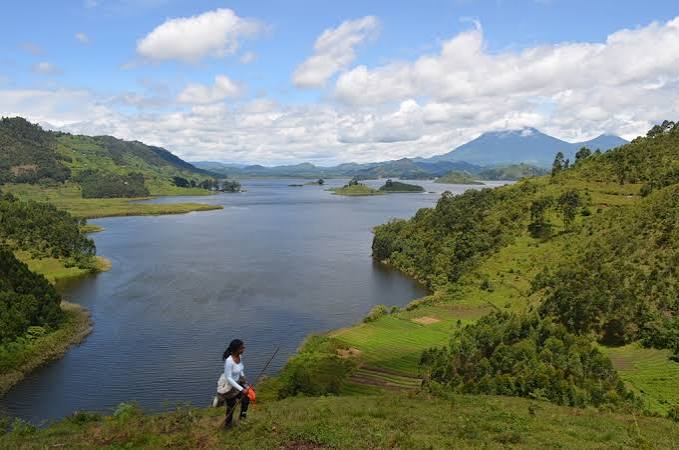
Lake Mutanda: The Volcano-View Lake Most Travellers Drive Past
Most travellers heading to Kisoro for gorilla trekking drive straight past Lake Mutanda without a second glance, eyes fixed on Bwindi or Mgahinga up ahead. That’s a genuine missed opportunity. Mutanda sits just thirty minutes from central Kisoro, ringed by more than a dozen small islands and backed by an almost impossibly perfect view of three Virunga volcanoes rising directly out of the water’s edge — a combination that quietly outshines its more famous neighbour, Lake Bunyonyi, for sheer volcano-view drama, even if it draws a fraction of the visitors.
Key Highlights
- A freshwater lake roughly 30 minutes from central Kisoro, in Uganda’s far southwest
- Direct views of three Virunga volcanoes — Muhabura, Sabinyo and Gahinga — rising straight from the water’s edge
- At least 15 small islands scattered across the lake, explored by traditional dugout canoe
- Strong birdlife including kingfishers, sacred ibis, grey crowned cranes and fish eagles
- The starting or finishing point of the Three Upland Lakes trek, a roughly 70-kilometre, 4-day hike linking Mutanda, Bunyonyi and smaller Lake Kayumbu
- A convenient, less-crowded base for gorilla trekking at both Bwindi and Mgahinga
Why the Volcano Views Set Mutanda Apart
Lake Bunyonyi gets most of the regional attention, and deservedly so for its islands and history — our piece on Lake Bunyonyi’s islands and stories covers that ground in depth. But Bunyonyi doesn’t offer anything close to Mutanda’s volcano panorama. From Mutanda’s shoreline and the lodges built along its ridgelines, Mount Muhabura, Mount Sabinyo and Mount Gahinga rise almost directly out of the water, part of the same Virunga chain that straddles Uganda, Rwanda and the DR Congo. Few vantage points in Uganda put you this physically close to three volcanoes at once without actually climbing one of them.
A Lake Shaped by the Same Volcanic System
Mutanda’s own basin sits within the broader volcanic geology of the Virunga region, which explains both the dramatic backdrop and the lake’s clear, cool water — a landscape built by the same tectonic and volcanic forces responsible for the mountains framing it. That geological connection is part of why the view feels so immediate rather than distant: this isn’t a lake with volcanoes somewhere on the horizon, it’s a lake sitting directly inside their shadow.
Islands and Canoe Exploration
At least fifteen small, tree-covered islands dot Lake Mutanda’s surface, most reachable only by traditional dugout canoe paddled by a local guide. Canoe trips here move at an unhurried pace by design, weaving between islands and papyrus-fringed inlets while giving a genuinely close vantage point on the lake’s bird life — kingfishers working the shallows, sacred ibis and grey crowned cranes along the reed beds, and fish eagles perched watchfully over open water.
A Quieter Alternative to Bunyonyi’s Canoe Trips
Because Mutanda sees considerably less tourist traffic than Bunyonyi, canoe trips here tend to feel more genuinely remote, without the same volume of other visitors on the water at the same time. For travellers who found Bunyonyi’s canoe experience enjoyable but crowded, or who simply want a second, quieter lake outing on the same regional itinerary, Mutanda delivers a comparable activity with a noticeably different feel.
The Three Upland Lakes Trek
For travellers with more time and a genuine appetite for multi-day walking, Lake Mutanda anchors one end of the Three Upland Lakes trek — a roughly 70-kilometre, four-day hike connecting Mutanda, Bunyonyi and the smaller Lake Kayumbu, typically routed through Echuya Forest and Kisoro along the way. It’s rated as moderate difficulty rather than a technical mountaineering challenge, making it accessible to reasonably fit hikers rather than requiring specialist trekking experience, and it turns what could be two separate lake visits into a single, connected walking journey through this whole highland lakes region.
Why This Trek Works So Well Here
Because Mutanda and Bunyonyi sit close enough together geographically, and because the terrain between them passes through genuinely scenic forest and farmland rather than featureless connecting road, the trek functions as far more than a transfer between two photo stops — it’s a legitimate multi-day hiking itinerary in its own right, with each night spent at a different lakeside or forest location along the route.
Planning Your Visit
Getting There and Where to Stay
Lake Mutanda sits roughly thirty minutes by road from central Kisoro, making it an easy stop for travellers already routing through the town en route to Mgahinga Gorilla National Park or Bwindi’s Nkuringo and Rushaga sectors. A handful of lodges are built directly on the lake’s ridgelines specifically to take advantage of the volcano views, ranging from more rustic community-run options to higher-end lodges positioned for sunrise-over-the-volcanoes photography. Several of these sit high enough above the water that the volcano panorama is visible directly from the room or dining area, removing any need to arrange a separate viewpoint excursion just to catch the view at the right hour.
What to Pack
Days around Lake Mutanda run warm at lake level but cool quickly once the sun drops, given the altitude of this southwestern highland region, so a light layer for evenings is worth packing alongside standard daytime safari wear. A reasonably capable camera or phone with a wide-angle option is worth prioritising here specifically for the volcano panorama, and binoculars add real value for the birdlife on canoe trips.
Combining Mutanda With Gorilla Trekking
Mutanda’s proximity to both Mgahinga and Bwindi’s southern sectors makes it a genuinely practical base for gorilla trekking, not just a scenic detour, letting travellers wake up to volcano views before a trekking day rather than staying in a more standard lodge closer to the park gate itself. Our complete guide to Mgahinga Gorilla National Park and Bwindi Impenetrable National Park page both cover the trekking side of a trip built around this base.
Photography and the Best Time of Day
Mutanda’s volcano panorama changes character dramatically depending on the hour, and it’s worth timing at least one lake activity around it rather than treating the view as a fixed backdrop. Early morning, when mist often clings to the lower slopes of Muhabura, Sabinyo and Gahinga and burns off gradually as the sun rises, tends to produce the most dramatic photography, while late afternoon light picks out the terraced hillsides around the lake in a warmer, more golden tone.
Weather and Cloud Cover
Like most of this Virunga-adjacent highland region, cloud cover can obscure the volcano peaks entirely on a given day regardless of season, so a multi-night stay improves your odds of catching a genuinely clear view considerably more than a single overnight does. The dry seasons, roughly June to August and December to February, offer somewhat better average visibility, though clear mornings can happen even in the wetter months if you’re willing to be up before sunrise to catch them.
Frequently Asked Questions
Is Lake Mutanda safe to swim in, like Lake Bunyonyi?
Mutanda is generally considered safe for swimming in the same way Bunyonyi is, since both lakes sit at an altitude and in a water system that avoids the bilharzia risk found in many of Uganda’s lower-lying lakes, though it’s always worth confirming current local guidance with your lodge before swimming anywhere.
How does Mutanda compare to Bunyonyi for a first-time visit?
Bunyonyi offers more developed tourism infrastructure, its island histories, and a wider range of activities; Mutanda offers a quieter experience and a genuinely superior volcano view. Many travellers with enough time visit both rather than choosing between them, especially given how close together they sit, and doing so gives a genuinely fuller picture of this highland lakes region than either one offers on its own.
Do I need to be an experienced hiker for the Three Upland Lakes trek?
The trek is rated moderate difficulty, suited to reasonably fit travellers with some hiking experience rather than requiring technical mountaineering skills. Multi-day stamina matters more than technical difficulty on any single day’s walking.
Can I visit Lake Mutanda as a day trip, or does it require an overnight stay?
A day visit for canoeing and the volcano views works well if you’re already based in Kisoro, but an overnight stay at one of the ridgeline lodges is the better way to properly experience the sunrise and sunset volcano views the lake is known for, and it removes the pressure of hoping for clear weather to line up with a single fixed visiting window. Given how close Mutanda sits to both Kisoro’s gorilla-trekking access points, an overnight here rarely adds meaningful extra travel time to an itinerary that already includes Bwindi or Mgahinga.
Recommended Safaris
Lake Mutanda pairs naturally with gorilla trekking at Bwindi or Mgahinga. Our complete guide to Mgahinga Gorilla National Park and Bwindi Impenetrable National Park page both cover the trekking this lake makes a scenic base for, while our piece on Lake Bunyonyi’s islands and stories is the natural next stop if you’re considering the Three Upland Lakes trek between the two. Ready to build Lake Mutanda into your own gorilla trekking itinerary? Reach our team through our Book Now page and we’ll plan it around your dates.



No comment