
Why Zebras Have Stripes: What Research Says
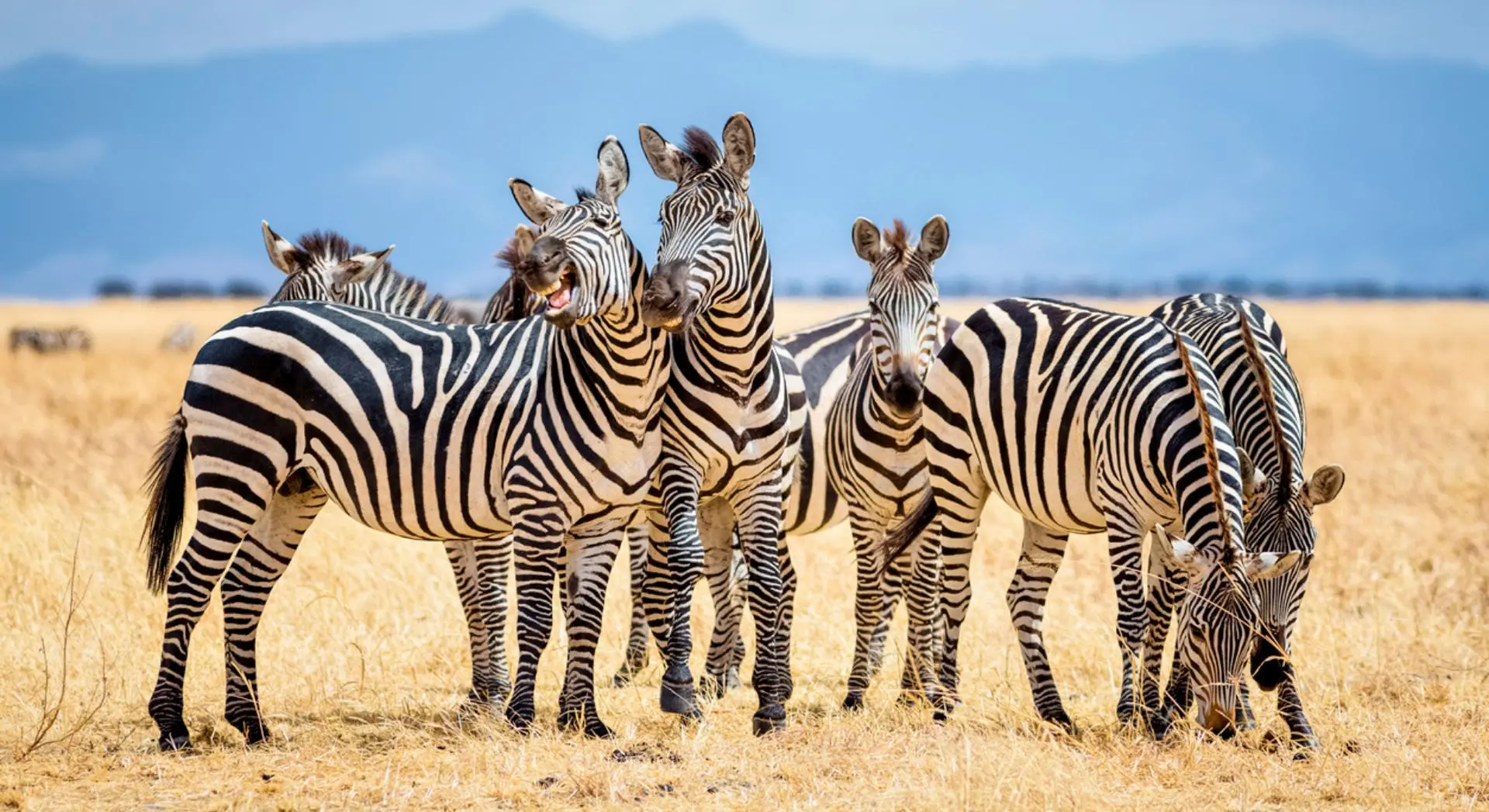
Imagine watching a herd of zebras grazing across the Serengeti plains in Tanzania. Hundreds of black-and-white patterns move through the golden grass, creating one of Africa’s most recognisable wildlife scenes.
At first, their stripes might seem like an unusual form of camouflage. But against the open savannah, zebras are often surprisingly visible.
So why do zebras have stripes?
For generations, scientists have debated whether zebra stripes confuse lions, help the animals recognise one another, regulate body temperature or protect against insects.
Modern research increasingly supports a different explanation: zebra stripes help reduce successful landings by blood-feeding flies.
However, the complete evolutionary story is still being investigated. This guide explores what scientific studies have discovered, which traditional explanations are less convincing and what safari travellers can observe in East Africa.
1. What Makes Zebra Stripes So Unusual?
Zebras belong to the horse family, Equidae, but unlike most horses and donkeys, they have distinctive black-and-white coats.
Their patterns vary between species and individuals.
Some zebras have broad stripes, while others display numerous narrow lines. Stripes may continue around the legs, neck and face.
These markings are not simply decorative. Producing such a distinctive appearance suggests that stripes have had an evolutionary advantage.
Researchers have proposed several explanations, but not all are supported equally by evidence.
2. What Are the Main Scientific Theories?
Scientists have investigated four major explanations for zebra stripes.
| Theory | Proposed Benefit | Research Assessment |
|---|---|---|
| Biting fly protection | Reduces successful fly landings | Strongest experimental support |
| Predator confusion | Makes moving zebras harder to target | Limited supporting evidence |
| Camouflage | Helps zebras blend into their surroundings | Generally weak evidence |
| Temperature regulation | Helps zebras remain cool | Not convincingly demonstrated |
| Social recognition | Helps zebras identify one another | Possible role, but not established as the main evolutionary driver |
These explanations are not necessarily mutually exclusive.
However, the biting-fly hypothesis currently has the clearest experimental support.
3. The Leading Explanation: Protection From Biting Flies
Blood-feeding flies can be troublesome and potentially dangerous for large mammals.
Horseflies and related insects may bite animals repeatedly, causing irritation, blood loss and opportunities for disease transmission.
Zebras occupy African landscapes where biting flies are common.
Their stripes appear to interfere with the insects’ ability or willingness to land successfully.
The important distinction is that stripes do not necessarily stop flies from approaching.
Instead, they seem particularly effective at reducing successful landings when flies get close.
4. What Did the 2019 Horse Experiment Discover?
In 2019, scientists published a study comparing the behaviour of horseflies around zebras and domestic horses.
The animals were observed at a horse farm in Britain.
Researchers also placed black, white and striped cloth coats over horses.
The results were revealing.
Horseflies landed less frequently on zebras than on ordinary horses.
When horses wore striped coats, fewer flies successfully landed on the covered sections.
However, the same protection did not extend to the horses’ uncovered heads.
This demonstrated that the visual pattern itself contributed to the reduction in fly landings.
The results provided strong experimental evidence supporting the insect-protection hypothesis.
5. Why Do Flies Struggle With Stripes?
Exactly how stripes reduce successful landings remains an active research question.
Scientists have investigated whether contrasting lines interfere with a fly’s visual processing as it approaches an animal.
Earlier research suggested that flies sometimes failed to slow down properly before reaching striped surfaces.
More recent experiments have examined contrast, stripe width and the presence of large dark patches.
The findings suggest that sharply defined contrasting patterns can make surfaces less attractive for landing.
What Scientists Know
| Observation | What It Suggests |
|---|---|
| Flies still approach zebras | Stripes do not simply repel every fly from a distance |
| Fewer flies land successfully | Protection occurs particularly at close range |
| Striped horse coats reduce landings | Coat pattern itself matters |
| High-contrast patterns perform better | Visual contrast influences fly behaviour |
| Mechanism remains under investigation | Scientists have not established one complete explanation |
The evidence supports the protective effect more strongly than any single proposed visual mechanism.
6. What Did the 2023 Research Reveal?
A 2023 study investigated why horseflies avoid landing on zebra-like patterns.
Researchers used domestic horses wearing coats with different visual designs.
They compared high-contrast stripes, low-contrast patterns and several other arrangements.
Horseflies were less inclined to land on sharply contrasting striped surfaces.
The researchers proposed that narrow stripes reduce the presence of large dark areas that might otherwise attract flies.
The study also found little support for the idea that polarised light was the main explanation.
This work helped narrow the possible mechanisms behind the insect-deterrent effect.
7. Do Zebra Stripes Protect Against Disease?
Reducing insect bites may provide benefits beyond avoiding irritation.
Some blood-feeding flies can transmit pathogens between animals.
Diseases transmitted mechanically or biologically by biting insects can affect the health of wild and domestic mammals.
By reducing successful landings, stripes may reduce opportunities for some insect bites and associated infections.
However, researchers have not shown that stripes eliminate disease transmission.
The protective advantage likely depends on fly species, habitat and other environmental factors.
8. Do Stripes Confuse Lions During a Chase?
One popular explanation suggests that zebras create visual confusion when running together.
A moving herd contains overlapping stripes that might appear difficult to separate.
This idea is appealing, especially when dozens of zebras run in different directions.
However, there is limited evidence that such patterns meaningfully prevent lions from identifying or capturing prey.
Lions regularly hunt zebras despite their distinctive coats.
Researchers studying predator vision have also questioned whether carnivores can resolve fine zebra stripes at the distances where they first detect prey.
The predator-confusion hypothesis remains less strongly supported than insect deterrence.
9. Can Zebra Stripes Provide Camouflage?
Black-and-white markings appear conspicuous to human observers.
Scientists have investigated how zebras look through the visual systems of lions and spotted hyenas.
A 2016 study found that large carnivores cannot resolve zebra stripes at distances as great as humans can.
At longer distances, the pattern may blend into a more uniform appearance.
However, this does not necessarily conceal the animal’s overall shape.
In open grasslands, zebras are generally identifiable as large grazing mammals.
The evidence therefore does not strongly support camouflage as the primary purpose of their stripes.
10. Do Black and White Stripes Keep Zebras Cool?
Another theory suggests that zebra stripes regulate body temperature.
Black surfaces absorb more solar radiation than white surfaces.
Researchers have proposed that temperature differences might influence airflow or heat transfer around the coat.
However, the evidence remains mixed.
Experiments with striped surfaces have not consistently demonstrated a meaningful cooling advantage.
Some observations suggest possible thermal effects under particular conditions, but they have not established that cooling explains why stripes evolved.
Temperature regulation therefore remains a debated secondary possibility rather than the leading scientific explanation.
11. Are Zebra Stripes Like Human Fingerprints?
Each zebra has its own distinctive stripe arrangement.
These patterns can help researchers distinguish individuals.
They are particularly useful in wildlife photography and population monitoring.
However, describing zebra stripes as fingerprints is a comparison rather than a statement that their patterns develop identically to human fingerprints.
Individual variation does not automatically mean stripes evolved primarily for identification.
Their uniqueness may be useful even if insect protection is the main reason striping developed.
12. Can Zebras Recognise One Another by Their Stripes?
Zebras are social mammals capable of recognising familiar individuals.
They use several forms of information, including appearance, movement, sounds and scent.
Stripe patterns could contribute to visual identification.
However, proving that stripes evolved mainly for social recognition is difficult.
Studies examining different zebra species have generally found stronger associations between intense striping and biting-fly exposure than social grouping.
Recognition may therefore be a useful feature without being the principal evolutionary explanation.
13. Why Do Different Zebra Species Have Different Stripes?
Africa has three living zebra species: plains zebras, Grevy’s zebras and mountain zebras.
Their coats differ noticeably.
<text></text>
| Zebra Species | Stripe Appearance | Distribution |
|---|---|---|
| Plains zebra | Relatively broad stripes with geographical variation | Widespread in eastern and southern Africa |
| Grevy’s zebra | Very narrow, closely spaced stripes | Mainly Kenya and Ethiopia |
| Mountain zebra | Distinctive pattern with comparatively limited belly striping | Southern Africa |
Researchers are still investigating why stripe width and distribution vary.
A 2022 study in Kenya found that biting flies preferred uniform-coloured pelts over zebra pelts but did not consistently distinguish between pelts from zebra species with different stripe widths.
This suggests that additional evolutionary influences may affect the precise patterns.
14. What Did Research in Kenya Reveal?
Scientific research conducted in a Kenyan savannah tested how biting flies responded to zebra and other animal pelts.
Researchers used pelts with different patterns under controlled field conditions.
They found that stable flies strongly preferred landing on uniformly coloured impala pelts rather than striped zebra pelts.
The results provided evidence under African environmental conditions, complementing earlier experiments involving domestic horses.
Importantly, the flies responded to the visual patterns at close range.
The study strengthened the conclusion that zebra striping can provide protection against biting insects.
15. Why Don’t Horses Have Stripes?
Domestic horses share an evolutionary relationship with zebras but generally have uniformly coloured coats.
This difference raises an interesting question.
If stripes prevent fly bites, why did all equids not evolve them?
Evolution operates under different ecological conditions.
The ancestral environments, fly exposure, genetic history and other selection pressures affecting horses and zebras were not identical.
The presence of a beneficial feature in one species does not mean it must evolve in every related species.
Researchers continue investigating these evolutionary differences.
16. Do Baby Zebras Have Stripes?
Yes. Zebra foals are born with visible stripe patterns.
Their markings may appear brownish rather than deep black during early life.
The colour can change as the young animal develops.
Foals normally remain close to their mothers, especially during their first days.
Although stripe patterns can help researchers identify individuals, foals also recognise their mothers through a combination of sensory and social cues.
Visitors should avoid separating young zebras from adults or disturbing family interactions for photographs.
17. Can Zebra Stripes Change as They Grow?
The underlying arrangement of stripes remains broadly recognisable throughout a zebra’s life.
However, the animal’s growing body can alter how the pattern appears.
Coat colour, condition and lighting can also affect photographs.
Researchers can use stable visual features to support individual identification over time.
Long-term photographic monitoring is particularly useful where animals are difficult to identify using ordinary field observations alone.
18. Where Can Travellers See Zebras in East Africa?
Zebras are among the most recognisable animals on East African safaris.
Plains zebras are widespread in several national parks and conservation areas.
Visitors can often watch them grazing in open grasslands, gathering at water sources or moving alongside wildebeest.
Popular Zebra Safari Destinations
| Country | Wildlife Destination | What to Expect |
|---|---|---|
| Tanzania | Serengeti National Park | Large zebra herds and seasonal movements |
| Tanzania | Ngorongoro Conservation Area | Zebras grazing alongside other herbivores |
| Kenya | Maasai Mara National Reserve | Zebra herds and predator-prey interactions |
| Kenya | Samburu and nearby conservancies | Opportunities to see Grevy’s zebras in suitable areas |
| Uganda | Lake Mburo National Park | Plains zebras in open savannah |
| Uganda | Kidepo Valley National Park | Zebra sightings in grassland habitats |
| Rwanda | Akagera National Park | Plains zebras alongside antelope and other wildlife |
Sightings depend on animal movements, weather and local conditions.
19. How to Photograph Zebra Stripes on Safari
Zebra stripes offer excellent opportunities for wildlife photography.
A single animal photographed from the side reveals the pattern clearly.
A group of zebras creates interesting overlapping shapes.
Early morning and late afternoon often provide attractive natural light.
Photography Ideas
- Photograph one zebra against open grassland.
- Capture several zebras standing together.
- Focus on the face and narrow head stripes.
- Look for reflections at water sources.
- Photograph foals beside their mothers.
- Capture a moving herd without disturbing it.
Always remain inside authorised safari areas and follow your guide’s instructions.
20. Frequently Asked Questions
Why Are Zebras Black and White?
Current research most strongly supports the theory that contrasting stripes reduce successful landings by certain biting flies.
Do Zebra Stripes Confuse Lions?
The idea is popular, but scientific evidence for an important predator-confusion advantage remains limited.
Are All Zebra Stripe Patterns Different?
Individual zebras have distinctive patterns that can help researchers recognise them.
Do Stripes Keep Zebras Cool?
Some researchers have explored this possibility, but experiments have not established cooling as the main evolutionary purpose.
Can Scientists Use Stripes to Identify Zebras?
Yes. Photographs of distinctive patterns can help identify and monitor individual animals.
The Science Behind Zebra Stripes
Zebra stripes have fascinated scientists and safari travellers for generations.
The familiar explanations involving camouflage, predator confusion and cooling are interesting, but they have not received the same level of experimental support.
Research increasingly shows that sharply contrasting stripes reduce successful landings by certain blood-feeding flies.
The exact visual mechanism remains under investigation, and stripe patterns may have additional functions.
For travellers exploring the Serengeti, Maasai Mara, Lake Mburo or Akagera, understanding this research adds another dimension to zebra sightings.







No comment