
Impalas Explained
Impalas Explained: Why They Are Everywhere and What Rutting Looks Like
The morning sun rises over Uganda’s Lake Mburo National Park as a herd of impalas grazes beside scattered acacia trees. Some animals lower their heads to feed, while others remain alert, watching the surrounding grassland.
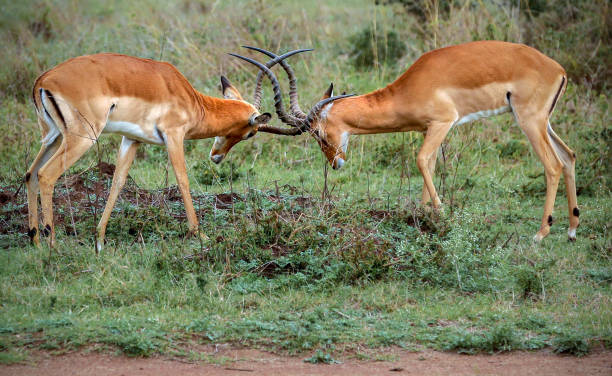
Suddenly, a male raises his head and produces a deep, rough roar. Another male approaches, and the two begin circling before briefly locking their curved horns.
This is part of the fascinating reproductive behaviour known as rutting.
Impala rutting behaviour and mating displays are among the most interesting wildlife interactions on an African safari. Although impalas are often overlooked because they are common in many savannah habitats, their social lives involve territorial competition, elaborate vocalisations and impressive displays of physical strength.
Their ability to feed on both grasses and leaves also helps explain why they thrive in many East African wildlife areas.
This guide explores what makes impalas successful, how their herds operate, why males fight and what travellers can expect when observing rutting behaviour in the wild.
1. What Is an Impala?
The impala (Aepyceros melampus) is a medium-sized African antelope recognised by its reddish-brown coat, pale underparts and distinctive black markings.
Males have long, curved, lyre-shaped horns, while females are normally hornless.
Impalas are agile animals known for their powerful jumps, alert behaviour and large social groups.
They are particularly associated with savannah woodland, grassland edges and areas containing both open vegetation and scattered trees.
Quick Impala Facts
| Feature | Description |
|---|---|
| Scientific name | Aepyceros melampus |
| Animal family | Bovidae |
| Main habitat | Savannah woodland and grassland |
| Diet | Grasses, leaves and shoots |
| Male horns | Long, curved and ridged |
| Female horns | Normally absent |
| Social organisation | Female herds, bachelor groups and territorial males |
| Main predators | Lions, leopards, cheetahs and wild dogs |
| Conservation status | Least Concern globally |
Although widespread, impalas are not found in every African habitat.
2. Why Do Impalas Seem to Be Everywhere?
Impalas are successful partly because they can use different types of vegetation.
Unlike animals that depend almost entirely on grass or leaves, impalas can adjust their feeding habits according to seasonal conditions.
They often graze when fresh grass is available and browse more when grasses become dry or less nutritious.
This feeding flexibility allows them to occupy environments where vegetation changes throughout the year.
Impalas also favour transitional habitats between woodland and grassland, providing access to feeding opportunities and cover.
Their adaptability helps explain why visitors frequently encounter them during game drives.
3. What Do Impalas Eat?
Impalas are classified as mixed feeders.
Their diet changes according to rainfall, plant quality and local availability.
During wetter periods, they may consume substantial amounts of fresh grass.
During drier periods, they often increase their intake of leaves, shoots and other available browse.
Seasonal Impala Feeding
| Season | Common Feeding Pattern |
|---|---|
| Wet season | Greater use of green grasses |
| Dry season | Increased browsing where grass quality declines |
| Transitional periods | A mixture of grass and leaves |
| Areas near woodland | Feeding on available shrubs and shoots |
Their feeding flexibility does not mean they can survive without suitable habitat or water.
Impalas generally remain associated with areas where drinking water is accessible.
4. How Do Impala Herds Work?
Impala social organisation changes with season and reproductive activity.
Females and their young often form herds.
Young and non-territorial males may gather in bachelor groups.
Adult males can establish territories and attempt to control access to groups of females.
Main Impala Social Groups
| Group | Typical Members |
|---|---|
| Female herd | Adult females and young |
| Bachelor group | Young and non-territorial males |
| Territorial male | Adult male defending a particular area |
| Breeding group | Females associated with a territorial male |
The size and composition of groups can change over time.
During periods of intense breeding competition, male behaviour becomes particularly noticeable.
5. What Is Impala Rutting?
Rutting is the period of heightened reproductive activity when males compete for mating opportunities.
During the rut, territorial males may increase their vocal displays, chase rivals, follow females and engage in confrontations.
Their behaviour can become dramatically different from the quiet feeding activity observed during other periods.
A rutting male may appear restless, repeatedly roaring and moving around the boundaries of his territory.
He may also spend less time feeding while concentrating on reproductive competition.
However, rutting does not necessarily involve constant fighting.
Much of the competition takes place through displays and vocal communication.
6. What Does Impala Rutting Look Like?
A rutting encounter may begin when a male notices another male approaching his territory.
He becomes alert, raises his head and produces a series of loud calls.
The rival may respond by approaching, withdrawing or displaying.
If neither male retreats, the encounter can escalate into physical competition.
Common Rutting Behaviours
| Behaviour | What Visitors May See |
|---|---|
| Loud roaring | Male produces deep, rough calls |
| Snorting | Short, forceful nasal sounds |
| Chasing | Male pursues a rival or follows females |
| Territorial display | Male patrols and advertises his presence |
| Horn sparring | Two males test one another |
| Horn locking | Males push against each other |
| Mate guarding | Male stays close to receptive females |
These behaviours vary between individuals and populations.
7. Why Do Male Impalas Roar During the Rut?
Male impalas produce surprisingly deep and powerful vocalisations.
Their rutting calls can sound very different from the high-pitched noises some travellers expect from antelopes.
Research shows that male impalas produce several kinds of roaring and snorting sounds.
A 2020 study of free-ranging impalas in Namibia found that males can retract their larynx while roaring.
This changes the effective length of the vocal tract and influences the sound produced.
The calls may help advertise the male’s presence to rivals and potential mates.
They can also communicate information relevant to competition.
8. What Is the Difference Between Rutting Snorts and Alarm Snorts?
Impalas sometimes snort when responding to potential danger.
Males also produce snorts during reproductive displays.
Although individual snorts may sound similar, their timing and surrounding vocalisations can differ.
Researchers found that rutting snorts often occur in rapid sequences and may alternate with roars.
Alarm snorts are generally more widely separated.
Therefore, a snorting impala is not automatically warning the herd about a predator.
Visitors should observe the surrounding behaviour before drawing conclusions.
9. Why Do Male Impalas Fight With Their Horns?
Male impalas use their horns during competition with rivals.
Two males may approach each other, lower their heads and lock their curved horns.
They may then push, twist or attempt to force the other animal backwards.
These contests can help establish or maintain dominance relationships.
However, not every confrontation becomes a serious fight.
Some encounters end when one male withdraws.
Sparring vs Serious Fighting
| Feature | Sparring | More Intense Fighting |
|---|---|---|
| Participants | Often bachelor males | Often competing mature males |
| Horn contact | Controlled pushing | Stronger clashes |
| Main context | Social assessment | Territorial competition |
| Intensity | Usually lower | Potentially higher |
| Outcome | May end without clear winner | One rival may retreat |
Physical fights can cause injuries, but roaring and chasing may resolve competition without major contact.
10. When Is Impala Rutting Season?
The timing depends on location.
In parts of southern Africa, impalas have a relatively concentrated rut, often associated with autumn and early winter.
Research in South Africa has documented intense rutting activity during April, May and early June.
However, tropical East African populations can show a less restricted breeding pattern.
Studies have reported year-round breeding and territorial activity in some Kenyan populations.
Rutting Season by Region
| Region | General Pattern |
|---|---|
| Southern Africa | Often a concentrated annual rut |
| Tropical East Africa | Breeding may occur throughout the year |
| Seasonal savannah habitats | Activity may rise during particular periods |
| Individual national parks | Timing varies with local conditions |
Travellers should not assume that all African impalas follow the same breeding calendar.
11. Do Female Impalas Choose Their Mates?
Female impalas are not simply passive participants in reproduction.
Their movements and reproductive condition influence which males gain mating opportunities.
Territorial males attempt to keep females within defended areas.
However, females may move between groups and territories.
A male’s ability to maintain access to females depends on competition, social interactions and the movements of the females themselves.
Researchers continue investigating the balance between male territorial control and female reproductive behaviour.
12. Do Rutting Males Stop Eating?
Rutting males can devote considerable time and energy to reproductive displays.
Roaring, chasing competitors and defending territories may reduce the time available for feeding.
In some populations, this energetic cost can be substantial.
A male maintaining a territory must balance reproductive opportunities against the physical demands of competition.
This helps explain why territorial status may be difficult to maintain for extended periods.
Rutting therefore involves more than displaying impressive horns.
It can be a demanding phase of an impala’s life.
13. Why Do Impalas Jump So High?
Impalas are famous for their powerful leaps.
They can clear substantial distances and heights when escaping danger.
Their long legs and muscular bodies allow rapid acceleration and agile movement.
Jumping helps them negotiate vegetation and respond to predators.
However, the popular claim that impalas jump only when they can see where they will land is an oversimplification.
Their movements reflect terrain, visibility, speed and perceived danger.
A jumping herd can produce a spectacular safari sight, but visitors should never deliberately frighten animals to encourage it.
14. How Do Impalas Avoid Predators?
Impalas are important prey animals within African savannah ecosystems.
They face threats from lions, leopards, cheetahs, African wild dogs and other predators.
Their survival depends partly on alertness, speed and herd behaviour.
When one impala detects danger, its reaction may alert nearby animals.
Group members may then run or leap away from the threat.
However, herd living also creates competition for food and increases the visibility of groups.
Impala social behaviour reflects a balance between these different pressures.
15. When Are Baby Impalas Born?
Female impalas usually produce a single calf after a pregnancy lasting approximately six to seven months.
Birth timing varies between regions.
In strongly seasonal populations, many births occur during periods when fresh vegetation is available.
In tropical populations, births may be less tightly restricted to one season.
Young calves can initially remain concealed in vegetation before becoming more active.
They gradually join other impalas and develop the ability to move rapidly.
This early period is important because calves are vulnerable to predators.
16. Where Can You See Impalas in East Africa?
Impalas occur in suitable savannah and woodland habitats across parts of East Africa.
They are particularly familiar in Uganda’s Lake Mburo National Park, where they are one of the characteristic antelope species.
Popular Impala Safari Destinations
| Country | Wildlife Destination | Impala Viewing |
|---|---|---|
| Uganda | Lake Mburo National Park | Frequently seen in suitable habitats |
| Kenya | Maasai Mara National Reserve | Common savannah antelope |
| Kenya | Tsavo East and Tsavo West | Present in suitable habitats |
| Tanzania | Serengeti National Park | Found in woodland and savannah areas |
| Tanzania | Tarangire National Park | Occur in suitable woodland habitats |
| Rwanda | Akagera National Park | Present in savannah habitats |
Exact sightings depend on habitat, season and animal movements.
Impalas are widespread in many suitable ecosystems, but they are not literally everywhere.
17. How Can Safari Visitors Recognise Rutting?
During a game drive, look for adult males showing unusually intense behaviour.
A male producing repeated deep roars may be involved in territorial activity.
Other signs include chasing competitors, closely guarding females and repeated horn displays.
What to Watch For
- A male standing apart from a bachelor group.
- Frequent roaring or rapid snorting.
- Chasing of other males.
- Repeated movement around a group of females.
- Horn sparring or locking.
- A rival withdrawing after a confrontation.
Not every horn clash is part of a peak breeding period.
Young males may spar outside the main rutting season.
18. How to Photograph Impala Rutting Behaviour
Rutting can provide memorable wildlife photography opportunities.
However, the animals may move quickly and unpredictably.
A telephoto lens allows visitors to photograph interactions without approaching too closely.
A fast shutter speed can help capture jumping, running and horn clashes.
Photography Tips
| Technique | Benefit |
|---|---|
| Telephoto lens | Maintains a respectful distance |
| Fast shutter speed | Freezes running and horn clashes |
| Continuous shooting | Captures rapid interactions |
| Wider composition | Includes both competing males |
| Early morning light | Highlights coat colours and horn shapes |
Avoid asking your guide to disturb a herd or move between competing animals.
Natural behaviour makes better wildlife photography than forced reactions.
19. Why Impalas Matter in African Ecosystems
Impalas play an important role in savannah food webs.
Their grazing and browsing influence vegetation.
They provide food for several predators.
Their movement and feeding behaviour also connect different parts of woodland and grassland habitats.
Because impalas can be abundant in suitable areas, they contribute substantially to the ecological relationships between plants, herbivores and carnivores.
However, their presence should never be taken for granted.
Habitat loss, hunting and changes in land use can affect local populations even when the species remains relatively widespread.
20. Frequently Asked Questions
Why Are Impalas So Common on Safari?
Their flexible diet, social behaviour and ability to occupy woodland-grassland habitats help them thrive in many protected areas.
What Is Impala Rutting?
Rutting is a period of heightened reproductive activity involving territorial displays, roaring, chasing and competition between males.
Do Female Impalas Have Horns?
No. Female impalas are normally hornless, while males have distinctive curved horns.
Do Impalas Fight to the Death?
Most encounters do not result in death. Males may spar, clash horns or withdraw, although serious injuries are possible.
Can You See Impala Rutting in Uganda?
Yes. Male impalas can display territorial and reproductive behaviour in Lake Mburo National Park, although the timing and intensity vary.
Why Impalas Deserve More Attention
Impalas are among the most familiar antelopes encountered during African safaris.
Their adaptable feeding habits help them survive in a range of savannah and woodland environments.
Their herds also reveal a complex social system involving females, young animals, bachelor males and territorial adults.
During the rut, normally quiet males may become surprisingly vocal and active.
Deep roars, forceful snorts, rapid chases and horn clashes reveal the competition behind their reproductive behaviour.
For travellers exploring Lake Mburo, the Maasai Mara, Serengeti or Akagera, taking time to observe impalas can reveal fascinating wildlife interactions that are easy to miss.






No comment