
Defassa Waterbuck vs Common Waterbuck
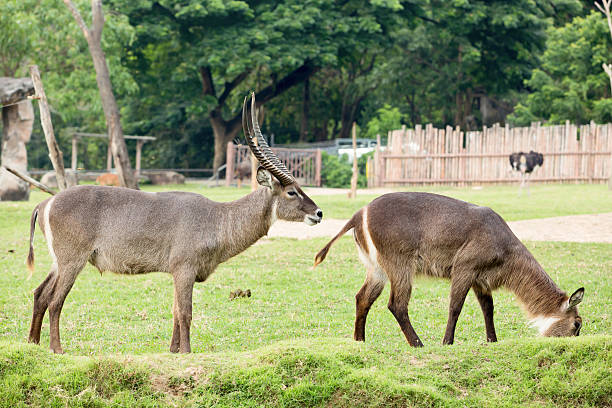
A large antelope stands quietly beside a waterhole in Uganda’s Queen Elizabeth National Park. Its thick brown coat, strong body and long curved horns make it easy to recognise as a waterbuck.
But which type of waterbuck is it?
Across Africa, wildlife enthusiasts frequently encounter two distinctive forms: the Defassa waterbuck and the common waterbuck. Although they look remarkably similar, a closer examination reveals an important difference.
Defassa waterbuck vs common waterbuck identification becomes surprisingly straightforward once you know where to look. The secret is not primarily in their horns, size or facial markings. It is the white pattern surrounding their tails.
This guide explains how to identify both forms, understand their geographical distribution and distinguish them from other East African antelopes.
1. What Is a Waterbuck?
The waterbuck is a large African antelope belonging to the genus Kobus.
It has a strong body, thick neck, rounded ears and a relatively shaggy coat. Adult males carry impressive ringed horns, while females are naturally hornless.
Waterbucks favour grasslands, woodland edges and floodplains where suitable vegetation and water are available.
They are widely recognised during safaris in Uganda, Kenya, Tanzania and other parts of Africa.
Two main geographical forms are commonly identified: Defassa waterbuck and common, or Ellipsen, waterbuck.
2. Defassa Waterbuck vs Common Waterbuck: Quick Comparison
| Feature | Defassa Waterbuck | Common Waterbuck |
|---|---|---|
| Scientific name | Kobus ellipsiprymnus defassa | Kobus ellipsiprymnus ellipsiprymnus |
| Rump marking | Broad white patches | White oval ring |
| Centre of rump | Largely pale or white | Darker, surrounded by white |
| Coat colour | Often more reddish-brown | Often more grey-brown |
| Body size | Generally slightly smaller | Generally slightly larger |
| Male horns | Long, curved and ridged | Long, curved and ridged |
| Females | Hornless | Hornless |
| Distribution | Primarily west of the eastern Rift Valley | Primarily east and south of the Rift Valley |
| Preferred habitat | Grassland near water | Grassland near water |
The rump markings provide the most useful field identification feature. Coat colour and body size are less reliable because individuals vary.
3. How to Identify a Defassa Waterbuck
The Defassa waterbuck is the form most commonly associated with Uganda’s savannah national parks.
Its most distinctive feature is the broad white area across the rump.
When viewed from behind, the pale markings cover much of either side of the tail.
Rather than forming a narrow oval border, the white colour occupies a larger area.
Main Defassa Identification Features
- Broad white rump patches.
- A thick, sometimes reddish-brown coat.
- Large, rounded ears.
- White markings around the muzzle and throat.
- Long, curved horns in adult males.
- A strong body and muscular neck.
The most helpful photograph is often a rear or three-quarter view showing the rump.
4. How to Identify a Common Waterbuck
The common waterbuck is also called the Ellipsen waterbuck because of its distinctive elliptical rump marking.
The white colour forms a ring around a darker central area.
This gives the impression of a large white oval painted around the animal’s tail.
The marking is especially visible when the animal turns away from the observer.
Main Common Waterbuck Identification Features
- Clear white oval or elliptical rump ring.
- Darker hair inside the white ring.
- Shaggy grey-brown coat.
- Large, rounded ears.
- White facial and throat markings.
- Curved, heavily ridged horns in males.
The ring is generally a more reliable distinguishing feature than horn shape or overall body colour.
5. Why Are the Rump Markings Different?
The two waterbuck forms have different geographical and evolutionary histories.
Their coat patterns are inherited characteristics that distinguish their populations.
Researchers have investigated these differences using body measurements, mitochondrial DNA and other genetic evidence.
A 2006 study confirmed substantial genetic differences between the two forms, while also finding evidence of hybridisation where their distributions overlap.
However, scientists have not established one definitive explanation for why their particular rump patterns evolved.
It is possible that visible markings play a role in communication or recognition, but visitors should not treat this as a proven evolutionary function.
6. Are Defassa and Common Waterbucks Different Species?
They are generally classified as two subspecies of one species.
The scientific names are:
Defassa waterbuck: Kobus ellipsiprymnus defassa
Common waterbuck: Kobus ellipsiprymnus ellipsiprymnus
Some historical classifications treated them as separate species.
More recent genetic research has explored their evolutionary differences and the degree of interbreeding between populations.
Evidence of gene flow supports treating them as closely connected forms, although their genetic histories are distinct.
For safari identification, the familiar subspecies names remain useful.
7. Where Do Defassa Waterbucks Live?
Defassa waterbucks occupy parts of western, central and eastern Africa.
They are particularly associated with areas west of the eastern branch of the Rift Valley.
In Uganda, Defassa waterbucks occur in several protected savannah ecosystems.
East African Defassa Locations
| Destination | Country | Safari Opportunity |
|---|---|---|
| Queen Elizabeth National Park | Uganda | Grasslands and lakeside habitats |
| Murchison Falls National Park | Uganda | Savannah and riverine grasslands |
| Lake Mburo National Park | Uganda | Woodland and open grazing areas |
| Maasai Mara National Reserve | Kenya | Defassa waterbucks in suitable habitats |
| Parts of western Kenya | Kenya | Populations near the Rift Valley region |
Distribution varies locally, and not every waterbuck seen in Kenya is necessarily a Defassa.
8. Where Do Common Waterbucks Live?
Common waterbucks are associated mainly with eastern and southern African populations.
Their distribution generally extends through areas east of the Rift Valley and farther south.
Suitable habitats include savannah woodland, river margins and grasslands.
Within Kenya, common waterbucks occur in some areas where Defassa populations are absent or where the two forms approach one another geographically.
Because their ranges overlap in certain regions, location alone cannot always confirm identification.
Visitors should examine the rump markings whenever possible.
9. Can the Two Waterbuck Forms Interbreed?
Yes.
Researchers have documented hybridisation between Defassa and common waterbucks in areas where their distributions meet.
This is particularly relevant in parts of Kenya.
Some individuals display intermediate markings rather than the classic broad white patch or complete oval ring.
How to Identify Possible Intermediate Animals
An intermediate waterbuck may show an incomplete white ring, irregular white patches or a pattern that does not clearly match either form.
However, unusual markings alone cannot confirm hybrid ancestry.
Reliable identification may require information about location, population history and genetic evidence.
A field guide should therefore allow for uncertainty rather than forcing every animal into one category.
10. Can You Tell Them Apart by Their Horns?
Not reliably.
Both forms have males with long, heavily ridged horns that curve backwards and then upwards or forwards.
The horns become more prominent as males mature.
Females of both forms lack horns.
Although individual horn size and shape vary, there is no simple horn characteristic that reliably separates every Defassa waterbuck from every common waterbuck.
For practical safari identification, focus on the rump first.
11. What Do Defassa and Common Waterbucks Eat?
Both are primarily grazers.
They feed on grasses in habitats where fresh vegetation and suitable water are available.
Their feeding patterns may change according to rainfall and vegetation quality.
Waterbucks are often seen grazing during the morning and afternoon.
They may also feed during cooler hours or under different environmental conditions.
Both forms have similar basic feeding ecology, so diet is not a dependable identification feature.
12. Why Are Waterbucks Usually Found Near Water?
Waterbucks are strongly associated with habitats offering access to water.
Their distribution is influenced by drinking requirements and the availability of suitable grazing.
Rivers, lakes, marshes and floodplain grasslands can provide favourable conditions.
However, the name waterbuck does not mean that the animals spend most of their lives swimming.
They are land-dwelling antelopes that use surrounding vegetation for feeding and cover.
They can enter water when necessary, but ordinary daily activity usually takes place on land.
13. Do Waterbucks Have Waterproof Coats?
Waterbucks have relatively coarse, shaggy coats with an oily secretion that produces a distinctive musky smell.
The secretion has traditionally been associated with water resistance.
However, the extent to which it waterproofs the coat should not be exaggerated.
Their thick hair and skin characteristics are part of their adaptation to savannah environments.
Both Defassa and common waterbucks share these general characteristics.
Coat texture alone is therefore not useful for distinguishing them.
14. How Do Waterbuck Herds Work?
Waterbucks have flexible social arrangements.
Females and younger animals may form groups, while males can establish territories.
Young males may also associate in bachelor groups.
Territorial males defend suitable areas and compete for reproductive opportunities.
During confrontations, males may display their horns, approach rivals or engage in physical combat.
These behaviours occur in both forms.
Consequently, herd structure and fighting behaviour are not reliable field identification differences.
15. How Do Waterbucks Compare With Uganda Kobs?
Waterbucks are often confused with Uganda kobs because both belong to the genus Kobus.
However, waterbucks are generally larger and more heavily built.
Uganda kobs have comparatively shorter coats and slimmer bodies.
Waterbuck vs Uganda Kob
| Feature | Waterbuck | Uganda Kob |
|---|---|---|
| Body build | Large and heavy | Medium-sized and slimmer |
| Coat | Thick and shaggy | Shorter and smoother |
| Male horns | Long, curved and heavily ridged | Curved, ridged horns |
| Rump marking | White patch or ring | Different pale markings |
| Habitat | Grassland and woodland near water | Open grassland and floodplain |
Understanding these differences helps visitors identify antelopes during Uganda game drives.
16. Where Is the Best Place to Photograph Waterbucks?
Waterbucks provide excellent opportunities for wildlife photography.
In Uganda, Queen Elizabeth, Murchison Falls and Lake Mburo national parks offer suitable environments.
In Kenya, the Maasai Mara and parts of the Rift Valley region provide further opportunities.
Photography Tips
- Photograph the animal from behind to show the rump marking.
- Use a side profile to capture the body and horns.
- Take photographs in early morning or late afternoon.
- Include the surrounding habitat.
- Photograph adult males and females for comparison.
- Avoid disturbing grazing or resting animals.
If the main purpose is identification, a clear rump photograph is more useful than a dramatic close-up of the face.
17. Frequently Asked Questions
What Is the Main Difference Between Defassa and Common Waterbucks?
The Defassa has broad white rump patches, while the common waterbuck has a white oval ring around a darker rump.
Which Waterbuck Is Found in Uganda?
The Defassa waterbuck is the form generally found in Uganda’s major savannah protected areas.
Are Both Waterbucks the Same Species?
They are commonly classified as subspecies of Kobus ellipsiprymnus.
Do Female Waterbucks Have Horns?
No. Females of both forms are naturally hornless.
Can Defassa and Common Waterbucks Produce Hybrids?
Yes. Research has documented hybridisation in parts of East Africa where their populations meet.
The Easiest Way to Identify a Waterbuck
Defassa and common waterbucks are closely related African antelopes with similar body shapes, diets, habitats and social behaviour.
The most reliable field difference is their rump colour pattern.
Defassa waterbucks have broad white patches, while common waterbucks display a striking white oval ring surrounding a darker centre.
Other characteristics, including coat colour and size, may provide supporting clues but are less dependable.
For travellers exploring Uganda, Kenya and Tanzania, learning this simple distinction can make wildlife identification more enjoyable.






No comment