
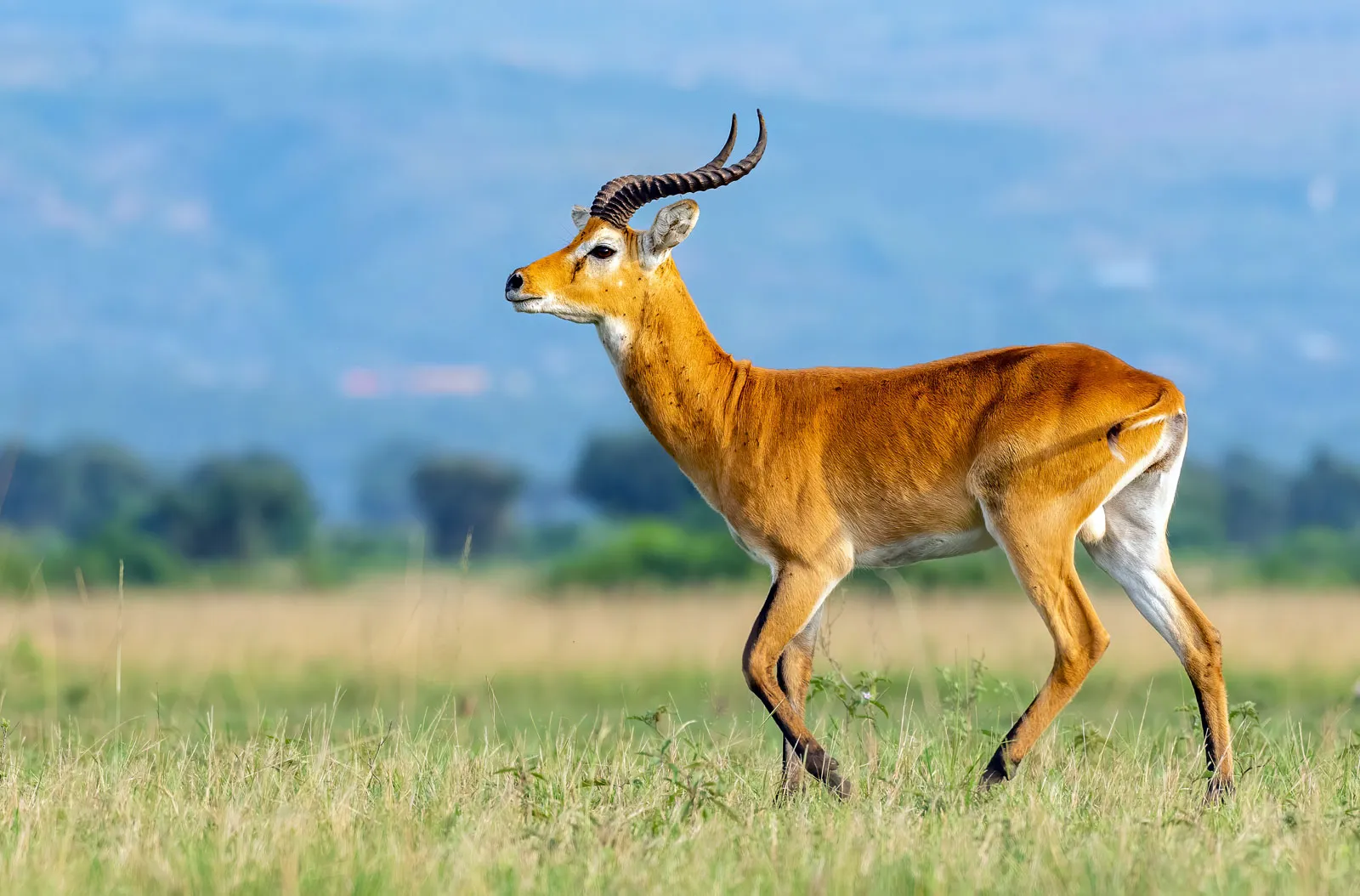
Uganda Kob: The Antelope on the Coat of Arms
The morning sun rises over the Kasenyi Plains in Queen Elizabeth National Park. A herd of reddish-brown antelopes grazes across the open grassland while several males stand alert, displaying their beautifully curved horns.
Nearby, a safari vehicle stops as a guide points towards the animals.
“These are Uganda kobs,” the guide explains. “They are the antelopes you see on Uganda’s coat of arms.”
For many travellers, this comes as a surprise. While lions, elephants and mountain gorillas receive much of the attention on Uganda safaris, the Uganda kob holds a special place in the country’s national identity.
The Uganda kob antelope is a symbol of the nation’s rich wildlife heritage. It also plays an important role in savannah ecosystems, supporting predator populations and attracting visitors to some of Uganda’s most beautiful protected areas.
This guide explains why the kob appears on Uganda’s coat of arms, how to recognise it, where it lives and what makes its unusual mating behaviour so fascinating.
1. What Is the Uganda Kob?
The Uganda kob is a medium-sized antelope belonging to the bovine family, which also includes cattle, buffaloes and other antelopes.
Its scientific name is Kobus kob thomasi, traditionally classified as a subspecies of the kob.
It is recognised by its reddish-brown coat, white underparts, dark facial markings and graceful appearance.
Adult males have prominent, curved, ridged horns. Females do not normally have horns.
Uganda Kob Quick Facts
| Feature | Description |
|---|---|
| Common name | Uganda kob or Ugandan kob |
| Scientific name | Kobus kob thomasi |
| Family | Bovidae |
| Main diet | Grasses |
| Habitat | Savannah grassland and floodplain |
| Male horns | Curved and ridged |
| Female horns | Normally absent |
| Social behaviour | Herds and territorial breeding groups |
| Famous location | Queen Elizabeth National Park |
| National significance | Featured on Uganda’s coat of arms |
The Uganda kob is closely associated with the country’s open grasslands, particularly those within western and northern Uganda.
2. Why Is the Uganda Kob on the Coat of Arms?
The Uganda kob appears on the national coat of arms because it represents Uganda’s abundant wildlife.
Uganda is home to an exceptional variety of natural habitats, including tropical forests, wetlands, mountains, rivers and savannah grasslands.
These ecosystems support hundreds of bird species and numerous mammals.
The Uganda kob provides a distinctly local wildlife symbol that reflects the country’s natural heritage.
Its position on the coat of arms also reminds Ugandans and international visitors that wildlife is part of the nation’s identity.
The animal was incorporated into Uganda’s national armorial design adopted around independence in 1962.
3. What Else Appears on Uganda’s Coat of Arms?
The coat of arms contains several symbols representing Uganda’s natural environment, culture and national aspirations.
A male Uganda kob stands on one side of the shield, while a crested crane stands on the other.
Symbols on Uganda’s Coat of Arms
| Symbol | Meaning |
|---|---|
| Uganda kob | Abundant wildlife |
| Crested crane | Uganda’s national bird |
| Shield and spears | Readiness to defend the country |
| Sun | Abundant sunshine |
| Waves | Lake Victoria and water resources |
| Traditional drum | Culture, gatherings and ceremonies |
| Green mound | Fertile land |
| River | The River Nile |
| Coffee and cotton | Important agricultural crops |
| National motto | For God and My Country |
Together, these elements represent Uganda’s identity, natural resources and cultural traditions.
The Uganda kob is therefore not simply a decorative animal. It carries an officially recognised national meaning.
4. How Can You Identify a Uganda Kob?
A Uganda kob can be recognised by its slender body, relatively long legs and reddish-brown coat.
Its underside is lighter, while the face has distinctive contrasting markings.
Adult males are especially attractive because of their strong, backward-curving horns.
The horns have visible ridges along much of their length.
Male vs Female Uganda Kob
| Feature | Male | Female |
|---|---|---|
| Horns | Present | Absent |
| Body size | Usually larger | Usually smaller |
| Coat | Reddish-brown | Reddish-brown |
| Behaviour | May defend mating territories | Often travels in female groups |
| Appearance | Muscular neck and curved horns | More delicate head profile |
Juveniles may resemble smaller versions of females before young males develop their horns.
5. Where Do Uganda Kobs Live?
Uganda kobs prefer open grasslands, floodplains and savannah habitats containing suitable grazing vegetation.
They often occur near areas where seasonal rainfall supports fresh grass growth.
Unlike forest antelopes, kobs generally favour relatively open landscapes.
These environments allow them to graze and monitor approaching predators.
Within Uganda, important populations occur in protected savannah ecosystems.
Their distribution is not uniform, however, and visitors should not expect to see them in every national park.
6. Where Can Tourists See Uganda Kobs?
Several Ugandan wildlife destinations provide opportunities to observe these antelopes.
<text></text>
| Destination | What Visitors Can Expect |
|---|---|
| Queen Elizabeth National Park | Large numbers in suitable grassland habitats |
| Kasenyi Plains | Excellent opportunities to observe kob herds and breeding behaviour |
| Murchison Falls National Park | Uganda kobs in northern savannah landscapes |
| Kidepo Valley National Park | Kob sightings in suitable habitats, depending on local distribution |
The Kasenyi Plains are particularly famous because they provide opportunities to observe both Uganda kobs and their predators.
A well-planned morning game drive may reveal males defending territories, females grazing and lions searching for prey.
7. What Do Uganda Kobs Eat?
Uganda kobs are primarily grazers.
They feed mainly on grasses, selecting suitable vegetation according to availability and growing conditions.
During periods of rainfall, fresh grass can become more abundant.
During drier conditions, feeding locations may change as animals search for suitable vegetation.
Uganda Kob Feeding Habits
| Feeding Feature | Explanation |
|---|---|
| Main food | Grasses |
| Preferred habitat | Open grazing areas |
| Feeding activity | Often visible during daylight |
| Seasonal changes | Influenced by rainfall and vegetation |
| Water | Access to suitable water sources is important |
Their feeding behaviour contributes to the ecological relationship between grasslands and large herbivores.
8. How Do Uganda Kob Herds Work?
Uganda kobs have a flexible social organisation.
Females and younger animals often form groups that move between feeding areas.
Males may live separately or establish breeding territories.
Group size changes according to habitat conditions, food availability and reproductive activity.
During certain periods, breeding males become particularly noticeable because they defend small areas and attempt to attract females.
These interactions provide some of the most interesting behaviour tourists can witness.
9. What Is a Uganda Kob Lek?
One of the Uganda kob’s most fascinating behaviours is its use of a mating system called a lek.
A lek is a traditional breeding area where several males defend small territories close together.
Females visit these areas to mate.
Males may display, chase rivals or engage in physical confrontations.
The lek system has attracted scientific interest because it offers opportunities to study mate choice, territorial competition and predator-related behaviour.
Researchers have investigated Uganda kob leks in Queen Elizabeth National Park for decades.
10. What Happens During Uganda Kob Mating Displays?
A territorial male may stand alert in an open area, watch other males and challenge rivals approaching his space.
If another male enters the territory, the resident may chase it away.
Sometimes two males lower their heads and clash horns.
Females move through the breeding area and may approach particular territories.
Common Mating Behaviours
| Behaviour | What It Means |
|---|---|
| Territorial standing | Male occupies and advertises a breeding area |
| Chasing rivals | Attempts to defend territory |
| Horn clashes | Physical competition |
| Female visits | Potential mating opportunities |
| Repeated displays | Competition among neighbouring males |
Not every lek encounter results in fighting.
Much of the competition involves positioning, movement and maintaining territories.
11. Do Uganda Kobs Breed Throughout the Year?
Uganda kob reproduction is influenced by habitat conditions and the availability of suitable vegetation.
Research in Queen Elizabeth National Park has shown that breeding activity can vary considerably with seasonal grass conditions.
However, births are not necessarily restricted to one short annual season.
A 1994 scientific study found that the number of kobs using mating grounds changed with vegetation greenness, while calf numbers did not follow one simple seasonal pattern.
This suggests that breeding is influenced by a combination of ecological and reproductive factors.
Visitors may therefore observe territorial males during different months of the year.
12. How Long Is a Uganda Kob Pregnant?
Female Uganda kobs generally carry their young for approximately eight to nine months.
They usually give birth to a single calf.
During early life, the calf depends on its mother for milk and protection.
It gradually becomes more mobile and begins feeding on vegetation.
Young calves may spend time concealed in vegetation, particularly when they are vulnerable.
As they grow, they become increasingly capable of following their mothers and remaining with other kobs.
13. What Animals Hunt Uganda Kobs?
Uganda kobs are important prey animals in several savannah ecosystems.
In Queen Elizabeth National Park, lions are particularly well-known predators of kob.
Leopards, hyenas and other carnivores may also prey on them.
Young calves can be vulnerable to additional predators.
Predators of Uganda Kobs
| Predator | Relationship With Kob |
|---|---|
| Lion | Important predator of adult and young kobs |
| Leopard | May ambush kobs in suitable cover |
| Spotted hyena | Can hunt or scavenge kob |
| Other predators | May target calves when opportunities arise |
This relationship helps explain why areas with substantial kob populations can also provide opportunities for predator sightings.
14. Why Are Kobs Important to Queen Elizabeth National Park?
The Uganda kob is an important grazing herbivore within Queen Elizabeth National Park.
Its presence contributes to the food web by supporting large predators.
The species also provides opportunities for researchers to study grazing, mating systems and interactions between predators and prey.
For tourists, large groups of kobs make the savannah appear lively.
A game drive through Kasenyi may reveal feeding herds, territorial males, calves and predators within the same landscape.
This combination makes the area particularly interesting for wildlife observation.
15. Are Uganda Kobs Endangered?
The broader kob species is assessed internationally as Least Concern, but that does not mean every local population is secure.
Individual populations can decline because of habitat conversion, illegal hunting and other pressures.
The Uganda kob also depends on suitable grasslands, which can be affected by changing land use and agricultural expansion.
Protected areas are therefore important for maintaining healthy populations.
Conservation efforts must consider both the animals and the habitats supporting them.
16. How Are Uganda Kobs Protected?
The Uganda Wildlife Authority manages national parks and other protected areas that support Uganda kob populations.
Conservation activities include ranger patrols, wildlife monitoring and habitat management.
Protecting kobs also benefits predators and other grassland species.
Tourism can contribute financially to conservation when park revenues support appropriate wildlife management.
However, effective protection requires long-term investment and cooperation with communities living near protected areas.
17. Uganda Kob vs Impala: What Is the Difference?
Visitors sometimes confuse Uganda kobs with impalas because both are medium-sized African antelopes.
However, they belong to different genera and have distinct physical features and habitat preferences.
Uganda Kob Compared With Impala
| Feature | Uganda Kob | Impala |
|---|---|---|
| Scientific group | Kobus kob | Aepyceros melampus |
| Coat | Reddish-brown | Reddish-brown |
| Male horns | Curved, ridged | Long, lyre-shaped |
| Main diet | Primarily grass | Grass and browse |
| Typical habitat | Open grassland and floodplain | Savannah woodland and grassland |
| Breeding behaviour | Can form concentrated leks | Territorial rutting and herd mating |
In Uganda, impalas are particularly associated with Lake Mburo National Park, while Uganda kobs are highly characteristic of Queen Elizabeth and Murchison Falls.
18. How to Photograph Uganda Kobs on Safari
Uganda kobs provide excellent wildlife photography opportunities.
Their reddish-brown coats stand out against green grassland, especially during the rainy season.
Male kobs are particularly photogenic because of their beautifully curved horns.
Photography Tips
- Use morning or late-afternoon light for softer photographs.
- Capture males standing in open grassland.
- Photograph females and calves together.
- Watch for territorial interactions and horn clashes.
- Use a telephoto lens for natural close-ups.
- Include the surrounding savannah to show their habitat.
Always maintain an appropriate distance and avoid disturbing mating behaviour.
19. Why the Uganda Kob Matters to National Identity
The Uganda kob connects wildlife conservation with national identity.
Its appearance on the coat of arms places a familiar savannah animal beside symbols of culture, agriculture and the country’s natural resources.
This recognition gives the kob significance beyond wildlife tourism.
It represents a responsibility to protect the landscapes that make Uganda special.
For young Ugandans learning about national symbols, understanding the kob also creates an opportunity to appreciate biodiversity and the importance of conservation.
For international visitors, encountering the living animal offers a deeper understanding of the country’s national emblem.
20. Frequently Asked Questions
Why Is the Uganda Kob on the Coat of Arms?
It represents Uganda’s abundant wildlife and natural heritage.
Is the Uganda Kob the National Animal of Uganda?
The Uganda kob is an important national wildlife symbol featured on the coat of arms. Its appearance there should not be confused with the crested crane’s official status as Uganda’s national bird.
Where Can I See Uganda Kobs?
Queen Elizabeth National Park, especially the Kasenyi Plains, is one of the best-known locations. They also occur in Murchison Falls National Park.
Do Female Uganda Kobs Have Horns?
No. Adult males normally possess curved horns, while females are hornless.
What Is Special About Uganda Kob Mating?
Males may gather in traditional breeding areas called leks, where they defend small territories and compete for mating opportunities.
Uganda’s Antelope of National Pride
The Uganda kob is much more than another antelope grazing on the African savannah.
It is a recognised symbol of Uganda’s wildlife heritage and an important part of the country’s national coat of arms.
Its reddish-brown coat, curved horns and fascinating breeding displays make it a rewarding animal to observe.
Within national parks, it also contributes to the wider ecosystem by grazing on vegetation and providing prey for carnivores.
For safari travellers, watching Uganda kobs on the Kasenyi Plains offers the opportunity to see an animal that represents the country’s extraordinary natural wealth.






No comment