
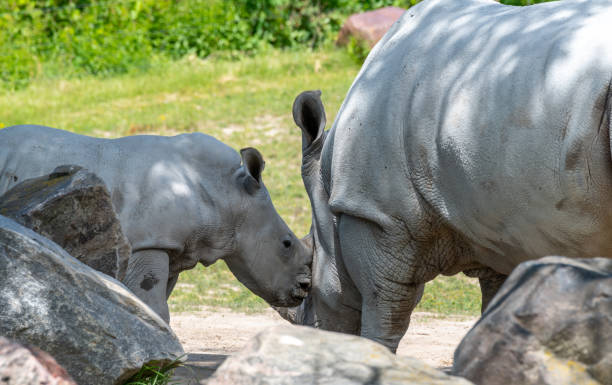
How Long Rhino Calves Stay With Their Mothers
The morning sun rises over Uganda’s Ziwa Rhino Sanctuary as a female white rhinoceros walks slowly across the grassland. Close beside her is a young calf, occasionally stopping to explore vegetation before hurrying to catch up.
Although the calf is already strong enough to walk and feed on grass, it still depends on its mother for protection, guidance and social security.
For safari travellers, watching a rhinoceros mother with her calf is one of Africa’s most memorable wildlife experiences. It also raises an interesting question: how long do rhino calves stay with their mothers?
Most African rhino calves remain close to their mothers for approximately two to three years. Some stay longer, particularly when the mother has not produced another calf.
During this time, the youngster gradually changes from a milk-dependent newborn into a more confident, independent animal.
Understanding this relationship reveals the importance of motherhood, slow reproduction and conservation in the lives of Africa’s rhinoceroses.
1. How Long Does a Rhino Calf Stay With Its Mother?
White and black rhinoceroses generally spend several years raising a calf.
However, the duration varies between species.
White rhino calves commonly remain with their mothers for around two to three years, sometimes slightly longer.
Black rhino calves also usually remain for several years, with some staying up to four years.
White vs Black Rhino Calves
| Feature | White Rhinoceros | Black Rhinoceros |
|---|---|---|
| Typical mother-calf association | Around 2–3 years | Around 2–3 years |
| Possible longer association | Up to about 3.5 years | Sometimes 4 years |
| Early feeding | Begins sampling grass | Begins exploring browse |
| Mother’s role | Feeding, protection and guidance | Feeding, protection and guidance |
| Separation | Often associated with the next birth | Often associated with the next birth |
These are approximate biological patterns rather than fixed ages.
2. What Happens When a Rhino Calf Is Born?
A female rhinoceros normally gives birth to a single calf after a long pregnancy.
The newborn is relatively large compared with many other African mammals.
White rhino calves may weigh several tens of kilograms at birth, while black rhino calves commonly weigh around 30–45 kilograms.
Despite their size, newborns are vulnerable.
The mother provides milk, protection and close supervision.
A calf can usually stand and begin walking within the early hours or days of life.
As its strength improves, it starts following the mother more confidently.
3. Why Do Rhino Calves Need Their Mothers for So Long?
Rhinos are large mammals that mature slowly.
A young calf must develop enough strength, feeding ability and environmental awareness to survive independently.
The mother protects the youngster while it learns about its surroundings.
She also guides it between feeding areas, resting places and water sources.
Main Benefits of Maternal Care
| Benefit | Importance |
|---|---|
| Milk | Supports early growth |
| Protection | Helps reduce danger from predators |
| Movement guidance | Keeps the calf near suitable habitat |
| Feeding experience | Exposes the calf to appropriate vegetation |
| Social development | Helps the calf respond to other rhinos |
| Familiarity with habitat | Supports increasing independence |
The mother-calf relationship is therefore much more than nursing.
4. How Long Do Baby Rhinos Drink Milk?
Rhino calves begin nursing soon after birth.
Milk remains important during early development, but calves gradually add vegetation to their diet.
White rhino calves may begin sampling grass within the first few weeks.
Both species can continue nursing for a year or longer, although the precise weaning period varies.
Some scientific sources describe black rhino nursing as continuing considerably longer in particular populations.
It is important to distinguish between beginning solid food, stopping nursing and becoming completely independent.
These events do not happen simultaneously.
5. When Do Rhino Calves Start Eating Grass?
White rhinos are primarily grazers.
Their broad, square-shaped mouths are suited to gathering grasses.
Young white rhinos begin experimenting with vegetation while they are still nursing.
Early attempts may involve nibbling grass beside their mothers.
Over time, they become better at feeding independently.
By the time they stop nursing, grass provides their main nutrition.
For safari visitors, a calf grazing alongside its mother does not necessarily mean it is old enough to survive alone.
6. What Do Black Rhino Calves Eat?
Black rhinoceroses are mainly browsers rather than grazers.
They feed on leaves, shoots, twigs and other plant material.
Their pointed, prehensile upper lips help grasp vegetation.
Black rhino calves gradually learn to feed on suitable plants while remaining close to their mothers.
They may sample vegetation before they are fully weaned.
Feeding Differences
| Feature | White Rhino | Black Rhino |
|---|---|---|
| Main adult diet | Grasses | Leaves and woody vegetation |
| Mouth shape | Broad and square | Pointed and grasping |
| Calf’s early solid food | Grass | Leaves and shoots |
| Feeding habitat | Often open grassland | Often bushland and woodland |
These feeding differences help explain why the two rhino species often use different habitats.
7. How Do Rhino Mothers Protect Their Calves?
Rhino mothers are highly protective.
A female may place herself between her calf and a perceived threat.
She may become alert, change direction or react defensively when danger approaches.
Young calves are vulnerable to some large predators.
However, the risk differs between habitats and species.
Possible Threats to Rhino Calves
- Lions.
- Hyenas in certain circumstances.
- Dangerous encounters with other rhinos.
- Habitat disturbance.
- Human interference.
- Illness or injury.
Healthy adult rhinoceroses have relatively few natural predators.
Their calves, however, require close protection while growing.
8. Why Do Rhino Calves Follow Their Mothers Everywhere?
Young calves depend on staying close to their mothers.
Following helps them remain protected and provides access to milk.
It also allows them to move through suitable feeding and resting habitats.
White rhino calves are often observed travelling ahead of their mothers, while black rhino calves more commonly follow behind.
However, the arrangement can vary.
A calf may occasionally explore nearby vegetation before returning to its mother.
Visitors should never interpret brief separation as evidence that a youngster has been abandoned.
9. Do Rhino Calves Play?
Yes. Rhino calves can be surprisingly playful.
Youngsters sometimes run short distances, move around their mothers, toss their heads or investigate unfamiliar objects.
Play provides opportunities to develop movement and coordination.
Some calves may interact with other young rhinoceroses where social conditions allow.
However, rhinoceroses do not have the same permanent family structures as elephants.
Black rhinos are generally more solitary, while white rhinos can form loose social associations.
10. When Does a Rhino Calf Become Independent?
Independence develops gradually.
A calf may stop nursing before it leaves its mother permanently.
As it grows, it becomes increasingly capable of finding food, moving between habitats and responding to other animals.
Separation often occurs when the female is preparing to give birth again or has produced another calf.
A young rhino may initially remain in a familiar area after separating.
Stages of Rhino Calf Development
| Stage | General Behaviour |
|---|---|
| Newborn | Depends on milk and close protection |
| Early months | Begins exploring vegetation |
| Growing calf | Eats increasing amounts of solid food |
| Older calf | Becomes more capable of independent movement |
| Juvenile | May separate from the mother |
| Subadult | Continues growing towards sexual maturity |
A rhino that can feed independently is not necessarily sexually mature.
11. What Happens When the Mother Has Another Calf?
The arrival of a new calf often changes the relationship between a female rhinoceros and her older offspring.
The mother must devote substantial attention to the newborn.
She may become less tolerant of the older calf remaining close.
Some females encourage or force older offspring to leave.
This helps the mother concentrate on the next calf’s needs.
However, separation does not happen in exactly the same way in every family.
The older youngster may remain nearby for a time before becoming more independent.
12. Why Do Female Rhinos Have Few Babies?
Rhinoceroses reproduce relatively slowly.
Pregnancy lasts approximately 15–16 months in black rhinos and around 16 months in white rhinos, with variation.
Females normally give birth to one calf at a time.
They then spend several years caring for that offspring.
Rhino Reproductive Characteristics
| Characteristic | General Pattern |
|---|---|
| Pregnancy | Approximately 15–17 months, depending on species |
| Typical birth | One calf |
| Nursing | Continues through early development |
| Maternal care | Several years |
| Birth interval | Often multiple years |
| Population recovery | Relatively slow |
This slow reproductive pattern makes protecting breeding females particularly important.
13. What Happens if a Rhino Calf Loses Its Mother?
A young rhino that loses its mother may face serious survival difficulties.
The consequences depend on its age and independence.
A milk-dependent calf may be unable to survive without specialised care.
An older juvenile may be better prepared to feed independently.
Conservation teams sometimes intervene when orphaned calves are found.
Specialist rehabilitation programmes may provide appropriate nutrition, veterinary care and opportunities for eventual release.
However, rehabilitation is complex, and successful release cannot be guaranteed.
Wildlife authorities decide when intervention is appropriate.
14. How Do Conservationists Monitor Rhino Mothers?
Rhinos are closely monitored in many protected areas because of the continuing threat of poaching.
Rangers and researchers may identify individual females and record births.
They also observe calf survival, habitat use and changes in behaviour.
Monitoring helps conservation teams assess breeding success and population growth.
A female raising a healthy calf represents an important contribution to the next generation.
Long-term records are particularly valuable because rhinoceroses reproduce slowly.
15. What Does Research Say About Calf Survival?
Scientific research shows that environmental conditions can affect rhinoceros calf survival.
A 2024 study published in the Journal of Mammalogy investigated how rainfall and habitat selection influenced white rhino calf survival.
The researchers found that the relationship between rainfall and calf survival depended partly on the habitat used by the mother.
This suggests that maternal habitat choices can influence the conditions experienced by calves.
However, rainfall is not the only factor affecting survival.
Predation, disease, food availability and human pressures may also contribute.
16. Why Are Rhino Mothers Important for Conservation?
Every surviving calf contributes to the long-term future of its population.
Because females produce relatively few offspring over their lifetimes, the loss of a breeding mother can have serious consequences.
Poaching may kill the female and leave a dependent calf orphaned.
This creates a double conservation impact.
Protecting adult females therefore helps protect both present and future generations.
Conservation programmes focus on anti-poaching operations, habitat protection, veterinary support and careful population monitoring.
17. Where Can Travellers See Rhino Mothers and Calves in East Africa?
East Africa has several protected areas where visitors may encounter rhinoceroses.
Both white and black rhinos occur in parts of Kenya, while Uganda has a conservation population of southern white rhinos.
Tanzania also protects black rhinos in selected conservation areas.
Rhino Safari Destinations
| Country | Destination | Rhino Experience |
|---|---|---|
| Uganda | Ziwa Rhino Sanctuary | Southern white rhinos |
| Kenya | Ol Pejeta Conservancy | Black and white rhinos |
| Kenya | Lewa Wildlife Conservancy | Black and white rhinos |
| Kenya | Lake Nakuru National Park | Rhino conservation populations |
| Kenya | Nairobi National Park | Black and white rhinos |
| Tanzania | Ngorongoro Conservation Area | Black rhinos |
| Tanzania | Serengeti National Park | Rare black rhino sightings |
A mother and calf sighting is never guaranteed.
18. Watching Rhino Calves at Ziwa Rhino Sanctuary
Uganda’s Ziwa Rhino Sanctuary is an important destination for rhinoceros conservation and wildlife education.
It has played a major role in efforts to restore rhinos in Uganda after their disappearance from the country’s wild populations.
Visitors may observe white rhinos under authorised guiding arrangements.
A female with her calf can offer an excellent opportunity to learn about rhino reproduction and parental care.
However, visitors must maintain the distance required by their guide.
A protective mother may respond aggressively if people approach too closely.
Never position yourself between a rhinoceros and its calf.
19. How to Photograph Rhino Mothers and Calves
Rhino calves provide memorable wildlife photography opportunities.
However, visitors should prioritise animal welfare over close photographs.
Use suitable zoom equipment rather than approaching.
Remain quiet and follow instructions from conservation personnel.
Responsible Photography Tips
- Keep a safe distance.
- Never separate a calf from its mother.
- Avoid blocking the animals’ movement.
- Use a telephoto lens.
- Do not encourage a calf to approach.
- Avoid sudden movements or loud noises.
- Follow all ranger instructions.
Young animals should be allowed to behave naturally without disturbance.
20. Frequently Asked Questions
How Many Years Do Rhino Calves Stay With Their Mothers?
Most remain for approximately two to three years, although some black rhino calves stay longer.
Do Rhino Mothers Abandon Their Calves?
Normally, mothers provide extensive care. Separation is often associated with the arrival of another calf rather than sudden abandonment.
When Do Rhino Calves Stop Drinking Milk?
Weaning varies between species and individuals. Calves begin eating vegetation well before nursing ends.
Are Rhino Calves Born With Horns?
Newborn rhinoceroses do not have fully developed horns. Horn growth becomes visible as the calf develops.
Can Rhino Calves Survive Without Their Mothers?
Older juveniles may be capable of independence, but young milk-dependent calves face serious risks without maternal care.
The Strong Bond Between Rhino Mothers and Calves
Rhinoceroses may appear tough and solitary, but the relationship between a mother and calf reveals a gentler side of their lives.
For several years, the female provides food, protection and guidance while the youngster grows.
The calf gradually learns to graze or browse, explore its surroundings and become independent.
Eventually, it may separate from its mother, often around the time another calf is born.
This long period of maternal care is one reason rhinoceros populations recover slowly after losses.
For travellers visiting Ziwa Rhino Sanctuary, Ol Pejeta, Lewa or Ngorongoro, observing a rhino mother with her calf is a reminder of why protecting breeding females matters.







No comment