
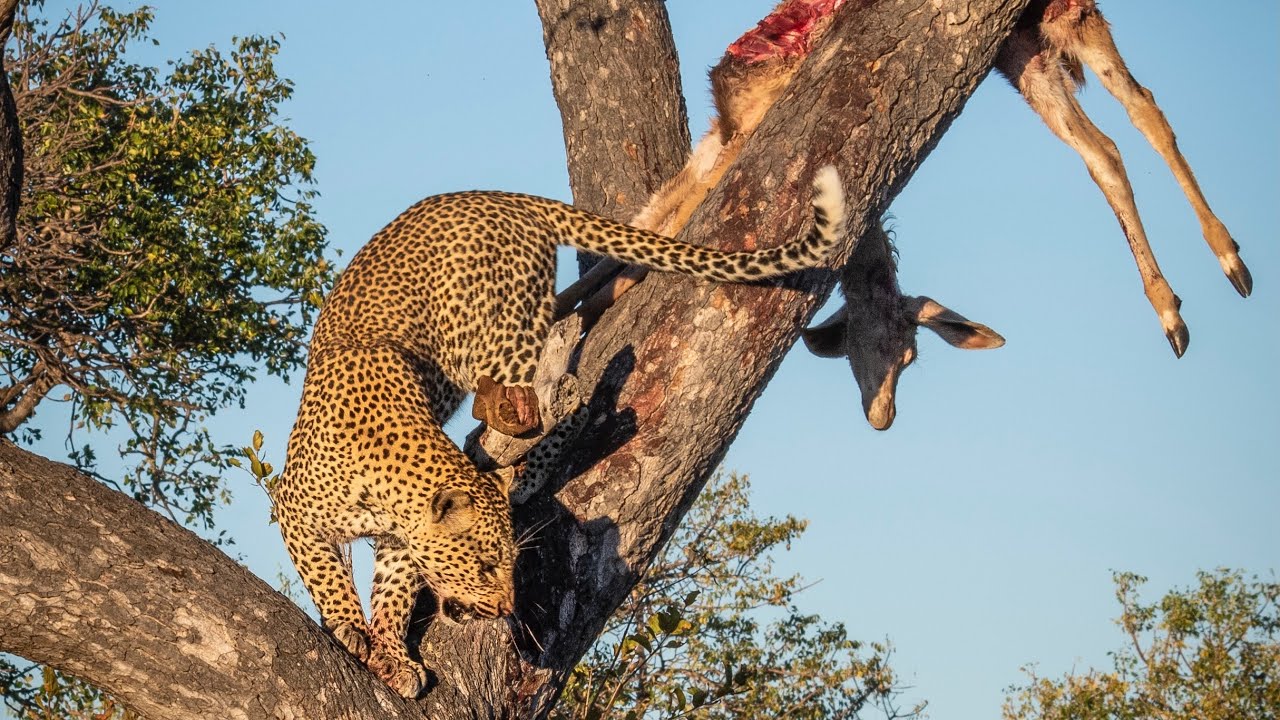
Why Leopards Haul Kills Into Trees
Imagine watching a leopard moving quietly through the grasslands of Uganda’s Queen Elizabeth National Park. After successfully catching an impala, the spotted predator grips its prey in powerful jaws and begins dragging it towards a nearby tree. Moments later, the leopard climbs the trunk, pulling the carcass into the branches before settling down to feed.
Why leopards haul kills into trees is one of the most fascinating questions in African wildlife behaviour. These secretive big cats are remarkable climbers, capable of lifting surprisingly heavy prey above the ground.
However, their behaviour is not simply a demonstration of strength. Carrying food into trees helps leopards protect their meals from competing predators, feed over longer periods and survive in landscapes shared with lions and hyenas.
Understanding this behaviour adds another interesting dimension to leopard sightings during an East African safari.
1. Why Do Leopards Carry Their Food Into Trees?
The main reason leopards hoist prey into trees is to reduce the risk of having their kills stolen.
In African savannahs, leopards share their habitats with larger and sometimes more dominant carnivores.
Spotted hyenas and lions may discover a fresh carcass and force a leopard to abandon its meal.
This behaviour, in which one animal steals food caught by another, is called kleptoparasitism.
By moving a carcass into a tree, a leopard can place its food beyond the easy reach of many ground-dwelling competitors.
This helps protect the energy invested in hunting.
Main Benefits of Hoisting Prey
- Reducing food theft by hyenas.
- Providing a place to feed with fewer disturbances.
- Allowing the leopard to return to unfinished food.
- Reducing some risks associated with feeding on the ground.
- Helping the leopard retain more of a successful kill.
However, hoisting does not make food completely safe. Other leopards can climb trees, and some carcasses may fall.
2. How Strong Are Leopards?
Leopards are muscular big cats with powerful shoulders, forelimbs and jaws.
Their bodies are well adapted for climbing, carrying prey and moving through difficult terrain.
A leopard may drag an antelope across the ground before lifting it into a tree.
Some can hoist prey approaching or exceeding their own body weight.
However, the size of a carcass and the shape of the tree strongly influence whether hoisting is possible.
A small monkey or young antelope is much easier to carry than a large adult ungulate.
Leopards therefore make use of different feeding strategies depending on the prey available.
3. How Do Leopards Lift Heavy Kills?
Hoisting a carcass requires strength, balance and careful movement.
The leopard commonly grips the prey with its jaws and begins climbing the trunk.
Its sharp claws help secure a grip on the bark, while powerful limbs support the combined weight.
Once the leopard reaches a suitable branch, it may pull the carcass into a fork or position it across several branches.
The animal can then begin feeding or leave the carcass temporarily.
What Makes a Good Feeding Tree?
A suitable tree generally needs:
- A trunk the leopard can climb.
- Strong branches capable of supporting the carcass.
- A stable fork where food can be positioned.
- Enough space for the leopard to rest or feed.
- A location that offers some separation from ground predators.
Not every tree provides these conditions.
A leopard may travel some distance before finding a suitable place to store its prey.
4. Why Hyenas Are a Major Problem for Leopards
Spotted hyenas are efficient predators and scavengers that readily exploit food opportunities.
They have powerful jaws and can quickly consume substantial portions of a carcass.
When a hyena discovers a leopard feeding on the ground, it may approach and attempt to steal the prey.
The leopard must then decide whether defending the kill is worth the risk.
In many cases, avoiding confrontation is the safer option.
What Research Revealed
A study conducted in South Africa’s Sabi Sand Game Reserve examined 2,032 prey items killed by 104 leopards between 2013 and 2015.
Researchers found that leopards hoisted approximately 51% of their kills.
At least 21% of kills were stolen by competitors, particularly spotted hyenas.
Hoisted kills were generally retained for longer feeding periods.
These findings provided strong evidence that storing prey in trees helps leopards reduce food theft.
5. Do Lions Also Steal Leopard Kills?
Yes. Lions can steal prey from leopards.
A lion is generally much larger than a leopard and can present a serious danger during close encounters.
When lions approach, leopards frequently retreat rather than attempt to defend a carcass.
Although lions sometimes climb trees, they are generally less agile climbers than leopards.
Hoisting prey may make it harder for lions to access, but it does not guarantee protection.
In some situations, a leopard may abandon its meal entirely when a lion appears.
Avoiding injury can be more important than keeping food.
6. Do Leopards Always Carry Their Kills Into Trees?
No. One common safari misconception is that every leopard stores its prey in a tree.
In reality, hoisting varies between habitats and individual animals.
Some leopards feed on the ground, particularly when vegetation provides effective cover.
Others drag prey beneath bushes, into rocky areas or towards sheltered places.
Research in South Africa’s Phinda Private Game Reserve documented tree hoisting in only around 9% of recorded kills, showing how much behaviour can vary between locations.
What Influences the Decision?
| Factor | How It Affects Hoisting |
|---|---|
| Nearby hyenas | May increase the benefit of storing food in a tree |
| Prey size | Very large carcasses are difficult to lift |
| Tree availability | Suitable branches make hoisting possible |
| Dense vegetation | May provide an alternative hiding place |
| Individual experience | Leopards can differ in feeding behaviour |
| Competition | Risk from other predators affects food protection |
A leopard’s decision depends on the circumstances rather than one fixed instinctive routine.
7. Does the Size of the Kill Matter?
Yes. Prey size is an important influence.
Small prey can often be consumed relatively quickly, reducing the need for storage.
Very large prey may provide more food but can be difficult or impossible to hoist.
Medium-sized carcasses are often more suitable for carrying into trees.
The Sabi Sand research found that leopards were more likely to hoist prey weighing approximately 40–140% of their own body mass.
This suggests that leopards balance the potential food reward against the physical effort required to protect it.
8. How Long Do Leopards Feed on a Tree-Stored Kill?
A leopard may return to the same carcass over several feeding sessions.
The duration depends on prey size, temperature, competition and how much food remains.
A substantial kill can sometimes provide meals over multiple days.
The leopard may rest nearby, descend for water or leave the tree temporarily before returning.
However, meat deteriorates over time, especially in warm weather.
Scavengers and other animals may also discover the carcass.
Tree storage is therefore a short-term feeding strategy rather than a way to preserve food indefinitely.
9. Can Other Animals Steal Food From Trees?
Although hoisting provides useful protection, it is not completely effective.
Other leopards are capable of climbing trees and may steal unattended food.
Large birds can sometimes feed on exposed remains.
A poorly positioned carcass may also fall to the ground, where hyenas or other scavengers can reach it.
Researchers have documented carcasses being dislodged from branches, sometimes by inexperienced leopard cubs.
This means a successful hoist reduces certain risks without eliminating every possibility of food loss.
10. Do Female Leopards Hoist Kills for Their Cubs?
Female leopards need reliable food supplies while raising dependent cubs.
Protecting a kill from competitors can help a mother retain food for herself and her young.
Cubs gradually learn to climb and feed on prey as they develop.
However, females do not always hoist more frequently than males.
In some studied populations, males have been more likely to carry prey into trees.
Females may instead hide smaller carcasses in vegetation or use other feeding strategies.
The Sabi Sand study found that females experiencing more frequent food theft had lower annual reproductive success, highlighting the importance of protecting kills.
11. Where Can You See Leopards Feeding in Trees?
Several East African safari destinations support leopards and provide opportunities to observe their tree-climbing behaviour.
| Destination | Country | Leopard Viewing Opportunities |
|---|---|---|
| Queen Elizabeth National Park | Uganda | Leopards in savannah and woodland habitats |
| Murchison Falls National Park | Uganda | Leopards around wooded areas and game tracks |
| Lake Mburo National Park | Uganda | Leopards in suitable woodland and rocky habitats |
| Serengeti National Park | Tanzania | Leopards resting or feeding in trees |
| Maasai Mara National Reserve | Kenya | Leopards using riverine and savannah trees |
| Tarangire National Park | Tanzania | Leopards in woodland and baobab landscapes |
Seeing a leopard with a carcass is less predictable than simply finding a resting leopard.
Sightings depend on hunting success, habitat and animal movements.
12. How Safari Guides Find Leopards in Trees
Experienced guides look for several clues when searching for leopards.
They may examine strong branches, tree forks and shady resting places.
A hanging carcass can indicate that a leopard has been feeding nearby.
However, the predator may have moved elsewhere.
Guides also listen for alarm calls from monkeys, antelopes and birds.
These sounds sometimes reveal the presence of a predator.
Fresh tracks and knowledge of frequently used resting areas can provide additional clues.
No single sign guarantees a leopard sighting.
13. Best Time to See Leopards With Their Kills
Leopards are often active during the night and around dawn and dusk.
A leopard that successfully hunts after dark may still be feeding on its carcass during an early morning game drive.
However, leopards can hunt and feed during daylight.
A stored kill may attract the animal back at different times.
Early morning and late afternoon game drives are practical choices for leopard observation, but there is no guaranteed viewing hour.
14. Photographing a Leopard With a Kill
A leopard resting beside prey in a tree can create an impressive wildlife photograph.
However, responsible viewing is essential.
Use optical zoom rather than driving unnecessarily close.
Avoid surrounding the tree with several vehicles or blocking the leopard’s route.
Never make noises to encourage the animal to climb, feed or move.
If the leopard appears uncomfortable, allow more distance.
Wildlife photography should capture natural behaviour without interfering with feeding or survival.
Why Leopards Protect Their Meals in Trees
Understanding why leopards haul kills into trees reveals an important survival strategy.
These powerful climbers use trees to protect food from hyenas and other competitors, allowing them to benefit from successful hunts over longer periods.
Their behaviour also depends on prey size, local habitat and the availability of suitable trees.
Not every leopard hoists every kill, but the ability to do so gives the species a valuable advantage in landscapes shared with larger predators.







No comment