
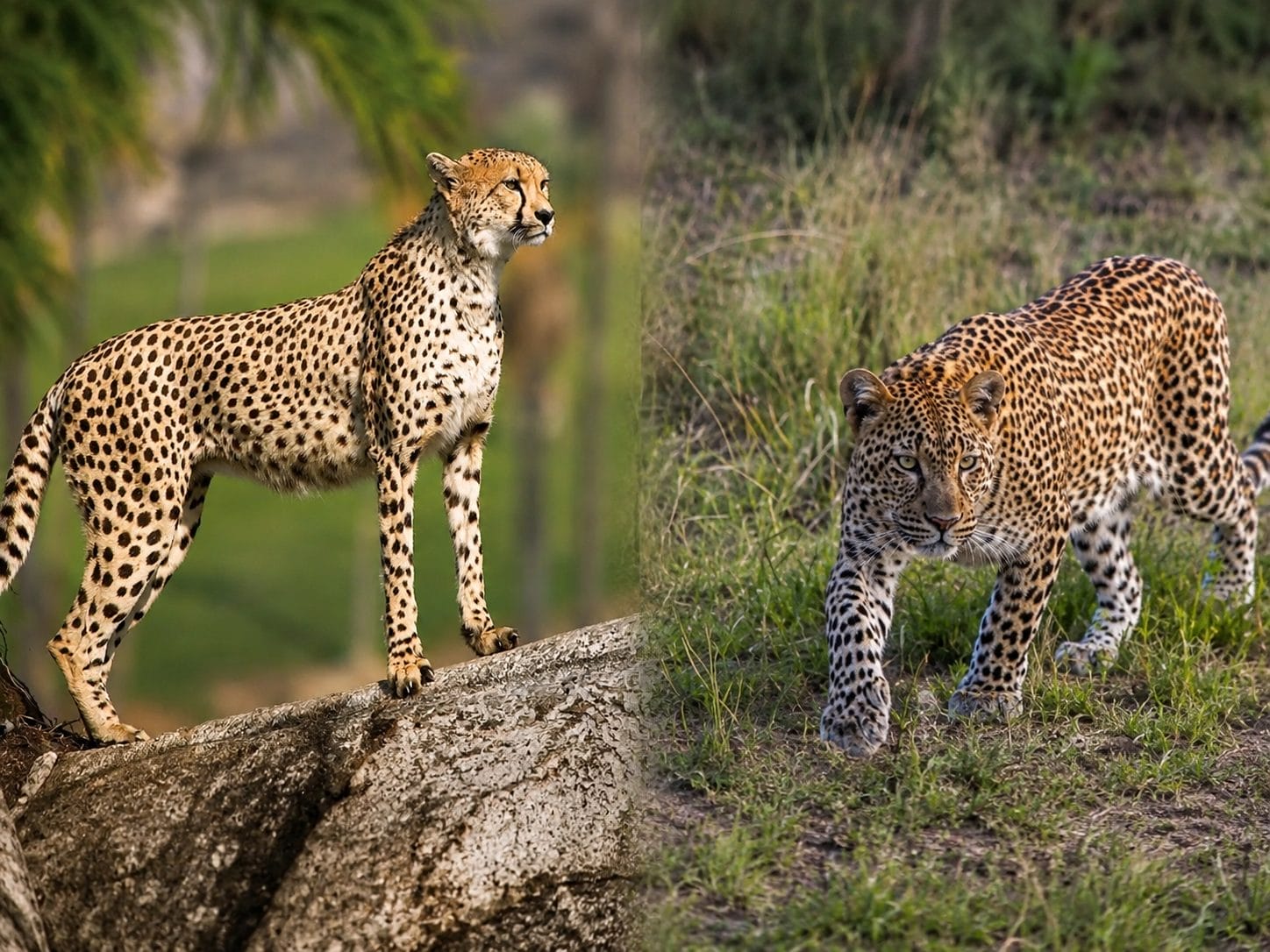
Leopard or Cheetah? Five Quick Ways to Tell
Imagine travelling across the golden plains of Tanzania’s Serengeti National Park when your safari guide suddenly stops the vehicle. A beautiful spotted cat is standing in the grass. Its golden coat is covered with black markings, and its eyes are fixed on a nearby herd of antelopes. But is it a leopard or a cheetah?
Learning how to tell leopards and cheetahs apart is an important skill for anyone interested in African wildlife. Although these two cats appear similar at first, they have different body shapes, coat patterns, hunting techniques and behaviours.
Cheetahs are famous for their incredible speed, while leopards are powerful climbers and skilled ambush hunters. Both occur in East Africa, including parts of Kenya, Tanzania and Uganda, although their distribution and abundance differ.
Here are five quick ways to identify them during your next African safari.
1. Look at the Spots: Rosettes vs Solid Black Dots
The easiest way to distinguish a leopard from a cheetah is to examine its coat.
Both animals have golden-yellow fur with dark markings, but their patterns are different.
Leopard: Rose-Shaped Markings
Leopards have distinctive markings called rosettes.
These are irregular rings or clusters of black spots surrounding a lighter centre.
The patterns resemble small roses and help leopards blend into vegetation, shadows and woodland habitats.
Every leopard has a unique arrangement of markings, which researchers can use to identify individuals.
Cheetah: Small, Solid Spots
Cheetahs have simple black spots distributed across most of their bodies.
Unlike leopard rosettes, these markings are generally solid rather than ring-shaped.
The spots help camouflage cheetahs among grass and other vegetation.
Quick identification tip: If the coat has dark rings or rosettes, think leopard. If it has small, solid black spots, think cheetah.
2. Check the Face: Cheetahs Have Black Tear Marks
Another reliable identification feature is the face.
Cheetahs have two prominent black lines running from the inner corners of their eyes down towards their mouths.
These markings are commonly called tear marks.
Researchers believe they may help reduce glare from sunlight, although their precise function has not been fully established.
The lines are particularly useful when identifying a cheetah from the front.
What Does a Leopard’s Face Look Like?
Leopards do not have the long black tear marks found on cheetahs.
Instead, they have broader heads, powerful jaws and spotted facial markings.
Their faces often appear more rounded and muscular.
Quick identification tip: Black tear lines below the eyes usually indicate a cheetah.
3. Compare Their Body Shapes: Speed vs Strength
Leopards and cheetahs have different body structures because they use different hunting strategies.
Cheetahs Are Built for Running
Cheetahs have long legs, narrow waists, deep chests and relatively small heads.
Their bodies are streamlined, allowing them to accelerate rapidly during short pursuits.
They also have long tails that help maintain balance when turning at speed.
Cheetahs are the fastest land animals, capable of reaching exceptional speeds during brief sprints.
However, they cannot maintain these speeds for long periods.
Leopards Are Built for Power
Leopards are generally more muscular and heavily built.
They have broad heads, powerful shoulders and strong forelimbs.
Their relatively compact bodies help them climb trees and overpower prey.
Leopards can also run quickly, but they usually depend on stalking and ambushing rather than prolonged high-speed chases.
Quick identification tip: A tall, slender cat with long legs is probably a cheetah. A stocky, muscular cat is more likely a leopard.
4. Watch Their Hunting Behaviour
How a spotted cat hunts can provide useful identification clues.
Cheetah Hunting
Cheetahs often hunt in daylight, particularly during cooler morning and late afternoon periods.
They use keen eyesight to locate prey across relatively open habitats.
After approaching carefully, they accelerate into a short, powerful chase.
Their preferred prey often includes gazelles and other medium-sized antelopes.
Once a cheetah catches an animal, it commonly uses a throat hold to subdue it.
Leopard Hunting
Leopards are stealthy ambush predators.
They use vegetation, darkness and natural cover to approach prey without being noticed.
A leopard may wait quietly before launching a short attack.
Leopards hunt a wide variety of animals, including antelopes, monkeys and smaller mammals.
They are often active at night, although daytime hunting also occurs.
Quick identification tip: A cat chasing an antelope at high speed across open grassland is likely a cheetah. One stalking through dense vegetation may be a leopard.
5. Look at the Trees: Leopards Are Expert Climbers
Tree-climbing behaviour provides another important clue.
Leopards are excellent climbers.
They frequently rest on branches, observe their surroundings and sometimes carry prey into trees.
Their powerful forelimbs and retractable claws make climbing easier.
Why Do Leopards Store Food in Trees?
Leopards may hoist prey into branches to reduce the risk of losing their meals to competitors such as spotted hyenas.
A stored carcass can provide several feeding opportunities.
However, not every leopard carries every kill into a tree.
Can Cheetahs Climb Trees?
Cheetahs can climb or scramble onto low, sloping trunks and other raised surfaces.
They may use these positions to scan for prey.
However, their bodies are specialised for running, and they are not accomplished tree climbers like leopards.
Cheetahs also have semi-retractable claws that provide traction during high-speed movement.
Quick identification tip: A spotted cat resting high on a branch or feeding beside a carcass in a tree is almost certainly a leopard.
Leopard vs Cheetah: Quick Comparison Table
| Feature | Leopard | Cheetah |
|---|---|---|
| Scientific name | Panthera pardus | Acinonyx jubatus |
| Coat pattern | Black rosettes | Solid black spots |
| Face | Broad, without tear lines | Narrower, with black tear lines |
| Body | Muscular and compact | Slender and long-legged |
| Hunting technique | Stalking and ambush | High-speed pursuit |
| Main activity | Often nocturnal or crepuscular | Frequently diurnal |
| Tree climbing | Excellent | Limited |
| Claws | Retractable | Semi-retractable |
| Tail | Thick, spotted or ringed | Long, with dark rings near the tip |
| Vocalisation | Rasping calls and growls | Chirps, purrs and other calls |
These differences make identification easier when several features are considered together.
Where Can You See Leopards in East Africa?
Leopards are widely distributed across suitable habitats in East Africa.
However, they are secretive and can be difficult to observe.
Popular safari destinations include:
- Queen Elizabeth National Park, Uganda.
- Murchison Falls National Park, Uganda.
- Lake Mburo National Park, Uganda.
- Serengeti National Park, Tanzania.
- Maasai Mara National Reserve, Kenya.
- Tarangire National Park, Tanzania.
During game drives, guides often search woodland, riverine vegetation and large trees for resting leopards.
Early morning and late afternoon can provide rewarding opportunities.
Where Can You See Cheetahs in East Africa?
Cheetahs are more strongly associated with open landscapes where they can detect and pursue prey.
Good destinations include:
- Serengeti National Park, Tanzania.
- Maasai Mara National Reserve, Kenya.
- Amboseli National Park, Kenya.
- Samburu and surrounding northern Kenya conservancies.
- Kidepo Valley National Park, Uganda, where cheetahs are rare.
Uganda’s cheetah population is much smaller and more restricted than those in Kenya and Tanzania.
Visitors seeking cheetahs as a priority are generally better served by established savannah destinations in Kenya or Tanzania.
Are Leopards or Cheetahs More Dangerous?
Both species are wild predators that must be treated with respect.
Leopards are powerful animals capable of defending themselves aggressively when threatened or cornered.
Cheetahs generally avoid confrontation with larger predators and people, but they are still capable of causing injuries.
Do not approach either species on foot without an authorised professional’s guidance.
Remain inside your safari vehicle where required and maintain suitable distances.
Never attempt to attract a predator with food or imitate animal calls.
Responsible viewing protects visitors and wildlife.
Which Is Faster: Leopard or Cheetah?
Cheetahs are considerably faster.
Their specialised bodies allow rapid acceleration and exceptional sprinting speeds.
Leopards are also capable runners, but they rely more heavily on strength, stealth and surprise.
The difference reflects two successful hunting adaptations.
A cheetah often depends on catching prey in an open chase, while a leopard aims to approach closely before attacking.
Neither hunting strategy is automatically better.
Each works under different environmental conditions.
Photography Tips for Spotted Cats
Both leopards and cheetahs are outstanding subjects for wildlife photography.
For identification photographs, try to capture the face, body shape and coat pattern.
A clear side view can reveal the leopard’s rosettes or the cheetah’s solid spots.
Photographing a cheetah running requires fast autofocus and a suitable shutter speed.
Leopards may provide opportunities for more stationary portraits when resting in trees.
Use optical zoom rather than moving too close.
Avoid interfering with hunting or feeding behaviour.
Why Protecting Both Species Matters
Leopards and cheetahs face conservation challenges across Africa.
Habitat loss, declining prey populations and conflict with people can threaten their survival.
Cheetahs are classified as Vulnerable, while leopards are also assessed as Vulnerable on the IUCN Red List.
Their conservation needs differ because of their habitats, movement patterns and ecological requirements.
Protecting connected landscapes, maintaining prey populations and reducing human-wildlife conflict are important for both species.
Responsible safari tourism can help support protected areas and local conservation initiatives.
Final Thoughts: Five Simple Identification Clues
Learning how to tell leopards and cheetahs apart makes wildlife watching more rewarding.
Remember the five main differences:
- Leopards have rosettes; cheetahs have solid black spots.
- Cheetahs have black tear marks; leopards do not.
- Leopards are muscular; cheetahs are slender and long-legged.
- Leopards favour ambush hunting; cheetahs specialise in high-speed chases.
- Leopards are expert tree climbers; cheetahs mainly stay on the ground.
During your next game drive, observe the animal carefully before reaching a conclusion.







No comment