
Where Hippos Walk at Night and Why They Leave the Water
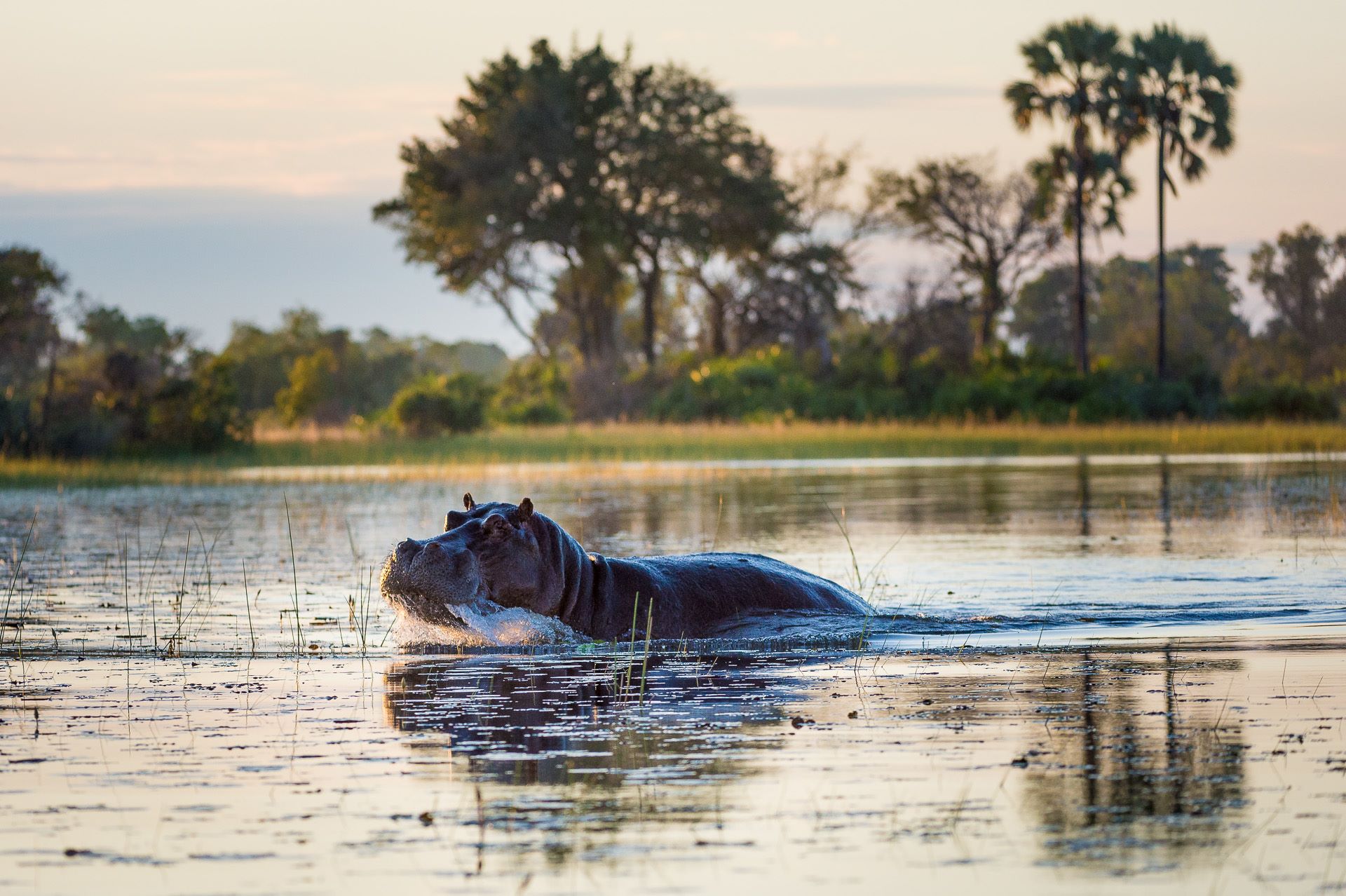
As the sun disappears behind Uganda’s Kazinga Channel, a large hippopotamus slowly rises from the water. During the afternoon, it rested among other hippos, with only its eyes, ears and nostrils visible. Now, as darkness approaches, it begins moving towards the grassy banks.
Within minutes, the animal has disappeared into the surrounding vegetation. It may travel across grassland, follow a familiar path or move towards a feeding area several kilometres away.
Understanding where hippos walk at night and why they leave the water reveals a fascinating side of these enormous African mammals.
Although visitors commonly observe hippos resting in rivers and lakes, these animals also depend on the surrounding land. Many leave the water during cooler hours to graze, sometimes walking surprising distances.
Their nightly movements influence grasslands, transport nutrients between habitats and occasionally bring them into contact with people.
1. Why Do Hippos Spend So Much Time in Water?
Common hippos are semi-aquatic mammals that spend substantial periods resting in rivers, lakes and pools.
Water helps them regulate their body temperature and provides a comfortable environment during hot weather.
Their skin produces a reddish protective secretion, but this does not eliminate the challenges of prolonged exposure to heat and sunshine.
Consequently, hippos often remain in water during the hottest parts of the day.
Why Water Matters to Hippos
| Benefit | Importance |
|---|---|
| Temperature regulation | Helps limit overheating |
| Resting environment | Provides comfortable daytime resting conditions |
| Social interaction | Allows groups to remain together |
| Skin protection | Reduces prolonged exposure to harsh sunlight |
| Reproduction | Important for mating and other behaviours |
| Safety | Provides a familiar refuge |
However, hippos cannot obtain all their nutritional needs simply by remaining submerged.
2. Why Do Hippos Leave the Water at Night?
The main reason is feeding.
Common hippos are predominantly herbivorous and consume substantial quantities of vegetation, especially grasses.
Many of their preferred grazing areas are located on dry land.
Leaving the water after sunset allows hippos to feed when temperatures are generally lower and the risk of overheating is reduced.
Their activity pattern reflects a balance between needing aquatic refuge and obtaining enough food.
However, not every hippo remains on land throughout the night, and some feed during daylight as well.
3. Where Do Hippos Walk After Sunset?
Hippos commonly travel from rivers, lakes and permanent pools towards nearby grasslands.
They may follow well-established paths through vegetation.
These routes can connect sleeping or resting areas with repeatedly used feeding grounds.
Common Night-Time Hippo Routes
| Habitat | Why Hippos Visit |
|---|---|
| Riverbanks | Access to nearby grazing |
| Open grasslands | Feeding on grasses |
| Lakeside plains | Foraging close to water |
| Floodplains | Seasonal food availability |
| Wetland margins | Access to vegetation |
| Agricultural fields | Opportunistic crop feeding in some areas |
Hippos do not always travel in straight lines.
They may follow terrain, familiar tracks and the distribution of suitable food.
4. How Far Can Hippos Walk at Night?
Hippos can travel several kilometres from their daytime aquatic refuge.
However, distance varies considerably between individuals, habitats and seasons.
A scientific review of human-hippo conflict reported that typical nocturnal feeding distances from water may average around 0.6–1.7 kilometres in some studied populations.
Other studies have documented grazing areas several kilometres from water, with longer movements possible under particular conditions.
Understanding Hippo Travel Distances
| Distance From Water | Interpretation |
|---|---|
| Less than 1 km | Commonly accessible nearby grazing |
| 1–3 km | Possible feeding distance |
| 3–5 km | Documented in some habitats |
| 5–10 km | Longer movements possible under suitable conditions |
| Beyond 10 km | Not a normal expectation for every population |
These are broad illustrations, not fixed movement categories.
The distance travelled along a winding route may also be greater than the straight-line distance from water.
5. What Do Hippos Eat on Land?
Hippos are primarily grazers.
They use their broad, muscular lips to pull and gather grasses.
Their large molars then grind the vegetation.
Although their enormous canine teeth look impressive, these are mainly associated with combat and display rather than cutting grass.
Common Foods
- Short grasses.
- Fresh grass shoots.
- Various locally available grass species.
- Occasional other plant material.
- Agricultural crops in areas of conflict.
Hippos can consume several tens of kilograms of vegetation in a day.
However, the exact amount changes with body size, food availability and activity.
6. What Are Hippo Grazing Lawns?
Repeated grazing can keep particular areas of grassland short.
These closely cropped patches are sometimes called hippo lawns.
As hippos return to feeding grounds, they repeatedly remove vegetation and influence its structure.
The result can be short grass surrounded by taller plants.
Such areas may also be used by other grazing animals.
However, the ecological effects depend on grazing intensity, rainfall and local vegetation.
Too much grazing pressure can damage plant communities, especially where habitat is restricted.
7. Do Hippos Follow the Same Paths Every Night?
Hippos may repeatedly use familiar routes between water and feeding areas.
These tracks can become visible corridors through vegetation.
In some places, frequent movement creates worn paths leading away from rivers.
However, routes are not permanently fixed.
Changes in flooding, vegetation, disturbance or access to food can influence movement.
What Hippo Trails May Look Like
A frequently used trail may have flattened vegetation, disturbed soil and large footprints.
Near water, the path may be muddy or deeply worn.
However, not every broad animal trail belongs to a hippo.
Other wildlife and livestock can produce similar signs.
Visitors should never follow suspected hippo tracks at night without authorised professional guidance.
8. Are Hippos Active Only at Night?
No. Hippos are often described as nocturnal grazers, but their activity is more flexible.
A recent 24-hour observational study in Botswana challenged the assumption that hippos spend the whole night feeding and all daylight hours resting in water.
Researchers observed periods of feeding, resting and other activity at different times.
In that study, hippos fed during only about a quarter of the night and were also observed feeding or resting on land during daylight.
This shows why broad descriptions should not be treated as rigid rules.
9. Do Hippos Return to Water Before Sunrise?
Many hippos return to aquatic resting areas before or around dawn.
However, the timing differs between individuals.
Some may return earlier, while others remain on land longer.
Weather, temperature and local conditions can influence their behaviour.
Illustrative Hippo Activity Pattern
| Period | Possible Activity |
|---|---|
| Late afternoon | Resting in water or preparing to move |
| Around sunset | Beginning to leave aquatic areas |
| Evening | Travelling and grazing |
| Middle of the night | Feeding, resting or moving |
| Before sunrise | Further feeding or returning towards water |
| Daytime | Often resting in water, with some activity on land |
This is an illustrative pattern rather than a guaranteed schedule.
10. Why Do Hippos Sometimes Walk Into Villages?
Human settlements and agricultural land sometimes occupy areas near rivers, lakes and wetlands.
These environments may overlap with traditional hippo feeding routes.
As hippos move between water and grassland, they may encounter gardens, crops, roads or buildings.
Some enter cultivated areas to feed.
This can create serious conflict because hippos are large, powerful and potentially dangerous.
The problem may become more difficult where natural grazing habitat has been converted to farmland.
11. Are Hippos Dangerous on Land at Night?
Yes. Hippos must be treated as potentially dangerous wild animals.
Despite their rounded bodies and seemingly slow movements, they can move quickly over short distances.
An unexpectedly encountered hippo may react defensively.
The risk increases when a person blocks its movement or stands between the animal and the water.
Hippos may also be difficult to see in darkness.
Essential Safety Rules
| Situation | Safer Response |
|---|---|
| Hippo seen near your lodge | Stay inside and contact staff |
| Hippo crossing a road | Stop at a safe distance and allow it to pass |
| Hippo heard outside at night | Do not investigate on foot |
| Hippo feeding near accommodation | Remain indoors or in an authorised safe area |
| Hippo between you and your destination | Do not approach or attempt to pass |
| Guided night activity | Follow the authorised guide’s instructions |
Never try to outrun, approach or photograph a hippo on foot at close range.
12. Why Should You Never Block a Hippo’s Route to Water?
Water is an important refuge for hippos.
When an animal feels threatened on land, it may attempt to return towards the aquatic area.
A person or vehicle blocking that direction can create a dangerous confrontation.
Visitors should avoid standing between a hippo and the water.
If a hippo is nearby, remain at a safe distance and allow it an unobstructed route.
Never deliberately challenge or corner the animal.
In an unexpected close encounter, seek professional assistance and prioritise reaching safety rather than trying to predict its next movement.
13. Do Hippos Walk Alone or in Groups?
Hippos commonly gather in groups while resting in water.
However, feeding behaviour on land is often more individual.
Adults may leave the water at different times and graze separately.
Mothers with young calves may remain together.
This explains why a tourist can see many hippos sharing a river pool during daylight but encounter only one or two on a nearby grassland at night.
The precise pattern varies between populations.
14. Do Baby Hippos Follow Their Mothers at Night?
Young hippos depend heavily on their mothers.
Calves may accompany them during movements between water and land.
However, very young calves have different nutritional and physical needs from adults.
They nurse and gradually become more capable of feeding on vegetation.
Mothers provide protection and maintain contact during movement.
Visitors should never approach a calf or position themselves between it and its mother.
A female hippo may respond defensively to perceived threats.
15. How Does Rainfall Affect Hippo Movements?
Rainfall changes the distribution of grass and water.
During wetter periods, temporary pools and fresh vegetation may become available.
Hippos may use additional resting locations or adjust their feeding routes.
During drier periods, suitable grazing can become concentrated in fewer areas.
Animals may need to travel farther or compete for limited resources.
Studies in African protected areas demonstrate that food availability can strongly influence hippo distribution.
However, responses differ according to each landscape.
16. How Do Hippos Connect Rivers and Grasslands?
Hippos play an important ecological role by moving nutrients between land and water.
They consume grass on land and deposit substantial quantities of dung in aquatic habitats.
This transfers nutrients and organic material into rivers and lakes.
Their movements therefore connect two ecosystems.
Ecological Effects of Hippo Activity
| Activity | Environmental Effect |
|---|---|
| Grazing | Changes grassland vegetation |
| Repeated walking | Creates trails and disturbed ground |
| Defecation in water | Transfers nutrients and organic matter |
| Movement between habitats | Connects aquatic and terrestrial systems |
| Concentrated use of pools | Influences local water conditions |
These effects are not always positive.
High concentrations of dung can reduce water quality or oxygen levels under certain conditions.
Healthy ecosystems depend on the interaction between wildlife populations, habitat conditions and natural processes.
17. Where Can Tourists See Hippos in East Africa?
East Africa offers excellent opportunities to observe common hippos in rivers, lakes and wetland habitats.
Popular Hippo Safari Destinations
| Country | Destination | Viewing Experience |
|---|---|---|
| Uganda | Queen Elizabeth National Park | Hippos along the Kazinga Channel |
| Uganda | Murchison Falls National Park | Nile River hippo groups |
| Uganda | Lake Mburo National Park | Hippos in suitable lake habitats |
| Kenya | Maasai Mara National Reserve | Hippos in the Mara River |
| Kenya | Lake Naivasha | Hippos in lake and shoreline habitats |
| Tanzania | Serengeti National Park | Hippo pools and river systems |
| Tanzania | Ngorongoro Conservation Area | Hippos in suitable crater wetlands |
| Rwanda | Akagera National Park | Hippos in lakes and waterways |
Most safari visitors observe hippos safely during daylight boat excursions or game drives.
18. Can You Watch Hippos Walking at Night on Safari?
Night-time hippo encounters are possible, but viewing opportunities depend on the destination and authorised activities.
Some properties near lakes and rivers may occasionally have hippos moving through surrounding grounds.
However, this is not an invitation to approach them.
Night drives are restricted or specially managed in many protected areas.
Visitors should use only permitted activities with qualified guides.
A hippo sighting is never worth taking risks by walking alone after dark.
19. What Do Hippo Footprints Look Like?
Hippos have four toes on each foot.
Their large, spreading feet can leave recognisable impressions in soft mud.
Near a frequently used riverbank, tracks may overlap with other signs such as flattened vegetation.
However, identifying wildlife tracks accurately requires experience.
Large footprints alone should not be used to confirm that a hippo recently passed.
Rangers and experienced guides consider the surrounding environment and other evidence.
20. Frequently Asked Questions
Why Do Hippos Leave the Water at Night?
They often leave aquatic resting areas to feed on grasses growing on land, taking advantage of cooler conditions.
How Far Can a Hippo Walk From Water?
Many forage within a few kilometres of water, although longer movements have been documented.
Do Hippos Sleep in Water During the Day?
They commonly rest in water during daylight, but they can also rest or feed on land.
Do Hippos Eat Fish?
Common hippos are predominantly herbivorous. Their ordinary diet is mainly vegetation, especially grasses.
Is It Safe to Walk Near Hippos at Night?
No. Close encounters can be dangerous. Stay in safe accommodation areas and follow professional guidance.
The Secret Night-Time Life of Hippos
Hippos are often imagined as animals that spend their lives floating in rivers.
In reality, they depend on both water and land.
They use aquatic habitats for resting, temperature regulation and social interaction, while nearby grasslands provide important feeding opportunities.
Their night-time journeys may involve familiar trails, several kilometres of walking and repeated visits to grazing areas.
These movements also shape vegetation and transfer nutrients between terrestrial and aquatic ecosystems.
However, hippos do not follow one rigid daily timetable, and their movements change with food, weather and local conditions.







No comment