
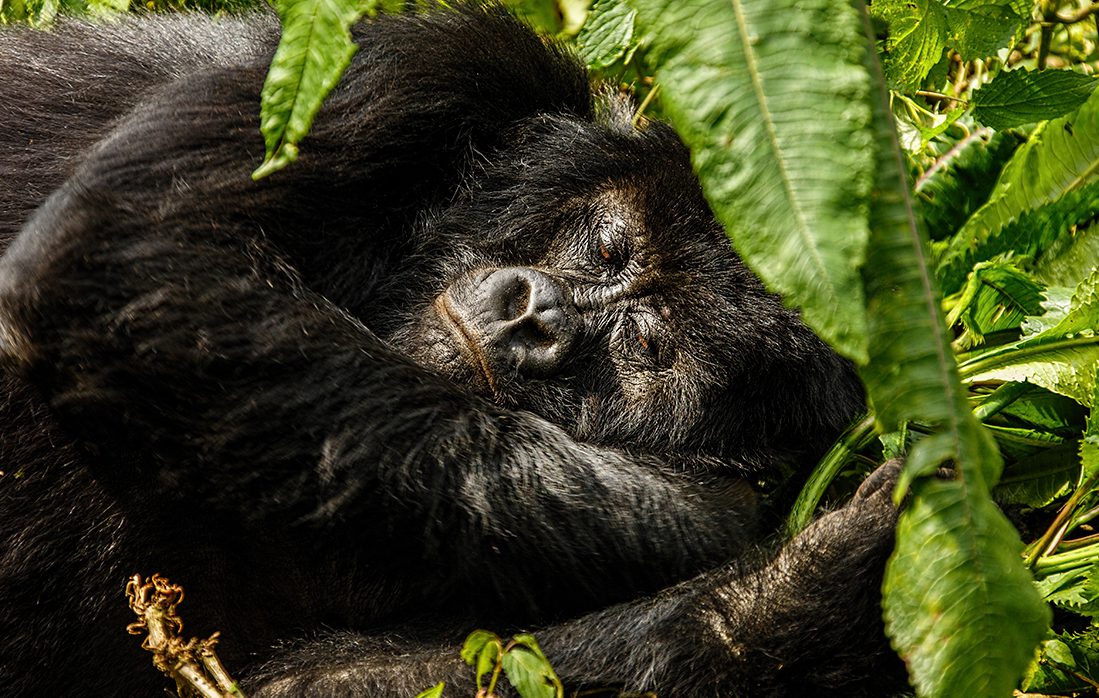
How Mountain Gorillas Build Nests and Spend Their Day
As the first light reaches Uganda’s Bwindi Impenetrable National Park, a mountain gorilla family begins to wake. A large silverback rises from a bed of flattened leaves, an adult female gathers her infant, and young gorillas start moving through the surrounding vegetation.
Within a short time, the family leaves its sleeping area and begins searching for food.
Understanding how mountain gorillas build nests and spend their day reveals a fascinating routine of feeding, resting, travelling, playing and maintaining family relationships.
Unlike humans, mountain gorillas do not return to permanent bedrooms. They normally build fresh sleeping nests each evening using nearby plants.
Their daily activities may appear simple, but every movement contributes to survival, social relationships and family stability.
For visitors trekking in Uganda or Rwanda, recognising these natural routines makes a gorilla encounter even more rewarding.
1. What Does a Mountain Gorilla Do All Day?
Mountain gorillas spend much of their daylight hours feeding, resting and moving between food sources.
They also groom, communicate, play and care for their young.
Their daily routine changes according to weather, food availability, group composition and habitat conditions.
Although gorillas follow recognisable patterns, they do not operate according to a fixed clock.
A Typical Day in a Gorilla Family
| Time | Common Activity |
|---|---|
| Early morning | Wake up and begin feeding |
| Mid-morning | Feed and move through vegetation |
| Late morning | Continue feeding or begin resting |
| Midday | Rest, groom and play |
| Early afternoon | Resume feeding and travelling |
| Late afternoon | Select a sleeping area |
| Evening | Build nests and settle for the night |
| Night | Sleep and rest |
This timetable is illustrative. Actual activity periods vary between groups and days.
2. How Do Gorillas Wake Up in the Morning?
Mountain gorillas are primarily active during daylight.
As morning approaches, individual family members begin moving around their sleeping nests.
Infants may remain close to their mothers, while juveniles become increasingly active.
The dominant silverback often plays an important role in the group’s movements, although other members also influence daily decisions.
The family usually leaves its overnight nesting area and begins feeding.
Trackers working in Bwindi and Volcanoes National Park often use these abandoned nesting sites to help establish where a gorilla family travelled.
3. What Do Mountain Gorillas Eat for Breakfast?
Gorillas do not have a formal breakfast, but feeding is an important early-morning activity.
Their diet consists mainly of plant material.
They consume leaves, stems, shoots, roots and other available vegetation.
The exact foods vary with habitat, season and individual preferences.
Common Gorilla Foods
| Food Type | Examples |
|---|---|
| Leaves | Tender leaves from forest plants |
| Stems | Soft herbaceous stems |
| Shoots | Young plant growth |
| Roots | Selected underground plant parts |
| Bark | Certain edible plant tissues |
| Fruit | Available fruits, depending on habitat |
Mountain gorillas spend considerable time selecting and processing vegetation.
They use their hands and powerful jaws to strip, break and chew plant material.
4. Why Do Gorillas Spend So Much Time Feeding?
Mountain gorillas are large-bodied animals that depend heavily on vegetation.
Many of their preferred foods are relatively bulky and require substantial chewing.
Obtaining enough energy therefore takes time.
Gorillas may remain in a feeding area while stripping leaves and stems from surrounding plants.
When useful vegetation becomes less available, the family moves to another location.
This feeding pattern helps explain why gorilla groups travel through forests rather than remaining in one place throughout the day.
5. What Happens During the Midday Rest?
Mountain gorillas commonly rest during the middle of the day.
After feeding, individuals may settle on the ground or arrange vegetation beneath themselves.
Some sleep briefly, while others remain awake.
Young gorillas may continue playing while adults rest nearby.
Mothers often spend this period caring for infants.
Researchers have also observed gorillas constructing temporary daytime nests.
These resting periods help balance activity and recovery.
6. Do Gorillas Build Nests During the Day?
Yes. Although evening nesting is the regular pattern, gorillas sometimes construct nests for daytime rest.
A gorilla may pull leaves, stems or branches into a comfortable resting platform.
These nests are generally used for shorter periods than overnight nests.
Not every daytime rest involves elaborate construction.
Sometimes gorillas simply settle into suitable vegetation.
Day Nests vs Night Nests
| Feature | Day Nest | Night Nest |
|---|---|---|
| Main purpose | Short rest | Overnight sleeping |
| Construction | Sometimes simple | Usually deliberately arranged |
| Timing | During daylight | Towards evening |
| Location | Ground or suitable vegetation | Ground or trees |
| Duration of use | Often relatively short | Usually overnight |
Nest-building is therefore part of both sleeping and resting behaviour.
7. How Do Mountain Gorillas Build Their Nests?
Mountain gorillas use vegetation already growing around them.
They do not normally transport building materials over long distances.
Instead, a gorilla selects a suitable place and pulls nearby stems, leaves and branches towards its body.
The vegetation is bent, folded and arranged into a supportive platform.
A ground nest may resemble a shallow bowl or flattened mattress.
Some gorillas create a raised rim using thicker stems.
Basic Nest-Building Process
- The gorilla selects a suitable resting position.
- It pulls nearby vegetation towards the centre.
- Stronger stems form a supporting structure.
- Softer leaves and plants create a resting surface.
- The gorilla adjusts the arrangement before settling down.
Experienced adults can complete a simple nest in only a few minutes.
8. What Materials Do Gorillas Use?
Gorillas commonly use leaves, branches, vines and herbaceous plants.
However, they do not select every plant randomly.
A scientific study conducted in Bwindi found that gorillas showed preferences for particular vegetation when choosing nesting sites and materials.
The researchers recorded the use of numerous plant genera and found differences between plants available and those selected for nests.
This suggests that gorillas respond to the qualities and availability of their surroundings.
Nesting Materials and Their Uses
| Material | Possible Function |
|---|---|
| Broad leaves | Soft resting surface |
| Flexible stems | Support and structure |
| Branches | Reinforce nest shape |
| Vines | Help hold vegetation together |
| Dense grasses and herbs | Cushioning and insulation |
Different habitats provide different combinations of materials.
9. Do Gorillas Sleep on the Ground or in Trees?
Both.
Mountain gorillas commonly construct nests on the ground, particularly large adult males.
Silverbacks are heavy animals, making ground nesting practical.
Females and younger gorillas may also construct nests in trees when suitable structures are available.
However, the proportion of ground and tree nests varies with vegetation, age and habitat conditions.
Ground vs Tree Nests
| Nest Type | Characteristics |
|---|---|
| Ground nest | Built from plants and branches near the forest floor |
| Tree nest | Arranged among branches capable of supporting the gorilla |
| Day nest | Temporary resting structure |
| Mother-infant nest | Shared sleeping space for a young infant and its mother |
Visitors should not assume that every gorilla sleeps in a tree simply because other great apes sometimes do.
10. Why Do Gorillas Build New Nests Every Night?
Mountain gorillas normally construct fresh sleeping nests each evening.
They do not maintain permanent sleeping structures like houses.
The family moves through its habitat while searching for food, so its overnight location also changes.
Fresh nests provide a suitable resting surface using locally available vegetation.
Researchers have proposed additional possible benefits, including hygiene, insulation and comfort.
However, the importance of each benefit may vary.
The behaviour also offers conservation teams useful information about gorilla movements.
11. Do Baby Gorillas Build Their Own Nests?
Very young infants usually sleep with their mothers.
This provides warmth, protection and access to nursing.
As young gorillas develop, they begin exploring and practising nest-building movements.
A youngster may pull leaves and stems into a small resting structure.
Early attempts may be less organised than those of experienced adults.
Over time, independent nest construction becomes part of normal gorilla behaviour.
Young gorillas learn while growing up in a social environment where nest-building is performed regularly.
12. What Does the Silverback Do During Resting Time?
The dominant silverback may rest while other family members feed, groom or play nearby.
He does not need to remain active every moment to maintain leadership.
However, his presence can provide security and social stability.
If another group approaches or an unusual disturbance occurs, the silverback may become alert.
He may also influence when the family leaves a resting area.
These roles make him an important figure in the group’s everyday activities.
13. How Do Young Gorillas Spend Their Afternoon?
Young mountain gorillas are often more playful than adults.
They climb vegetation, chase one another, wrestle and occasionally practise chest-beating.
Play helps develop physical coordination and social relationships.
However, juveniles also spend time feeding and resting.
Their activities are influenced by age, individual personality and the behaviour of nearby family members.
For visitors, these interactions are often among the most entertaining moments of a gorilla trek.
14. How Far Do Mountain Gorillas Travel Each Day?
Mountain gorillas generally move between feeding and resting locations within their home ranges.
Daily travel distances vary according to vegetation, weather and social circumstances.
Some days involve relatively short movements between nearby feeding areas.
On other days, a family may travel farther.
There is no fixed distance that every gorilla group must cover daily.
This is also why tourists cannot reliably predict the difficulty of a gorilla trek based on yesterday’s location.
15. What Happens Before Sunset?
As the day progresses, gorilla families gradually reduce their travelling and feeding activities.
They select a suitable location for the night.
The choice may depend on vegetation, terrain and the needs of the family.
Individuals begin constructing sleeping nests within the same general area.
The nests are separate but usually close enough to maintain the social grouping.
Young infants remain with their mothers.
The family then settles into its overnight resting period.
16. How Long Do Mountain Gorillas Sleep?
Mountain gorillas spend much of the night resting in their nests.
Their actual sleep can be interrupted by movement, nursing, changes in position or other activity.
The length of the overnight resting period changes with seasonal daylight and group behaviour.
They may also nap during the day.
Rather than describing gorillas as sleeping for one exact number of hours, it is more accurate to recognise that they have an extended overnight rest alongside shorter daytime resting periods.
17. How Do Trackers Use Gorilla Nests?
Abandoned sleeping nests provide valuable information for conservation teams.
Trackers may use nest locations to establish where a family spent the previous night.
They can examine surrounding vegetation for signs of movement and feeding.
Researchers may also record nest numbers, dimensions and positions.
What Nest Sites Reveal
| Observation | Conservation Value |
|---|---|
| Nest location | Helps track movements |
| Number of nests | Contributes to group-size estimates |
| Nest materials | Provides information about habitat use |
| Droppings near nests | May support approved non-invasive research |
| Repeated nesting patterns | Helps study ranging behaviour |
Nest counts alone are not always sufficient to identify every individual accurately.
Researchers combine them with other information.
18. Can Tourists See Gorilla Nests?
Sometimes.
During a gorilla trek in Bwindi, Mgahinga or Rwanda’s Volcanoes National Park, a ranger may point out abandoned nesting areas.
However, visitors should not enter or disturb nest sites without authorisation.
Fresh nests may contain biological material useful for research.
Approaching them unnecessarily can also disturb the habitat.
The best way to learn about nesting behaviour is to listen to the ranger’s explanation and observe gorillas from the required distance.
19. What Can Visitors Expect During One Hour With Gorillas?
A standard gorilla trekking encounter provides up to one hour with the assigned family.
You may find the gorillas feeding, resting, playing or moving through vegetation.
Sometimes a silverback remains seated throughout much of the encounter.
At other times, the family changes feeding locations.
There is no guarantee of witnessing nest-building, chest-beating or another particular behaviour.
The experience depends on what the wild animals are doing naturally.
Common Activities Visitors May Observe
- Feeding on leaves and stems.
- Resting on the forest floor.
- Mothers nursing infants.
- Youngsters playing.
- Grooming and social contact.
- Soft grunts and other vocalisations.
- Movement between feeding areas.
Visitors should remain quiet and follow the ranger’s instructions.
20. Why Gorilla Daily Routines Matter for Conservation
Understanding gorilla feeding, movement and nesting helps researchers assess habitat use.
Nest studies can reveal which plants gorillas prefer for resting.
Daily movement records help explain how families use different parts of the forest.
Social observations provide information about relationships, reproduction and group stability.
These details support long-term conservation planning.
They also remind visitors that protecting mountain gorillas requires protecting the entire forest environment in which they live.
Frequently Asked Questions
Do Mountain Gorillas Build a New Nest Every Night?
Yes. Mountain gorillas normally construct fresh sleeping nests each evening rather than returning to permanent beds.
Do Silverbacks Sleep in Trees?
Large silverbacks usually sleep on the ground, although nesting behaviour varies with habitat and individual circumstances.
Do Baby Gorillas Sleep Alone?
Very young infants normally share a sleeping nest with their mothers.
Can Gorillas Build Nests During the Day?
Yes. Gorillas sometimes arrange vegetation into temporary resting nests during daylight.
Do Gorillas Sleep Together in One Nest?
Most independent gorillas construct their own sleeping places, while young infants usually share with their mothers.
A Day in the Life of Mountain Gorillas
Mountain gorillas spend their days feeding, resting, travelling and interacting with family members.
Their routine reflects the demands of life in a mountain forest where food, shelter and social relationships are essential.
Nest-building is one of their most fascinating daily behaviours.
Using leaves, stems and branches, gorillas create temporary beds that provide a resting place before the next day’s activities begin.
These nests also offer researchers valuable evidence about habitat use and family movements.
For travellers exploring Bwindi, Mgahinga or Rwanda’s Volcanoes National Park, understanding the gorillas’ daily routine makes the encounter more meaningful.







No comment