
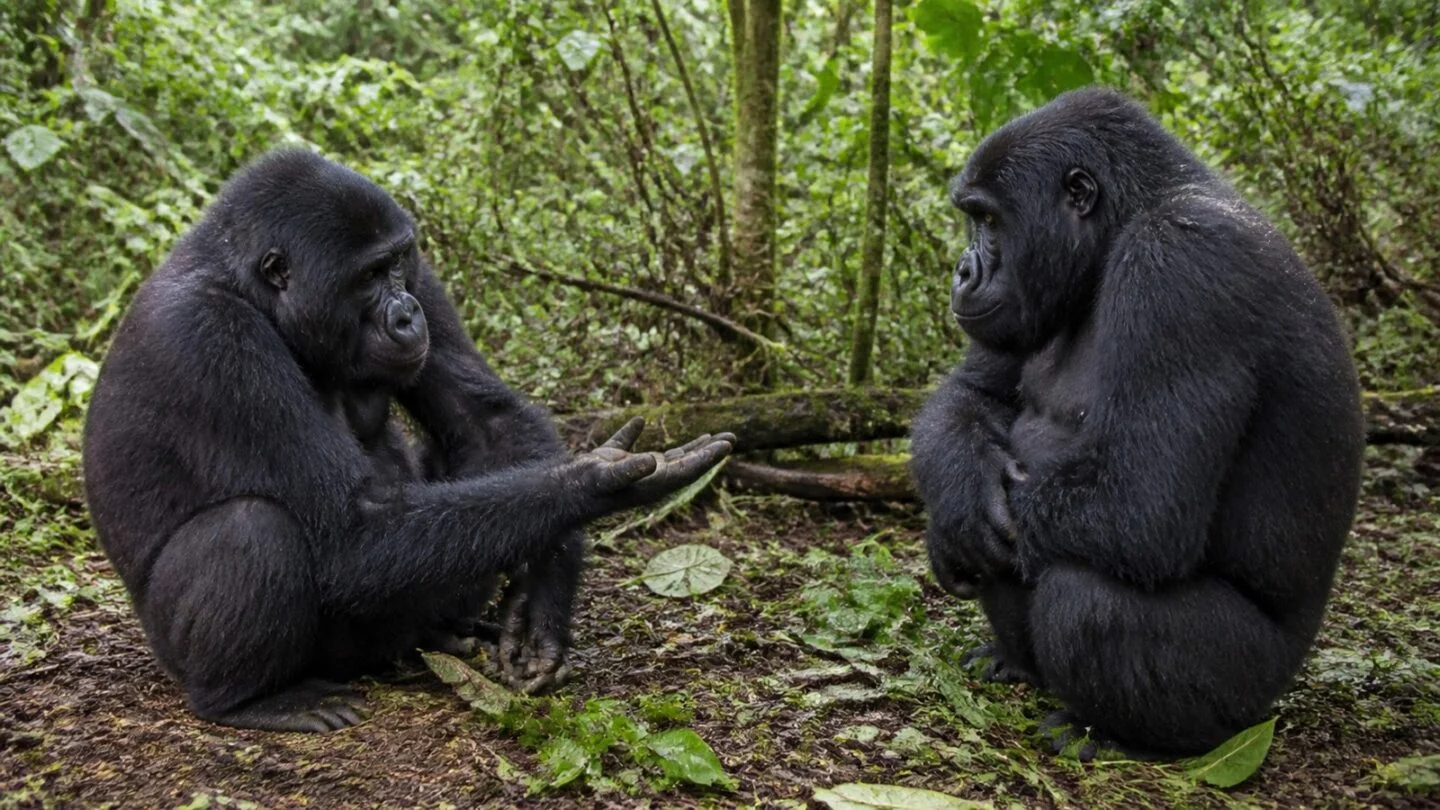
Gorilla Body Language
Gorilla Body Language: Chest Beats, Grunts and Yawns Explained
Deep inside Uganda’s Bwindi Impenetrable National Park, a silverback sits quietly among the forest vegetation. Nearby, a young gorilla plays with its sibling while an adult female feeds on fresh leaves. Suddenly, the silverback rises, beats his chest several times and settles back into the vegetation.
A few moments later, another gorilla makes a low grunting sound. An adult opens its mouth in a wide yawn, revealing impressive canine teeth.
What do these behaviours mean?
Understanding gorilla body language and communication can make a gorilla trekking experience in Uganda or Rwanda more interesting. Mountain gorillas communicate through sounds, facial expressions, posture, gestures and physical contact.
However, not every chest beat signals anger, and a yawn does not always mean a gorilla is tired.
This guide explains common gorilla behaviours, what scientists understand about them and how visitors can observe these remarkable animals respectfully.
1. How Do Mountain Gorillas Communicate?
Mountain gorillas are highly social primates living in family groups that may contain silverbacks, adult females, juveniles and infants.
Communication helps them maintain relationships, coordinate movements and respond to unfamiliar situations.
They use a combination of vocal and non-vocal signals.
A gorilla may grunt while feeding, beat its chest during a display or use gentle physical contact when interacting with another family member.
Common Gorilla Communication Signals
| Behaviour | Possible Meaning |
|---|---|
| Chest-beating | Display, social signalling or play |
| Soft grunts | Contact and social communication |
| Deep rumbling sounds | Communication within the group |
| Yawning | May accompany rest or heightened arousal |
| Grooming | Social interaction and body care |
| Playful chasing | Social play |
| Stiff posture | Heightened attention or tension |
| Loud screams | Distress, conflict or intense excitement |
These meanings depend on context. A single movement rarely tells the complete story.
2. Why Do Silverbacks Beat Their Chests?
Chest-beating is one of the most recognisable mountain gorilla behaviours.
A silverback may rise onto his hind legs and rapidly strike his chest with cupped hands.
The movement produces a distinctive drumming sound that can travel through dense forest.
Chest-beating helps communicate information to other gorillas.
It may play a role in competition between males and interactions involving potential mates.
However, it does not automatically mean that the silverback is preparing to attack.
What Scientists Discovered
A 2021 study of wild mountain gorillas found that larger males produced chest beats with lower peak frequencies than smaller males.
This suggests that chest-beating communicates reliable information about body size.
Other gorillas may use these sounds when assessing potential rivals.
The display may therefore help animals communicate without needing direct physical confrontation.
3. Does Chest-Beating Mean a Gorilla Is Angry?
Not always.
Chest-beating can occur in different social situations.
An adult male may display when another group is nearby or during interactions involving competition.
Young gorillas may also imitate chest-beating while playing.
The meaning depends on surrounding behaviour.
For example, a relaxed juvenile briefly beating its chest during play is different from an adult male displaying while facing a rival.
Visitors should avoid assuming that every loud sound represents aggression.
4. Why Do Young Gorillas Beat Their Chests?
Young mountain gorillas frequently explore their physical abilities through play.
They may chase one another, tumble across vegetation, climb small trees and imitate adults.
Chest-beating can be part of this playful behaviour.
Youngsters are developing coordination and social skills.
Watching juveniles imitate adult displays can be particularly entertaining during a gorilla trek.
However, visitors should never encourage the behaviour by beating their own chests.
Gorillas must be allowed to interact naturally without human provocation.
5. What Do Gorilla Grunts Mean?
Mountain gorillas produce several types of grunts and low-frequency vocalisations.
Some sounds help maintain contact between family members.
Researchers have documented double-grunts during feeding, resting, movement and other social activities.
Certain calls can receive vocal replies from nearby gorillas.
These exchanges may help animals coordinate and maintain social contact even when vegetation limits visibility.
However, the same general category of grunt does not always have one fixed meaning.
The sound’s structure and context both matter.
6. What Is a Gorilla Double-Grunt?
A double-grunt consists of two closely spaced vocal elements.
Researchers have studied these calls in mountain gorillas and found that they vary between individuals.
Dominant animals may produce them more frequently than lower-ranking individuals.
Double-grunts occur during several everyday activities.
They are not exclusively warning sounds.
For trekkers, hearing quiet vocal exchanges while gorillas feed can reveal how frequently family members communicate.
These sounds are part of ordinary gorilla social life.
7. Why Do Gorillas Make Deep Rumbling Sounds?
Gorillas produce low, resonant vocalisations that visitors may describe as rumbles or belch-like calls.
Some function as close-contact communication within the group.
Others may occur during social interactions or group movements.
The sounds can be difficult for beginners to distinguish.
Experienced researchers examine acoustic patterns, individual identity and surrounding behaviour to interpret them.
A quiet rumble from a resting gorilla should not automatically be treated as a warning.
8. Why Do Gorillas Yawn?
Yawning is a familiar behaviour, but its interpretation is not always straightforward.
A gorilla may yawn while resting or transitioning between activities.
Yawning can also occur during periods of arousal or tension in primates.
However, researchers have not established a simple rule that every mountain gorilla yawn indicates aggression.
Some yawns expose large canine teeth, which can appear threatening to visitors.
The safest interpretation is to consider the animal’s overall behaviour rather than the open mouth alone.
Understanding Gorilla Yawns
| Situation | Possible Interpretation |
|---|---|
| Resting gorilla yawns | May be related to rest or changing alertness |
| Yawn during tense interaction | May accompany heightened arousal |
| Teeth visible during a yawn | Does not automatically indicate an attack |
| Repeated yawning | Requires behavioural context |
| Yawning followed by threatening displays | Ranger should assess the situation |
Visitors should not imitate gorilla yawns or attempt to provoke a reaction.
9. Does Showing Teeth Mean a Gorilla Is Threatening You?
Not necessarily.
Gorillas expose their teeth during different facial movements, including yawning and certain vocalisations.
A wide-open mouth may look alarming because gorillas possess large canine teeth.
However, appearance alone does not establish intention.
Researchers distinguish facial expressions by examining movements, posture and social circumstances.
A relaxed animal yawning while resting is different from one showing several signs of agitation.
During trekking, allow your ranger to interpret potentially concerning behaviour.
10. What Does a Relaxed Gorilla Look Like?
Relaxed gorillas often spend time feeding, resting or interacting quietly with family members.
Their movements may be slow and unhurried.
An adult may sit while stripping leaves from a plant.
A mother may hold an infant close as it rests.
Younger gorillas may play nearby.
However, visitors should avoid interpreting stillness as permission to approach.
A resting gorilla remains a powerful wild animal that requires appropriate space.
11. How Do Gorillas Show Affection?
Mountain gorillas develop important social relationships.
Mothers carry, groom and protect their infants.
Young gorillas often engage in playful physical contact.
Group members may rest close together or groom one another.
These interactions help maintain relationships within the family.
Although travellers sometimes describe these behaviours as hugs or affection, scientists interpret them through observed social relationships and behaviour.
Avoid assuming that every interaction has exactly the same emotional meaning as a similar human action.
12. What Does Gorilla Grooming Mean?
Grooming involves examining or handling another gorilla’s fur or skin.
It can help remove debris and maintain social contact.
In some primates, grooming is central to group relationships.
Mountain gorillas also groom, although the frequency and social importance of grooming differ among great ape species.
During a trek, visitors may see mothers grooming infants or individuals interacting while resting.
These quieter moments can be as interesting as dramatic displays.
13. How Do Gorillas Show Fear or Discomfort?
Gorillas may respond to disturbance through changes in posture, movement or vocal activity.
An animal may stop feeding, become more attentive or move away.
In other circumstances, a gorilla may produce warning sounds or displays.
However, these behaviours cannot be interpreted reliably without context.
Possible Signs of Increased Tension
- Sudden changes in activity.
- Repeated threatening displays.
- Stiff or unusually attentive posture.
- Loud vocalisations during conflict.
- Rapid movement towards a perceived threat.
- Attempts to move away from disturbance.
These signs do not necessarily predict an attack.
Visitors must follow the ranger’s instructions rather than attempting independent behavioural assessments.
14. Why Do Silverbacks Sometimes Charge?
Silverbacks play important protective roles within gorilla families.
They may react when they perceive a threat or become involved in conflict with another gorilla.
A charge may involve rapid movement and threatening displays.
Some charges stop before physical contact, but visitors should never assume a charge is harmless.
If a gorilla displays threatening behaviour, remain calm.
Do not run, shout or stare aggressively.
Follow your ranger’s instructions immediately.
Never deliberately encourage a chest beat or charge for photographs.
15. How Do Mother Gorillas Communicate With Infants?
Mother gorillas use physical contact, positioning and vocal communication when interacting with their young.
Infants depend heavily on their mothers during early development.
They may cling to their mother’s body, nurse and gradually begin exploring nearby vegetation.
Mothers can respond to their offspring’s movements and calls.
These exchanges help young gorillas develop social and practical skills.
Watching a mother interact with her infant is one of the most memorable experiences during mountain gorilla trekking.
16. What Can Gorilla Play Tell Us?
Young gorillas use play to explore their surroundings and interact socially.
Common behaviours include chasing, wrestling, climbing and playful chest-beating.
Play can help develop coordination and social relationships.
However, interactions that begin playfully may change quickly.
Visitors should not move closer to playing gorillas or place themselves between youngsters and adults.
The ranger determines the appropriate viewing position.
17. Can Gorillas Understand Human Body Language?
Gorillas can respond to the movements and behaviour of nearby people.
Habituated gorillas have gradually become accustomed to carefully managed human observation.
However, habituation does not make them domesticated or harmless.
Sudden movements, close approaches and unusual actions may disturb them.
Visitors should therefore keep their behaviour predictable.
Remain quiet, avoid unnecessary gestures and maintain the current distance required by the park authority.
18. Gorilla Body Language in Uganda and Rwanda
The same species of mountain gorilla inhabits Bwindi, Mgahinga and Rwanda’s Volcanoes National Park.
Its basic communication behaviours are not determined by international borders.
Where to Observe Mountain Gorilla Behaviour
| Destination | Gorilla Habitat | What Visitors May Observe |
|---|---|---|
| Bwindi, Uganda | Dense montane rainforest | Feeding, play, vocalisations and social interactions |
| Mgahinga, Uganda | Bamboo and mountain forest | Family movements, social displays and feeding |
| Volcanoes, Rwanda | Volcanic mountain vegetation | Chest-beating, grooming, play and vocal communication |
The behaviour you see depends on the individual family and circumstances of the encounter.
No operator can guarantee that a silverback will beat his chest during a particular trek.
19. How to Observe Gorilla Behaviour Responsibly
The best gorilla encounters happen when visitors remain quiet and allow the animals to behave naturally.
Avoid speaking loudly or making sudden movements.
Keep cameras on non-flash settings.
Never imitate gorilla calls or chest-beating.
Do not approach infants or block family members from moving.
Follow current mask, health and viewing-distance requirements.
Visitor Behaviour Checklist
| Do | Avoid |
|---|---|
| Listen to the ranger | Interpreting every sound as a threat |
| Watch the whole family | Focusing only on the silverback |
| Maintain the required distance | Moving closer for photographs |
| Remain quiet | Imitating gorilla calls |
| Observe natural interactions | Encouraging displays |
| Follow safety instructions | Running during a threatening encounter |
Responsible behaviour protects both visitors and gorillas.
20. Frequently Asked Questions
Why Do Gorillas Beat Their Chests?
Chest-beating communicates information that may be relevant to competition and social interactions. Research shows that the sound can indicate male body size.
Does a Gorilla Grunt Mean It Is Angry?
No. Grunts occur in several social contexts, including feeding, resting and maintaining contact.
Why Do Gorillas Show Their Teeth When Yawning?
A wide yawn naturally exposes the teeth. Its meaning depends on context, and it should not automatically be interpreted as a threat.
Can Female Gorillas Beat Their Chests?
Chest-beating is most strongly associated with adult males, but gorillas of other ages and sexes can also produce similar displays.
Should You Copy Gorilla Sounds During Trekking?
No. Visitors should remain quiet and allow natural communication without interference.
Learning the Language of Gorillas
Gorilla body language reveals a complex world of social relationships and communication.
Chest-beating can communicate information about strength and body size. Grunts help gorillas maintain social contact, while yawns may occur during rest or heightened arousal.
Grooming, play and physical contact reveal further aspects of family life.
However, no single gesture can explain everything a gorilla is experiencing.
The behaviour must be considered alongside the animal’s surroundings, relationships and recent activities.







No comment