
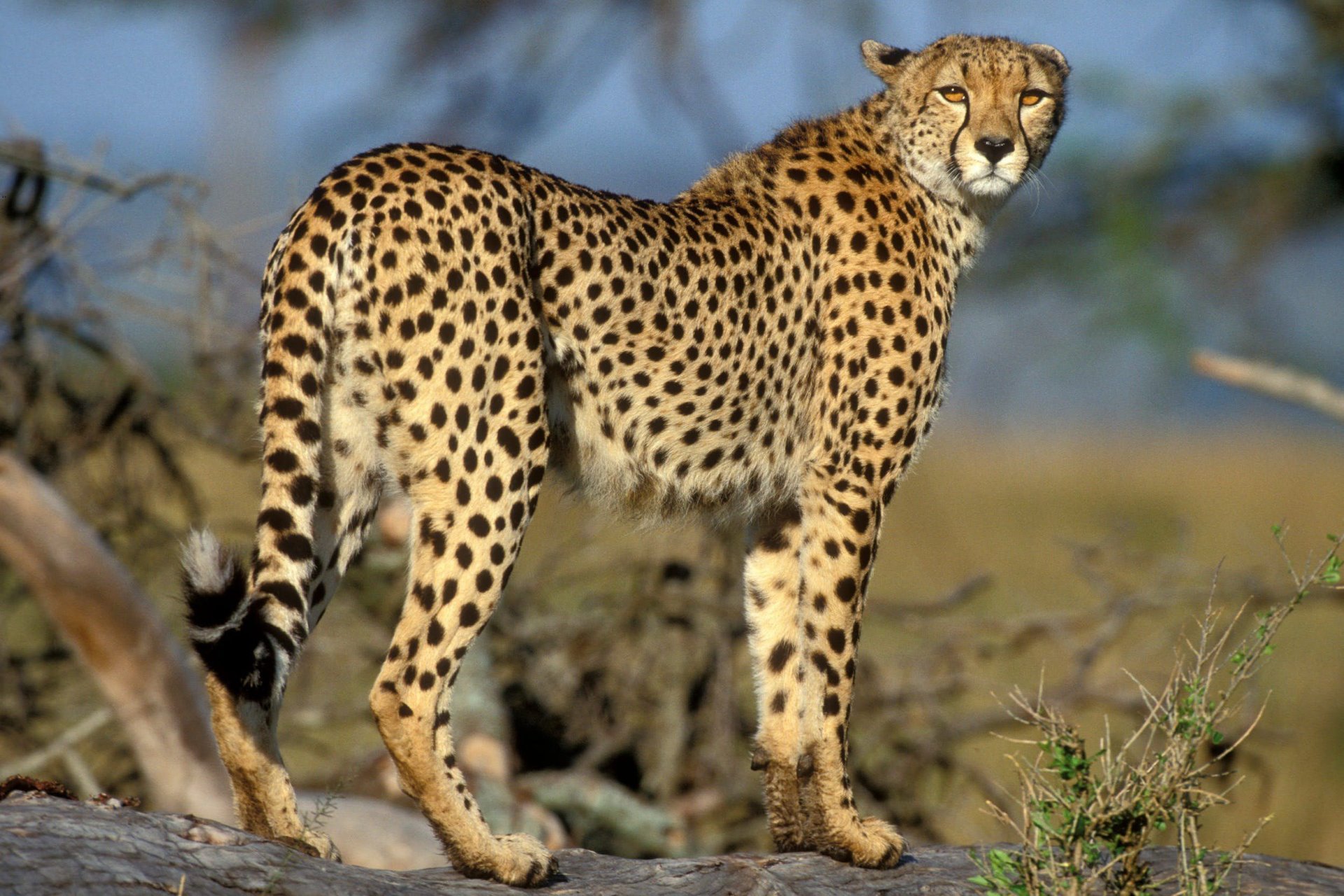
How fast can a cheetah really run, and how long can it keep going?
The cheetah is the fastest land animal in the world. Its long legs, flexible spine, powerful muscles and lightweight body allow it to accelerate rapidly and reach speeds that no other land mammal can match. When hunting across the African savannah, a cheetah can move from a slow approach to an explosive sprint in just a few seconds.
However, its incredible speed comes with an important limitation. A cheetah cannot maintain its maximum speed for long. It is built for short, powerful bursts rather than long-distance running. A typical high-speed chase lasts only around 20 to 30 seconds, covering a few hundred metres before the animal must slow down and recover.
This combination of speed, acceleration and agility makes the cheetah one of the most remarkable predators in Africa. Visitors on safari in Tanzania, Kenya, South Africa and other wildlife destinations may see cheetahs resting in the grass, scanning the plains or preparing to hunt. Understanding how they move helps explain why these animals are such specialised hunters.
How fast can a cheetah run?
A cheetah can reach speeds commonly reported at around 100 to 112 kilometres per hour (60 to 70 miles per hour). This makes it the fastest land mammal.
However, the highest figures should be understood as short-duration sprint estimates rather than speeds a cheetah regularly reaches during every hunt. Research tracking wild cheetahs in Botswana recorded a maximum speed of approximately 93 kilometres per hour during observed hunts. This shows that actual hunting speeds vary depending on the animal, terrain, prey and circumstances.
A cheetah does not need to reach 110 kilometres per hour every time it hunts. Its acceleration and ability to change direction are often more important than reaching its absolute top speed.
At full sprint, a cheetah can cover approximately 6 to 7 metres in a single stride. It may take around four strides per second, allowing it to cover considerable ground in a remarkably short period.
How quickly can a cheetah accelerate?
One of the cheetah’s most impressive abilities is its acceleration. It can accelerate from a stationary position to approximately 72 kilometres per hour in around 2.5 seconds.
This is comparable to the acceleration of some high-performance sports cars. The difference is that a cheetah achieves this speed using its own muscles and body structure.
When hunting, a cheetah usually does not begin with a full-speed sprint from a great distance. It approaches its intended prey carefully, using vegetation and natural features for concealment. Once it gets close enough, it launches a rapid chase.
The ability to accelerate quickly gives the cheetah an advantage when pursuing fast-moving animals such as gazelles and impalas. It can close the distance before its prey has enough time to escape.
How long can a cheetah maintain its maximum speed?
A cheetah can maintain its highest sprinting speeds for only a short period. A typical high-speed chase lasts approximately 20 to 30 seconds, although the duration varies according to the conditions.
During this time, the animal may cover around 200 to 300 metres at high speed. Some sources describe longer maximum distances under particular conditions, but these should not be confused with the distance covered at full speed throughout an ordinary hunt.
The cheetah’s body produces enormous amounts of energy during a sprint. Its muscles work intensely, its breathing increases and its body temperature rises.
Continuing at maximum speed for several minutes would place too much physical strain on the animal. It therefore depends on a short burst of speed to catch prey before exhaustion becomes a serious problem.
This is why cheetahs often approach their targets as closely as possible before beginning the chase. A long pursuit would reduce their chances of success.
Why can’t a cheetah run at top speed for longer?
Running at extreme speed requires enormous energy. A cheetah’s muscles must generate powerful movements repeatedly, while its heart and lungs work harder to supply oxygen and support the body’s activity.
The animal also produces considerable heat during intense exercise. If it continues sprinting for too long, overheating and physical exhaustion become serious risks.
Unlike animals adapted for endurance, cheetahs are specialised for explosive acceleration. Their bodies prioritise speed, flexibility and agility rather than the ability to maintain a fast pace over long distances.
After a chase, a cheetah often needs time to recover. It may lie down, pant heavily and wait for its breathing and body temperature to return towards normal.
Recovery can take around 20 minutes or longer, depending on the intensity of the chase and environmental conditions. The animal needs this time before it can comfortably resume normal activity.
How far can a cheetah run during a hunt?
The distance covered during a cheetah hunt varies considerably. Some chases end within a short distance, while others involve several hundred metres of rapid movement.
The animal usually tries to get close to its prey before accelerating. Once the chase begins, it may sprint, slow down, change direction and accelerate again as the prey attempts to escape.
A cheetah does not necessarily run in a straight line. Gazelles and other prey animals make sudden turns to avoid capture. The cheetah must respond quickly, adjusting its speed and direction.
Research on wild cheetahs has shown that hunting involves a combination of acceleration, braking and sharp turns. The animal may actually reduce its speed towards the end of a chase to improve its ability to follow prey changing direction.
This explains why a successful hunt depends on more than maximum speed. Timing, positioning, balance and the ability to anticipate the prey’s movements are equally important.
What makes a cheetah so fast?
The cheetah’s speed comes from several physical adaptations that work together. Its entire body is designed to support rapid acceleration and controlled movement at high speeds.
A flexible spine
The cheetah has an unusually flexible backbone that allows its body to stretch and contract during running. As the spine flexes, the front and back legs move through a wide range of motion.
This increases the distance covered with each stride. The body acts almost like a spring, helping the animal extend its reach as it accelerates.
Long and powerful legs
Cheetahs have long legs relative to their body size. Their powerful hindquarters provide the force needed to push against the ground, while their front legs help control movement and support balance.
Their long stride allows them to cover several metres with each running cycle.
Semi-retractable claws
Unlike most other cats, cheetahs cannot fully retract their claws. Their claws remain partly exposed and provide traction when running.
The ridged pads on their feet also help grip the ground, much like the tread on a vehicle’s tyres.
This grip is important when accelerating, braking and changing direction on grass or loose soil.
A long balancing tail
A cheetah’s long tail plays an important role during high-speed movement. It helps the animal maintain balance and adjust its direction when following prey.
When a gazelle makes a sudden turn, the cheetah must shift its body quickly without losing control. Its tail helps counterbalance these movements.
Large lungs and nostrils
Cheetahs have large nasal passages and lungs that support the rapid intake of air during intense activity. Their respiratory system helps meet the demands of powerful bursts of movement.
Their heart and other internal organs also support the high energy requirements of sprinting.
Can a cheetah turn while running at full speed?
Yes. A cheetah can make sharp turns while sprinting, which is essential when hunting animals that change direction quickly.
A gazelle rarely runs in a perfectly straight line when escaping a predator. It may suddenly turn left, right or jump to avoid being caught.
The cheetah must respond immediately. Its flexible spine, strong legs, semi-retractable claws and long tail help it maintain control during these movements.
However, sharp turns require the animal to manage its speed. Running at maximum speed in a straight line is different from making a sudden change of direction.
The cheetah may slow down slightly before turning, then accelerate again as it adjusts to the prey’s movements.
This balance between speed and agility is one of the reasons cheetahs are successful hunters.
How does a cheetah hunt using its speed?
Cheetahs usually hunt during daylight, particularly in the early morning and late afternoon when temperatures are more comfortable.
Their hunting process begins with observation. A cheetah may climb onto a termite mound, rocky outcrop or small rise to scan the surrounding grassland for potential prey.
Once it identifies a target, it begins approaching carefully. It uses natural vegetation and the shape of the landscape to remain less visible.
The cheetah generally tries to get within a relatively short distance before starting its sprint. Getting too close can alert the prey, while starting too far away increases the physical demands of the chase.
When the moment is right, it accelerates rapidly towards the target. It may use sudden changes in direction to follow the prey’s escape movements.
If successful, the cheetah brings the animal down and kills it with a bite to the throat. It then needs time to recover before eating.
Hunting is physically demanding, and not every chase succeeds. The prey’s speed, awareness, direction changes and distance from the cheetah all influence the outcome.
Which animals can a cheetah outrun?
Cheetahs are faster than most land animals over a short sprint, but their advantage depends on the distance and the conditions.
Some of their common prey species include:
Thomson’s gazelles: These small antelopes are among the cheetah’s familiar prey in East Africa. They are fast and agile, using sudden turns and changes in direction to escape.
Grant’s gazelles: These larger gazelles are also found in parts of the Serengeti and other East African grasslands. Their speed and alertness make them challenging targets.
Impala: Impalas are common in several African wildlife areas, including Kruger National Park. They can run quickly and make sharp turns when escaping predators.
Springbok: Found in southern Africa, springbok are fast antelopes known for their impressive jumping behaviour. They are among the prey species available to cheetahs in parts of the region.
Young wildebeest: Cheetahs may target young wildebeest, particularly when vulnerable individuals become separated from the herd.
A cheetah does not always catch the fastest animal it encounters. It usually looks for opportunities where it can get close, isolate a target or take advantage of an animal that is distracted.
Can a cheetah outrun a lion?
Over a short sprint, a cheetah is much faster than a lion. However, the two animals have different hunting strategies and physical strengths.
Cheetahs are built for acceleration and speed. Lions have heavier bodies, stronger muscles and greater physical power.
A lion is capable of running at considerable speed over short distances, but it cannot match a cheetah’s maximum sprinting ability.
The difference is particularly clear when considering their hunting methods. Cheetahs generally rely on speed and agility to catch smaller or medium-sized prey. Lions often hunt through coordinated approaches, ambushes and group tactics.
A cheetah usually avoids direct confrontation with lions because lions are much stronger and can kill cheetahs or take their kills.
Speed helps a cheetah escape some dangerous encounters, but it does not make the animal safe from larger predators.
Can a cheetah outrun a human?
Yes. A cheetah can easily outrun a human over a short distance.
Even the fastest human sprinters reach speeds far below the cheetah’s maximum. The fastest recorded human sprinting speeds are approximately 44 to 45 kilometres per hour, while cheetahs can reach more than 90 kilometres per hour.
The difference becomes even greater when considering acceleration. A cheetah can reach high speeds within a few seconds, while a human needs more time to accelerate.
Humans have an advantage in endurance over long distances under suitable conditions. Cheetahs, however, are specialised for short, explosive sprints and would not maintain their maximum speed over a long-distance run.
This comparison demonstrates the difference between sprinting ability and endurance. A cheetah is an exceptional sprinter, while humans are capable of sustained movement over much longer distances.
Do cheetahs get tired after catching prey?
Yes. A cheetah often becomes exhausted after a successful chase.
Its breathing may become rapid, and it may lie down to recover. The intense physical effort can raise its body temperature significantly.
The recovery period is important because the animal cannot immediately begin another high-speed chase. It needs time for its breathing and temperature to settle.
There is also a danger that other predators may approach while the cheetah is recovering.
Lions, hyenas and even groups of vultures can threaten its control of a kill. Cheetahs are relatively lightly built compared with larger predators and often avoid unnecessary confrontations.
This means a successful hunt does not always guarantee a meal. The cheetah must recover, remain alert and begin eating before another animal takes its prey.
Where can you see cheetahs running in the wild?
Cheetahs occur in several parts of Africa, with important populations in East and Southern Africa. Some of the best-known safari destinations for observing them include the Serengeti, Maasai Mara, Kruger National Park and private conservation areas in South Africa.
Serengeti National Park, Tanzania
The Serengeti is one of the most famous places to observe wild cheetahs. Its open grasslands provide suitable habitat for hunting and make it possible to spot animals from a distance.
Cheetahs are often seen scanning the plains, resting on termite mounds or moving through areas where gazelles are abundant.
The southern Serengeti and other open grassland areas can offer particularly rewarding sightings, although wildlife distribution changes throughout the year.
Maasai Mara National Reserve, Kenya
The Maasai Mara is another important destination for cheetah viewing. Its open plains support gazelles, impalas and other prey species.
Visitors may encounter cheetahs resting in the grass, moving across the landscape or preparing to hunt. The reserve is also part of the wider Serengeti-Mara ecosystem, which supports seasonal movements of grazing animals.
Kruger National Park, South Africa
Kruger provides opportunities to see cheetahs in a landscape of grasslands, woodland and bushveld. They can be more difficult to spot in areas with thick vegetation, but open habitats provide better visibility.
Visitors can explore the park through guided game drives or self-drive safaris along designated roads.
Private reserves in South Africa
Several private reserves within the Greater Kruger region offer guided wildlife experiences where cheetahs may be encountered. Some provide opportunities for off-road tracking under controlled conditions, subject to reserve rules.
A knowledgeable guide can help locate cheetahs and explain their behaviour.
Sightings of high-speed hunts are never guaranteed. Cheetahs spend much of their time resting, scanning their surroundings and conserving energy. Seeing one run at full speed is a rare and exciting experience.
What is the difference between a cheetah’s speed and endurance?
Speed and endurance describe two different physical abilities.
Speed refers to how quickly an animal can move over a short distance. Endurance refers to how long it can maintain physical activity without becoming exhausted.
Cheetahs have exceptional sprinting speed but limited endurance at maximum effort. Their bodies are designed to accelerate rapidly, cover short distances and make quick turns.
Animals such as wild dogs are known for their endurance-based hunting strategies. They can pursue prey over longer distances, working together as a pack to exhaust their target.
Humans are also capable of sustained movement over long distances, particularly when walking or running at a controlled pace.
A cheetah would win a short sprint against almost any land animal, but it would not maintain that speed throughout a long-distance race.
How does a cheetah compare with other fast animals?
The cheetah is the fastest land animal, but several other animals are known for impressive speeds.
| Animal | Approximate maximum speed |
|---|---|
| Cheetah | 100–112 km/h |
| Pronghorn | 88–98 km/h |
| Springbok | 80–90 km/h |
| Lion | 70–80 km/h |
| Ostrich | 65–70 km/h |
| Thomson’s gazelle | 70–80 km/h |
| Greyhound | 65–72 km/h |
These figures are approximate and vary between sources, individuals and measurement methods. They also do not mean that every animal can maintain its maximum speed for the same length of time.
The pronghorn, for example, is particularly well adapted to sustained high-speed running over longer distances compared with the cheetah.
The cheetah remains exceptional because of its combination of rapid acceleration, high sprinting speed and agility.
Why you may not see a cheetah running during a safari
Although cheetahs are famous for their speed, visitors rarely see them performing a full-speed sprint during an ordinary game drive.
Hunting requires suitable conditions. The cheetah must find prey, approach without being detected and identify an opportunity to attack. If the prey notices it early, the chase may never happen.
Cheetahs also spend a considerable amount of time resting. They conserve energy during the hotter parts of the day and often become more active during cooler morning and late-afternoon periods.
Even when a cheetah begins chasing prey, the action may be over within seconds. A visitor who looks away briefly could miss the entire event.
Safari guides often observe changes in animal behaviour that suggest a possible hunt. A cheetah standing upright, staring in one direction or slowly approaching a herd may be assessing its next opportunity.
However, it is important to remember that hunting is a natural process. Guides cannot guarantee a chase, and visitors should never encourage animals to run for entertainment or photography.
Understanding the cheetah’s incredible speed
A cheetah can reach approximately 100 to 112 kilometres per hour in a short sprint, although measured speeds during wild hunts can be lower. It can accelerate rapidly, cover several metres in a single stride and change direction while pursuing fast-moving prey.
Its maximum speed lasts only for a brief period, generally around 20 to 30 seconds during a high-speed chase. Afterward, the animal needs time to recover because sprinting places considerable demands on its muscles, heart, lungs and body temperature.
The cheetah’s hunting success depends on much more than running fast. It must approach carefully, choose the right moment, follow the prey’s movements and complete the chase before exhaustion takes over.
For safari visitors, seeing a cheetah in the wild is already a memorable experience. Watching one accelerate across the African plains offers a rare opportunity to witness the speed and precision that make it the world’s fastest land mammal.

No comment