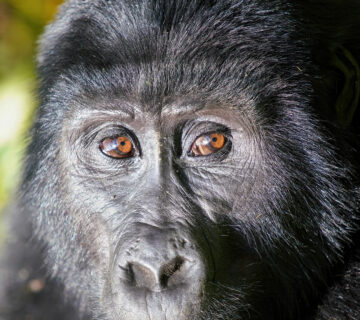
Facts about Mountain Gorillas in Africa.
Facts about Mountain Gorillas in Africa.: The largest apes, gorillas inhabit lowland regions, woodlands, and marshes in East, Central, and Western Africa. There are two species of gorillas: the Eastern gorilla and the Western gorilla. Whereas the Eastern gorillas are separated into Mountain gorillas and Eastern lowland gorillas, the Western gorillas are separated into Western lowland gorillas and Cross River gorillas.
The mountain gorilla and the Eastern lowland gorilla, which are restricted to the Virunga Mountains and Kahuzi Biega National Park, are the two subspecies of eastern gorillas. In Equatorial Guinea, Gabon, Congo Brazzaville, Angola, the Central African Republic, Cameroon, and the Democratic Republic of the Congo, western lowland gorillas are more frequently found in zoos.
Only in the parks that border the three countries—the Volcanoes National Park in Rwanda, the Virunga National Park in the Democratic Republic of the Congo, and the Bwindi Impenetrable Forest and Mgahinga National Park in Uganda—can visitors see mountain gorillas, which are found only in East and Central Africa in the countries of Rwanda, Uganda, and the Democratic Republic of the Congo.
Because they are the most endangered gorilla species worldwide, mountain gorillas are the most fascinating and interesting subspecies of gorillas, even if there are other subspecies that live in other African countries in Central, East, and Western Africa.
Trekking with gorillas in the Bwindi impenetrable national park
The hazy mountains of Rwanda, Uganda, and the Democratic Republic of the Congo conceal mountain gorillas. Although the number of mountain gorillas is growing annually due to the three nations’ effective conservation methods, Uganda’s Bwindi Impenetrable National Park is home to more gorillas than Rwanda or Congo.
However, Rwanda is one of Africa’s most upscale gorilla trekking destinations. There are numerous facts about mountain gorillas in Africa because they are the most endangered ape in the world and are in danger from habitat loss and human activity. Rwanda has developed a flourishing economy around gorilla encounters, which are the only primate species on Earth with growing numbers. Some characteristics shared by mountain gorilla species are listed below.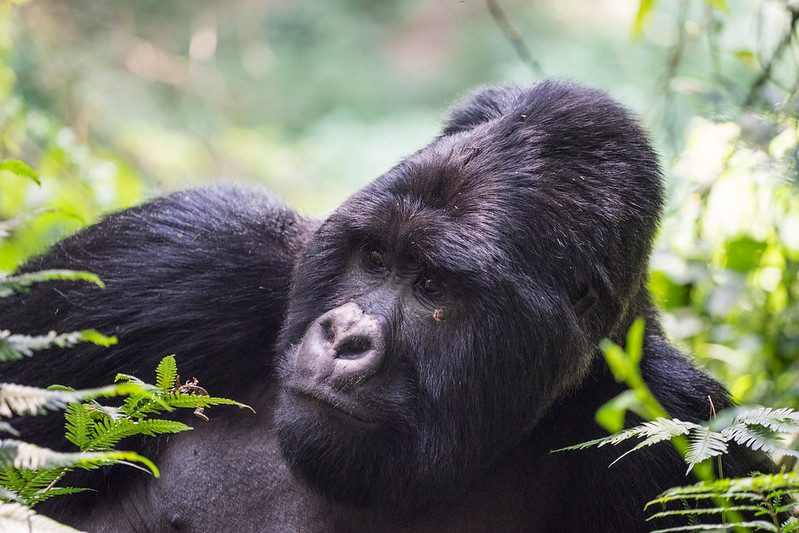
When necessary, mountain gorillas can growl, bark, or scream.
Without being provoked, mountain gorillas never attack or become hostile. Sometimes, but not often, the males will fight over the ladies.
Mountain gorillas use a range of body language and sounds to communicate.
Throughout the day, they groom, climb, swing from treetops, and playfully chase one another. Fruit, leaves, stalks, and shrubs make up their food.
Groups of mountain gorillas typically consist of 20 to 30 individuals or more.
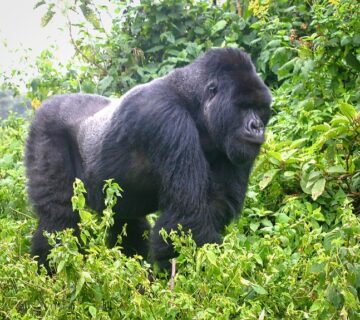
A dominating silverback is in charge of the mountain gorillas. The other males in the group have the option of leaving to find partners or remaining as bachelors in the group until they eventually succeed the dominant silverback. Once they reach adulthood, females typically go on to join a lone male or another group of their choosing.
It is common for females to switch groups over the course of their lives. Gorillas spend most of their time on the ground due to their size and weight. Both species use leaves, shrubs, and tree branches to construct nests on the ground where they can rest at the beginning and end of each day. Females and juveniles may construct their nests atop trees.
The following is a list of some of the distinctive characteristics that set these intriguing species apart.
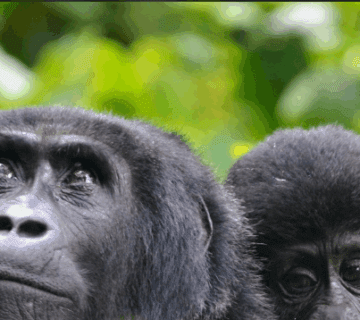
Similar to how each human finger print is different, each gorilla has a distinct nose print. Because it distinguishes them, they are utilized for identification.
Humans and gorillas have the same DNA.
In comparison to lowland gorillas, mountain gorillas are typically larger and have longer hair. They also have shorter arms.
Human hands and feet are identical to those of gorillas. With the exception of the thumbs and big toes, they nearly look identical.
Gorillas are highly clever creatures that can be trained to understand basic sign language and interact with people. Please keep in mind that they are still wild creatures, so even when they become accustomed to something, their reactions can still be unexpected.
The world’s only home of both mountain and lowland gorillas is Central Africa, which includes Uganda, Rwanda, and Congo. Fantastic, huh?
Omnivores include gorillas. Only plant roots, tree bark, shoots, fruits, vines, and possibly tiny insects are consumed by them.
In comparison to other primates, such as chimpanzees, where the male gorilla is twice as large as the female, these are the largest primates.
The silverback, the dominant male, is in charge of the group’s protection and serves as its leader until a more powerful male overthrows it. Gorillas travel in small groups of fewer than thirty.
Despite being wild, gorillas are generally peaceful and quiet, yet they may retaliate if they feel threatened. Because gorillas are so strong, it would take around six powerful, well-built men to subdue one.
About 400 pounds is the weight of the male gorilla, and 200 pounds is the weight of the female.
The fact that these animals construct a fresh nest each night to sleep in is another fascinating truth.
They are thought to live for about 35 years.
They give birth to one child after an 8.5-month gestation period.
Why Each Gorilla’s Unique Nose Print Genuinely Functions Like a Human Fingerprint for Identification
Since researchers genuinely use this distinctive feature to track individual gorillas over years of observation, this identification method genuinely allows scientists and guides to follow specific animals’ life stories across decades of habituation work. All in Africa Safaris can share how guides use nose-print identification during your trek.
How the Nightly Nest-Building Habit Genuinely Reveals Gorillas’ Sophisticated Environmental Adaptation
Since gorillas genuinely construct a fresh nest from leaves and branches every single night, this behavior genuinely demonstrates a level of environmental problem-solving that many visitors don’t expect from a wild primate species.
Why the Silverback’s Leadership Role Genuinely Extends Beyond Simple Dominance Into Active Group Protection
Since the dominant male genuinely bears responsibility for defending the entire family against threats, understanding this role genuinely adds weight to encountering a silverback during a trek, recognizing him as protector rather than merely the largest individual. All in Africa Safaris can help you understand silverback behavior during your trekking encounter.
How Rwanda’s Thriving Conservation Economy Genuinely Demonstrates That Tourism Can Directly Aid Species Recovery
Since mountain gorillas genuinely remain the only great ape species with a growing population, Rwanda’s tourism-funded conservation model genuinely offers a real-world example of how responsible wildlife tourism can reverse, not just slow, a species’ decline.
Why the 98% Shared DNA Genuinely Makes Trekking Feel More Like Recognition Than Simple Observation
Since gorillas genuinely share this much genetic material with humans, watching their expressions, social bonds, and problem-solving genuinely creates a sense of familiarity that observing more distantly related wildlife simply doesn’t produce. All in Africa Safaris can share more about the behavioral parallels you’ll observe during your trek.
How Female Gorillas Switching Groups Genuinely Reflects a Complex, Ongoing Social Structure
Since females genuinely transfer between groups throughout their lives rather than remaining permanently in their birth family, this pattern genuinely shows mountain gorilla society operates with more fluidity than a simple fixed family unit.
Why Gorillas’ Generally Peaceful Temperament Genuinely Contrasts With Common Public Misconceptions
Since these animals genuinely avoid conflict unless provoked or threatened, understanding this true temperament genuinely helps trekkers approach their encounter with appropriate respect rather than unfounded fear based on outdated stereotypes. All in Africa Safaris can set realistic expectations for gorilla behavior before your trek.
How the Eight-and-a-Half-Month Gestation Period Genuinely Underscores the Slow Pace of Population Recovery
Since each birth genuinely requires this extended gestation followed by years of dependent infancy, understanding this reproductive timeline genuinely explains why mountain gorilla conservation requires such sustained, long-term commitment to show measurable results.
Why the Near-Identical Hand and Foot Structure Genuinely Reinforces the Deep Evolutionary Connection
Since gorilla hands and feet genuinely resemble human anatomy so closely apart from thumb and toe proportions, observing this similarity firsthand genuinely deepens the sense of kinship many trekkers describe feeling during their encounter.
How Understanding Gorilla Intelligence Genuinely Changes How Trekkers Interpret Their Behavior
Since gorillas genuinely demonstrate trainable cognitive abilities including basic sign language comprehension in documented cases, recognizing this intelligence genuinely shifts how visitors read the subtle communication happening during a trekking encounter. All in Africa Safaris can share more insights into gorilla intelligence and communication.
Why the Fresh Nest Habit Genuinely Applies to Both Ground-Dwelling Adults and Tree-Nesting Juveniles
Since females and younger gorillas genuinely sometimes construct nests in trees while larger adults genuinely stay ground-based, this distinction genuinely reflects how body size and safety considerations shape nesting behavior differently across the group.
Planning Your Mountain Gorilla Trekking Adventure
From nose-print identification to nightly nest-building, genuinely mountain gorillas offer endlessly fascinating behavior to observe firsthand. All in Africa Safaris can turn this overview into a fully confirmed itinerary tailored to your travel dates.