
Elephant Matriarchs: How One Female Leads the Herd
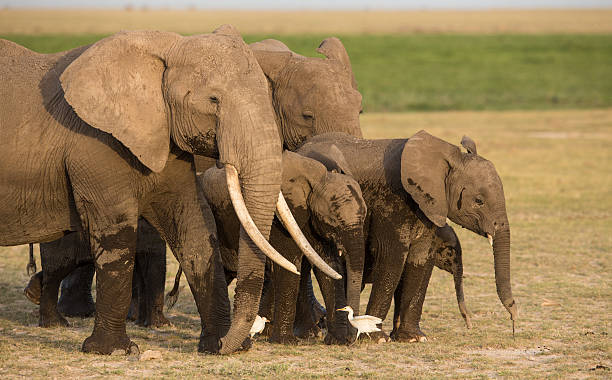
The morning sun rises over Kenya’s Amboseli National Park as a family of elephants walks slowly across the open grasslands. At the front is an older female with long tusks and a weathered face. Behind her, younger females guide their calves through the dust while several juveniles follow closely.
The older female pauses, raises her trunk and examines the air. Moments later, the family changes direction towards a distant feeding area.
She is the matriarch, one of the most important individuals in elephant society.
Elephant matriarch leadership and herd behaviour reveal how experience, memory and social relationships help African elephants survive.
Unlike many animal societies, elephant families are generally led by females. The matriarch’s knowledge can influence where the herd travels, how it responds to danger and how younger elephants develop.
Scientists studying elephants in Kenya have discovered that older matriarchs possess valuable social knowledge and may make better decisions when facing threats.
For safari travellers, understanding the role of these remarkable females makes every elephant encounter more meaningful.
1. What Is an Elephant Matriarch?
An elephant matriarch is the leading adult female of a family group.
She is often the oldest and most experienced female, although leadership also involves social relationships and the ability to influence other elephants.
African savannah elephant families commonly include related adult females and their offspring.
A matriarch may travel with her daughters, sisters, grandchildren and other relatives.
Adult males usually leave their birth families as they mature and follow different social patterns.
Main Responsibilities of a Matriarch
| Responsibility | Why It Matters |
|---|---|
| Guiding movement | Helps coordinate family travel |
| Finding resources | Uses experience of food and water |
| Recognising danger | Helps the family respond appropriately |
| Social knowledge | Distinguishes familiar elephants from strangers |
| Protecting calves | Supports coordinated family defence |
| Maintaining relationships | Influences group cohesion |
| Passing on experience | Creates opportunities for younger elephants to learn |
The matriarch does not control every action of every elephant. Leadership is part of a flexible social system.
2. How Does a Female Become the Matriarch?
Leadership in a natural elephant family generally passes to another experienced female when the previous matriarch dies or can no longer lead.
Often, an older daughter, sister or another senior female assumes the role.
There is no formal contest or ceremony.
The transition emerges through existing family relationships and group behaviour.
However, becoming the matriarch does not instantly give a female the knowledge accumulated by her predecessor.
Experience develops over many years.
This is one reason the loss of an older female can affect a family beyond the immediate emotional and social disruption.
3. Why Are Older Female Elephants So Important?
Elephants are exceptionally long-lived mammals.
Over several decades, a female may experience droughts, predator encounters, changes in vegetation and interactions with many other elephant families.
These experiences provide information that younger animals may not possess.
An older matriarch can draw on memories of previous conditions when responding to familiar challenges.
Scientists have shown that families with older matriarchs often perform better in certain social and threat-recognition tasks.
However, age alone does not guarantee good leadership in every situation.
The value of experience depends on the challenges the family encounters.
4. What Did the Famous 2001 Research Discover?
One of the most important studies of elephant matriarchs was published in the journal Science in 2001.
Researchers working with African elephants in Amboseli examined how family groups responded to recorded elephant calls.
The study tested whether elephants could distinguish familiar individuals from unfamiliar ones.
Families with older matriarchs demonstrated better social discrimination.
This suggested that experienced females hold knowledge benefiting the wider group.
The researchers also identified a possible relationship between this social knowledge and reproductive success.
Their findings provided important evidence that older individuals can influence the survival and functioning of social animal groups.
5. How Do Matriarchs Recognise Other Elephants?
Elephants communicate through vocalisations, body movements, touch and chemical signals.
Some calls carry information about the caller’s identity.
A matriarch may recognise individuals encountered during earlier social interactions.
This knowledge can help her assess whether an approaching elephant is familiar or unfamiliar.
Social Recognition and Its Benefits
| Information | Possible Benefit |
|---|---|
| Familiar family calls | Helps maintain contact |
| Unfamiliar calls | Supports cautious assessment |
| Recognised individuals | Helps manage social encounters |
| Group relationships | Supports social stability |
| Previous interactions | Informs responses to other elephants |
Elephants have complex social networks, and recognition is not limited to the matriarch. Her experience may nevertheless provide a particular advantage.
6. How Does a Matriarch Protect the Herd From Lions?
Lions can threaten young elephants, particularly vulnerable calves.
Adult elephants are powerful, but protecting younger members requires coordination.
In 2011, researchers published a study examining how elephant families responded to recorded lion roars.
The experiments compared calls from different numbers and sexes of lions.
Families led by older matriarchs responded more appropriately to certain dangerous situations, particularly those involving male lions.
The findings suggested that experience helps matriarchs assess threats.
However, a matriarch does not physically defend every calf alone.
Other adult females may also participate in protective behaviour.
7. How Do Elephants Protect Their Calves?
Elephant families often cooperate when responding to danger.
Adults may gather around vulnerable calves, adopt alert postures or move together.
A matriarch’s response can influence the actions of other family members.
Possible Defensive Behaviours
- Adults gathering more closely.
- Calves moving between larger elephants.
- Increased alertness.
- Ears spreading and trunks lifting.
- Changes in walking direction.
- Vocal communication.
- Coordinated movement away from danger.
These behaviours depend on the particular threat.
A group becoming closely packed does not necessarily mean a predator is nearby.
Safari visitors should allow elephants space and avoid approaching protective adults.
8. How Do Matriarchs Remember Water Sources?
Elephants need substantial quantities of water, making reliable water access important.
During dry periods, families may travel between feeding areas, rivers and waterholes.
Older females can possess valuable knowledge about landscapes and seasonal resources.
Such knowledge may help families make decisions during difficult environmental conditions.
However, researchers are still investigating exactly how ecological information is acquired, retained and transmitted.
It would be inaccurate to assume that every matriarch knows the location of every water source.
Local experience, environmental change and resource availability all influence movement.
9. Why Are Matriarchs Valuable During Drought?
Drought can reduce vegetation and make water more difficult to find.
Calves may be especially vulnerable when conditions become severe.
Research on African elephants has linked the presence and experience of older females with important survival advantages.
A recent scientific review discusses evidence that families with older matriarchs can experience better calf survival during droughts.
However, researchers also acknowledge that some apparent advantages may relate to body size, social dominance and resource access rather than memory alone.
The evidence supports the importance of experienced females without suggesting that they can prevent every drought-related loss.
10. Does the Matriarch Always Walk at the Front?
No.
Although photographs often show a large female leading a line of elephants, matriarchs do not always occupy the front position.
Family members may spread out while feeding.
Younger elephants sometimes move ahead, and adults may surround calves.
The matriarch’s importance lies in her influence over group decisions rather than her physical position.
Visitors should therefore not identify the leader simply by selecting whichever elephant is walking first.
Researchers use long-term observation and individual identification to establish family relationships and leadership.
11. How Do Elephant Families Make Decisions?
Elephant decision-making is more flexible than a simple system of one leader giving orders.
The matriarch often plays an influential role, especially when specialised knowledge is valuable.
However, other adult females can also influence movement and social behaviour.
For example, one female may begin travelling, while other family members respond.
Group decisions can emerge through movement, vocal signals and social relationships.
This coordinated behaviour helps elephants remain together while allowing individuals some freedom.
12. What Is an Elephant Family Group?
An elephant family is generally a social unit of related females and their dependent offspring.
Several families may associate temporarily, creating larger groups.
These associations are sometimes described as bond groups or clans, depending on the social structure being discussed.
Elephant Social Structure
| Group | Typical Members |
|---|---|
| Family unit | Related adult females and offspring |
| Larger female association | Multiple families interacting |
| Adult male group | Males associating outside female-led families |
| Solitary male | Adult bull travelling independently |
| Temporary gathering | Several groups meeting around resources |
The term herd is useful in everyday safari language but may describe either one family or a much larger temporary gathering.
13. What Role Do Grandmothers Play?
Older female elephants may remain socially connected to daughters and grandchildren.
Their presence can provide additional experience and support within the family.
Grandmothers may travel alongside calves and respond to social situations involving younger individuals.
However, care for calves involves several family members.
Researchers describe cooperative attention and support among related females, sometimes referred to as allomothering.
This means a young elephant can benefit from contact with adults other than its mother.
The matriarch’s contribution is part of this wider family network.
14. How Do Young Elephants Learn From Older Females?
Young elephants spend years developing their social and survival skills.
They observe adult movements, feeding choices and responses to unfamiliar situations.
Repeated interactions provide opportunities to learn.
For example, young elephants may follow adults to water or observe how family members respond to other groups.
Scientists recognise the importance of social learning, although the precise mechanisms vary between behaviours.
A matriarch’s experience can therefore influence younger generations indirectly through everyday family activities.
15. How Do Matriarchs Communicate With the Herd?
Elephants use a remarkable range of communication signals.
Low-frequency rumbles can travel considerable distances under suitable conditions.
They also communicate through touch, body posture, trunk movements and scent.
Some rumbles produce vibrations that can travel through the ground.
These signals may help elephants maintain contact or respond to changes in their surroundings.
Common Communication Methods
| Signal | Possible Function |
|---|---|
| Low-frequency rumble | Contact and coordination |
| Trumpeting | Excitement, alarm or other intense states |
| Trunk touching | Social interaction |
| Ear and body movements | Visual signalling |
| Scent detection | Information about individuals or surroundings |
| Ground vibration | Additional sensory information |
The meaning of a signal depends on context, not simply the sound or movement alone.
16. What Happens When a Matriarch Dies?
The death of a matriarch can create major changes within an elephant family.
A surviving senior female may assume leadership.
However, the group may lose important ecological and social knowledge.
Researchers studying elephant populations have raised concerns about the long-term consequences of removing experienced females.
Younger leaders may not possess the same ability to recognise threats or navigate difficult social situations.
In some cases, social disruption can affect group stability for years.
This is why the protection of older elephants is an important conservation concern.
17. How Does Poaching Affect Elephant Families?
Poaching can remove experienced adults from elephant populations.
The loss is not limited to the number of animals killed.
When a matriarch disappears, her family may also lose years of accumulated knowledge.
Calves may become orphaned, and surviving elephants may experience changes in social relationships.
Scientific research on socially disrupted elephant populations highlights the importance of preserving stable family structures.
Effective anti-poaching measures therefore protect both individual animals and the knowledge held within elephant societies.
18. Where Can You Observe Elephant Matriarchs in East Africa?
East Africa offers excellent opportunities to watch female-led elephant families.
However, identifying the actual matriarch usually requires detailed knowledge of the group.
Recommended Elephant Safari Destinations
| Country | National Park | Elephant Experience |
|---|---|---|
| Kenya | Amboseli | Famous long-studied elephant families |
| Kenya | Tsavo East | Large landscapes and elephant movements |
| Tanzania | Tarangire | Elephant families, particularly around dry-season resources |
| Tanzania | Serengeti | Savannah and woodland elephants |
| Uganda | Murchison Falls | Family groups in grassland and riverine habitats |
| Uganda | Queen Elizabeth | Elephants across savannah and woodland |
| Rwanda | Akagera | Elephant families within a protected savannah ecosystem |
An experienced guide can explain family behaviour even when individual elephants are not formally identified.
19. How to Recognise Matriarch Leadership on Safari
Visitors can watch for coordinated movements and responses among adult females.
One older elephant may appear particularly influential when the family changes direction or reacts to disturbance.
However, age is difficult to determine precisely from appearance alone.
Large tusks or a heavily wrinkled face do not automatically prove that an individual is the leader.
Behaviours Worth Watching
- Adult females responding to one another’s movements.
- Calves remaining close to their mothers.
- Families gathering around young elephants.
- Older females becoming attentive to unfamiliar sounds.
- Coordinated changes in direction.
- Rumbles and trunk contact during social interactions.
These observations can reveal social organisation without requiring visitors to approach closely.
20. Why Protecting Matriarchs Matters
Elephant conservation is not only about maintaining population numbers.
It also involves preserving stable social relationships and opportunities for knowledge transfer.
Older females can provide experience that younger animals have not yet acquired.
Scientific studies demonstrate advantages in social recognition and predator assessment among families led by older matriarchs.
Protecting these animals helps maintain functioning family groups.
This is particularly important as elephants face habitat fragmentation, human-wildlife conflict and illegal killing.
Conservation strategies that preserve social stability can complement efforts to protect habitat and reduce mortality.
Frequently Asked Questions
Is Every Elephant Herd Led by a Female?
African elephant family units are normally female-led. However, temporary gatherings can contain several families, each with its own matriarch.
Is the Matriarch Always the Oldest Elephant?
Often, but leadership also depends on relationships, experience and the group’s circumstances.
What Happens When a Matriarch Dies?
Another experienced female may assume leadership, although the family can lose valuable social and ecological knowledge.
Do Male Elephants Follow Matriarchs?
Young males remain with their birth families before gradually becoming more independent. Mature males generally live outside permanent female-led family units.
Can Matriarchs Recognise Danger?
Yes. Scientific experiments demonstrate that older matriarchs can be particularly effective at distinguishing certain social and predator-related signals.
The Wisdom Behind Elephant Leadership
Elephant matriarchs demonstrate how experience can influence survival in the wild.
These older females often guide family movements, recognise social relationships and help the herd respond to danger.
Their importance extends beyond physical strength or age.
Decades of experience can provide knowledge that younger elephants have not yet developed.
Research in Kenya’s Amboseli ecosystem has shown that older matriarchs can make better decisions in certain challenging situations.
For travellers watching elephants in Amboseli, Tarangire, Murchison Falls or Akagera, these findings make ordinary herd movements more fascinating.







No comment