
How Baby Elephants Learn to Use Their Trunks
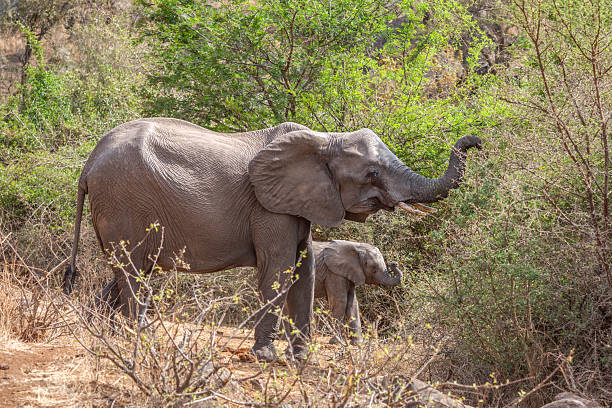
The morning sun rises over Kenya’s Amboseli National Park as a family of elephants moves through the grasslands. An adult female pulls up a mouthful of fresh grass with her trunk, shakes off the soil and places the food into her mouth.
Beside her, a young calf tries to do the same thing. It stretches its small trunk towards the grass, curls it awkwardly and drops the vegetation before reaching its mouth.
A few moments later, the calf tries again.
How baby elephants learn to use their trunks is one of the most fascinating parts of elephant development. Although calves are born with fully formed trunks, they are not born with the precise coordination demonstrated by adults.
They gradually develop the ability to grasp food, collect water, investigate objects and communicate through touch.
This learning process involves physical development, repeated practice and interactions with experienced family members.
For travellers visiting Uganda, Kenya, Tanzania or Rwanda, watching a calf explore its surroundings offers a memorable glimpse into elephant family life.
1. Why Is an Elephant’s Trunk So Important?
An elephant’s trunk is an elongated combination of the nose and upper lip.
It is one of the most versatile structures in the animal kingdom.
Adult elephants use their trunks for breathing, smelling, feeding, drinking, touching and producing sounds.
They can handle delicate objects and move heavy vegetation.
Main Uses of an Elephant’s Trunk
| Function | How It Helps |
|---|---|
| Feeding | Collects grass, leaves and branches |
| Drinking | Draws water into the trunk and transfers it to the mouth |
| Smelling | Detects food, other elephants and environmental information |
| Touching | Supports social communication |
| Dust bathing | Throws dust and soil onto the body |
| Exploring | Investigates unfamiliar objects |
| Breathing | Provides an airway through the nostrils |
Young elephants must gradually learn to coordinate these different functions.
2. Are Baby Elephants Born Knowing How to Use Their Trunks?
Not completely.
A newborn elephant can move its trunk, but fine control develops over time.
The muscles and nervous system must learn to work together to produce accurate movements.
During the first weeks, a calf may swing its trunk without successfully grasping anything.
It may also curl the trunk towards its mouth or touch nearby objects.
Researchers studying African elephant calves have documented gradual changes in trunk control during early development.
These movements are normal parts of learning rather than signs that something is wrong.
3. Why Do Baby Elephants Look Clumsy?
An elephant’s trunk is an unusually complex muscular structure.
Unlike a human arm, it does not contain bones or joints along its length.
Its movements depend on coordinated muscle contractions.
For a young calf, controlling this flexible structure takes practice.
An attempt to pick up grass may require several movements before the trunk tip reaches the correct position.
The calf must also coordinate its trunk with its head, mouth and body.
This explains why young elephants sometimes appear clumsy while feeding or investigating objects.
4. How Does Trunk Control Develop With Age?
Elephant calves develop at different rates, but researchers have identified broad patterns.
During early life, calves depend primarily on milk while gradually exploring vegetation and improving motor control.
Baby Elephant Trunk Development
| Age | Common Development |
|---|---|
| Birth to 1 month | Basic movement with limited precision |
| 1–3 months | Increasing exploration and attempts to handle objects |
| 3–6 months | More successful handling of vegetation |
| 6–12 months | Improved feeding and drinking coordination |
| Around 1 year | Much more developed trunk control |
| Beyond 1 year | Continued refinement through daily experience |
These are approximate stages, not strict deadlines.
A calf’s progress depends on individual development and circumstances.
5. How Do Baby Elephants Learn to Pick Up Grass?
Feeding is one of the most important skills a young elephant develops.
Adult elephants use their trunks to pull, gather and manipulate vegetation before eating.
A calf may initially attempt to imitate these movements without much success.
It might grasp a small bunch of grass but drop it while trying to bring it towards its mouth.
With repeated practice, the movement becomes smoother.
The calf gradually learns to position the trunk tip, hold vegetation and transfer it successfully.
Researchers have observed young elephants sampling plants long before solid food becomes their main source of nutrition.
6. Do Baby Elephants Drink Milk Through Their Trunks?
No. Elephant calves nurse directly from their mothers using their mouths.
The mother’s mammary glands are located between her front legs.
A young calf positions its mouth against a teat to suckle.
The trunk may move out of the way or curl during nursing, but it is not used as a drinking straw for milk.
This distinction often surprises first-time safari visitors.
Milk Drinking vs Water Drinking
| Activity | How It Works |
|---|---|
| Nursing | Calf suckles directly with its mouth |
| Drinking water as a newborn | May use its mouth directly |
| Drinking water with developed trunk control | Draws water into the trunk and pours it into the mouth |
| Feeding on vegetation | Uses the trunk to collect and transfer plant material |
Calves continue nursing while gradually learning to eat more solid food.
7. How Do Baby Elephants Learn to Drink Water?
Adult elephants draw water into their trunks and then release it into their mouths.
They do not normally drink by sending water directly from the trunk into the stomach.
This process requires careful coordination.
Young calves may initially bend down to drink using their mouths.
As they grow, they practise collecting water with their trunks.
Early attempts may result in spills or incomplete transfers.
Research on African elephant development indicates that trunk-assisted drinking becomes more reliable during the first year.
8. Why Do Baby Elephants Suck Their Own Trunks?
Young elephants sometimes place the tips of their trunks into their mouths.
The behaviour may resemble a human child sucking a thumb.
Scientists have documented trunk-sucking in elephant calves, but its purpose is not necessarily identical to human thumb-sucking.
It may occur during exploration, self-directed activity or periods of comfort.
The behaviour also provides opportunities for the calf to move and position its trunk.
Visitors should avoid assuming that every instance means the calf is hungry, anxious or sleepy.
9. Do Baby Elephants Learn by Watching Their Mothers?
Yes. Social learning plays an important role in elephant development.
Young elephants spend considerable time near their mothers and other family members.
They can observe how adults select plants, handle vegetation and interact with their surroundings.
Repeated exposure helps calves become familiar with different foods and social behaviours.
However, learning is not simply copying every adult movement.
Physical development and individual experimentation also contribute.
A calf must practise controlling its own trunk even after observing the correct movement.
10. What Role Do Aunts and Older Sisters Play?
Elephant families are generally organised around related females and their offspring.
Young calves often interact with older sisters, aunts and other female relatives.
These individuals may provide protection and opportunities for social contact.
Researchers describe care offered by females other than the mother as allomothering.
An older female may touch a calf with her trunk, remain close while it explores or help maintain contact within the herd.
Such interactions contribute to the calf’s social development.
They also provide opportunities for young elephants to experience different forms of trunk-based communication.
11. How Do Baby Elephants Use Their Trunks During Play?
Play is an important part of young elephant behaviour.
Calves may chase one another, push gently, explore vegetation or touch each other with their trunks.
Some wrap their trunks around companions during playful encounters.
These activities provide opportunities to practise movement and social interaction.
Common Playful Trunk Behaviours
- Curling the trunk towards the mouth.
- Touching another calf.
- Picking up and dropping vegetation.
- Reaching towards the mother’s tail.
- Exploring mud or water.
- Moving the trunk from side to side.
- Investigating unfamiliar objects.
Not every action has a proven learning function, but play and exploration are important parts of development.
12. Can Baby Elephants Smell With Their Trunks?
Yes. The trunk contains the elephant’s nostrils and provides a powerful sense of smell.
Young elephants use smell as they explore their environment.
A calf may raise its trunk towards a scent or bring the trunk tip close to vegetation.
Over time, it becomes better at coordinating movements involved in investigating objects and food.
Smell helps elephants gather information about other animals, water sources and their surroundings.
However, newborn sensory abilities and later learned behaviours should not be confused.
Calves possess the sensory system at birth while continuing to develop the skills required to use it effectively.
13. How Do Calves Communicate Through Touch?
Elephants frequently use their trunks during social interactions.
A mother may touch her calf, while youngsters may reach towards familiar family members.
Trunk contact can occur during greetings, reassurance, exploration or playful behaviour.
The meaning depends on the situation.
Trunk Contact and Social Interaction
| Behaviour | Possible Context |
|---|---|
| Mother touching calf | Care and social contact |
| Calves touching trunks | Play or exploration |
| Trunk placed near another elephant’s mouth | Social investigation |
| Trunk reaching towards an adult | Contact-seeking |
| Repeated touching during a reunion | Social greeting |
These gestures are part of the communication system that young elephants gradually learn to understand.
14. What Happens When Calves Play in Water?
Water provides many opportunities for young elephants to practise trunk movements.
A calf may splash, push water with its trunk or investigate the surface of a pool.
As coordination improves, it becomes better at collecting water and transferring it to its mouth.
Adult elephants also use water and mud to cool themselves and maintain skin comfort.
Calves may participate in these activities alongside their families.
However, visitors should not interpret every splash as deliberate training.
Play, exploration and ordinary physical activity can overlap.
15. What Did Scientific Research Discover?
A 2010 study examined early development among 12 African elephant calves born in managed care.
Researchers recorded developmental milestones, including changes in trunk use and interactions with adult elephants.
The study found a gradual progression of physical and behavioural skills.
A separate 2020 field study of free-ranging Asian elephant calves in southern India examined trunk motor control.
It found that trunk skills developed gradually, taking approximately a year to become well established.
Although Asian and African elephants differ, both studies support the conclusion that effective trunk use requires extended development.
16. Why Is the First Year So Important?
During the first year, young elephants undergo major physical and behavioural changes.
They become steadier on their feet, explore more independently and develop better trunk coordination.
They also begin consuming greater amounts of vegetation while continuing to nurse.
The first year is therefore an important transition from complete dependence towards increasing independence.
However, elephants remain dependent on their mothers and wider family groups for much longer.
Learning continues well beyond the first year.
17. Do Baby Elephants Have a Favourite Trunk Side?
Researchers have observed that some elephants prefer moving their trunks in one direction when collecting food.
This is sometimes compared with left- or right-handedness in humans.
A study of Asian elephant calves found that directional preferences could emerge early in development.
However, such preferences did not necessarily indicate advanced trunk control.
Whether similar patterns develop identically in every African elephant population remains a subject for further research.
Visitors may notice an adult repeatedly curling its trunk towards the same side when feeding.
18. Where Can You Watch Baby Elephants Learning?
East Africa offers excellent opportunities to observe elephant families with young calves.
The most rewarding sightings often involve relaxed family groups feeding or interacting naturally.
Places to Watch Elephant Calves
| Country | National Park | Wildlife Experience |
|---|---|---|
| Kenya | Amboseli National Park | Well-studied elephant families |
| Kenya | Tsavo East National Park | Elephants in expansive savannah habitats |
| Tanzania | Tarangire National Park | Family groups around seasonal resources |
| Tanzania | Serengeti National Park | Elephants feeding and travelling |
| Uganda | Murchison Falls National Park | Elephant families in grassland and riverine habitats |
| Uganda | Queen Elizabeth National Park | Elephants in woodland and savannah |
| Rwanda | Akagera National Park | Elephant families in a protected savannah ecosystem |
Calf sightings depend on local births, movements and individual family circumstances.
19. How to Photograph Baby Elephants Responsibly
Young elephants can provide memorable wildlife photography opportunities.
However, calves are closely protected by their mothers and other adults.
Never ask your safari guide to approach a calf closely or separate it from the family.
Photography Recommendations
| Technique | Benefit |
|---|---|
| Telephoto lens | Allows photography from a safe distance |
| Continuous shooting | Captures quick trunk movements |
| Wider framing | Includes calf and mother |
| Early morning light | Provides attractive natural lighting |
| Patience | Encourages observation of undisturbed behaviour |
Stay inside your vehicle where required and follow your guide’s instructions.
20. Frequently Asked Questions
Are Baby Elephants Born With Trunks?
Yes. Elephant calves are born with trunks, but precise movement control develops gradually.
How Long Does It Take to Learn Trunk Control?
Many important skills improve considerably during the first year, although development varies among individuals.
Do Baby Elephants Drink Milk Through Their Trunks?
No. They nurse directly from their mothers using their mouths.
Why Do Baby Elephants Swing Their Trunks?
Young calves are still developing coordination and frequently explore their surroundings through movement.
Can Baby Elephants Pick Up Small Objects?
Yes. Their ability to grasp and manipulate objects improves as their trunk control develops.
Learning One Movement at a Time
Watching a baby elephant learn to use its trunk offers a fascinating insight into animal development.
Although the trunk is present from birth, controlling it requires repeated practice and growing coordination.
Young calves gradually learn to collect vegetation, drink water, investigate objects and communicate through touch.
Their mothers and other family members provide protection and opportunities for social learning throughout this process.
For travellers visiting Amboseli, Tarangire, Murchison Falls, Queen Elizabeth or Akagera, observing a calf experimenting with its trunk can be just as memorable as watching a large elephant herd.







No comment