
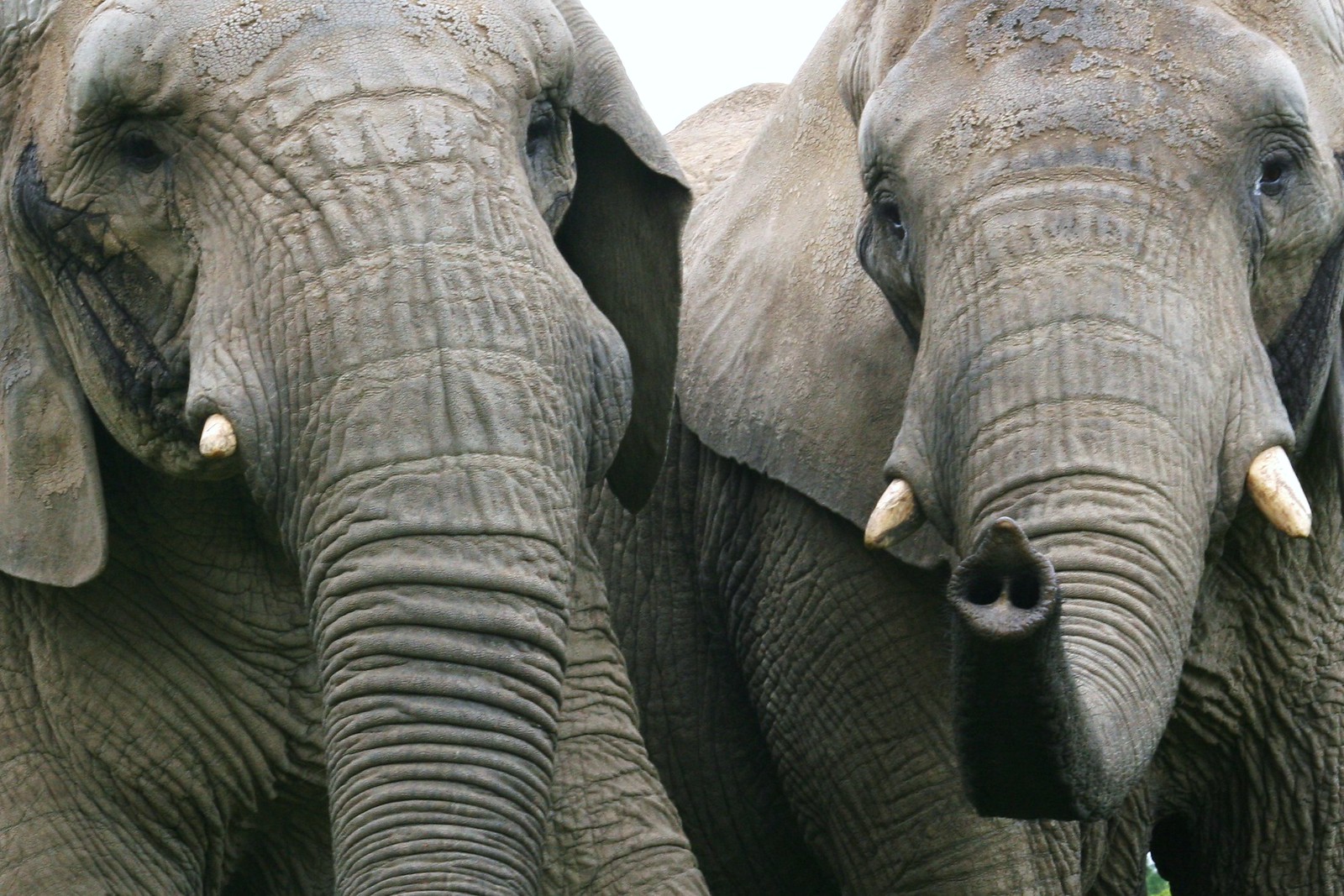
What is the difference between an African and an Asian elephant?
African and Asian elephants are the only two elephant groups living in the world today. Both are intelligent, highly social mammals with long trunks, large bodies and strong family relationships. They share many characteristics, but their physical appearance, habitats, behaviour and conservation challenges differ.
The easiest way to distinguish them is by looking at their ears, heads, backs, tusks and trunks. African elephants generally have much larger ears, a dipped back and two finger-like tips at the end of the trunk. Asian elephants have smaller ears, a rounded or arched back, a twin-domed head and only one finger-like tip on the trunk.
There is also an important distinction within Africa. Scientists recognise two African elephant species: the African savanna elephant and the African forest elephant. The savanna elephant is the largest of all elephant species, while the forest elephant is smaller and adapted to dense tropical forests.
How many elephant species are there?
There are three living elephant species recognised by modern scientific classification.
The African savanna elephant (Loxodonta africana) is found mainly in eastern and southern Africa. It inhabits grasslands, open savannahs, woodlands and other landscapes where food and water are available.
The African forest elephant (Loxodonta cyclotis) lives mainly in the tropical forests of Central and West Africa. It is smaller than the savanna elephant and has straighter tusks, more rounded ears and a more compact body.
The Asian elephant (Elephas maximus) occurs in parts of South and Southeast Asia. Its range includes countries such as India, Sri Lanka, Nepal, Bhutan, Bangladesh, Myanmar, Thailand, Cambodia, Laos, Vietnam, Malaysia and Indonesia.
Although African savanna and forest elephants share the same continent, they are genetically distinct species. Therefore, comparing African and Asian elephants involves recognising that Africa has two different elephant species with their own characteristics.
Physical differences between African and Asian elephants
The two elephant groups may look similar from a distance, but several features make identification relatively straightforward. You can often recognise the difference without seeing the entire animal.
Size and body weight
African savanna elephants are generally larger than Asian elephants. Adult male African savanna elephants can stand approximately 3 to 4 metres at the shoulder and weigh around 4,000 to 6,300 kilograms, although exceptional individuals may exceed these figures.
Asian elephants are usually smaller. Adult males commonly stand around 2.5 to 3.5 metres at the shoulder and weigh approximately 3,000 to 5,000 kilograms.
African forest elephants are smaller than African savanna elephants and can be closer in size to Asian elephants. Their compact bodies help them move through dense forest vegetation.
Size varies according to sex, age, nutrition and individual genetics. Adult males are generally much larger than females in both African and Asian elephant populations.
Ear size and shape
<PRIVATE_PERSON>
The ears provide one of the clearest ways to identify an African elephant. African savanna elephants have enormous, fan-shaped ears that can extend beyond the shoulders. Their shape is often compared to the outline of the African continent.
Asian elephants have smaller, more rounded ears. Their ears do not extend as far down the body as those of African savanna elephants.
African forest elephants also have rounded ears, although they remain distinct from the smaller ears of Asian elephants in overall size and shape.
Elephants use their ears for communication and temperature regulation. When an elephant flaps its ears, blood circulates through the many blood vessels inside them and releases heat into the surrounding air. This helps the animal regulate its body temperature, particularly in hot environments.
The large ears of African savanna elephants are especially useful in the warm, open habitats where they live.
Head shape
The shape of the head is another useful identification feature.
African savanna elephants generally have a fuller, rounded head with a single dome-like profile. Their forehead slopes gently towards the trunk.
Asian elephants have a more distinctive twin-domed head. Two rounded projections create a noticeable indentation along the centre of the forehead.
African forest elephants have a head shape associated with African elephants, although their smaller size and other physical characteristics make them different from savanna elephants.
When observing an elephant from the front or side, the forehead can help confirm what the ears and trunk already suggest.
Back shape
African savanna elephants generally have a concave or dipped back. The middle section appears lower than the shoulders and hindquarters, giving the animal a slightly saddle-shaped profile.
Asian elephants usually have a convex or arched back. Their upper body appears more rounded, with the highest point often around the middle of the back.
African forest elephants have a back that is generally straighter than that of savanna elephants.
This difference is useful when observing elephants walking through open grassland or woodland. Even when the tusks are not visible, the body profile can provide a clue to the species.
Tusks and teeth
Tusks are another important difference between African and Asian elephants.
Both male and female African elephants can develop tusks. These are elongated upper incisor teeth that continue growing throughout much of an elephant’s life. However, some individuals are naturally tuskless.
Male African elephants usually develop larger tusks than females. Tusks can be used for digging, stripping bark, moving branches, accessing water and defending against threats.
Asian elephants have a different pattern. Large tusks are mainly found in males, and not all males develop them. Female Asian elephants usually have small tusks called tushes, which may be barely visible beyond the upper lip. Some males also have small or poorly developed tusks.
The difference is particularly noticeable when comparing adult males and females. A female African elephant may have clearly visible tusks, while a female Asian elephant usually has much smaller ones.
Tusks have also made elephants targets of ivory poaching. Illegal hunting has reduced populations in several parts of Africa and Asia, although the scale and causes of pressure vary between regions.
Trunk shape and tip
An elephant’s trunk is one of its most important body parts. It combines the functions of the nose and upper lip, allowing the animal to breathe, smell, drink, feed, communicate and handle objects.
African elephants have two finger-like projections at the end of the trunk. These projections work together to grasp grass, leaves, small branches and other objects.
Asian elephants have one finger-like projection at the tip. They often curl the trunk around food or use the single projection to grip smaller items.
Both types have remarkable control over their trunks. They can pick up large branches, collect small pieces of food, spray water and touch other elephants during social interactions.
An elephant’s trunk contains tens of thousands of muscle units, giving it considerable strength and flexibility. It is also extremely sensitive, helping the animal explore its surroundings through touch and smell.
Skin and colour
African savanna elephants generally have grey, heavily wrinkled skin. Their skin folds help retain moisture and can hold mud and dust, which provide some protection from sunlight and biting insects.
Asian elephants also have grey skin, but it is often smoother in appearance. Some individuals have pink or pale patches around the ears, forehead, trunk and other areas.
African forest elephants may appear brownish or grey depending on the light, vegetation and soil around them. Their skin can also be covered with mud and forest debris.
Colour alone is not a reliable way to identify an elephant because dust, mud, lighting and individual variation can change its appearance.
Where do African and Asian elephants live?
African and Asian elephants occupy different continents and have adapted to a range of environments.
African elephant habitats
African savanna elephants inhabit grasslands, open woodland, shrubland and savannah ecosystems. They need extensive areas to find food and water because their daily feeding requirements are substantial.
They are found in several African countries, including Uganda, Kenya, Tanzania, Botswana, Zimbabwe, Zambia, Namibia and South Africa.
In Uganda, African savanna elephants can be seen in protected areas such as Queen Elizabeth National Park, Murchison Falls National Park and Kidepo Valley National Park. They are often encountered near rivers, waterholes and open feeding grounds.
African forest elephants live mainly in the tropical forests of Central and West Africa. Important populations occur in countries such as Gabon, the Republic of the Congo, the Democratic Republic of the Congo and Cameroon.
Their smaller bodies and straighter tusks are useful adaptations for moving through dense forest vegetation.
Asian elephant habitats
Asian elephants live in tropical and subtropical forests, grasslands, scrubland and mixed woodland. Their habitat requirements vary across their range, depending on rainfall, vegetation and access to water.
India supports one of the largest remaining populations of wild Asian elephants. Other important populations occur in Sri Lanka, Thailand, Myanmar, Malaysia and Indonesia.
Asian elephants often move between forests and open feeding areas. Their movements may bring them close to agricultural land and villages, creating conflict when they feed on crops or damage property.
Unlike African savanna elephants, Asian elephants are not naturally found in open African grasslands. Their distribution is restricted to parts of South and Southeast Asia.
Differences in behaviour and social structure
African and Asian elephants share many social characteristics. Both form family groups led by experienced females, communicate through sounds and body movements, and maintain strong relationships between mothers and calves.
However, their social organisation can vary according to habitat, food availability and local population conditions.
Family groups and leadership
Female African savanna elephants usually live in family groups led by a matriarch. She is often an older and experienced female who knows where to find water, food and safe resting areas.
Several related females and their offspring may form a family unit. Larger groups sometimes come together temporarily at water sources or areas with abundant food.
Asian elephant females also form family groups led by an experienced female. Their groups may be smaller or more loosely organised, depending on habitat and local conditions.
In both groups, young elephants receive care and protection from their mothers and other females. Calves remain dependent on their families for several years.
Male elephant behaviour
Male elephants generally leave their maternal family groups as they mature. They may live alone or associate with other males in bachelor groups.
Adult males sometimes join female herds, particularly during breeding periods. Their movements are influenced by food availability, competition and reproductive opportunities.
Older males may enter a condition known as musth, during which testosterone levels increase and the animal becomes more active and competitive. Musth males can be particularly aggressive, so wildlife observers should maintain a safe distance.
Communication
Both African and Asian elephants communicate using vocalisations, body movements, touch and scent.
They produce low-frequency sounds, including infrasonic calls that can travel over long distances. These calls help elephants maintain contact, coordinate movement and communicate information about possible threats.
Trunk touching, ear movements and body positioning also help convey social signals. Mothers use touch and vocalisations to maintain contact with their calves, while adults may greet familiar group members through trunk interactions.
What do African and Asian elephants eat?
Both African and Asian elephants are herbivores. They feed on a wide variety of plant material, including grass, leaves, roots, bark, fruits, branches and shrubs.
Their diets change according to habitat and season.
African savanna elephants eat grasses, leaves, tree bark, roots and fruit. During the wet season, fresh grass may be abundant, while dry-season feeding can involve more woody vegetation and tree bark.
African forest elephants consume fruit, leaves, bark and other forest vegetation. They play an important role in dispersing seeds through their droppings, helping maintain the diversity of tropical forests.
Asian elephants feed on grasses, bamboo, leaves, roots, bark, fruit and cultivated crops when they enter agricultural areas. Their diets vary considerably across South and Southeast Asia.
Elephants spend many hours feeding each day because their large bodies require substantial amounts of plant material. An adult may consume around 100 to 150 kilograms of vegetation daily, although the amount varies with body size, diet and environmental conditions.
They also need regular access to water for drinking and bathing. During hot weather, elephants may use rivers, pools and mud wallows to cool themselves and protect their skin.
How long do African and Asian elephants live?
Both African and Asian elephants can live for several decades. Their lifespans are often estimated at around 50 to 70 years, although survival varies between individuals and populations.
African elephants in the wild may live for approximately 50 to 60 years, with some surviving longer. Asian elephants can also reach 60 years or more in favourable conditions.
Their longevity depends on several factors, including access to food and water, disease, injuries, habitat conditions and human activity.
Elephants have a slow reproductive rate. Pregnancy lasts approximately 22 months, making it the longest gestation period among living mammals. A female usually gives birth to one calf, although twins occur occasionally.
Calves depend on their mothers and other family members for protection and learning. Females may reproduce every four to five years or longer, depending on their condition and environmental circumstances.
Because elephants reproduce slowly, population recovery can take many years after heavy losses.
Which elephant is more endangered?
Both African and Asian elephants face serious conservation challenges, but their threats differ.
African savanna elephants are classified as Endangered, while African forest elephants are classified as Critically Endangered on the IUCN Red List. Asian elephants are also classified as Endangered.
African elephants face significant pressure from illegal ivory hunting, habitat loss and human-elephant conflict. In some areas, elephants are killed for their tusks, while expanding farms and settlements reduce the land available to them.
African forest elephants face particularly serious pressure from poaching and the loss of tropical forest habitat. Their slow reproductive rate makes it difficult for populations to recover quickly.
Asian elephants face major threats from habitat fragmentation and conflict with people. As forests become divided by roads, farms and settlements, elephants may lose access to traditional feeding and migration areas.
Crop raiding can lead to retaliatory killing, while roads and railway lines create additional risks. Illegal capture and trade also affect some Asian elephant populations.
Conservation efforts include protecting national parks, maintaining wildlife corridors, reducing poaching, monitoring populations and helping communities live more safely alongside elephants.
Where can you see African elephants in East Africa?
East Africa offers some of the best opportunities to observe African savanna elephants in natural habitats. Uganda, Kenya and Tanzania all have important elephant populations.
In Uganda, Queen Elizabeth National Park is a well-known destination for elephant viewing. Visitors may encounter herds feeding in open grassland, moving through woodland or gathering near the Kazinga Channel.
Murchison Falls National Park also supports elephants across its savannah and woodland habitats. Game drives in the northern sector provide opportunities to see elephants feeding and moving across the plains.
Kidepo Valley National Park offers another setting for observing elephants in a more remote savannah environment. Its open landscapes and surrounding mountains create a distinctive wildlife experience.
In Kenya, Amboseli National Park is famous for its large elephants and views of Mount Kilimanjaro. The Maasai Mara also supports elephants, which can be seen moving through grassland and woodland habitats.
Tanzania’s Serengeti National Park, Tarangire National Park and Ruaha National Park provide further opportunities to observe African elephants. Tarangire is particularly known for its large elephant herds and impressive baobab landscapes.
These destinations offer opportunities to observe the animals’ natural behaviour, including feeding, bathing, social interactions and movement between habitats.
Can African and Asian elephants live together?
African and Asian elephants do not naturally share the same geographical range. African elephants are native to Africa, while Asian elephants are native to South and Southeast Asia.
They may be kept in the same zoological facilities or managed environments, but this does not mean they naturally form mixed herds. Their social relationships are based on their own species and established family structures.
Although they have similar physical characteristics, they belong to different genera and have evolved separately over millions of years.
They should therefore be understood as distinct species with different evolutionary histories, habitats and conservation needs.
Why both elephant species are important to the environment
Elephants are often described as ecosystem engineers because their feeding and movement patterns influence the environments in which they live.
African savanna elephants can open up dense vegetation by pushing over trees, breaking branches and feeding on shrubs. This can create open areas used by grasses and other wildlife.
African forest elephants help maintain tropical forest diversity by spreading seeds through their droppings. Some tree species depend heavily on elephants to disperse their large fruits over long distances.
Asian elephants also influence forest and grassland ecosystems. Their feeding, movement and seed dispersal help shape vegetation patterns and support ecological processes.
Protecting elephants therefore benefits many other species. Conservation programmes that maintain large habitats, healthy vegetation and wildlife corridors help support entire ecosystems.
How to identify an African or Asian elephant during a safari
When you see an elephant during a wildlife drive, begin by looking at its ears. Large, fan-shaped ears usually indicate an African savanna elephant, while smaller, rounded ears suggest an Asian elephant.
Next, examine the trunk. African elephants have two finger-like projections at the tip, while Asian elephants have one. The head also provides a useful clue: African savanna elephants have a fuller, single-domed head, whereas Asian elephants have two prominent forehead domes.
Tusks can help with identification, but they should not be your only guide. Both male and female African elephants can have tusks, while only some male Asian elephants develop large tusks.
The shape of the back provides another useful distinction. African savanna elephants generally have a dipped back, while Asian elephants have a more rounded or arched profile.
Understanding these features makes it easier to recognise the different elephant species and appreciate their adaptations. Whether you encounter a large herd in Uganda’s Queen Elizabeth National Park, an elephant family in Kenya’s Amboseli or a forest elephant in Central Africa, each species plays an important role in the natural environment.



No comment