
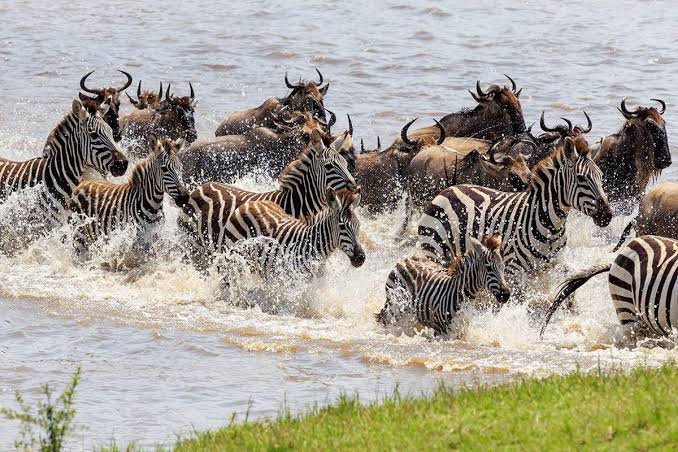
Why Zebras and Wildebeest Migrate Together
Why zebras and wildebeest migrate together is one of the most interesting questions surrounding Africa’s Great Migration. Every year, enormous herds of wildebeest and plains zebras move across Tanzania’s Serengeti National Park and Kenya’s Maasai Mara ecosystem in search of suitable grazing and reliable water. Although these animals belong to different families and have different feeding habits, they follow similar seasonal movements through the grasslands of East Africa.
Watching zebras and wildebeest travelling across the savannah is one of the most memorable experiences of an African safari. Large herds gather on open plains, graze near one another and sometimes approach dangerous river crossings during the same migration period. Their movements are mainly driven by rainfall and changing grass conditions, although their different diets and responses to predators influence how they use the landscape.
For travellers planning a Serengeti or Maasai Mara safari, understanding how these two species interact provides a fascinating perspective on the Great Migration. Their relationship involves feeding differences, shared habitats, competition and the challenges of surviving in an environment where food and water change with the seasons.
What Is the Great Wildebeest Migration?
The Great Migration is the seasonal movement of large herbivore populations across the Serengeti–Mara ecosystem in Tanzania and Kenya.
Approximately 1.2–1.5 million wildebeest participate in the wider migration, accompanied by hundreds of thousands of zebras and gazelles. Population estimates vary between surveys and years.
Unlike animals that migrate along a straight route, wildebeest and zebras move through a changing network of grazing areas.
Rainfall influences the growth of grass, while seasonal changes in food quality affect where the animals spend their time.
During the wetter months, large numbers gather on the short-grass plains of southern Serengeti. As conditions become drier, many herds move towards western and northern grazing areas.
Quick Facts About Wildebeest and Zebra Migration
| Feature | Wildebeest | Plains Zebra |
|---|---|---|
| Scientific name | Connochaetes taurinus | Equus quagga |
| Animal family | Bovidae | Equidae |
| Main diet | Grasses, especially nutritious young growth | Wide range of grasses |
| Digestive system | Ruminant | Hindgut fermenter |
| Main habitat | Savannah and grassland | Grassland and open woodland |
| Migration driver | Access to suitable grazing and water | Food availability, water and safety |
| Main predators | Lions, hyenas and crocodiles | Lions, hyenas and crocodiles |
| Seasonal range | Serengeti–Mara ecosystem | Serengeti–Mara ecosystem |
1. Zebras and Wildebeest Follow the Same Rainfall Patterns
Rainfall is one of the main reasons zebras and wildebeest migrate through the same region.
The Serengeti–Mara ecosystem experiences seasonal changes in rainfall that influence the growth and nutritional quality of grasses.
When rain falls, fresh vegetation begins growing across suitable areas of the savannah.
These new feeding opportunities attract grazing animals.
Both wildebeest and zebras respond to the changing distribution of food, although they do not always select exactly the same grass patches.
Why Rainfall Influences Their Movement
During wetter periods, fresh grass becomes available across parts of southern Serengeti.
As the dry season develops, some grasslands become less productive, encouraging migrating animals to search for alternative feeding areas.
The animals may travel considerable distances before finding suitable conditions.
However, the migration does not follow a perfectly predictable calendar.
Rainfall can arrive early, late or unevenly across different regions, changing where herds gather.
This explains why the precise location of migrating zebras and wildebeest varies from year to year.
2. Zebras and Wildebeest Eat Grass Differently
One of the most important differences between zebras and wildebeest involves their digestive systems and feeding preferences.
Wildebeest are ruminants that rely on microbial fermentation in a specialised stomach.
They generally benefit from nutritious grasses that provide sufficient protein and energy.
Zebras are hindgut fermenters, allowing them to process larger quantities of fibrous vegetation.
This enables zebras to make use of some grasses that are less suitable for wildebeest.
How Their Diets Compare
Zebras can consume relatively coarse grasses, including taller or more fibrous vegetation.
Wildebeest generally select shorter, nutritious grass when it is available.
These differences influence how the animals distribute themselves across grazing areas.
In some circumstances, zebra grazing can change grass structure and improve access to shorter vegetation for other herbivores.
However, zebras and wildebeest also compete for food, particularly when suitable grazing is limited.
Their feeding relationship is therefore more complex than the common explanation that zebras always prepare grass for wildebeest.
3. Do Zebras Lead Wildebeest During Migration?
Safari visitors sometimes hear that zebras lead the migration because they eat taller grass before wildebeest arrive.
Although zebras may travel ahead of wildebeest in particular areas, there is no permanent arrangement in which one species always leads the other.
Scientific research published in 2024 examined the movements and feeding behaviour of migratory herbivores in Serengeti National Park.
The study found that competitive grazing can encourage zebras to move ahead of wildebeest, while smaller gazelles may benefit from grazing changes created by larger herbivores.
This suggests that movement patterns are influenced by feeding competition and habitat conditions rather than a fixed leadership system.
Why Zebras Sometimes Move Ahead
Zebras can use areas containing taller, coarser grasses.
Wildebeest may prefer nearby patches containing shorter, more nutritious growth.
As grazing conditions change, the two species may separate or follow slightly different routes.
They can later gather in the same grasslands when suitable feeding opportunities become available.
4. Do Zebras and Wildebeest Protect Each Other From Predators?
Both species face threats from large African predators, including lions, spotted hyenas and Nile crocodiles.
Travelling through areas containing many herbivores can provide opportunities for earlier predator detection.
However, it is important to distinguish between sharing the same migration landscape and deliberately travelling together for protection.
Research using camera traps in the Serengeti found that wildebeest, zebras and gazelles were frequently recorded separately rather than consistently forming mixed-species groups.
This indicates that shared food resources and seasonal movements are major explanations for their overlapping migration routes.
How Group Living Can Improve Safety
Animals travelling in groups may benefit from several defensive advantages.
More individuals can detect potential predators approaching from different directions.
Large groups may also reduce the probability that a particular animal becomes the target of an attack.
However, predators can take advantage of large herbivore concentrations.
Lions and hyenas may hunt along migration routes, while crocodiles present additional risks near river crossings.
The relationship between herd size and individual safety therefore depends on the situation.
5. Wildebeest and Zebras Respond Differently to Danger
Although both species encounter similar predators, they do not always respond to threats in the same way.
Research tracking wildebeest and zebras in the Serengeti–Mara ecosystem found differences in how the animals selected feeding areas.
Wildebeest movements were strongly associated with access to high-quality grazing.
Zebras appeared to balance food availability against predation risk more noticeably.
These differences help explain why zebras and wildebeest may occupy neighbouring habitats without remaining in the same group.
How They Detect Predators
Both animals rely on sight, hearing and awareness of their surroundings.
Zebras have good vision and can detect movement across open grasslands.
Wildebeest are also alert to nearby activity and may react rapidly when other animals begin running.
When danger appears, movements can spread through large groups.
However, neither species is consistently responsible for warning the other.
6. Why They Cross the Mara River During the Same Season
The Mara River is one of the most famous natural obstacles encountered during the Great Migration.
Both zebras and wildebeest may need to cross the river while moving between seasonal grazing areas.
Crossings are particularly associated with northern Serengeti and the Maasai Mara between July and October, although timing varies according to rainfall.
The animals face similar challenges, including strong currents, slippery rocks, steep riverbanks and Nile crocodiles.
Do Zebras and Wildebeest Cross Together?
They sometimes cross during the same period or at the same location.
However, mixed crossings are not guaranteed.
A group of zebras may enter the river before wildebeest, while other crossings involve mainly wildebeest.
Some animals hesitate for hours before entering the water.
Others move away and search for alternative crossing locations.
The presence of both species near the river reflects their overlapping seasonal movements rather than a requirement to cross together.
7. Different Digestive Systems Help Them Use the Savannah
The digestive differences between zebras and wildebeest are particularly important during periods when grass quality changes.
Zebras can process relatively large quantities of fibrous grass through their hindgut digestive system.
Wildebeest rely on rumination and generally select nutritious forage that can be efficiently processed.
These adaptations allow the animals to use overlapping habitats while responding differently to food conditions.
However, both species still require suitable grazing and reliable water.
Neither animal can survive indefinitely in grasslands where available food and water become inadequate.
8. Why Gazelles Often Appear Near the Migration
The Great Migration also includes large numbers of Thomson’s gazelles and other grazing animals.
Gazelles are smaller than wildebeest and zebras and generally select nutritious plant material.
Their feeding preferences may bring them into grasslands recently grazed by larger animals.
Research indicates that grazing by wildebeest and zebras can sometimes create feeding conditions that benefit smaller herbivores.
This helps explain why several species may occur in the same general migration area, even when they are not moving as one continuous mixed herd.
9. When Do Zebras and Wildebeest Give Birth?
Wildebeest and zebras have different reproductive patterns.
In the Serengeti, wildebeest calving is highly seasonal.
Large numbers of calves are born during a relatively short period, usually around January to March, with February often being particularly important.
The southern Serengeti and Ndutu area provide significant calving habitats when fresh grass is available.
Zebra births are less synchronised.
Although births may increase during favourable conditions, zebras can give birth over a longer period of the year.
Why Calving Matters During Migration
Newborn wildebeest calves must stand and move quickly because their mothers remain part of mobile grazing herds.
Zebra foals also develop the ability to stand and follow their mothers shortly after birth.
Both species face significant predation pressure during the early stages of life.
Their reproductive differences influence how they use the landscape, but both depend on suitable feeding conditions for mothers and young animals.
10. Do Zebras and Wildebeest Always Travel Together?
No. Although their migration routes overlap, zebras and wildebeest frequently form separate groups.
You may encounter an enormous wildebeest herd with relatively few zebras nearby.
Elsewhere, zebras may dominate a particular grazing area.
Their distribution changes according to food availability, habitat structure, water access and predator risk.
This is an important distinction for travellers.
The Great Migration is a regional ecological event involving several species, rather than a single permanently combined herd.
Where to See Zebras and Wildebeest Migrating in East Africa
The best locations for observing large migratory herds are within the Serengeti–Mara ecosystem.
Serengeti National Park, Tanzania
Serengeti National Park provides opportunities to observe zebras and wildebeest across extensive grasslands.
Different parts of the park become important during different months as the animals respond to rainfall and feeding conditions.
The southern plains are particularly associated with wildebeest calving, while northern Serengeti is famous for river crossings.
Ndutu and the Southern Serengeti
The Ndutu area is important during the calving season.
Large wildebeest concentrations may gather on nutrient-rich short-grass plains, accompanied by zebras, gazelles and predators.
Travellers visiting during suitable conditions can observe grazing behaviour and interactions between herbivore species.
Maasai Mara National Reserve, Kenya
The Maasai Mara becomes an important seasonal destination for migrating wildebeest and zebras.
Large herds may gather across the grasslands during the dry season.
The reserve is also famous for Mara River crossings, although the precise timing varies.
Mara Triangle, Kenya
The Mara Triangle provides access to important migration habitats and sections of the Mara River.
Its open grasslands offer opportunities to observe grazing herds and predator activity during the migration season.
Best Time to See Zebras and Wildebeest Together
The migration takes place throughout the year, but different locations are productive at different times.
| Period | Typical location | Main wildlife activity |
|---|---|---|
| January–March | Southern Serengeti and Ndutu | Grazing and wildebeest calving |
| April–May | Central and western Serengeti | Herd movements following rainfall |
| June–July | Western and northern Serengeti | Large herd movements |
| August–September | Northern Serengeti and Maasai Mara | Seasonal grazing and possible river crossings |
| October | Northern Serengeti and Maasai Mara | Continued movements depending on rainfall |
| November–December | Central and southern Serengeti | Many herds move towards renewed grazing |
These dates describe typical migration patterns. They should not be treated as a fixed annual schedule.
Photography Tips for Zebras and Wildebeest During Migration
Large migrating herds provide excellent opportunities for wildlife photography.
A zoom lens of approximately 100–400 mm allows photographers to capture individual animals and wider herd scenes.
For running animals, use a shutter speed around 1/1000–1/2000 second when lighting conditions permit.
Early morning and late afternoon often provide attractive natural light.
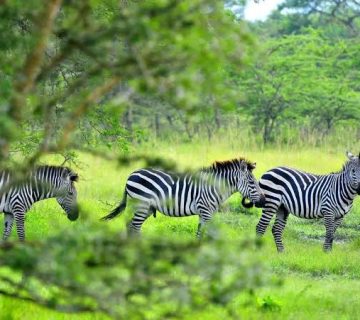
Try photographing zebras and wildebeest feeding near one another to show their contrasting body shapes and markings.
Wider photographs can illustrate the scale of the migration and the surrounding Serengeti or Maasai Mara landscapes.
Never ask a driver to chase moving herds or block animals approaching river crossings.
Conservation Challenges Facing Migrating Herbivores
The Great Migration depends on maintaining connected habitats across the Serengeti–Mara ecosystem.
Wildebeest and zebras need access to seasonal grazing areas and reliable water sources.
Habitat fragmentation, fencing, settlement expansion and changes in land use can interfere with animal movements.
Climate variability may also influence rainfall patterns and grass availability.
Protecting migration corridors allows herbivores to continue moving between feeding habitats.
Responsible wildlife tourism supports conservation by creating economic opportunities connected to protected landscapes.
Visitors can help by choosing experienced safari guides, respecting wildlife viewing regulations and avoiding disturbance to migrating animals.
Why Zebras and Wildebeest Migrate Together
Zebras and wildebeest migrate through the same landscapes primarily because both depend on seasonal grazing and water.
Their different digestive systems and feeding preferences influence how they use available grass.
Zebras can consume coarser vegetation, while wildebeest generally seek nutritious grass.
Both encounter similar predators and environmental challenges, but they do not always travel together in mixed groups.
Scientific research demonstrates that food quality, competition and predation risk influence their movements in different ways.
For travellers visiting the Serengeti and Maasai Mara, understanding these relationships makes the Great Migration even more interesting.
Watching zebras and wildebeest moving across the plains provides an opportunity to observe how different animal species respond to changing environmental conditions while sharing one of Africa’s most remarkable wildlife landscapes.


No comment