
What is the difference between a cheetah, leopard and jaguar?
The cheetah, leopard and jaguar are three of the world’s most recognisable wild cats. Their spotted coats, powerful bodies and hunting abilities make them easy to admire, but they are different species with distinct physical features, habitats and behaviours. Knowing how to identify them helps you understand their roles in the wild and makes wildlife viewing more interesting, particularly when visiting African national parks.
The cheetah and leopard both live in Africa, which means safari visitors may encounter either species in destinations such as the Serengeti, Masai Mara, Kruger National Park and selected parks in Uganda. The jaguar, however, lives in the Americas and is not naturally found in Africa. It inhabits tropical forests, wetlands and other environments across Central and South America.
The easiest way to distinguish these cats is by looking at their coats, body shapes, faces and hunting methods. The cheetah has solid black spots and dark tear marks running down its face. The leopard has rosette-shaped markings, a muscular body and excellent climbing ability. The jaguar also has rosettes, but many contain smaller black spots inside them, and it has a heavier build and exceptionally powerful jaws.
The cheetah: built for speed
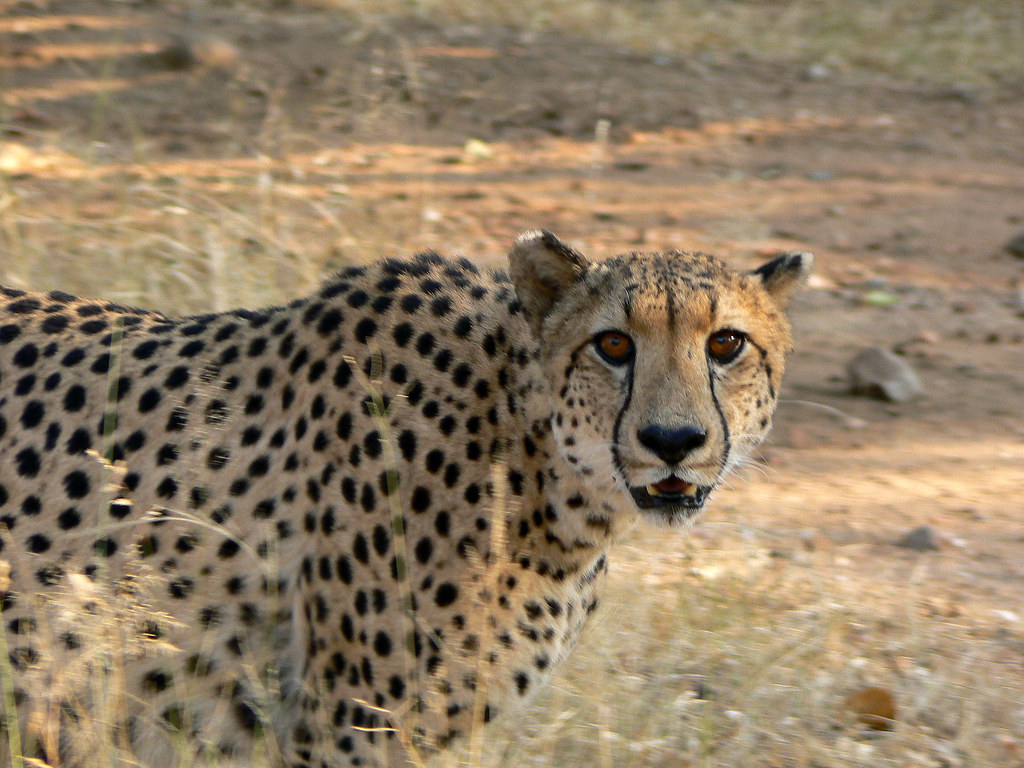
The cheetah, scientifically known as Acinonyx jubatus, is famous for being the fastest land animal. Its body is specially adapted for high-speed pursuits across open ground. Unlike the heavier leopard and jaguar, the cheetah has a slim frame, long legs, a narrow waist and a relatively small head.
Its coat is yellowish or golden with solid black spots spread across the body. These spots are individual markings rather than the ring-shaped patterns seen on leopards and jaguars. The most recognisable facial feature is the pair of black tear marks running from the inner corners of the eyes down towards the mouth. These markings help identify a cheetah even when viewing it from a distance.
A cheetah’s long tail helps it maintain balance and change direction while running. Its claws are only partially retractable, giving it additional grip when accelerating and turning. This feature makes its feet different from those of most other cats, whose claws retract more completely.
Cheetahs mainly inhabit open grasslands, savannahs and lightly wooded areas where they can spot prey and pursue it over relatively clear ground. They are found across parts of eastern and southern Africa, with smaller and more restricted populations elsewhere. A critically endangered population of Asiatic cheetahs also survives in Iran.
During a hunt, a cheetah usually approaches its prey carefully before launching a fast chase. It relies on acceleration, agility and precise turns to catch animals such as gazelles and other small to medium-sized antelopes. The chase requires considerable energy, so a cheetah cannot maintain its highest speed for long periods.
After catching prey, cheetahs are vulnerable to larger predators. Lions, hyenas and leopards may steal their kills or attack their cubs. Cheetahs therefore tend to eat quickly and remain alert while feeding.
Unlike lions, cheetahs do not live in large prides. Females generally live alone, except when raising cubs. Male cheetahs may also live alone, although related males sometimes form small groups known as coalitions.
Cheetahs are generally active during daylight, especially in the cooler morning and late afternoon hours. This behaviour makes them easier to observe during many African game drives. Their open-country hunting style also means visitors may see them scanning grasslands from termite mounds, small hills or other raised positions.
The leopard: a powerful and adaptable hunter
The leopard, scientifically known as Panthera pardus, is a muscular and highly adaptable big cat. It lives across parts of Africa and Asia, occupying a wide range of habitats, including savannahs, forests, mountains, grasslands and areas close to human settlements.
Unlike the cheetah, the leopard has a compact, muscular body, a broad head and powerful shoulders. Its legs are shorter and stronger, making it well suited to climbing, stalking and overpowering prey at close range.
The leopard’s coat is covered in dark markings called rosettes. These are clusters of black spots arranged in irregular ring-shaped patterns, usually with a lighter centre. The markings vary between individuals and provide camouflage in different environments.
Leopards are particularly famous for their climbing ability. They can climb trees with considerable strength and agility, even while carrying heavy prey. Taking a kill into a tree helps protect it from scavengers and other predators, although this behaviour depends on the surroundings and the size of the prey.
Their hunting strategy relies mainly on stealth and surprise. A leopard usually moves quietly through vegetation, approaches its target and attacks from close range. It can hunt animals of different sizes, including antelopes, monkeys, rodents, birds and other mammals. Its flexible diet helps it survive in habitats where prey availability changes.
Leopards are mostly solitary. Adults usually occupy individual territories, although their ranges may overlap. Mothers remain with their cubs until they are capable of surviving independently.
Unlike cheetahs, leopards are often active at night, although they can also hunt during daylight. Their secretive behaviour and ability to hide in thick vegetation make them challenging to spot during a safari. Visitors may find them resting on tree branches, walking along rocky outcrops or moving through grassland.
In East Africa, leopards can be found in several protected areas. These include the Serengeti National Park, Masai Mara National Reserve, Queen Elizabeth National Park, Murchison Falls National Park and South Luangwa National Park in neighbouring Zambia.
The leopard’s ability to adapt to different habitats makes it one of the most widely distributed wild cats. It can survive in places where other large predators struggle, provided there is sufficient prey, cover and space.
The jaguar: a powerful cat of the Americas
The jaguar, scientifically known as Panthera onca, is the largest wild cat in the Americas. It lives mainly in Central and South America, with its strongest populations associated with the Amazon Basin and the Pantanal wetlands.
Although jaguars look similar to leopards, they have a noticeably heavier build. They possess broad heads, strong jaws, thick necks, muscular shoulders and relatively short, powerful legs. Their bodies are designed for strength rather than the extreme running speed associated with cheetahs.
The jaguar’s coat is golden or yellowish, with dark rosettes arranged across its body. The rosettes are usually larger and more complex than those of a leopard. Many contain one or more small black spots inside the ring, which is one of the most useful ways to distinguish the two species.
Jaguars are excellent swimmers and are often associated with rivers, lakes, flooded forests and wetlands. They can move through water comfortably and hunt aquatic or semi-aquatic animals. Their diet includes fish, turtles, caimans, capybaras, deer and other available prey.
Their hunting technique depends on stealth, strength and a powerful attack. Jaguars often approach prey quietly before launching a sudden strike. Their exceptionally strong jaws allow them to kill prey with a powerful bite, sometimes penetrating the skull or crushing the shell of certain animals.
Jaguars are generally solitary, except during mating and when females are raising cubs. They may be active during the day or night depending on local conditions, prey availability and human activity.
The jaguar’s distribution is entirely separate from that of Africa’s native big cats. It does not naturally occur in Uganda, Kenya, Tanzania, Rwanda or South Africa. Travellers who want to see jaguars in the wild need to visit destinations in Central or South America.
The main differences in appearance
The coat pattern is one of the easiest ways to identify these three cats. A cheetah has solid black spots that do not form rosettes. A leopard has smaller rosettes, usually without a central black spot. A jaguar has larger, more complex rosettes, many of which contain dark spots inside the rings.
The facial markings are another useful clue. Cheetahs have distinctive black tear marks running from their eyes towards their mouths. Leopards and jaguars do not have these markings.
Their body shapes also differ. The cheetah is slender and long-legged, with a lightweight appearance. The leopard is muscular and compact, with strong shoulders and a broad head. The jaguar is generally heavier and stockier, with a particularly broad head and powerful jaws.
Their tails provide another identifying feature. A cheetah has a relatively long tail that helps it balance during high-speed turns. A leopard also has a long tail, which assists with balance when climbing and moving through trees. A jaguar has a comparatively shorter tail.
Differences in habitat and geographical range
The three cats occupy different geographical regions, making location a useful identification clue.
Cheetahs and leopards both occur in Africa, but they favour different hunting conditions. Cheetahs are commonly associated with open grasslands and savannahs where they can pursue prey. Leopards are more adaptable and use forests, rocky areas, woodland and savannah habitats.
Jaguars live in the Americas. Their preferred environments include tropical rainforests, river systems, wetlands and other areas with suitable prey and vegetation cover. The Pantanal in Brazil is one of the best-known destinations for jaguar viewing.
For visitors planning an African wildlife holiday, the cheetah and leopard are the relevant species among these three. The jaguar belongs to a different continent and requires a separate wildlife trip.
Differences in hunting behaviour
Although all three cats are carnivores, their hunting strategies reflect their physical abilities and habitats.
The cheetah is a pursuit hunter. It uses sight to locate prey, approaches carefully and then accelerates rapidly to catch an animal across open ground. Its long legs, flexible spine and partially retractable claws support this hunting method. It usually targets smaller or medium-sized prey that it can overpower without prolonged physical combat.
The leopard is an ambush hunter. It depends on camouflage, patience and a sudden attack. It often hunts from cover, using vegetation, rocks or trees to approach prey without being noticed. Its strength allows it to catch a wide range of animals, and it may carry its kill into a tree to keep it away from competing predators.
The jaguar also relies on ambush hunting, but its powerful jaws and muscular body allow it to tackle a different range of prey. It can hunt animals in and around water, including caimans and turtles. Its ability to swim gives it access to food sources that may be less available to other large cats.
Which animal is the fastest?
The cheetah is the fastest of the three and is widely recognised as the fastest land mammal. Its speed comes from a combination of long legs, a flexible spine, strong hindquarters and a lightweight body.
During a chase, a cheetah can accelerate rapidly and reach very high speeds over short distances. However, it cannot maintain its maximum speed for long. A failed chase can leave the animal exhausted, which is why it needs to choose its target and timing carefully.
Leopards and jaguars are not built for the same type of high-speed pursuit. They rely more on stealth, strength and short bursts of movement when attacking prey.
Which animal is the strongest?
The jaguar is generally considered the most powerfully built of the three. Its broad head, muscular jaw structure and strong body allow it to deliver an exceptionally powerful bite relative to its size.
The leopard is also very strong. Its ability to climb trees while carrying prey demonstrates its muscular strength and impressive grip. It can take animals heavier than itself into trees, depending on the circumstances.
The cheetah is built primarily for speed and acceleration rather than physical strength. Its lighter frame and smaller teeth make it less suited to fighting larger predators. It usually avoids direct confrontations with stronger animals.
Can a leopard and jaguar be mistaken for each other?
Yes. Leopards and jaguars are often confused because both have yellowish coats covered in dark rosettes. Their body shapes are also more similar to each other than either is to the slender cheetah.
However, their markings provide a reliable identification clue. Jaguar rosettes are generally larger and often contain smaller black spots inside them. Leopard rosettes are usually smaller and do not have these central spots.
Their geographical ranges also make identification easier. A spotted big cat in an African national park is a leopard, not a jaguar. A similar-looking cat in the Amazon rainforest or Pantanal is likely to be a jaguar.
Their body shapes can also help. Jaguars usually have broader heads, thicker necks and heavier bodies. Leopards tend to look more slender, with longer tails and a more agile appearance.
What is a black panther?
The term black panther does not describe a separate species. It refers to a melanistic leopard or jaguar, meaning an animal with unusually dark pigmentation.
Melanism causes the coat to appear black or very dark brown. However, the normal rosette markings may still be visible when light falls on the animal at the right angle.
Black leopards occur in parts of Africa and Asia, while black jaguars occur in Central and South America. Cheetahs are not commonly described as black panthers because this term is associated with melanistic leopards and jaguars.
A black leopard can be difficult to spot in dense vegetation, especially in low light. Its dark coat provides camouflage, although the animal still has the same basic physical characteristics as other leopards.
Where can you see cheetahs and leopards on an African safari?
Africa offers several destinations where visitors have opportunities to see cheetahs and leopards in their natural habitats. However, sightings depend on the season, animal movements, weather and the skill of the local guides.
In Kenya, the Masai Mara National Reserve is well known for its cheetah and leopard populations. Its open grasslands provide suitable hunting grounds for cheetahs, while riverine forests and areas with thick vegetation offer cover for leopards.
In Tanzania, the Serengeti National Park is another important destination for viewing both species. The open plains support cheetahs, while leopards are often found around riverine forests, rocky outcrops and woodland areas. The Ngorongoro Conservation Area also offers opportunities to see leopards and other large predators.
In Uganda, visitors may encounter leopards in Queen Elizabeth National Park, Murchison Falls National Park and Kidepo Valley National Park. Leopards are generally difficult to locate because they are secretive and often active during the night. Cheetahs are not a regular feature of Uganda’s established national park wildlife viewing.
South Africa’s Kruger National Park offers opportunities to see both cheetahs and leopards. Cheetahs are more commonly associated with open areas, while leopards can be found in different habitats throughout the park.
For jaguar viewing, travellers need to look beyond Africa. Brazil’s Pantanal is particularly well known for wildlife tours focused on finding jaguars along rivers and wetlands. Other parts of Brazil, Peru, Ecuador and several Central American countries also contain jaguar habitat.
How to identify the three cats during wildlife viewing
When observing a spotted cat during a game drive, start by looking at its face. Black tear marks extending from the eyes towards the mouth indicate a cheetah. If these markings are absent, examine the coat pattern more closely.
Look at the spots across the animal’s body. Solid black spots indicate a cheetah. Rosettes without central black spots suggest a leopard, while larger rosettes containing smaller black spots are characteristic of a jaguar.
Next, observe the animal’s body shape. A slim, long-legged cat is likely to be a cheetah. A muscular cat with a compact body and a long tail is likely to be a leopard. A heavily built cat with a broad head and powerful shoulders may be a jaguar.
Finally, consider the location. In an African national park, you are likely looking at a cheetah or leopard. In the forests and wetlands of Central or South America, the same general appearance may belong to a jaguar.
Avoid relying on a single feature when the animal is far away or partly hidden. Use its markings, body shape, behaviour and location together.
Why these differences are important for conservation
Understanding the differences between cheetahs, leopards and jaguars also helps explain why each species needs different conservation measures.
Cheetahs require large areas of suitable habitat where they can find prey and move across open landscapes. Habitat loss, human-wildlife conflict, illegal wildlife trade and competition with larger predators affect their survival. Their specialised hunting adaptations also make them vulnerable when suitable open habitats disappear.
Leopards face different pressures because they occupy a wider variety of environments. Habitat destruction, loss of natural prey, conflict with livestock owners, poaching and illegal trade threaten populations in several parts of Africa and Asia. Their ability to adapt does not remove the need for protected habitats and effective conservation programmes.
Jaguars depend on connected forests, wetlands and river systems. Deforestation, agricultural expansion, habitat fragmentation, illegal hunting and conflict with livestock owners threaten their populations. Protecting large natural landscapes and maintaining wildlife corridors are important for their long-term survival.
All three species play important roles as predators. They help regulate prey populations and contribute to the balance of their natural ecosystems. Protecting them also supports the wider habitats and wildlife communities on which they depend.
Choosing the right destination to see these wild cats
If your main interest is seeing cheetahs and leopards, an African safari is a suitable choice. The Masai Mara, Serengeti and Kruger National Park are among the established destinations where visitors have opportunities to observe both species.
If you are particularly interested in cheetahs, look for open grassland destinations where prey animals are abundant. If leopards are your priority, consider parks with riverine forests, woodland, rocky areas and experienced guides who know the animals’ territories.
If you want to see a jaguar, plan a trip to Central or South America. The Pantanal in Brazil is one of the most recognised destinations for dedicated jaguar-watching experiences.
The cheetah, leopard and jaguar may share spotted coats and similar hunting instincts, but their differences are clear once you understand their markings, body structures, habitats and behaviour. The cheetah is the specialist speed hunter, the leopard is an adaptable and skilled climber, and the jaguar is a powerful predator associated with the forests and wetlands of the Americas. Recognising these features makes every wildlife encounter more informative and helps you appreciate the different ways these remarkable cats survive in the wild.


No comment