
Weaver Colonies: How Males Build Nests and Females Judge Them
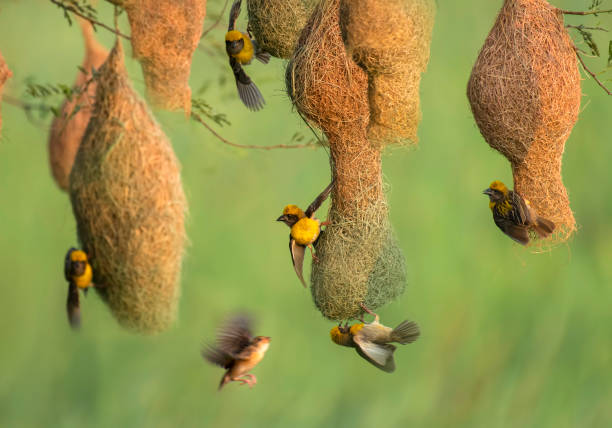
Weaver colonies are among Africa’s most fascinating birdwatching attractions, where hundreds of colourful birds may gather in trees, building carefully woven nests and competing for mates. These small, energetic birds are famous for their remarkable construction skills, using grass, leaves and plant fibres to create hanging nests without any tools. In many weaver species, males perform most of the initial construction, while females inspect the finished structures before deciding whether to accept a potential partner.
For travellers exploring Uganda, Kenya, Tanzania and Rwanda, watching a busy weaver colony provides an excellent opportunity to observe bird behaviour at close range. Male weavers may spend several days constructing intricate nests, only for visiting females to reject them. When this happens, the males often dismantle the unwanted structures and begin building again. This unusual breeding behaviour makes weaver colonies interesting places for wildlife photographers, birdwatchers and anyone interested in African nature.
What Are Weaver Birds?
Weaver birds are small to medium-sized African songbirds belonging to the family Ploceidae. The family contains numerous species, many of which are recognised for their distinctive hanging nests and colourful breeding plumage.
They occur throughout much of sub-Saharan Africa, occupying savannahs, wetlands, forests, agricultural landscapes and urban gardens.
Some species nest individually, while others form large colonies containing dozens or hundreds of nests.
Their name comes from the way many species weave plant fibres around branches to create complex nesting structures.
Quick Facts About Weaver Birds
| Feature | Description |
|---|---|
| Bird family | Ploceidae |
| Common group | Weaver birds |
| Typical length | Approximately 11–25 cm, depending on species |
| Common colours | Yellow, black, brown, greenish and red |
| Main diet | Seeds, insects and other plant material |
| Main habitats | Grasslands, wetlands, forests and gardens |
| Nest construction | Woven grass, leaves and plant fibres |
| Breeding behaviour | Varies by species |
| Nest shape | Rounded, oval or elongated |
| Social behaviour | Solitary nesting or colonial breeding |
| African distribution | Widespread across sub-Saharan Africa |
Many male weavers develop brighter colours during the breeding season, helping them attract females and advertise their territories.
Why Do Weaver Birds Build Nests in Colonies?
Colonial nesting is common among several familiar African weaver species, particularly Village Weavers and some masked weavers.
A suitable nesting tree may contain dozens of woven structures suspended from its branches.
Colonies are often located near feeding areas, wetlands or grasslands where birds can collect nesting materials.
Benefits of Colonial Nesting
Nesting in colonies may offer several advantages.
Birds can detect approaching predators through the movements and warning calls of neighbouring individuals.
Groups may also help deter certain predators through collective responses.
Additionally, a colony brings potential mates into a relatively small area, making courtship interactions easier.
However, colonial nesting has disadvantages. Crowded nesting sites can attract predators, increase competition and encourage the spread of parasites.
The balance between these costs and benefits differs among species and habitats.
How Male Weaver Birds Build Their Nests
In many species, nest construction is primarily the responsibility of males.
The process requires careful coordination between the bill and feet, allowing birds to manipulate flexible materials while balancing on branches.
A male may carry hundreds of strips of vegetation to a nest before completing the structure.
1. Selecting a Suitable Branch
The male begins by identifying a branch strong enough to support the nest.
Many species choose thin, flexible branches that extend away from the main trunk.
Some prefer trees growing above water, although this behaviour varies.
A suitable branch must provide support while allowing the nest to hang freely.
2. Collecting Fresh Building Materials
Male weavers gather strips of grass, palm leaves and other flexible plant fibres.
Fresh green materials are particularly useful because they bend easily during construction.
As the vegetation dries, the woven structure becomes firmer.
The bird carries each strip in its bill and returns repeatedly to the nesting location.
3. Creating the First Supporting Ring
The first construction stage involves securing plant fibres around the selected branch.
The male twists and loops strips together, creating a supporting framework.
This early structure forms the foundation for the rest of the nest.
4. Building the Nest Chamber
Once the supporting framework is secure, the bird adds more strips to create the walls and roof.
It repeatedly passes vegetation through the existing framework, tightening the structure as construction progresses.
The emerging nest gradually takes on a rounded or oval appearance.
5. Forming the Entrance
Many weaver nests have entrances positioned underneath or towards the lower side.
Some species construct extended entrance tubes, while others have shorter openings.
The design varies according to the species and may help restrict access by certain predators.
6. Displaying the Nest to Females
When the nest reaches a suitable stage, the male begins advertising it to visiting females.
He may hang upside down, flutter his wings and produce repeated calls.
The female then decides whether to investigate the structure more closely.
How Female Weaver Birds Judge Male Nests
Female choice is one of the most interesting aspects of weaver breeding behaviour.
In species such as the Village Weaver, females inspect nests before deciding whether to accept the male.
Research suggests that females assess several features, including nest condition, construction materials and the potential suitability of the nesting location.
However, preferences differ between species. A feature that strongly influences one species may be less important to another.
What Females May Examine
| Nest feature | Possible influence on selection |
|---|---|
| Fresh plant materials | Indicates a recently constructed nest |
| Structural strength | May support eggs and developing chicks |
| Nest location | Influences exposure to predators and weather |
| Entrance position | May affect access and protection |
| Male behaviour | Contributes to mate assessment |
| Surrounding vegetation | Provides concealment and support |
Studies of Village Weavers have found that females frequently select fresh nests rather than older, brown structures. However, experiments suggest that nest colour alone does not fully explain their preferences.
Female choice can involve several factors, including the characteristics of the male himself.
What Happens When a Female Rejects a Nest?
Rejection is a normal part of breeding behaviour in several weaver species.
A female may inspect a nest, leave without accepting the male and investigate other structures in the colony.
The rejected male may continue displaying or eventually dismantle the nest.
He can then collect fresh materials and construct another structure in the same territory.
This process may happen repeatedly before he attracts a mate.
Research on Southern Masked Weavers has shown that nest-building behaviour changes with experience, suggesting that repeated construction helps birds develop their weaving skills.
Why Are Some Weaver Nests Green and Others Brown?
One of the easiest features to observe in an active weaver colony is the difference in nest colour.
Newly constructed nests commonly contain fresh green grass or leaves.
As these materials dry, they gradually turn yellowish or brown.
Understanding Nest Colour
| Nest appearance | Possible explanation |
|---|---|
| Bright green | Recently collected vegetation |
| Green and yellow | Materials beginning to dry |
| Brown | Older, dried nesting materials |
| Partly dismantled | Nest may be undergoing replacement |
| Fresh vegetation added | Construction or refurbishment may be continuing |
A brown nest is not necessarily abandoned. Occupied nests can also contain dried materials.
Observing bird activity provides a more reliable indication of whether a nest is in use.
Common Weaver Birds Found in Uganda
Uganda supports numerous species of weaver birds, making the country particularly rewarding for birdwatchers.
Different species occupy wetlands, forests, farms, gardens and savannah habitats.
Weaver Species to Look For
| Weaver species | Main identification feature | Typical habitat |
|---|---|---|
| Village Weaver | Yellow plumage and black facial mask in breeding males | Gardens, woodland and settlements |
| Black-headed Weaver | Yellow body and dark head in breeding males | Wetlands and waterside vegetation |
| Northern Brown-throated Weaver | Brown throat and contrasting plumage | Papyrus and freshwater wetlands |
| Golden-backed Weaver | Bright golden-yellow back | Wooded areas and gardens |
| Baglafecht Weaver | Yellow and black breeding plumage | Woodland and forest edges |
| Jackson’s Golden-backed Weaver | Golden-yellow back and black head in males | Wetland vegetation |
| Grosbeak Weaver | Large, heavy bill | Wetlands and forest-edge vegetation |
Some weavers are difficult to distinguish outside the breeding season because males lose their brightest colours.
Female identification can also require careful attention to bill shape, body markings and habitat.
Best Places to See Weaver Colonies in Uganda
Uganda provides excellent opportunities to observe nest-building behaviour because several weaver species occur near accessible roads, wetlands and settlements.
Recommended Birdwatching Destinations
| Destination | Birdwatching opportunities |
|---|---|
| Entebbe Botanical Gardens | Weavers in mature trees and gardens |
| Mabamba Wetland | Wetland-associated weaver species |
| Lake Victoria shoreline | Colonial nesting around suitable vegetation |
| Queen Elizabeth National Park | Savannah and waterside weavers |
| Lake Mburo National Park | Grassland and woodland species |
| Murchison Falls National Park | Riverine and savannah birds |
| Mabira Forest surroundings | Forest-edge and garden weavers |
Weaver Birds Around Entebbe
Entebbe is a convenient destination for observing weaver birds because of its gardens, lakeshores and mature trees.
Some species nest close to human activity, making them accessible to patient observers.
Visitors may watch males collecting plant fibres, constructing nests and displaying to females.
Weaver Birds in Queen Elizabeth National Park
Queen Elizabeth National Park contains grasslands, wetlands and wooded habitats supporting numerous bird species.
Weavers may be observed near suitable water sources and within vegetation surrounding the park’s lakes and channels.
Birdwatching can be combined with game drives and Kazinga Channel boat safaris.
How Long Does It Take a Weaver Bird to Build a Nest?
Construction time varies considerably between species, individual birds, weather conditions and material availability.
Some experienced male weavers can complete the main structure of a nest within a few days.
Other nests take longer, particularly when construction is interrupted or materials are difficult to obtain.
Researchers studying Southern Masked Weavers have found that individual males differ in construction speed and technique.
Birds may also become more efficient as they build additional nests.
This indicates that although nest-building behaviour has an inherited foundation, experience can influence how birds perform the task.
Do Female Weaver Birds Help Build Nests?
The division of nesting responsibilities varies between weaver species.
In many familiar Ploceus weavers, males construct the main outer structure.
After accepting a nest, females may contribute to lining the interior with softer materials.
They generally undertake incubation and much of the care of developing chicks, although parental responsibilities differ between species.
It is therefore inaccurate to assume that every African weaver follows exactly the same breeding pattern.
Weaver Bird Eggs and Chick Development
After accepting a suitable nest and mating, a female may lay a clutch of eggs.
Many weaver species lay approximately two to four eggs, although clutch sizes vary.
Incubation commonly lasts around 12–15 days in several familiar species.
Newly hatched chicks are helpless and depend on adult birds for warmth and food.
As they grow, their feathers develop and they become increasingly active inside the nest.
Young weavers eventually leave the nest but may continue receiving food from their parents for a period.
Main Breeding Stages
| Stage | What happens |
|---|---|
| Courtship | Male displays and attracts females |
| Nest inspection | Female examines potential nesting site |
| Nest acceptance | Pair mates and nesting progresses |
| Egg laying | Female deposits eggs |
| Incubation | Eggs are kept warm until hatching |
| Chick development | Young birds receive food and protection |
| Fledging | Juveniles leave the nest |
What Do Weaver Birds Eat?
Weaver birds have varied diets that commonly include seeds, grains and insects.
Many species feed heavily on insects during the breeding season because growing chicks require protein-rich food.
Some weavers also consume fruits, nectar and other plant materials.
Common Weaver Bird Foods
Grass seeds and wild grains.
Insects and caterpillars.
Beetles and small flying insects.
Agricultural grains where available.
Small fruits and plant material.
Weavers can contribute to insect control and seed consumption within their habitats.
However, large flocks of certain species may also damage agricultural crops, creating conflicts with farmers.
Best Time to Watch Weaver Nest Building
Active nest construction often increases during breeding periods associated with seasonal rainfall.
Fresh vegetation becomes available after rains, providing flexible materials for weaving.
However, breeding patterns differ across species and regions.
Some weavers may nest during more than one period of the year, particularly in habitats with reliable resources.
Birdwatching Conditions
| Period | What visitors may observe |
|---|---|
| Early morning | Collecting materials and nest construction |
| Mid-morning | Courtship displays and feeding |
| Afternoon | Nest maintenance and colony activity |
| Rainy periods | Increased nesting activity in some species |
| Dry periods | Feeding flocks and existing nests |
Early morning is particularly useful for observing active colonies before temperatures rise.
Tips for Photographing Weaver Colonies
Weaver colonies offer interesting photography opportunities because several types of behaviour may occur within a small area.
A camera with a 200–400 mm telephoto lens can capture birds working on nests without requiring close approaches.
Use a shutter speed around 1/1000 second when photographing males fluttering their wings or carrying grass.
For stationary birds, slower shutter speeds may be suitable when lighting conditions permit.
Recommended Photography Subjects
Males carrying long strips of green grass.
Birds hanging upside down while weaving.
Females inspecting newly constructed nests.
Males displaying with open wings.
Completed nests hanging from branches.
Adults feeding chicks near nest entrances.
Avoid touching nests or pulling branches aside to improve photographs.
Conservation of Weaver Birds and Their Habitats
Many familiar weaver species remain widespread, although habitat conditions influence individual populations.
The removal of nesting trees, wetland drainage and excessive pesticide use can reduce breeding and feeding opportunities.
Conserving wetlands, mature trees and natural grasslands helps maintain suitable habitats.
Responsible birdwatching also benefits local communities when visitors hire knowledgeable guides and support conservation activities.
Why Weaver Colonies Are Worth Watching on Safari
Weaver colonies offer visitors a chance to observe complex bird behaviour without requiring a long search for rare species.
Their energetic movements, carefully constructed nests and elaborate courtship displays provide fascinating opportunities for wildlife observation.
The interaction between male nest builders and selective females also demonstrates how mating behaviour can influence the structures birds create.
For travellers exploring Uganda and other East African destinations, spending time near an active weaver colony can reveal an extraordinary amount of wildlife activity within a single tree.
Watching a male patiently thread grass through his nest while a female approaches to inspect it is one of the most rewarding everyday birdwatching experiences in Africa.





No comment