
East African Bee-Eaters: Species You Can Tell Apart
East African bee-eaters are among the most colourful and entertaining birds you can encounter during a wildlife safari. With their bright green, yellow, blue, red and chestnut feathers, these small insect-eating birds add remarkable colour to savannahs, wetlands, forests and riverbanks across Uganda, Kenya, Tanzania and Rwanda. Although several species look similar, careful observation of their throat colours, facial markings, tails and preferred habitats can help birdwatchers identify them correctly.
From the tiny Little Bee-eater perched on a roadside branch to the spectacular Northern Carmine Bee-eater flying over open grasslands, East Africa supports an impressive variety of species. Some remain in the region throughout the year, while others arrive during seasonal migrations. Learning how to distinguish these birds makes your birdwatching safari more rewarding, particularly when several species occur in the same destination.
What Are Bee-Eaters?
Bee-eaters belong to the family Meropidae, a group of slender, colourful birds found across Africa, Europe, Asia and Australia.
As their name suggests, many species feed on bees, but their diet also includes wasps, dragonflies, butterflies, flying termites and other insects.
Most bee-eaters catch their prey in flight. They typically watch from an exposed branch, launch into the air to capture an insect and return to a perch.
When handling bees and wasps, they may strike or rub the insects against a branch before swallowing them. This behaviour can help remove the sting and reduce the risk of injury.
Bee-eaters have several recognisable physical features, including slender bodies, long pointed wings and slightly downward-curving bills.
Quick Facts About East African Bee-Eaters
| Feature | Description |
|---|---|
| Bird family | Meropidae |
| Main bird genus | Merops |
| Typical length | Approximately 15–38 cm, depending on species and tail |
| Common colours | Green, blue, yellow, red and chestnut |
| Main diet | Bees, wasps, dragonflies and other flying insects |
| Feeding behaviour | Catching insects in flight |
| Nesting sites | Burrows in earth banks or suitable sandy ground |
| Main habitats | Savannahs, wetlands, forests and woodland |
| Social behaviour | Solitary, pairs or colonies |
| Distribution | Widespread across East Africa |
| Best observation time | Daylight hours when insects are active |
How to Identify East African Bee-Eaters
The easiest way to identify a bee-eater is to study several features together rather than relying on its overall colour.
Some species share green backs, yellow throats and black facial masks. Others have distinctive red throats, blue cheeks or long tail streamers.
Habitat is another useful clue. A bee-eater perched in a highland forest may belong to a different species from one hunting insects above an open savannah.
East African Bee-Eater Identification Chart
| Species | Main identification feature | Typical habitat |
|---|---|---|
| Little Bee-eater | Small green body, yellow throat and black breast band | Savannah and woodland |
| Cinnamon-chested Bee-eater | Green upperparts, cinnamon chest and pale cheek patch | Highland forests |
| Blue-breasted Bee-eater | Green body, yellow throat and bluish breast band | Wet grassland and woodland |
| White-fronted Bee-eater | White forehead and bright red throat | Rivers and open woodland |
| Red-throated Bee-eater | Red throat without a white forehead | Riverbanks and savannah |
| White-throated Bee-eater | White throat and strongly patterned head | Open dry woodland |
| Blue-cheeked Bee-eater | Bright blue cheek markings and green body | Wetlands and open country |
| European Bee-eater | Chestnut upperparts and yellow throat | Open country during migration |
| Northern Carmine Bee-eater | Brilliant carmine-red body and blue-green head | Savannah and river valleys |
| Swallow-tailed Bee-eater | Green plumage and deeply forked tail | Dry woodland |
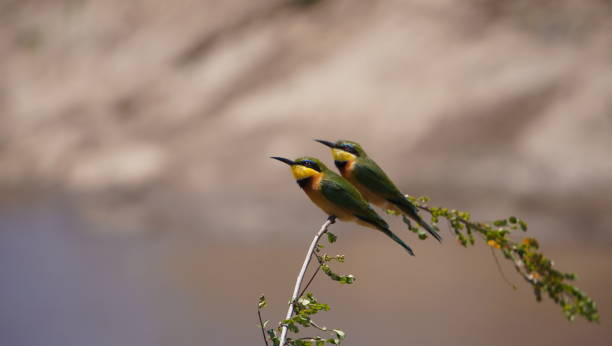
1. Little Bee-Eater: The Small Green Bee-Eater
Scientific name: Merops pusillus
The Little Bee-eater is one of the most frequently encountered bee-eaters in East Africa.
It occurs in open woodland, grasslands, agricultural areas and savannah habitats, often perching on small branches close to the ground.
Adults are approximately 15–17 centimetres long, with mainly green upperparts, a yellow throat and a black band separating the throat from the chestnut-coloured underparts.
A blue line above the eye is another useful identification feature in many East African individuals.
How to Recognise It
Small, compact body.
Bright green back and wings.
Yellow throat bordered by a black band.
Chestnut-coloured upper chest.
Black eye mask and blue eyebrow.
Usually perched relatively low.
Little Bee-eaters often hunt from exposed branches, making them suitable subjects for wildlife photography.
They are commonly encountered in Uganda’s Queen Elizabeth and Lake Mburo national parks, as well as suitable habitats across Kenya and Tanzania.
2. Cinnamon-Chested Bee-Eater: The Highland Forest Specialist
Scientific name: Merops oreobates
The Cinnamon-chested Bee-eater resembles the Little Bee-eater but is larger and generally associated with higher elevations.
It has green upperparts, a yellow throat, a dark breast band and rich cinnamon-coloured underparts.
A noticeable white cheek patch helps distinguish it from the Little Bee-eater.
This species frequently occupies forest edges, highland woodlands and gardens near montane forests.
How to Recognise It
Look for its slightly larger size, darker green upperparts, rich cinnamon chest and white cheek marking.
Unlike the Little Bee-eater, it often perches higher in trees and occurs in cooler highland habitats.
In Uganda, suitable places to search include Bwindi Impenetrable National Park and nearby highland forest-edge areas.
The species also occurs around Kenya’s central highlands and Tanzania’s northern highland forests.
3. Blue-Breasted Bee-Eater: A Small Bird With Subtle Blue Markings
Scientific name: Merops variegatus
The Blue-breasted Bee-eater is another small green species that birdwatchers may confuse with the Little Bee-eater.
Despite its name, the blue colouring is generally concentrated around the breast band rather than covering the entire chest.
The bird has green upperparts, a yellow throat and a noticeable pale cheek marking.
It favours grassland, woodland and wetter open habitats in parts of East Africa.
How to Recognise It
Its pale cheek patch and bluish breast band are useful features.
However, the blue colouring may be difficult to see under poor lighting conditions.
Birdwatchers should examine the throat, cheek markings and breast band carefully before confirming identification.
4. White-Fronted Bee-Eater: The Bird With a White Forehead
Scientific name: Merops bullockoides
The White-fronted Bee-eater is a particularly attractive species found near rivers, lakes and other suitable open habitats.
It is recognised by its white forehead, dark facial mask and bright red throat.
Its upperparts are mainly green, while the underparts contain warm cinnamon-brown colouring.
These birds often occur in groups and may nest colonially in suitable sandy banks.
How to Recognise It
The combination of a white forehead and red throat is the most useful identification feature.
The bird also has blue colouring around the lower body and tail region.
In Kenya, White-fronted Bee-eaters can be found around suitable Rift Valley habitats, including areas near Lake Naivasha.
They also occur in parts of Tanzania and Uganda.
5. Red-Throated Bee-Eater: Similar Colours, Different Head
Scientific name: Merops bulocki
The Red-throated Bee-eater resembles the White-fronted Bee-eater because both have bright red throats.
However, the Red-throated Bee-eater lacks the distinctive white forehead.
Its head is greenish, and the throat contrasts with surrounding green and reddish-brown plumage.
The species occurs locally in western Uganda and other parts of Central and West Africa.
How to Recognise It
The main identification difference is the forehead.
White-fronted Bee-eaters have a conspicuous white forehead, while Red-throated Bee-eaters do not.
Both may occur around suitable riverine environments, making careful observation important.
6. White-Throated Bee-Eater: A Distinctive Migrant
Scientific name: Merops albicollis
The White-throated Bee-eater is a slender bird with a strongly patterned head and long central tail feathers.
Its white throat contrasts with a dark breast band, while the head has noticeable black-and-white markings.
The species breeds in parts of northern tropical Africa and migrates seasonally into other regions.
In East Africa, it is mainly encountered as a non-breeding visitor.
How to Recognise It
Look for its white throat, striking facial pattern, greenish body and long tail streamers.
These features separate it from the smaller Little Bee-eater, which has a yellow throat.
White-throated Bee-eaters often occupy open woodland, forest edges and wooded grasslands.
7. Blue-Cheeked Bee-Eater: The Elegant Green Migrant
Scientific name: Merops persicus
The Blue-cheeked Bee-eater is a slender, predominantly green bird with bright blue cheek markings.
Adults have long central tail feathers, a narrow black eye mask and a slightly curved bill.
The species is migratory and occurs seasonally in suitable East African habitats.
It particularly favours open country, wetlands, agricultural landscapes and areas containing plentiful flying insects.
How to Recognise It
Its bright blue cheeks provide an important identification clue.
The bird’s long tail streamers and slender appearance also help distinguish it from smaller resident bee-eaters.
Birdwatchers should compare it carefully with the similar Olive Bee-eater, sometimes called the Madagascar Bee-eater, which also occurs in East Africa.
8. European Bee-Eater: The Colourful Seasonal Visitor
Scientific name: Merops apiaster
The European Bee-eater is among the most colourful migratory birds visitors may encounter in East Africa.
It has a chestnut-coloured crown and back, a yellow throat, turquoise-green underparts and long central tail feathers.
The species breeds mainly in Europe and neighbouring regions before migrating to Africa.
During migration and the non-breeding season, it may be observed in East African open country.
How to Recognise It
The chestnut upperparts and bright yellow throat provide useful clues.
European Bee-eaters often travel in flocks, calling repeatedly while flying over open landscapes.
Unlike Little Bee-eaters, they are noticeably larger and have longer tail streamers.
9. Northern Carmine Bee-Eater: The Brilliant Red Bird
Scientific name: Merops nubicus
The Northern Carmine Bee-eater is one of East Africa’s most spectacular bee-eaters.
Its brilliant carmine-red plumage, greenish-blue head and long pointed wings make it particularly distinctive.
Adults are much larger than Little Bee-eaters and frequently hunt flying insects above open savannahs and river valleys.
Northern Carmine Bee-eaters may follow large mammals or vehicles to capture insects disturbed by movement.
How to Recognise It
The intense red body colour is unmistakable.
Unlike smaller green bee-eaters, this species has an elongated body, long wings and conspicuous red plumage.
It occurs in parts of East Africa, with movements varying according to breeding and seasonal conditions.
10. Swallow-Tailed Bee-Eater: The Bird With the Forked Tail
Scientific name: Merops hirundineus
The Swallow-tailed Bee-eater is a colourful species associated with dry woodland and savannah environments.
It has green upperparts, blue markings around the head and a distinctive deeply forked tail.
Its slender shape and rapid movements make it an interesting bird to watch as it catches insects in flight.
How to Recognise It
The deeply forked tail is the most useful identification feature.
Its combination of green and blue feathers also helps distinguish it from other small bee-eaters.
The species occurs locally in parts of East Africa, particularly in suitable dry woodland habitats.
Little Bee-Eater vs Cinnamon-Chested Bee-Eater
These two species are particularly easy to confuse because both have green upperparts, yellow throats and warm brown underparts.
However, there are several reliable differences.
| Feature | Little Bee-eater | Cinnamon-chested Bee-eater |
|---|---|---|
| Body size | Smaller | Noticeably larger |
| Cheek markings | Usually lacks a large white cheek patch | Distinct white cheek patch |
| Breast colour | Chestnut to buff | Rich cinnamon |
| Preferred habitat | Open grassland and woodland | Highland forest and forest edges |
| Perching behaviour | Frequently perches low | Often perches higher in vegetation |
| Uganda locations | Queen Elizabeth and Lake Mburo | Bwindi and suitable highland forests |
For beginners, habitat and size provide helpful starting points. A clear view of the cheek markings can often confirm the identification.
Where to See Bee-Eaters in East Africa
East Africa offers excellent birdwatching opportunities because different bee-eater species occupy a variety of habitats.
Uganda’s savannah national parks support several colourful species, while Kenya and Tanzania provide opportunities to observe resident and migratory bee-eaters in open woodland, wetlands and highland forests.
Best Bee-Eater Birdwatching Destinations
| Country | Destination | Species to look for |
|---|---|---|
| Uganda | Queen Elizabeth National Park | Little, Blue-breasted and other locally occurring bee-eaters |
| Uganda | Murchison Falls National Park | Little, Red-throated and migratory bee-eaters |
| Uganda | Lake Mburo National Park | Little and seasonal migratory bee-eaters |
| Uganda | Bwindi Impenetrable National Park | Cinnamon-chested Bee-eater |
| Kenya | Lake Naivasha | White-fronted and migratory bee-eaters |
| Kenya | Maasai Mara | Little, European and other seasonally present bee-eaters |
| Kenya | Aberdare highlands | Cinnamon-chested Bee-eater |
| Tanzania | Serengeti National Park | Little, European and other savannah bee-eaters |
| Tanzania | Ngorongoro Highlands | Cinnamon-chested Bee-eater |
| Rwanda | Akagera National Park | Little and other locally occurring savannah bee-eaters |
These are birdwatching possibilities rather than guaranteed sightings. Local distribution, season and habitat conditions determine which species are present.
How Bee-Eaters Catch Bees Without Being Stung
Bee-eaters are highly skilled aerial hunters.
They usually begin hunting from an exposed branch, watching for insects moving through the surrounding air.
When a bee or wasp passes nearby, the bird launches from its perch and captures the insect with its pointed bill.
After returning to a branch, it may repeatedly strike or rub the insect against the perch.
This behaviour can help remove the sting and discharge some venom before swallowing the prey.
However, bee-eaters do not feed exclusively on bees. Dragonflies, butterflies, flying termites and other insects are also important food sources.
How Bee-Eaters Build Their Nests
Unlike weaver birds, which construct hanging grass nests, bee-eaters generally excavate tunnels in suitable soil or sandy banks.
Many species dig horizontal or slightly sloping burrows using their bills and feet.
These tunnels lead to nesting chambers where females lay their eggs.
Some bee-eaters nest in pairs, while others form large breeding colonies.
Colonial nesting can be particularly impressive along riverbanks, where numerous birds may occupy neighbouring burrows.
Visitors should never walk across active nesting banks or approach burrow entrances closely.
Best Time to Watch Bee-Eaters in East Africa
Resident species such as the Little Bee-eater can be observed throughout the year.
Migratory species are more seasonal, so travellers should consider their target birds when planning a safari.
European Bee-eaters are often encountered during migration periods and the northern winter. Other migrants have different seasonal movements.
Seasonal Birdwatching Guide
| Period | Birdwatching opportunities |
|---|---|
| January–March | Resident species and some northern migrants |
| April–May | Resident birds and seasonal migration movements |
| June–August | Resident species and some intra-African migrants |
| September–November | Resident species and returning northern migrants |
| December | Resident birds and northern winter visitors |
Late morning and afternoon can be productive for watching feeding behaviour because warm conditions encourage insect activity.
Early morning remains useful for photography, particularly when birds are perched in good light.
Photography Tips for East African Bee-Eaters
Bee-eaters are excellent wildlife photography subjects because of their bright plumage and frequent use of exposed perches.
A telephoto lens of approximately 300–500 mm is useful for photographing birds without approaching too closely.
For birds in flight, use a shutter speed of around 1/1600 second or faster when lighting conditions permit.
Watch for individuals repeatedly returning to the same branch after capturing insects.
This behaviour can provide opportunities to photograph hunting, feeding and flight without disturbing the birds.
Avoid using flash around nests or approaching breeding colonies unnecessarily.
Conservation of East African Bee-Eaters
Many East African bee-eater species remain widespread, but habitat destruction can affect local populations.
Wetland drainage, pesticide use, agricultural expansion and the destruction of nesting banks may reduce feeding and breeding opportunities.
The removal of trees and shrubs can also eliminate important hunting perches.
Protecting grasslands, wetlands, riverbanks and forest edges supports bee-eaters and numerous other insect-eating birds.
Responsible birdwatching can contribute to conservation by supporting local guides and encouraging the protection of natural habitats.
Learning to Identify East African Bee-Eaters
East African bee-eaters are among the most rewarding birds to observe during a wildlife safari.
Their beautiful feathers, impressive flying abilities and fascinating feeding behaviour make them attractive to both beginners and experienced birdwatchers.
The easiest way to distinguish species is to examine their throat colours, facial markings, body sizes, tail shapes and preferred habitats.
A Little Bee-eater has a small green body and yellow throat. A Cinnamon-chested Bee-eater is larger and has rich cinnamon underparts. A White-fronted Bee-eater shows a white forehead and red throat, while a Northern Carmine Bee-eater is recognised by its brilliant red plumage.
With binoculars, patience and a knowledgeable guide, you can learn to identify many of these species during your travels through Uganda, Kenya, Tanzania and Rwanda.







No comment