
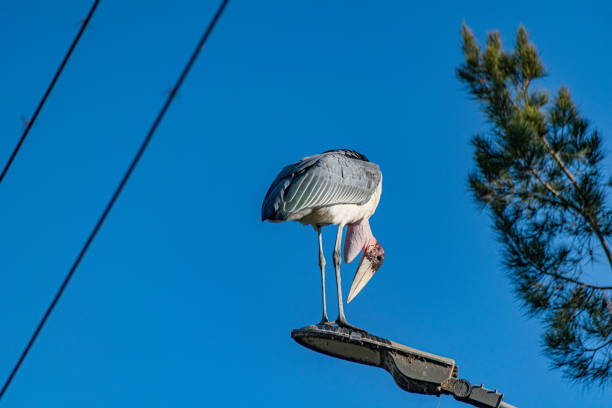
Marabou Storks in Kampala: Why They Live Above the City
The Marabou Stork (Leptoptilos crumenifer) is one of Kampala’s most recognisable birds, frequently seen standing on rooftops, nesting in tall trees or soaring above the busy streets of Uganda’s capital. With its enormous wings, bald pinkish head, long bill and unusual throat pouch, this large African bird has become a familiar part of Kampala’s urban wildlife. Although Marabou Storks originally occupied savannahs, wetlands and other natural habitats, many have adapted remarkably well to city life.
For visitors arriving in Uganda, seeing large Marabou Storks perched above buildings may come as a surprise. These birds are often associated with national parks and African wilderness areas, yet Kampala provides them with reliable food, suitable nesting trees and places to rest. Their presence also raises interesting questions about urban wildlife, waste management and how animals adapt to expanding cities.
What Is a Marabou Stork?
The Marabou Stork is a large African wading bird belonging to the family Ciconiidae, which includes other stork species.
Its scientific name is Leptoptilos crumenifer, although the name Leptoptilos crumeniferus also appears in older scientific literature.
Marabou Storks are widespread across sub-Saharan Africa, occupying savannahs, wetlands, floodplains, fishing areas and increasingly urban environments.
Unlike many storks that primarily hunt living prey, Marabou Storks are highly adaptable scavengers. They consume dead animals, fish, insects, small vertebrates and discarded food.
This flexible feeding behaviour helps explain their success in cities such as Kampala.
Quick Facts About the Marabou Stork
| Feature | Description |
|---|---|
| Common name | Marabou Stork |
| Scientific name | Leptoptilos crumenifer |
| Family | Ciconiidae |
| Average height | Approximately 115–152 cm |
| Wingspan | Approximately 2.3–2.9 metres |
| Main colours | Dark grey, black and white |
| Head | Mostly bald, pinkish |
| Distinctive feature | Large inflatable throat pouch |
| Main diet | Carrion, fish, insects and discarded food |
| Natural habitat | Savannahs, wetlands and floodplains |
| Urban habitat | Tall trees, rooftops and waste-disposal areas |
| Conservation status | Least Concern |
| Distribution | Sub-Saharan Africa |
Why Do Marabou Storks Live in Kampala?
Kampala provides several conditions that make urban life attractive to Marabou Storks.
The most important factors are food availability, suitable nesting trees and relatively easy access to feeding locations.
1. Abundant Food From Human Waste
Marabou Storks are scavengers that can consume a wide variety of animal-based food.
In natural environments, they often feed on carcasses, fish and other available prey.
In Kampala, discarded food and organic waste provide additional feeding opportunities.
Open rubbish areas, markets and food-disposal locations can attract these large birds.
Research into Kampala’s Marabou Storks has identified human-generated waste as an important reason for their successful adaptation to urban environments.
However, rubbish can also expose birds to plastics, contaminated food and other harmful materials.
2. Tall Trees Provide Nesting Locations
Marabou Storks commonly build their nests high above the ground.
Kampala contains mature trees with strong branches that can support their large nests.
These trees provide elevated locations where birds can rest, breed and watch their surroundings.
Areas around Makerere University have historically supported particularly large nesting colonies.
A 2020 Makerere University study recorded 1,006 nests across 190 nesting trees at 50 surveyed sites around Kampala and the Makerere area. This illustrates the importance of surviving mature trees within the city.
3. Urban Environments Offer Regular Feeding Opportunities
Unlike natural habitats where food availability may change significantly between seasons, urban areas can provide a relatively continuous supply of discarded food.
This allows Marabou Storks to remain near feeding locations throughout much of the year.
Kampala’s markets, waste-disposal areas and surrounding settlements provide opportunities for scavenging.
Researchers have also documented changes in breeding patterns among Kampala’s Marabou Storks, partly associated with the availability of food throughout the year.
4. Access to Nearby Wetlands and Waterways
Kampala lies close to Lake Victoria and several wetland systems.
These surrounding environments provide additional feeding opportunities.
Marabou Storks can travel between urban nesting areas and natural feeding habitats.
Their broad wings allow them to cover considerable distances while searching for food.
Why Do Marabou Storks Prefer Tall Trees and Rooftops?
Marabou Storks are large birds that require suitable places for resting and nesting.
Tall trees provide elevated positions where birds can build nests and remain above much of the activity occurring at ground level.
Their nests are usually constructed from sticks and branches arranged into substantial platforms.
Although Marabou Storks frequently perch on rooftops and buildings, their breeding nests are typically built in trees.
Advantages of Elevated Locations
| Feature | Benefit |
|---|---|
| Tall trees | Suitable nesting platforms |
| Strong branches | Support heavy nests |
| Elevated perches | Provide places to rest |
| Open surroundings | Allow easier take-off and landing |
| Nearby feeding areas | Reduce travel between food and nesting sites |
Suitable trees are particularly important for breeding colonies.
As Kampala expands, the removal of mature trees can reduce available nesting habitat, even when food remains plentiful.
What Do Marabou Storks Eat in Kampala?
Marabou Storks are opportunistic feeders, meaning they consume different foods depending on availability.
Their powerful bills allow them to handle a wide range of prey and scavenged materials.
In natural habitats, Marabou Storks frequently feed alongside vultures at animal carcasses.
In urban areas, they may search through discarded food and organic rubbish.
Common Foods Eaten by Marabou Storks
| Food type | Common feeding location |
|---|---|
| Animal carcasses | Savannahs and open environments |
| Fish | Lakes, wetlands and fishing areas |
| Discarded meat | Markets and waste-disposal areas |
| Food scraps | Urban rubbish sites |
| Insects | Grasslands and disturbed ground |
| Frogs and reptiles | Wetlands and freshwater habitats |
| Small animals | Open vegetation and feeding areas |
Although Marabou Storks help consume organic waste, they should not be considered a replacement for proper rubbish collection and disposal.
Poorly managed waste can attract large numbers of scavenging birds while also creating environmental and public health problems.
Why Do Marabou Storks Have Bald Heads?
One of the most unusual characteristics of the Marabou Stork is its largely featherless head and neck.
This appearance is closely associated with its scavenging lifestyle.
When feeding on carcasses, a bare head is easier to keep clean than one covered with dense feathers.
The lack of feathers may reduce the accumulation of decaying material during feeding.
The bird’s exposed skin can also contribute to temperature regulation.
Marabou Storks often stand with their wings partly extended, a behaviour that may help with drying feathers and managing body temperature.
What Is the Large Throat Pouch Used For?
Adult Marabou Storks have a distinctive hanging throat pouch, particularly noticeable in mature birds.
The pouch is inflatable and plays a role in courtship and social displays.
It is not primarily used for storing fish or other food.
During breeding displays, adults may inflate the pouch and produce sounds while interacting with potential mates.
This unusual feature makes the species relatively easy to recognise.
How Do Marabou Storks Fly Above Kampala?
Despite their enormous size, Marabou Storks are accomplished soaring birds.
They use rising columns of warm air, known as thermals, to gain height without constantly flapping their wings.
Once airborne, they can travel considerable distances while conserving energy.
Their long, broad wings provide the lift needed for efficient soaring.
Visitors may see several Marabou Storks circling high above Kampala, particularly when warm air creates favourable flying conditions.
Marabou Stork Flight Characteristics
| Feature | Description |
|---|---|
| Wings | Long and broad |
| Flying style | Soaring and gliding |
| Neck position | Retracted during flight |
| Main advantage | Energy-efficient travel |
| Common observation | Circling high above the city |
Unlike herons, which also retract their necks during flight, Marabou Storks have a much heavier appearance and broader wings.
Where Can Visitors See Marabou Storks in Kampala?
Marabou Storks have historically been observed in several parts of Kampala, particularly around mature trees, established nesting colonies and areas where food is available.
Their distribution changes as trees are removed, buildings are developed and waste-management practices improve.
Places to Look for Marabou Storks
| Location | What visitors may observe |
|---|---|
| Makerere University area | Established nesting trees and large birds |
| Central Kampala | Birds resting or soaring above buildings |
| Areas near major markets | Scavenging activity where food waste is accessible |
| Mature roadside trees | Resting and possible nesting activity |
| Urban green spaces | Birds perched high above the ground |
| Lake Victoria surroundings | Feeding and movement near freshwater habitats |
Makerere University is particularly notable because scientific studies have documented substantial Marabou Stork nesting activity there.
Visitors should observe birds from public areas and avoid approaching active nesting trees unnecessarily.
Marabou Stork Breeding and Nesting Behaviour
Marabou Storks often breed in colonies, with several pairs nesting in the same group of trees.
Their nests are large platforms constructed from branches and sticks.
Both adults participate in nest construction and caring for their young.
Females usually lay two or three eggs, although clutch sizes vary.
Incubation lasts approximately one month, and chicks remain in the nest for several additional months while developing.
Parents feed their chicks by regurgitating food.
How Kampala Has Influenced Their Breeding
Urban food availability has influenced the breeding behaviour of Marabou Storks in Kampala.
A scientific study published in 2017 reported that some urban Marabou Storks began nesting several weeks earlier than traditionally expected, with a smaller proportion beginning as much as four months earlier.
Researchers associated these changes with the year-round availability of human-generated food waste.
This demonstrates how urban environments can influence the natural behaviour of wildlife.
Are Marabou Storks Dangerous to People?
Marabou Storks generally avoid direct confrontation with people.
However, they are large wild birds with powerful bills and should be treated with caution.
Visitors should never attempt to touch, chase or feed them.
Birds accustomed to human food waste may approach areas where rubbish or discarded food is available.
Close interaction can create risks for both people and birds.
Safe Ways to Observe Marabou Storks
Maintain a respectful distance.
Avoid feeding birds.
Never approach active nests.
Keep children away from resting or feeding birds.
Do not disturb birds while photographing them.
Avoid standing directly beneath heavily occupied nesting trees.
Dispose of food waste responsibly.
Large nesting colonies can also produce considerable droppings, making cleanliness and waste management important in frequently occupied public spaces.
The Role of Marabou Storks in Kampala’s Environment
Marabou Storks perform an important ecological function as scavengers.
By consuming carrion and other organic material, they contribute to the breakdown and recycling of animal matter.
However, their presence in large urban concentrations creates challenges.
Droppings can accumulate beneath nesting trees, while discarded waste may attract more birds into crowded areas.
The best approach is to maintain effective waste management while protecting suitable natural habitats.
Benefits and Challenges of Urban Marabou Storks
| Benefits | Challenges |
|---|---|
| Consume animal remains | Droppings beneath nesting colonies |
| Contribute to nutrient recycling | Noise around occupied trees |
| Provide urban birdwatching opportunities | Potential conflicts in public spaces |
| Demonstrate wildlife adaptation | Exposure to contaminated waste |
| Support awareness of urban biodiversity | Dependence on poorly managed rubbish |
Best Time to See Marabou Storks in Kampala
Marabou Storks can be observed throughout the year.
Early morning is suitable for watching birds resting, leaving nesting areas or beginning their daily feeding activities.
Late afternoon may provide opportunities to see birds returning towards established roosting areas.
Warm periods during the day can be particularly interesting for watching soaring behaviour.
Birdwatching Conditions
| Time | Common activity |
|---|---|
| Early morning | Resting, calling and movement from roosts |
| Mid-morning | Soaring and searching for food |
| Afternoon | Feeding and resting |
| Late afternoon | Movement towards nesting or roosting areas |
| Throughout the year | Urban birdwatching opportunities |
Breeding activity varies, so visitors interested in nesting behaviour should ask local birdwatching guides about active colonies.
Photography Tips for Marabou Storks in Kampala
Marabou Storks are relatively accessible photography subjects because of their large size and frequent use of elevated perches.
A telephoto lens of 200–400 mm is suitable for photographing birds perched in trees.
For birds soaring above the city, use a fast shutter speed of approximately 1/1000 second or faster when lighting permits.
Photographs can include Kampala’s skyline to demonstrate how these birds have adapted to urban environments.
Early morning light may provide particularly attractive conditions.
Avoid standing directly beneath nesting colonies or photographing birds in ways that interfere with pedestrians and traffic.
Marabou Stork Conservation and Urban Wildlife Management
The Marabou Stork is classified as Least Concern on the IUCN Red List.
Its wide distribution and ability to exploit different food sources contribute to its relatively secure global conservation status.
However, urban populations face specific challenges, including the loss of nesting trees, pollution and conflicts with people.
Kampala’s continuing development makes the protection of mature trees particularly important.
Effective rubbish collection can reduce unhealthy concentrations of scavenging birds without requiring harmful wildlife control measures.
Protecting wetlands and other natural feeding habitats also supports healthier bird populations.
Why Marabou Storks Have Become Part of Kampala’s Identity
Marabou Storks have become a familiar sight in Kampala because of their unusual appearance and ability to live close to people.
Their large nests, enormous wings and distinctive silhouettes make them noticeable even in a busy city.
For tourists, seeing these birds provides an unexpected introduction to Uganda’s remarkable birdlife.
While Uganda is famous for gorillas, chimpanzees, lions and other safari animals, Kampala’s Marabou Storks demonstrate that wildlife can also be observed within urban environments.
Their story reflects the relationship between growing cities, natural habitats and animal adaptation.
Marabou Storks live above Kampala because the city provides reliable feeding opportunities, suitable nesting trees and access to surrounding natural habitats.
Their scavenging behaviour has allowed them to adapt successfully to urban conditions, while their remarkable soaring abilities make them a familiar sight above Kampala’s streets.
However, their success also reflects the influence of human waste and urban development on wildlife.
For visitors interested in Uganda’s birds, observing Marabou Storks offers an opportunity to understand how wild animals survive alongside people.
Protecting mature trees, improving waste management and conserving natural wetlands can help maintain a healthier relationship between Kampala’s residents and its remarkable urban birds.




No comment