
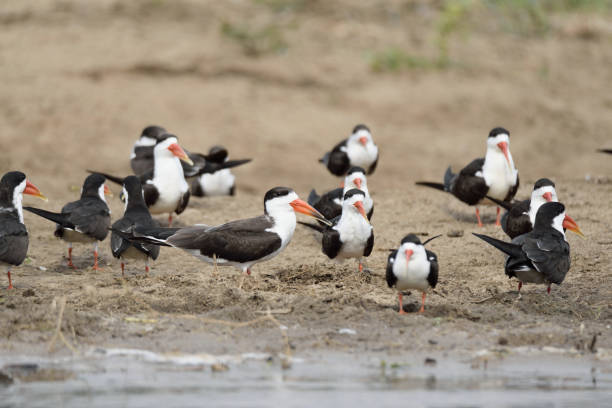
African Skimmers on the Nile Near Murchison
The African Skimmer (Rynchops flavirostris) is one of Uganda’s most unusual and fascinating waterbirds, recognised for its distinctive orange-and-yellow bill and remarkable feeding technique. Unlike most birds that dive into water to catch fish, African Skimmers fly just above the surface, dragging their elongated lower bill through the water until they encounter prey. This extraordinary behaviour makes them among the most interesting birds to observe during a Nile River safari in Murchison Falls National Park.
For birdwatchers exploring northwestern Uganda, the Nile provides opportunities to encounter African Skimmers resting on exposed sandbanks, flying in groups or hunting across calm stretches of water. Their black-and-white feathers, bright reddish legs and graceful flight make them relatively easy to recognise when present. However, sightings depend on seasonal movements, river conditions and the availability of suitable sandbanks.
What Is an African Skimmer?
The African Skimmer is a medium-sized waterbird belonging to the family Laridae, which also includes gulls and terns.
Its scientific name is Rynchops flavirostris, and it is one of three living skimmer species worldwide.
African Skimmers occur across parts of sub-Saharan Africa, particularly along large rivers, lakes, lagoons and waterways with exposed sandy banks.
They are strongly associated with freshwater habitats where small fish are available near the surface.
Unlike herons and storks, which often walk through shallow water, African Skimmers catch most of their food while flying.
Quick Facts About the African Skimmer
| Feature | Description |
|---|---|
| Common name | African Skimmer |
| Scientific name | Rynchops flavirostris |
| Family | Laridae |
| Bird group | Skimmers |
| Body length | Approximately 36–42 cm |
| Wingspan | Approximately 100–110 cm |
| Main colours | Black and white |
| Bill | Orange-red with a yellow tip |
| Distinctive feature | Lower bill longer than upper bill |
| Main food | Small fish |
| Feeding method | Skimming the water surface |
| Main habitat | Rivers, lakes and sandy shorelines |
| Nesting habitat | Exposed sandbanks |
| Conservation status | Near Threatened |
| Uganda destination | Murchison Falls National Park |
Why Are African Skimmers Different From Other Waterbirds?
The African Skimmer has an unusual bill that immediately distinguishes it from most other birds.
Its lower mandible is considerably longer than the upper mandible. Both sections are narrow and laterally compressed, creating a specialised structure for catching fish.
While flying close to the water, the bird opens its bill and lowers the longer mandible beneath the surface.
When the bill contacts a fish, it closes rapidly and captures the prey.
This feeding technique allows the bird to hunt without repeatedly diving beneath the water.
How to Identify an African Skimmer
Look for the following characteristics:
Black crown, hindneck and upperparts.
White forehead, breast and belly.
Long orange-red bill with a yellow tip.
Lower mandible extending beyond the upper mandible.
Bright reddish legs.
Long, pointed wings.
Forked tail.
Low, graceful flight above water.
Juvenile birds have duller plumage and less colourful bills than adults.
Their lower mandibles also develop progressively as they grow.
African Skimmers Along the Nile in Murchison Falls National Park
Murchison Falls National Park is Uganda’s largest national park and one of the country’s most important destinations for wildlife safaris.
The park is crossed by the Victoria Nile, which eventually flows into Lake Albert.
This extensive river system provides feeding and resting habitats for numerous waterbirds, including African Fish Eagles, pelicans, herons, cormorants and skimmers.
African Skimmers have been recorded along the Nile, particularly around exposed sandbanks and suitable open-water areas.
Scientific observations have documented concentrations of African Skimmers upstream from Paraa, demonstrating the importance of this section of the river for the species.
The Murchison Falls wetland system is also internationally recognised for supporting significant waterbird populations.
Where to Look for African Skimmers
| Location | Birdwatching opportunity |
|---|---|
| Victoria Nile near Paraa | Open water and exposed sandbanks |
| Sandbanks upstream from Paraa | Resting and feeding skimmers |
| Nile River below Murchison Falls | Suitable sandy sections and open water |
| Nile Delta towards Lake Albert | Waterbirds and seasonal feeding habitats |
| Lake Albert shoreline | Additional opportunities in suitable habitats |
African Skimmers move according to water levels and food availability, so historical observation sites should not be treated as guaranteed locations.
How African Skimmers Catch Fish
The African Skimmer’s feeding behaviour is one of the most remarkable hunting techniques among African birds.
Instead of watching from a perch and diving like a kingfisher, it flies low over calm water.
Its lower mandible cuts through the surface while the bird continues moving forward.
When the submerged bill encounters a fish, the bird snaps its bill shut.
The African Skimmer’s Hunting Process
Locating suitable water: The bird searches for calm stretches containing small fish near the surface.
Flying low: It approaches the water with its long wings extended.
Lowering its bill: The elongated lower mandible enters the water.
Skimming the surface: The bird continues flying while maintaining contact with the water.
Catching prey: Its bill closes rapidly when it encounters a fish.
Continuing its flight: The bird swallows or handles its catch before searching again.
African Skimmers may hunt individually or in loose groups.
Watching several birds moving across the river with their bills cutting through the surface is a particularly memorable sight.
What Do African Skimmers Eat?
African Skimmers feed mainly on small fish captured close to the water’s surface.
Their feeding technique is most effective where fish are accessible and the water is relatively calm.
Different freshwater fish species form part of their diet across Africa.
Main Food Sources
| Food | Feeding habitat |
|---|---|
| Small freshwater fish | Calm river surfaces |
| Young tilapia | Suitable shallow-water areas |
| Small river fish | Open freshwater channels |
| Other small aquatic prey | Occasionally available near the surface |
Unlike many herons, African Skimmers are highly specialised fish hunters.
Their feeding success depends on suitable water conditions and the availability of prey.
Why African Skimmers Prefer Exposed Sandbanks
Sandbanks are essential habitats for African Skimmers because they provide places to rest, gather and breed.
These sandy areas often emerge when river levels fall during drier periods.
The birds use exposed sandbanks as resting locations between feeding sessions.
They also construct simple nesting scrapes directly in the sand.
Importance of Sandbanks
| Sandbank feature | Benefit to skimmers |
|---|---|
| Open sandy surface | Suitable resting space |
| Limited vegetation | Clear visibility of surroundings |
| Isolation by water | May reduce access by some land predators |
| Nearby feeding areas | Convenient access to fish |
| Exposed dry sand | Suitable nesting conditions |
However, sandbanks can become unsuitable when river levels rise unexpectedly.
Flooding can destroy nests and force birds to relocate.
African Skimmer Breeding and Nesting Behaviour
African Skimmers usually breed in loose colonies on exposed sandy islands and riverbanks.
Unlike many birds that construct nests from twigs or grass, they lay their eggs in shallow scrapes in the sand.
Females commonly lay two or three eggs, although clutch sizes vary.
Both parents participate in protecting the nesting area and caring for the young.
The eggs are naturally coloured to blend with sandy surroundings, helping conceal them from predators.
Why Breeding Colonies Need Protection
Sandbank nesting creates several challenges.
Eggs and chicks can be threatened by flooding, predators and disturbance from people or boats.
Visitors should never walk across occupied sandbanks because eggs may be difficult to see.
Boat operators should also avoid approaching breeding colonies closely enough to cause adult birds to abandon their nests temporarily.
Maintaining a respectful distance is important for successful breeding.
Best Time to See African Skimmers Near Murchison Falls
African Skimmer sightings depend strongly on seasonal changes in river water levels.
Periods when sandbanks become exposed can provide favourable opportunities for observing resting or nesting birds.
Historical observations from the Murchison Falls wetland system have recorded sizeable concentrations between October and March, although birds move frequently.
Dry-season conditions can make sandbanks more visible, but the timing and extent of suitable habitat vary.
Seasonal Birdwatching Guide
| Period | Birdwatching conditions |
|---|---|
| January–February | Often suitable exposed sandbanks and possible skimmer sightings |
| March–May | Increasing rainfall may affect river conditions |
| June–August | Dry-season opportunities, depending on water levels |
| September–November | Seasonal movements and changing river conditions |
| December | Potential concentrations around suitable sandbanks |
Travellers specifically interested in African Skimmers should ask local birdwatching guides about recent sightings before arranging a Nile excursion.
Best Time of Day
African Skimmers often feed during early morning and late afternoon.
They may also hunt in low-light conditions.
Calm water can make their surface-skimming behaviour easier to observe.
During warmer parts of the day, birds may gather on exposed sandbanks to rest.
African Skimmers vs African Terns: How to Tell Them Apart
African Skimmers may be confused with certain terns because both have long, pointed wings and frequently fly above water.
However, their bills and feeding techniques are different.
| Feature | African Skimmer | Typical tern |
|---|---|---|
| Bill | Lower mandible longer than upper | Mandibles approximately equal |
| Main feeding technique | Skims water surface | Often dives or picks prey |
| Plumage | Black upperparts and white underparts | Varies by species |
| Wing shape | Long and pointed | Usually long and pointed |
| Feeding flight | Very low over water | Often higher before diving |
| Resting habitat | Exposed sandbanks | Sandbanks and shorelines |
The African Skimmer’s unusually shaped bill is the most reliable identification feature.
Other Birds to Watch Along the Nile
The Nile River within Murchison Falls National Park supports an impressive variety of waterbirds.
Even when African Skimmers are absent, visitors can enjoy rewarding birdwatching.
Notable Nile River Birds
| Bird species | Main identification feature |
|---|---|
| African Fish Eagle | White head and powerful territorial call |
| Pied Kingfisher | Black-and-white plumage and hovering flight |
| Giant Kingfisher | Large body and shaggy crest |
| Goliath Heron | Enormous size and reddish head |
| African Darter | Long neck and pointed bill |
| Great White Pelican | Large white body and enormous bill |
| Rock Pratincole | Associated with rocky river sections |
| Shoebill | Large shoe-shaped bill and preference for papyrus swamps |
| African Jacana | Long toes adapted to floating vegetation |
The Nile Delta towards Lake Albert is particularly interesting for specialist birdwatchers searching for wetland species such as the Shoebill.
Photography Tips for African Skimmers
African Skimmers are challenging but rewarding photography subjects because of their rapid flight and specialised hunting behaviour.
A telephoto lens of approximately 300–600 mm is useful for photographing birds from a boat.
For flying birds, use a shutter speed of around 1/1600–1/2500 second when lighting conditions permit.
Continuous autofocus can help track birds moving close to the water.
Recommended Photography Techniques
Photograph birds from the side to reveal their unusual bill shape.
Use continuous autofocus for skimming flight.
Watch groups resting on exposed sandbanks.
Keep the water surface visible to illustrate feeding behaviour.
Use early morning light when possible.
Protect camera equipment from water spray.
Avoid disturbing nesting colonies.
Photographers should never request that boat operators chase birds or approach sensitive nesting areas for closer images.
Planning a Murchison Falls Birdwatching Safari
African Skimmer birdwatching can be combined with a wider Murchison Falls National Park safari.
The park offers game drives, guided nature experiences and boat excursions along the Nile River.
For visitors specifically targeting skimmers, a specialist birdwatching excursion may be more suitable than a general sightseeing cruise.
Suggested Three-Day Safari Itinerary
| Day | Destination | Main activity |
|---|---|---|
| Day 1 | Kampala to Murchison Falls | Transfer and afternoon wildlife viewing |
| Day 2 | Murchison Falls National Park | Morning game drive and Nile boat safari |
| Day 3 | Nile River and return journey | Optional early birdwatching and transfer to Kampala |
If African Skimmers are your main birdwatching target, consider allowing additional time to investigate recent sightings.
Boat access, permitted routes and departure schedules should be confirmed with your safari operator.
Conservation of African Skimmers
The African Skimmer is classified as Near Threatened on the IUCN Red List.
Its population faces pressure from disturbance at breeding sites, changes in river flow, flooding and habitat degradation.
Because the species depends on exposed sandbanks, alterations to natural water levels can affect nesting success.
Human activities such as sand extraction, uncontrolled shoreline development and disturbance from boats may also threaten suitable habitats.
How Travellers Can Help Protect African Skimmers
Responsible visitors should:
Maintain a safe distance from resting and nesting birds.
Avoid landing on occupied sandbanks.
Support responsible boat operators.
Never approach chicks or eggs.
Avoid leaving rubbish in waterways.
Follow park regulations and guide instructions.
Support the conservation of natural river habitats.
Protecting African Skimmers also benefits other waterbirds that depend on healthy freshwater environments.
Why African Skimmers Are Worth Seeing on the Nile
African Skimmers are among Uganda’s most remarkable waterbirds because of their unusual feeding technique and close relationship with seasonal river habitats.
Their specialised bills, graceful flight and dependence on exposed sandbanks make them different from most birds encountered during an ordinary wildlife safari.
Murchison Falls National Park provides opportunities to observe this species along suitable stretches of the Nile, particularly where calm water and exposed sandbanks occur.
Although sightings cannot be guaranteed, patient birdwatchers may be rewarded with the unforgettable sight of African Skimmers flying low over the river, their elongated bills cutting through the water in search of fish.
For travellers interested in Uganda’s birdlife, this distinctive species is an excellent reason to spend more time exploring the Nile River and its surrounding wetlands.







No comment