Gorillas are the largest living primates and among humanity’s closest living relatives, sharing roughly 98 percent of our DNA. Understanding where they came from and where they live today helps explain why gorilla trekking in destinations like Bwindi, Mgahinga, and Volcanoes National Park is such a tightly protected, carefully managed experience.
Gorillas on the Family Tree
Gorillas belong to the great ape family, alongside chimpanzees, bonobos, orangutans, and humans. Fossil and genetic evidence suggests gorillas split from the lineage that eventually led to humans and chimpanzees somewhere between 8 and 10 million years ago, making them one of the earlier branches to diverge from our shared ancestor. Over millions of years, gorillas adapted to a largely herbivorous diet and a life spent mostly on the forest floor, developing the powerful build and knuckle-walking gait that distinguishes them today.
Two Species, Four Subspecies
All living gorillas are classified into two species: the eastern gorilla and the western gorilla, each split into two subspecies. The mountain gorilla, the subspecies travelers come to Uganda, Rwanda, and Congo to see, is one of two eastern gorilla subspecies, alongside the eastern lowland gorilla (also called Grauer’s gorilla), found further west in the Democratic Republic of Congo’s lowland forests. The western gorilla species, native to Central African countries like Cameroon, Gabon, and the Republic of Congo, includes the more numerous western lowland gorilla and the critically endangered Cross River gorilla, of which only a few hundred remain along the Nigeria-Cameroon border.
Mountain Gorilla Habitat: Life at Altitude
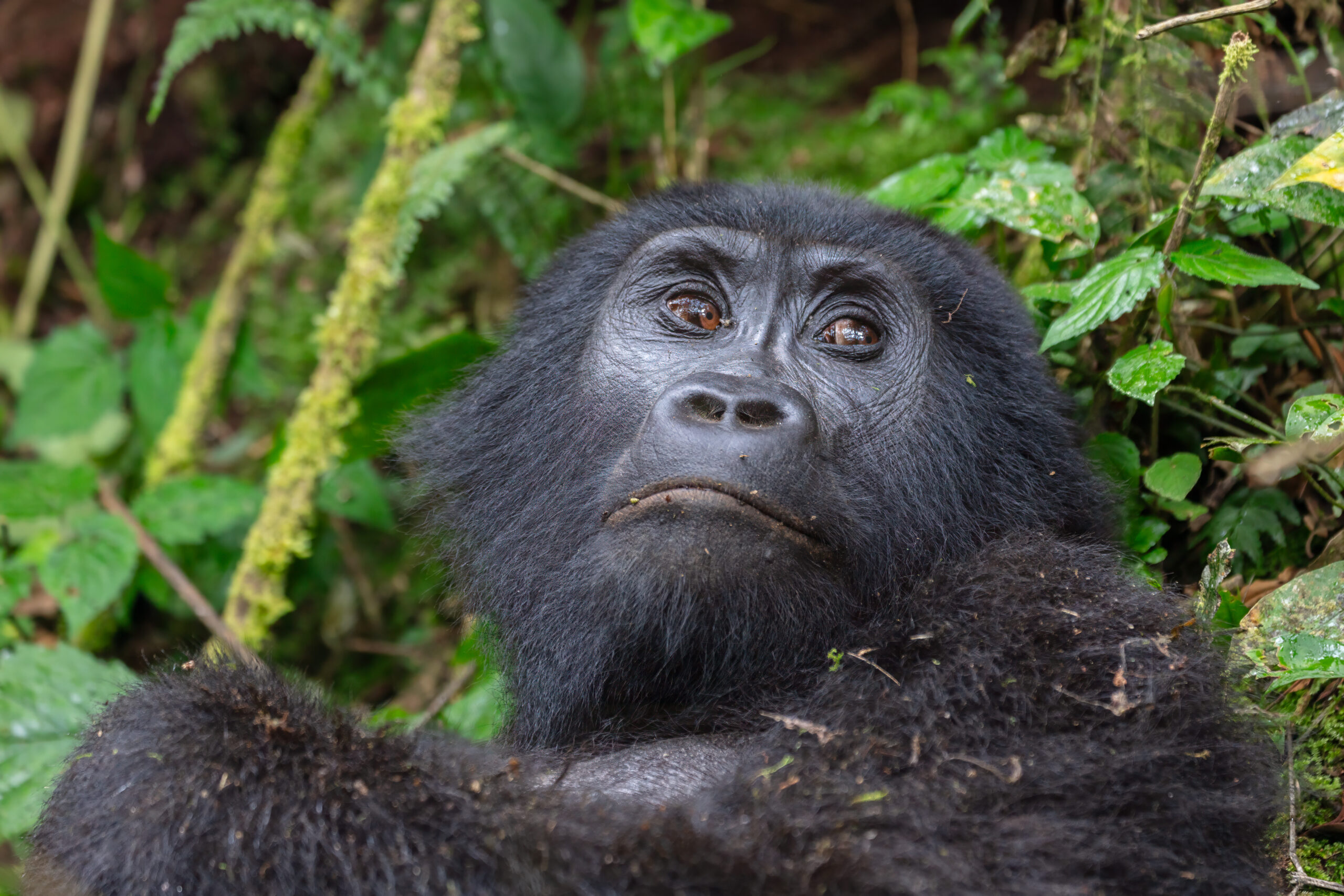
Mountain gorillas are unusual among great apes for living at high elevation, typically between 2,200 and 4,300 meters, in cool, misty montane and bamboo forest. Their entire wild population is confined to two isolated regions: the Virunga Massif, a chain of volcanoes spanning the borders of Uganda, Rwanda, and the Democratic Republic of Congo, and Bwindi Impenetrable National Park in southwestern Uganda, an ancient forest that predates the last ice age. This restricted range is precisely why the population, once feared close to extinction, has become one of conservation’s genuine success stories, recovering to just over 1,000 individuals through decades of protection, habituation, and regulated tourism.
Lowland Gorillas: A Different World
Lowland gorillas, both eastern and western, live in warmer, denser tropical rainforest at much lower elevations than their mountain cousins, often spending more time foraging over larger territories for fruit, which makes up a bigger share of their diet than it does for mountain gorillas. Because their habitat is harder to access and far less developed for tourism, lowland gorillas are seen by far fewer visitors each year, and reliable trekking experiences for them are much more limited than the well-established mountain gorilla circuit in East Africa.
Why Habitat Matters for Conservation
Every gorilla subspecies is classified as endangered or critically endangered, and habitat loss from agriculture, logging, and human encroachment remains the single biggest long-term threat across their range. Mountain gorillas are the exception showing real population growth, largely because Uganda, Rwanda, and the DRC have invested heavily in ranger patrols, veterinary monitoring, and permit-funded conservation, with tourism revenue directly supporting the parks and surrounding communities that protect this habitat.
Social Structure and the Role of the Silverback
Mountain gorillas live in stable family groups of anywhere from a handful to over 30 individuals, led by a single dominant adult male known as a silverback for the distinctive band of silver-grey hair that develops across his back with age. The silverback decides where the group forages, feeds, and rests each day, mediates disputes between members, and is the family’s primary defense against threats, including rival males and, historically, poachers. Most groups also include several adult females, their offspring, and sometimes younger blackback males who haven’t yet developed the silverback coloring; young males typically leave their birth group as they mature, either to form their own group or join another.
How Gorillas Communicate
Gorillas are far from silent. Researchers have documented more than 25 distinct vocalizations, from soft grumbles used during peaceful feeding to sharp barks and roars that signal alarm or aggression. Chest-beating, often misread as pure aggression, is more accurately a form of long-distance communication, used to announce location, assert dominance, or simply release excitement, and is frequently accompanied by other displays like standing bipedally or slapping vegetation. Body language, eye contact, and touch all play a role too, gorilla families groom each other regularly, reinforcing social bonds much the way primates, including humans, do across the board.
Diet: What Gorillas Actually Eat
Mountain gorillas are almost entirely herbivorous, spending much of each day feeding on leaves, stems, shoots, and bamboo, with fruit making up a much smaller share of the diet than it does for their lowland relatives, largely because fruiting trees are scarcer at the elevations mountain gorillas call home. An adult silverback can eat over 18 kilograms of vegetation a day, and this near-constant foraging is one reason trekking groups often find gorillas exactly where trackers expect them: feeding in a relatively contained area rather than ranging widely.
The Legacy of Dian Fossey and Modern Conservation Science
Much of what’s known about mountain gorilla behavior traces back to primatologist Dian Fossey, who established the Karisoke Research Center in Rwanda’s Virunga Mountains in 1967 and spent nearly two decades habituating and studying wild gorilla groups. Her research laid the groundwork for the habituation process still used today, gradually acclimating gorilla families to human presence so they can be safely observed. That same research infrastructure now underpins ongoing veterinary monitoring, anti-poaching patrols, and population census work across Uganda, Rwanda, and the DRC, work credited with helping the mountain gorilla population grow at a time when most great ape populations elsewhere are shrinking.
Lifespan and Reproduction
Mountain gorillas live an estimated 35 to 40 years in the wild, with females typically giving birth for the first time around age 10 and, from there, having a single infant roughly every four to six years, one of the slowest reproductive rates of any great ape. This slow pace is part of why population recovery has taken decades of sustained conservation work rather than happening quickly on its own; every surviving infant matters disproportionately to the overall population trajectory. Infants stay close to their mothers for the first few years, riding on her back once old enough, and remain within the family group well into adolescence, learning foraging routes and social behavior largely by observation.
Threats Beyond Habitat Loss
While habitat loss remains the dominant long-term threat, mountain gorillas face several other risks that conservation programs actively manage. Snares set for other forest animals like antelope can injure or kill gorillas who wander into them, which is why ranger patrols regularly sweep trekking areas to remove traps. Disease transmission from humans is a serious enough concern that it shapes many of the rules trekkers follow, including the minimum viewing distance and the requirement that sick visitors postpone their trek. Civil unrest in parts of the DRC’s Virunga region has also periodically disrupted conservation work there, underscoring how closely gorilla survival is tied to regional stability as well as ecological protection.
For travelers, this means a trip to see mountain gorillas is also, in a real sense, a visit to one of the last intact pieces of Albertine Rift forest left on the planet. If you’re planning a trip, All in Africa Safaris can help you choose between Uganda’s Bwindi and Mgahinga or Rwanda’s Volcanoes National Park based on the experience, season, and pace you’re looking for.
How Habituation Changes a Gorilla Family
Wild gorilla families aren’t born ready for tourism, habituation is a gradual, years-long process in which trackers spend increasing amounts of time near a group, allowing individuals to grow accustomed to a calm, non-threatening human presence without altering their natural behavior otherwise. A family typically needs two to three years of near-daily contact before it’s considered fully habituated and safe to open to regular trekking, and even then, habituation is maintained through continued, careful visitation rather than being a one-time achievement. This is part of why the number of trekkable families grows slowly even as overall gorilla numbers recover, habituating a new group takes patience and sustained investment long before the first tourist ever sees them.
How Scientists Track Individual Gorillas
Researchers and rangers identify individual gorillas the same way you might recognize a person, by facial features, particularly the nose print, which is as unique to each gorilla as a fingerprint is to a human. Combined with scars, build, and behavioral quirks, this lets conservation teams monitor specific individuals over decades, tracking health, family transfers, and reproduction across a gorilla’s entire life. This long-term individual monitoring is part of what makes mountain gorilla population data unusually precise compared to many other endangered species, where broader estimates are the norm rather than a near-complete census. This precision is also what lets rangers notice quickly when a particular individual hasn’t been seen in a while, prompting a targeted search rather than waiting for the next scheduled census.
What This Means for Trekkers
When you go trekking, your guide can often tell you specific details about the family you visit, individual names, ages, family history, sometimes even a particular gorilla’s personality quirks, because that level of knowledge exists thanks to decades of exactly this kind of monitoring. It turns an already remarkable encounter into something more personal, you’re not just seeing “a gorilla family,” you’re meeting individuals whose life stories researchers have tracked for years, which is part of why so many trekkers describe the experience as more moving than they expected.