
Silverback Succession: What Happens When a Group Leader Dies
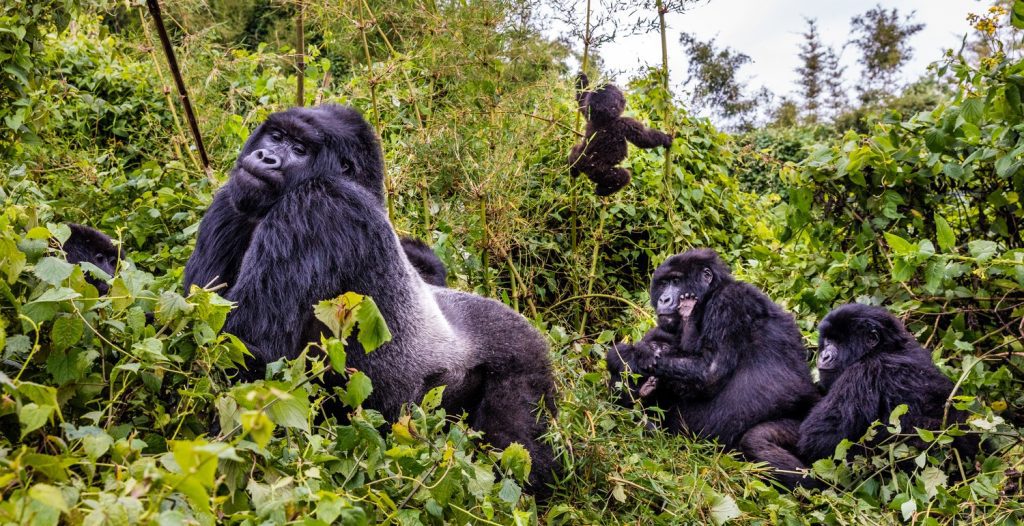
Deep in the forests of Uganda’s Bwindi Impenetrable National Park, a mountain gorilla family moves slowly through the vegetation. At the centre of the group is a powerful silverback who protects the younger gorillas, settles disputes and helps determine where the family travels.
For years, this male may have provided stability and protection. But what happens when he grows old or dies?
Silverback succession in mountain gorillas is one of the most fascinating aspects of primate social behaviour. The death of a dominant male can change family relationships, create new leadership opportunities and sometimes cause an entire group to separate.
Some families remain together under another silverback. Others divide into smaller groups, while females may transfer to neighbouring families.
Understanding these changes helps travellers appreciate the complex lives of mountain gorillas in Uganda and Rwanda.
1. What Is a Silverback Gorilla?
A silverback is a mature male gorilla recognised by the grey or silver-coloured hair across his back.
Male gorillas generally develop this distinctive colouring as they mature, usually around 12 years of age.
Silverbacks are often the largest individuals within a family.
However, not every silverback is the dominant leader.
Some gorilla families contain several mature males, with one holding the main leadership position.
The Silverback’s Responsibilities
| Responsibility | Importance |
|---|---|
| Group protection | Responds to possible threats |
| Movement decisions | Influences daily travel |
| Social relationships | Helps maintain group stability |
| Conflict management | Intervenes during disputes |
| Infant protection | May protect vulnerable youngsters |
| Breeding | Often fathers offspring within the group |
Leadership involves more than physical strength. Experience, relationships and the support of other group members can also matter.
2. Why Is the Dominant Silverback Important?
Mountain gorillas live in social groups that may include adult females, infants, juveniles and several males.
The dominant silverback often occupies a central position in the group’s activities.
When the family moves to another feeding area, other gorillas may follow his movements.
If danger appears, he may respond with threatening displays or protective behaviour.
Young gorillas can also develop strong relationships with adult males.
The leader therefore provides both physical protection and social stability.
However, gorilla families are not controlled entirely by one individual. Females and subordinate males also make choices that influence group behaviour.
3. What Happens Immediately After a Silverback Dies?
There is no single outcome when a dominant silverback dies.
The response depends on the family’s composition and whether other mature males are present.
A group containing several silverbacks may remain together under another male.
A family with only one mature male can face a more difficult transition.
Adult females may eventually transfer to other groups, while young gorillas face an uncertain period.
Possible Outcomes
| Family Situation | Possible Outcome |
|---|---|
| Another mature male is present | Leadership may pass to him |
| Several mature males remain | Group may stay together or divide |
| No suitable adult male remains | Family may disintegrate |
| Adult females transfer | Membership changes |
| Young males mature | New leadership opportunities develop |
Researchers monitor these transitions because they can affect the long-term stability of gorilla families.
4. Does the Strongest Gorilla Automatically Become Leader?
Not necessarily.
Although physical strength matters, gorilla succession is not always decided through fighting.
A mature male may already have established relationships with females and younger group members.
If the dominant silverback dies, that individual may become the new leader without a dramatic confrontation.
In other cases, competing males may display aggression or move away with different members of the original family.
Leadership can therefore emerge through social relationships as well as competition.
5. Can Two Silverbacks Divide One Family?
Yes. This has been documented among mountain gorillas.
When a dominant male dies, two remaining silverbacks may each attract different members of the original group.
Over time, this can produce two separate families.
The Shinda Family in Rwanda
One documented example involved the silverback Shinda, who died in November 2008.
His group was monitored by the Dian Fossey Gorilla Fund in Rwanda.
After his death, two remaining silverbacks, Ugenda and Ntambara, eventually led separate groups.
The division developed over several months rather than happening immediately.
This example demonstrates how the loss of one leader can result in the formation of new gorilla families.
6. What Happens to Female Gorillas?
Adult female gorillas have an important role in family succession.
They may remain with another silverback in the original group or transfer elsewhere.
Their decisions can depend on social relationships, available males and the circumstances surrounding the leader’s death.
Females sometimes transfer between gorilla families even when there has been no death.
These movements influence group membership and breeding relationships.
A silverback’s death can therefore change the social structure of several neighbouring groups, not just his original family.
7. What Happens to Baby Gorillas?
Infants can be particularly vulnerable when family leadership changes.
A young gorilla depends heavily on its mother for food, warmth and protection.
If the family loses its dominant male, the infant may also lose an important protector.
Some incoming males may threaten or kill infants that are not their own, a behaviour known as infanticide.
However, this is not an inevitable consequence of succession.
Research has shown that infanticide associated with group disintegration is relatively uncommon across the mountain gorilla population studied.
The presence of other mature males can help provide continuity and protection.
8. Why Does Infanticide Sometimes Occur?
Infanticide is a difficult but important part of understanding gorilla behaviour.
In some circumstances, a male may kill an infant fathered by another male.
This can affect the mother’s reproductive cycle and potentially increase the new male’s future breeding opportunities.
However, gorilla social behaviour is complex, and infanticide does not occur during every leadership change.
What Research Shows
A long-term study published in 2013 examined more than four decades of mountain gorilla records.
Researchers reported that approximately 1.7% of infants born during the study died through infanticide associated with group disintegration.
The finding shows that the risk is real but should not be exaggerated.
Conservation researchers use such evidence to understand reproductive behaviour and group stability.
9. What Happens to Young Male Gorillas?
Young males may remain with their original family while developing towards adulthood.
Some eventually leave and spend time living alone.
Others remain as subordinate males and may later gain leadership opportunities.
Following the death of a dominant silverback, a mature son or another resident male may be well placed to assume leadership.
However, succession is not automatically hereditary.
A silverback’s son does not necessarily become the next leader simply because of his family relationship.
10. Can a Gorilla Family Disappear Completely?
Yes. Some families eventually cease to exist as distinct social groups.
This can happen when members transfer to other families following the loss of a leader.
A group may also divide into smaller units that establish their own identities.
However, the disappearance of a family name does not mean all its members have died.
Many may continue living in other groups.
Family Changes After Leadership Loss
| Change | Meaning |
|---|---|
| Succession | Another male becomes leader |
| Group division | One family separates into two |
| Female transfer | Females join other groups |
| Male dispersal | A male leaves to live independently |
| Group disintegration | Original family no longer exists as one unit |
These changes are part of the natural social dynamics of mountain gorillas.
11. Do Gorillas Grieve When a Silverback Dies?
Mountain gorillas can show strong social bonds and behaviours suggesting responses to death.
Researchers have documented gorillas remaining close to deceased individuals, examining bodies and maintaining contact.
However, scientists are cautious about describing these observations as identical to human grief.
The behaviour of surviving group members can vary considerably.
Some may remain near the body, while others eventually move away.
Such observations provide valuable insights into gorilla social relationships and responses to loss.
12. How Do Rangers Discover That a Silverback Has Died?
Mountain gorilla families authorised for tourism or research are monitored regularly.
Trackers learn to recognise individual gorillas and follow changes in their health and movements.
If a dominant male disappears, field teams investigate his absence.
They may search the area and review recent observations.
When a body is found, authorised conservation personnel may coordinate a veterinary investigation.
These procedures help researchers establish what happened and understand possible threats to other gorillas.
13. What Happens to Gorilla Trekking After a Leader Dies?
A silverback’s death can affect tourism arrangements.
If the family remains stable, authorised trekking may continue according to park management decisions.
However, a family experiencing major changes may require closer monitoring.
Park authorities can adjust visitor allocations when necessary.
Travellers should understand that they book a gorilla trekking experience rather than a guaranteed encounter with a particular silverback.
The welfare of the animals always takes priority.
14. Silverback Succession in Uganda and Rwanda
The basic social processes occur in mountain gorilla populations across both countries.
However, individual family histories differ.
| Feature | Uganda | Rwanda |
|---|---|---|
| Main habitats | Bwindi and Mgahinga | Volcanoes National Park |
| Multiple silverbacks in some families | Yes | Yes |
| Leadership changes | Naturally occurring | Naturally occurring |
| Group splitting | Possible | Possible |
| Female transfers | Possible | Possible |
| Conservation monitoring | Rangers and research teams | Rangers and research teams |
Researchers and park authorities document family histories to understand these changes over time.
15. Why Silverback Succession Matters for Conservation
Gorilla conservation involves more than counting individuals.
Researchers must also understand reproduction, group formation and survival.
When a dominant silverback dies, his loss can influence several generations of gorillas.
Tracking the subsequent changes helps scientists study social relationships and population dynamics.
This information contributes to conservation planning and long-term wildlife monitoring.
It can also help tourism authorities manage encounters responsibly when families experience unusual instability.
16. What Can Visitors Learn From Gorilla Family Histories?
During a gorilla trek, visitors often focus on the size and appearance of the dominant silverback.
However, asking about the family’s history can make the encounter more meaningful.
Useful questions include:
- How long has the present silverback led the family?
- Did another silverback lead the group previously?
- Has the family ever divided?
- Are there subordinate silverbacks?
- Have females transferred from other groups?
- How do rangers identify individual gorillas?
These questions help travellers appreciate the relationships behind the animals they observe.
17. Does a New Leader Change a Family’s Name?
Not always.
A gorilla family may retain an established name after its original leader dies.
This allows researchers to preserve the group’s historical identity.
However, newly formed families may receive separate names.
For example, a group that splits into two stable units may eventually be recognised as two distinct families.
Names are assigned and maintained through park and research records rather than changing automatically whenever a silverback dies.
Life Continues After a Silverback
Silverback succession in mountain gorillas is a natural but important part of family life.
When a dominant leader dies, another male may assume responsibility, several males may divide the family, or individuals may transfer elsewhere.
For young gorillas and mothers, these changes can bring both opportunities and risks.
Long-term studies in Uganda and Rwanda show that gorilla family structures are flexible rather than fixed.
Through careful monitoring, researchers continue learning how these remarkable animals adapt to the loss of important group members.







No comment