
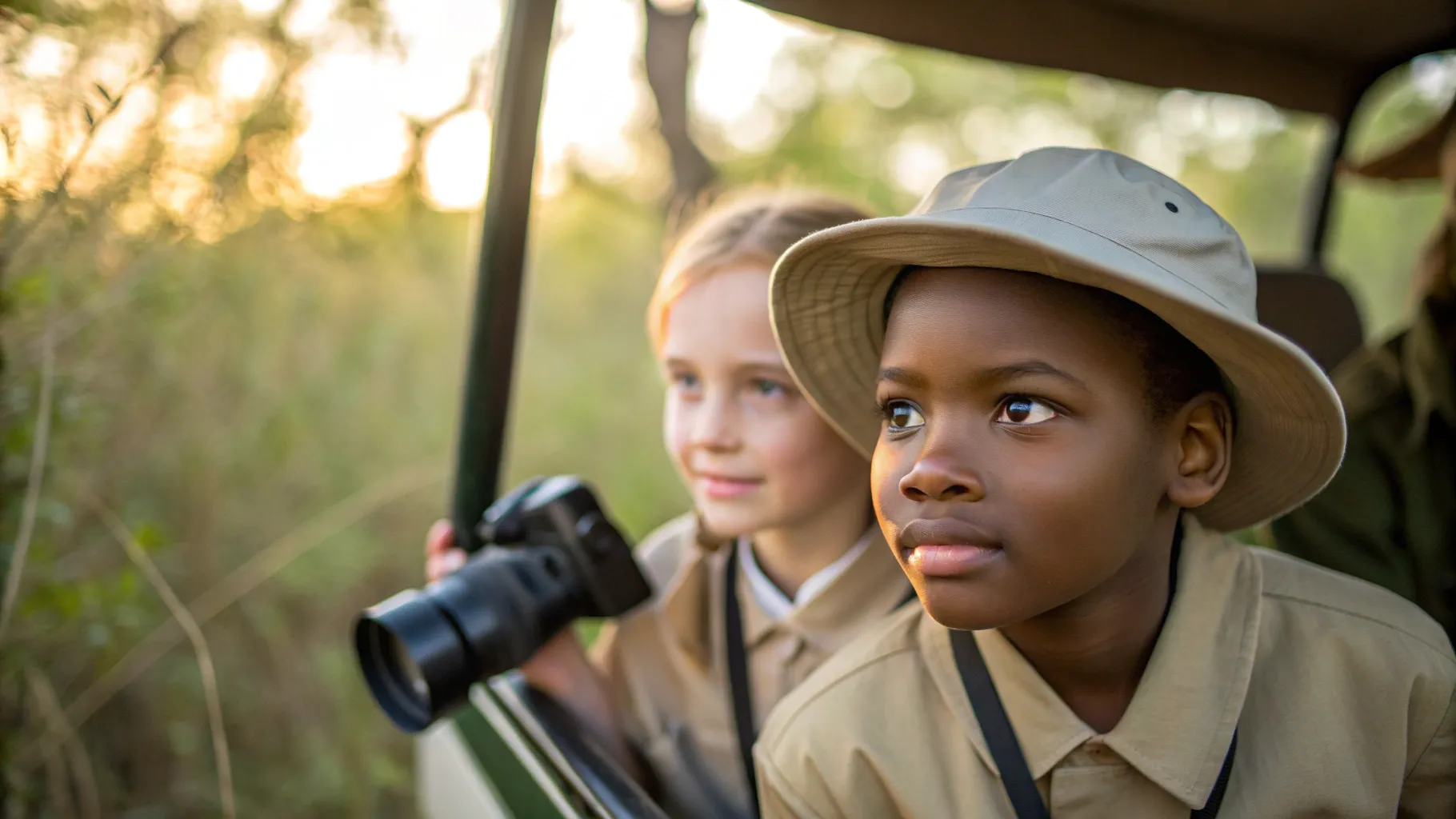
Safari as a School Project: Learning Activities for Ages 8 to 12
A safari as a school project offers children aged 8 to 12 an opportunity to learn about wildlife, geography, conservation and African cultures through practical experiences. Instead of studying animals entirely through textbooks, children can observe wildlife in natural habitats, record their discoveries and connect classroom lessons with real experiences.
East African destinations such as Uganda, Kenya, Tanzania and Rwanda provide excellent opportunities for educational safaris. Their national parks contain different habitats, including savannah grasslands, forests, wetlands and lakes. These environments help children understand how animals survive, interact and adapt to their surroundings.
Parents and teachers can turn a family safari or organised school trip into an educational project using wildlife journals, animal identification challenges, photography, mapping exercises and conservation discussions.
This guide explains how to organise safari learning activities for children aged 8 to 12, select suitable destinations and develop projects that encourage curiosity, creativity and environmental awareness.
Why a Safari Makes an Excellent School Project
Children often learn more effectively when they can connect information with practical observations.
A safari introduces subjects such as science, geography, mathematics, English and environmental education.
Watching elephants feed, observing birds near wetlands or identifying different vegetation types can help children understand concepts previously discussed in class.
Subjects Children Can Study During a Safari
| School subject | Safari learning activity | Skills developed |
|---|---|---|
| Science | Observe animal behaviour | Scientific observation |
| Geography | Identify habitats and landscapes | Environmental understanding |
| Mathematics | Count animals and compare groups | Recording and calculations |
| English | Write a safari journal | Vocabulary and writing |
| Art | Draw wildlife and landscapes | Creativity |
| Environmental studies | Discuss conservation | Environmental responsibility |
| Social studies | Learn about local communities | Cultural understanding |
A successful project should encourage children to ask questions, collect information and explain what they have discovered.
Choosing Educational Safari Destinations in East Africa
Different national parks offer different learning opportunities. Choosing the right destination depends on the children’s ages, school subjects and available travel time.
Uganda: Wildlife, Wetlands and Forests
Queen Elizabeth National Park provides opportunities to observe elephants, buffaloes, antelopes and birds. The Kazinga Channel can introduce children to wetland environments and aquatic wildlife.
Murchison Falls National Park offers lessons about river systems, landscapes and wildlife habitats.
Lake Mburo National Park is another suitable destination for studying zebras, impalas and savannah environments.
Kenya: Savannah Wildlife and Animal Behaviour
The Maasai Mara is suitable for learning about predators, herbivores and food chains.
Lake Nakuru National Park offers opportunities to study birdlife, rhinos and conservation.
Tanzania: Wildlife and Geography
Serengeti National Park provides examples of animal movement, grazing behaviour and savannah environments.
Ngorongoro Crater can support geography lessons about volcanic landscapes and wildlife habitats.
Tarangire National Park offers opportunities to observe elephants and study baobab trees.
Rwanda: Conservation and Habitats
Akagera National Park provides educational opportunities involving savannah wildlife, wetlands and conservation.
Children can compare different habitats and learn how protected areas support biodiversity.
| Country | Destination | Main educational topic |
|---|---|---|
| Uganda | Queen Elizabeth | Wildlife and wetland habitats |
| Uganda | Murchison Falls | Rivers and animal behaviour |
| Kenya | Maasai Mara | Food chains and grassland habitats |
| Kenya | Lake Nakuru | Birds and rhino conservation |
| Tanzania | Serengeti | Animal movement and ecosystems |
| Tanzania | Ngorongoro | Volcanic geography |
| Rwanda | Akagera | Biodiversity and conservation |
Wildlife Identification Activities for Ages 8 to 12
Animal identification is one of the easiest ways to make a safari educational.
Before departure, prepare a checklist containing animals commonly found in your chosen destination.
Children can record sightings and describe distinguishing features.
Create an Animal Observation Chart
| Animal | Identification feature | Observation task |
|---|---|---|
| Elephant | Trunk and large ears | Observe feeding behaviour |
| Giraffe | Long neck and spotted coat | Record browsing habits |
| Zebra | Black-and-white stripes | Compare stripe patterns |
| Buffalo | Heavy body and curved horns | Observe herd movement |
| Hippopotamus | Large body and broad mouth | Watch behaviour near water |
| Lion | Powerful body and rounded ears | Observe resting or social behaviour |
Encourage children to record what they actually observe rather than copying descriptions from books.
They can add the time, location and weather conditions beside each sighting.
Learning About Food Chains and Animal Relationships
A safari helps children understand how plants, herbivores, predators and decomposers contribute to natural systems.
Teachers can introduce food chains before travelling.
For example, grass provides food for zebras, while lions may prey on zebras.
Children should understand that real ecosystems contain many connected food relationships rather than one simple chain.
Food Chain Learning Exercise
Ask children to identify:
Three plants growing in the habitat.
Two animals that eat vegetation.
One predator that hunts other animals.
Evidence of animal feeding.
Ways animals depend on their surroundings.
After the game drive, students can create a diagram explaining their observations.
Geography Activities During a Safari
East Africa contains diverse landscapes, making safaris useful for geography lessons.
Children can study grasslands, forests, wetlands, rivers and volcanic formations.
Map Reading and Location Skills
Before travelling, give students a simple map showing the destination.
Ask them to identify the country, national park and nearby geographical features.
During the safari, they can compare the landscape with information studied beforehand.
Useful questions include:
Is the surrounding land flat or mountainous?
Are there rivers or lakes nearby?
What types of vegetation are visible?
How does the environment affect wildlife?
What changes between different habitats?
These activities develop geographical observation without requiring complicated equipment.
Mathematics Activities Using Wildlife Observations
Children can practise mathematics by collecting simple wildlife data.
For example, they might count animals in a herd or compare sightings between two game drives.
Sample Wildlife Counting Activity
| Animal | Morning sightings | Afternoon sightings |
|---|---|---|
| Zebra | 12 | 8 |
| Giraffe | 5 | 3 |
| Elephant | 7 | 11 |
| Buffalo | 16 | 9 |
Students can calculate totals, differences and percentages.
Explain that sightings are not necessarily unique animals. The same individual may appear more than once, so the figures should not be treated as population estimates.
Safari Journals and Creative Writing
A safari journal allows children to record observations in their own words.
Each student can write a short daily entry describing animals, landscapes and interesting discoveries.
Encourage them to include:
Date and location
Animals observed
Weather conditions
Favourite wildlife encounter
Questions for the guide
A short reflection
Younger children may prefer short sentences and drawings.
Older students can write detailed descriptions and compare different habitats.
Wildlife Photography and Drawing Projects
Photography and drawing encourage children to observe wildlife carefully.
A camera, smartphone or sketchbook can help them record animal features, habitats and behaviour.
Suggested Photography Challenges
Children can complete the following assignments:
Photograph three different bird species.
Draw an elephant’s trunk and ears.
Record two animals feeding.
Photograph an interesting landscape.
Sketch an animal’s footprint from a safe viewing position.
Teach children to photograph wildlife without disturbing animals or leaving designated safe areas.
Conservation Lessons for School Children
Conservation is an important part of educational safaris.
Children can learn why national parks protect wildlife and how human activities affect natural habitats.
Ask guides to explain habitat loss, poaching, pollution and conservation programmes using age-appropriate language.
Conservation Discussion Questions
| Question | Learning objective |
|---|---|
| Why are national parks protected? | Understand wildlife protection |
| What happens when forests disappear? | Learn about habitat loss |
| Why should visitors avoid littering? | Understand pollution |
| How can communities benefit from tourism? | Explore responsible tourism |
| Why should people avoid feeding wildlife? | Understand animal safety |
After the safari, students can prepare posters suggesting practical ways to protect wildlife.
Planning a School Safari Schedule
A successful educational safari should balance structured learning with relaxation.
Children aged 8 to 12 generally benefit from manageable activities and regular breaks.
| Time | Suggested activity |
|---|---|
| 7:00 am | Breakfast and project briefing |
| 8:00 am | Guided game drive |
| 10:30 am | Wildlife checklist review |
| 12:30 pm | Lunch and rest |
| 2:00 pm | Drawing or journal writing |
| 3:30 pm | Short educational activity |
| 5:00 pm | Group discussion |
Schools should confirm child supervision, transport arrangements, activity restrictions and emergency procedures before departure.
Presenting the School Project After the Safari
The learning experience should continue after children return home or to school.
Students can organise their observations into a written report, illustrated booklet or classroom presentation.
A simple project can include:
Introduction to the national park.
Map of the destination.
Animals and habitats observed.
Wildlife counting results.
Conservation lessons.
Personal reflections.
Teachers can assess observation skills, accuracy, creativity and understanding.
Planning a safari as a school project gives children aged 8 to 12 opportunities to explore wildlife, geography, mathematics and conservation through practical learning.
Well-organised activities such as wildlife identification, journals, photography and habitat studies can make the experience educational and enjoyable.
Choose suitable destinations, provide qualified supervision and keep learning activities appropriate for each child’s age.
With careful preparation, an East African safari can become a rewarding school project that strengthens children’s understanding of wildlife and environmental protection.



No comment