
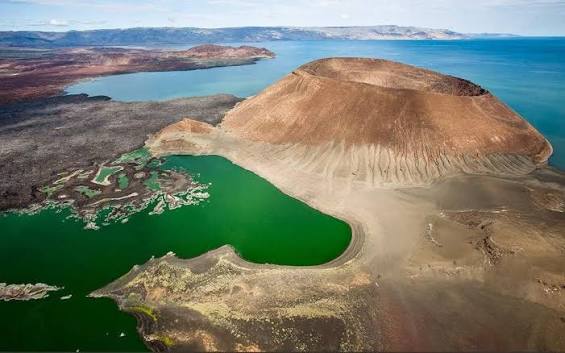
Lake Turkana: Journey to Kenya’s Jade Sea
In Kenya’s remote far north, where the landscape turns volcanic and the heat genuinely punishing, lies a lake so strikingly coloured it earned its own nickname: the Jade Sea. Lake Turkana is Africa’s largest desert lake and the world’s largest permanent desert lake, a UNESCO World Heritage Site holding some of the richest hominin fossil deposits ever discovered, alongside an active volcanic island and one of Kenya’s most distinctive indigenous communities.
Key Highlights
- Lake Turkana is Africa’s largest desert lake, striking jade-green water that gives the lake its nickname
- Lake Turkana National Parks hold UNESCO World Heritage status, recognised for both ecological and paleontological significance
- Koobi Fora, on the lake’s eastern shore, has yielded fossil remains from roughly 230 individuals across three Homo species
- “Turkana Boy,” the most complete early human skeleton ever found, was discovered near the lake
- Central Island, an active volcano with crater lakes, sits in the middle of the lake, home to flamingos and crocodiles
- The El Molo, one of Kenya’s smallest indigenous communities, live along the lake’s shores
Why It’s Called the Jade Sea
Lake Turkana’s distinctive jade-green colouring, caused by algae concentrations in its alkaline waters, gives the lake its evocative nickname and makes it genuinely unlike any other major lake in East Africa, a striking visual contrast against the surrounding arid, volcanic desert landscape. As Africa’s largest desert lake and the world’s largest permanent desert lake, Turkana’s sheer scale amid such an inhospitable surrounding environment is itself a remarkable geographic fact, a genuine inland sea rising unexpectedly from one of the continent’s harshest landscapes.
Africa’s Most Saline Major Lake
Turkana ranks as the most saline of Africa’s large lakes, a characteristic that shapes both its distinctive colour and the specially adapted ecosystem of fish and other species able to tolerate its alkaline chemistry, considerably different water chemistry than the freshwater lakes more typical elsewhere in the region.
Koobi Fora: One of the World’s Richest Fossil Sites
On the lake’s eastern shore, the Koobi Fora site has yielded what ranks among the richest troves of hominin fossil remains found anywhere on Earth, representing roughly 230 individuals spanning three distinct species of Homo alongside four australopith species. Excavated substantially by the Leakey family and subsequent researchers, Koobi Fora’s fossil-rich deposits have contributed more to scientific understanding of ancient paleo-environments than virtually any other single site on the African continent.
Turkana Boy: The Most Complete Early Human Skeleton
Among Koobi Fora’s most significant discoveries is the skeleton known as “Turkana Boy,” an 11-to-13-year-old Homo ergaster individual dated to roughly 1.6 million years ago, and widely regarded as the most complete early human skeleton ever discovered anywhere in the world. This single find has profoundly shaped scientific understanding of early human physical development and anatomy, a discovery of genuinely global paleoanthropological significance tied directly to this specific remote Kenyan lake.
Central Island: An Active Volcano Within the Lake
Rising from the middle of Lake Turkana itself, Central Island, sometimes called Crocodile Island, is an active volcano composed of more than a dozen craters and cones, three of which hold their own small crater lakes. The island maintains persistent fumarolic activity, visible vapour emissions marking its ongoing volcanic status, while its crater lakes support populations of flamingos, crocodiles and tilapia, a genuinely unusual ecosystem existing within a lake that is itself already a remarkable geographic feature.
Visiting Central Island
Boat trips to Central Island offer visitors a close encounter with this active volcanic feature and its distinctive crater-lake wildlife, a genuinely adventurous add-on activity for travellers who’ve made the considerable journey to reach Lake Turkana in the first place.
The El Molo: One of Kenya’s Smallest Communities
Along the lake’s shores, particularly around the settlement of Loyangalani, live the El Molo, one of Kenya’s smallest indigenous communities, traditionally sustained through fishing on Lake Turkana itself in a landscape too arid to support significant agriculture or herding at scale. Visiting El Molo communities offers genuine insight into a way of life shaped directly by this extreme, remote environment, a cultural dimension considerably different from the pastoralist traditions more commonly encountered elsewhere in Kenya’s safari circuit.
Approaching Community Visits Respectfully
Given the El Molo’s small population and the genuine vulnerability that comes with being one of Kenya’s smallest ethnic communities, visitors should approach any community visit here with particular care and respect, working through operators with established, ethical relationships with local residents.
Fishing on Lake Turkana
Beyond its scientific and cultural significance, Lake Turkana supports a genuine fishing tradition, Nile perch, tilapia and catfish among the species anglers pursue here. Our detailed piece on catching Nile perch in Lake Turkana covers this specific activity in depth for travellers specifically interested in fishing rather than the lake’s broader geological and cultural attractions.
Planning a Visit
Getting There
Lake Turkana’s remote northern Kenya location means reaching it requires genuine planning, typically a domestic flight connection or a considerably longer overland journey, reflecting the lake’s status as one of Kenya’s more adventurous, off-the-beaten-path destinations rather than a standard circuit stop.
Best Time to Visit
Given the region’s genuinely extreme heat, timing a visit around cooler periods and ensuring robust sun and heat protection matters considerably more here than at most other Kenya safari destinations.
A Lake Shrinking and Shifting Over Time
Lake Turkana’s water levels have fluctuated meaningfully over recent decades, influenced by both natural climate variability and upstream water use along the rivers feeding the lake, a genuine ongoing environmental concern for both the lake’s unique ecosystem and the communities depending on it for fishing and freshwater access. Understanding this context adds a layer of environmental significance to a Lake Turkana visit, a landscape that, despite its ancient geological and paleontological history, faces genuinely contemporary environmental pressures.
Why This Matters for the Lake’s Future
Scientists and conservationists continue monitoring Lake Turkana’s water balance closely, given the lake’s ecological uniqueness and its role sustaining both wildlife and the El Molo and other communities along its shores, making ongoing research here relevant well beyond pure paleontological interest.
The Jade Sea’s Surrounding Desert Landscape
Beyond the lake itself, the surrounding Turkana region presents a genuinely striking desert landscape, volcanic rock formations, sparse vegetation and a stark, almost otherworldly visual character that stands in sharp contrast to the greener savanna and forest landscapes found across most of Kenya’s more visited safari regions. This desert setting is integral to Lake Turkana’s broader appeal, a landscape that rewards travellers specifically drawn to raw, dramatic scenery alongside the lake’s scientific and cultural significance.
Wildlife Adapted to Extreme Conditions
Species found around Lake Turkana have adapted specifically to this harsh desert environment, a genuinely different wildlife community than visitors encounter at Kenya’s more famous savanna parks, adding further ecological distinctiveness to what’s already one of the country’s most geographically unusual destinations.
Why Lake Turkana Is Called the Cradle of Humankind
The sheer density and significance of hominin fossils found around Lake Turkana, spanning multiple species across an immense timescale, has earned the broader region genuine standing alongside other famous East African fossil sites in the story of human evolution. Unlike single-discovery sites elsewhere, Turkana’s fossil record offers researchers an unusually continuous window into how multiple hominin species lived, evolved and eventually gave way to modern humans, cementing the lake’s place as one of the most scientifically important locations anywhere in the study of human origins.
Ongoing Research Significance
Paleoanthropological research around Lake Turkana continues today, meaning the region’s contribution to understanding human evolution remains an active, unfolding scientific story rather than a settled historical chapter, adding genuine intellectual weight to a visit here well beyond simply viewing dramatic scenery.
Is Lake Turkana Right for Your Kenya Trip?
Lake Turkana suits travellers specifically seeking a genuine off-the-beaten-path adventure, with real interest in paleontology, geology or cultural immersion well beyond Kenya’s standard safari circuit, rather than first-time visitors prioritising maximum wildlife density on a tighter itinerary. The journey itself, the remoteness, the heat, the logistical planning required, is part of the experience here, making Turkana a destination best suited to a second or third Kenya trip, or travellers whose priorities genuinely lean toward adventure and discovery over conventional safari comfort.
Frequently Asked Questions
Why is Lake Turkana called the Jade Sea?
Its distinctive jade-green colouring comes from algae concentrations in the lake’s alkaline water, a genuinely striking visual feature against the surrounding desert landscape.
Can I actually see fossil sites at Koobi Fora?
Access varies and is best arranged through a specialised operator familiar with the site’s research and preservation requirements, given its significance as an active paleontological research area.
Is it safe to visit Central Island given its volcanic activity?
Yes, with an experienced local guide; the island’s fumarolic activity is persistent but not acutely dangerous to visitors following standard guided safety practices.
How remote is Lake Turkana compared to Kenya’s main safari circuit?
Considerably more remote, requiring dedicated travel planning via flight or a long overland journey, making it a genuinely adventurous addition rather than a standard itinerary stop.
What’s the best way to visit the El Molo community respectfully?
Working through an operator with established, ethical local relationships is the best approach, given the community’s small size and genuine vulnerability.
Recommended Safaris
Lake Turkana suits travellers building a dedicated northern Kenya adventure itinerary beyond the standard safari circuit. Our piece on fishing at Lake Turkana covers that specific activity further. Ready to explore this remote, geologically and historically remarkable corner of Kenya? Reach our team through our Book Now page and we’ll plan it around your dates.

No comment