An Unexpected Sight in the African Wilderness
Most people hear the words “zebra crossing” and immediately think of the familiar black and white stripes painted across a road, reminding drivers to slow down for pedestrians. It is a phrase recognised in many parts of the world, and one that rarely brings wildlife to mind.
On safari in East Africa, however, a zebra crossing means something entirely different.
It is not painted on asphalt. There are no traffic lights, road markings, or waiting pedestrians. Instead, it is a herd of wild zebras moving together across open grasslands, riverbanks, or dusty safari tracks. The first time I witnessed one, I realised that this was the original zebra crossing, and it was far more impressive than any road sign.
The Road Came to a Stop
It happened during an early morning game drive. The sun had just risen, casting a warm glow across the savannah as our vehicle followed a narrow dirt track through the national park. We were hoping to spot elephants or perhaps a pride of lions before the day grew too hot.
Without warning, our guide slowed the vehicle.
Ahead of us stood a line of zebras. One stepped onto the track, followed by another, then another. Within moments, dozens of zebras were calmly crossing the road, completely unbothered by the waiting vehicles.
Nobody sounded a horn.
Nobody tried to hurry them along.
In the African wilderness, wildlife has the right of way.
Watching Nature Set the Rules
The crossing was surprisingly organised.
Adult mares led the way while young foals stayed close beside their mothers. A dominant stallion remained alert, pausing frequently to look in every direction before continuing across the road. The herd moved at a steady pace, never rushing yet never stopping for long.
Our guide explained that zebras depend on one another for safety. Crossing together reduces the chances of an individual becoming separated from the group, especially in areas where predators may be nearby.
Rather than seeing dozens of independent animals, we were watching a close knit family making a careful journey.
Why Zebras Travel in Herds
Zebras are highly social animals that rarely live alone. Most plains zebras form family groups consisting of one stallion, several mares, and their offspring. These family groups often join larger herds that can number from a few dozen to several hundred animals.
Living in groups offers many advantages.
With so many eyes and ears watching the surroundings, predators are easier to detect. Lions, spotted hyenas, leopards, and African wild dogs all hunt zebras, so remaining together greatly improves the chances of survival.
If danger appears, the herd reacts almost instantly. Heads rise together, ears point forward, and within seconds the group can break into a fast gallop across the plains.
More Than Black and White Stripes
As the zebras crossed in front of us, their distinctive coats caught the morning light.
From a distance, every zebra looked almost identical. Up close, the differences became obvious. Every stripe curved differently across the shoulders, legs, and face. Some animals had bold, wide stripes while others displayed much narrower patterns.
Scientists use these unique markings to identify individual zebras in the wild. Much like fingerprints in humans, no two zebras share exactly the same stripe pattern.
Researchers photograph zebras over many years to monitor population growth, movement, breeding success, and social behaviour without needing to tag or capture the animals.
Why the Stripes Matter
The purpose of zebra stripes has fascinated scientists for generations.
One widely accepted theory suggests that moving stripes make it more difficult for predators to focus on a single animal during a chase. When an entire herd runs together, the constantly shifting patterns create visual confusion.
Research has also shown that biting flies are less likely to land on striped coats than on animals with solid coloured fur. This reduces irritation and may lower the risk of diseases carried by insects.
Some studies suggest that stripes may also help regulate body temperature by influencing airflow close to the skin. Although researchers continue to investigate this idea, many scientists believe the stripes provide several survival benefits rather than serving just one purpose.
Sharing the Journey With Other Animals
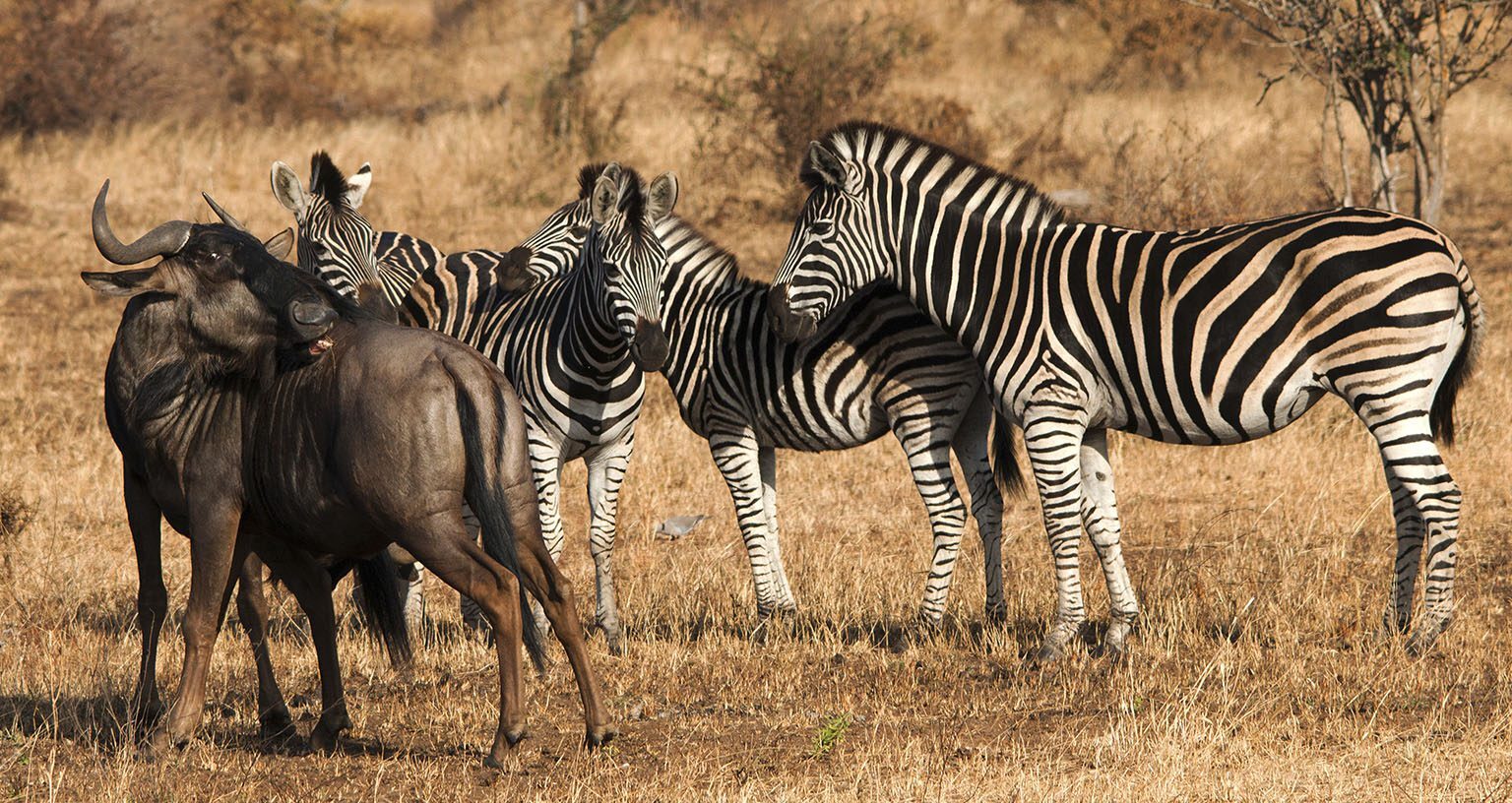
As the final zebras crossed the track, another familiar species appeared behind them.
A group of wildebeest followed the same route across the plains.
This partnership is common throughout East Africa. Zebras and wildebeest often travel together because each species brings different strengths. Zebras have excellent eyesight, while wildebeest rely heavily on their sense of smell. Together they detect predators more effectively than either species could alone.
These mixed herds become especially impressive during the annual Great Migration in Tanzania and Kenya, where hundreds of thousands of zebras accompany wildebeest in search of fresh grazing after seasonal rains.
Where You Can Witness a Wild Zebra Crossing
Seeing a herd of zebras crossing a safari track is a common but unforgettable experience in many of East Africa’s national parks.
In Uganda, Lake Mburo National Park and Kidepo Valley National Park are among the best places to observe zebras roaming freely across open grasslands.
Kenya offers outstanding opportunities in the Maasai Mara National Reserve, Amboseli National Park, Tsavo East National Park, and Tsavo West National Park.
In Tanzania, visitors regularly encounter zebras in Serengeti National Park, Ngorongoro Conservation Area, Tarangire National Park, and Ruaha National Park. During the migration season, enormous herds create dramatic crossings as they move across rivers and open plains.
Every destination offers a different landscape, but the sight of zebras confidently crossing in front of a waiting safari vehicle remains a favourite moment for many travellers.
Safari Etiquette During Wildlife Crossings
One lesson every safari visitor quickly learns is patience.
When wildlife crosses the road, vehicles stop and wait quietly. Guides avoid blocking the animals’ path or attempting to influence their movement. This respectful approach allows wildlife to continue behaving naturally while visitors enjoy an authentic experience.
Keeping noise to a minimum also improves the encounter. The quieter everyone remains, the more relaxed the animals stay, allowing you to observe natural behaviour for longer.
It is a simple reminder that national parks belong to wildlife, not to the people visiting them.
A Zebra Crossing Worth Waiting For
As the last foal disappeared into the long grass, our guide restarted the engine and continued the game drive.
The entire crossing had lasted only a few minutes, yet it became one of the highlights of the safari.
Back home, a zebra crossing is something you pass without a second thought on your daily commute. In Africa, it becomes a reminder that nature follows its own rules. Roads exist only where people have built them, but the paths used by wildlife are often far older.
The next time someone mentions a zebra crossing, your mind may still picture black and white stripes. After experiencing one in the African wilderness, however, you might picture something much better: a peaceful herd of wild zebras walking confidently across the savannah, completely unaware that they have just stopped traffic in the most unforgettable way possible.