Lake Bunyonyi.
Known literally as “place of many little birds,” Lake Bunyonyi is a freshwater lake that is believed to be the second deepest in Africa. At 1,962 meters above sea level, it occupies 61 square kilometers. The freshwater lake ranges in depth from 44 to 900 meters and is 25 kilometers long and 7 kilometers broad. Nonetheless, the water’s temperature keeps rising, reaching a maximum of 25°C (77°F) at the surface.
With a deepest point of about 900 meters, Lake Bunyonyi is thought to be the second-deepest lake in Africa. There are 29 islands scattered across the lake. The most well-known of these are Bushara, Kyahugye, Bwama and Njuyeera, Bucuranuka, and Akampene Island, also referred to as the punishment island. The deepest lake in Uganda, it is also home to crayfish, otters, and other small birds.
It is situated near the Rwandan border in southwest Uganda, between Kisoro and Kabale.
The past
Lake Bunyonyi is a young lake that is thought to have developed when lava flowed from one of the Virunga mountains and managed to occupy the Ndego River. As the lava flow continued to block the river, the river drowned and the lake was created.
Because this lake is home to more than 200 different species of birds, it is known as the “place of many little birds.” The ideal spot for bird viewing is the Nyombi swamp, where you may spot a variety of birds, including red-chested sunbirds, grey-crowned cranes, and swamp flycatchers, to name a few.
Each of the 29 islands is more intriguing than the others. You have the opportunity to visit and explore each island on the lake using your favorite form of transportation. The most frequently visited are
Despite being the smallest island in the lake, Akampene (Punishment Island) is thought to be the most memorable. Akampene Island has a dark past and a custom that the locals have followed for a very long time. To make amends for their sins, young females who became pregnant before marriage were brought to this island and bound to the lone tree that stands there. This custom was disregarded and dismissed as an antiquated custom as circumstances changed.
One of the most fascinating islands is Kyahugye Island, where you may witness a variety of creatures. Zebras, waterbucks, impalas, and many other animals can be seen on the island. An hour-long ride will be the ideal addition to a miniature game drive, complete with a view of the far shimmering seas and cool breezes. These creatures were brought to the region.
Lake Bunyonyi Bushara Island: You must visit Bushara Island to get a better look at the local birds. Bring your long-lens camera and binoculars so you can make the most of the event.
Of all the islands, Bwama Island is the biggest and is also inhabited. A Scottish missionary named Dr. Leonard Sharp arrived in Uganda in the 1920s and established a leprosy sanctuary in 1931. He established a leprosy treatment facility where patients may get care without feeling mistreated or abandoned. This is deeply ingrained in the history of the island. At the moment, the island inhibitors are attending school in these hospital buildings.
Bacuranuka Island: This island has a fascinating mythology. An elderly woman approached a group of twenty men who were brewing obushera, a traditional beverage, and asked to take a sip. The men were ungentlemanly in not offering her a sip of the wine.
They eagerly accepted the elderly woman’s request for a ride to the mainland since they wanted her out of the way. After one of the men was taken to the mainland with her, the elderly woman became enraged and cursed the island, which flipped over and sucked in the men who were making “bushera” there.
You can be certain that every one of the 29 little islands has a unique story that connects to the history and cultural values of the area.
Activities
Lake Bunyonyi offers a wide variety of activities. Our Lake Bunyonyi Lodges & Resorts provide a variety of activities, including as bird watching, hiking, canoeing, boat crusing, mountain biking, and nature walks. Alternatively, you can opt to unwind in the cozy surroundings.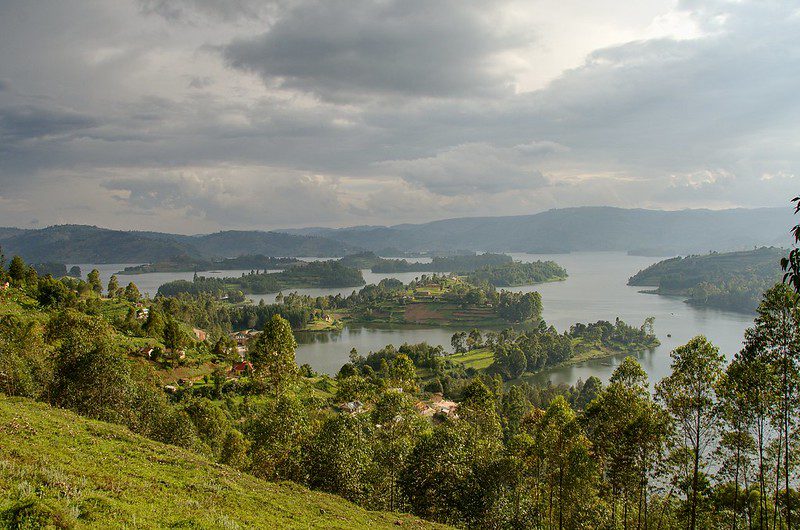
Observing birds
One of Uganda’s top spots for birdwatching is Lake Bunyonyi. There are more than 200 bird species there, including migratory, indigenous, and infrequent birds. Visitors can take canoes to Nyombi Swamp and explore the surrounding woodland and lakeshores for birdwatching opportunities.
Among the birds that can be found along the lakeshores are the grey-crowned cranes, red-chested sunbirds, flycatchers, white-tailed blue monards, slender-billed baglafetch, weavers, egrets, herons, and woodpeckers. Bunyonyi is the ideal location if you enjoy birds and are in desperate need of a peaceful retreat.
You can wander about and take in the beautiful scenery because the waters are really safe. You may learn a lot about the 29 islands—both inhabited and uninhabited—and the various tribes that call the lake home when you travel with a local guide. Numerous boats are available for rent on the lake’s shores, ready to transport you inland throughout the day.
A stroll around the communities provides a more comprehensive experience by introducing you to the customs, history, cultural beliefs, and mythological tales that have been passed down through the generations. The locals are really friendly.
The 29 islands may be clearly seen from the tracks that go along the terraces, banana plantations, and verdant flora. It provides an excellent backdrop for all community outings and excursions.
Canoeing
On Lake Bunyonyi, this is the most popular form of transportation. To take care of their personal affairs, the residents frequently go across the lake between islands and across hillsides.
A canoe trip is a great method to get a better sense of what it’s like to live their way because it allows you to spend more time on the lake and allows you to pause in the center for a moment of peace and a sweeping perspective. As long as a guide is beside you, you can opt to be paddled or even paddle yourself.
For those who like to glide with the lake and watch the sunset, this service is offered at any time of day, including evenings. This nighttime and perhaps romantic canoeing adventure will never be forgotten because the lake is free of dangerous aquatic animals like crocodiles and hippos.
Biking in the mountains
Around the lake and uphill on the nearby hills are a number of roads and tracks. You can see the enchanted islands more clearly throughout the voyage, and you can interact closely with many of the locals. Bikes are available for rent at some of the lodging locations. Your tour guide can set this up to ensure that everything is ready in advance.
Ziplining
Lingering over the lake and splashing the water as you drift from one end to the other is an exciting and enjoyable experience. On-site safety gear is available for this activity. To guarantee everyone’s safety on the ziplines, the equipment is thoroughly checked.
You can swing over the lake’s placid waters and even perform half somersaults to feel the breeze on your face and touch the water.
neighborhood market
People congregate in local markets to socialize and catch up with one another. You should experience the African Market. African crafts, veggies, shoes, clothing, gadgets, and just much anything else you can imagine can be found in the markets surrounding Lake Bunyonyi. While some stay around and catch up with one another, others ride in with more goods to sell, and others move quickly as they bargain for lower rates.
Swimming
When you’re on vacation, a change from the swimming pools is exactly what you need, and Lake Bunyoyi is available all day. Any time of day is a good opportunity to relax on the lake’s shores, sunbathe, and go deep diving.The lake is devoid of bilharzia and is full of fresh water. Although there isn’t a beach, protective infrastructure have been installed to make deep dives into the open waters simple.
Western Uganda’s Bakiga and Batwa. Following their expulsion from Bwindi Gorilla Forest, Mgahinga National Park, and Echuya Forest, the Batwa made their home by the lake. In Uganda, the Batwa are a distinct tribe with a distinctive culture and customs.
A tiny group of people known as the Batwa Pygmies live in the “Echuya Forest Reserve” on the boundary between Kabale and Kisoro. They are thought to have originated in the Democratic Republic of the Congo. This hunting tribe was uprooted from their territory due to development and transferred to Western Uganda. Previously, they lived in the DRC rain forests. Nearly 4,000 Batwa people reside in this region.
The Batwa, who have long been ignored, have an interesting history that includes their own origin narrative and a special bond with the forest. They usually keep to themselves and reside in little stick and grass dwellings. Participating in the Batwa experience, which was established by the Kellerman Foundation, greatly supports this endangered population.