
Turtle Nesting Beaches in Tanzania and Kenya: Responsible Viewing Rules
Turtle nesting beaches in Tanzania and Kenya offer travellers an opportunity to learn about sea turtle conservation along East Africa’s Indian Ocean coastline. Every year, female sea turtles return to suitable sandy beaches to lay their eggs. Several weeks later, tiny hatchlings emerge and begin moving towards the ocean.
Watching this natural process can be a memorable wildlife experience. However, nesting turtles and hatchlings are extremely sensitive to disturbance. Bright lights, loud noises, careless movements and people standing too close can interfere with their behaviour.
Coastal destinations such as Watamu, Diani, Mafia Island and parts of Zanzibar support important sea turtle habitats. Conservation organisations work with local communities to monitor nests and protect vulnerable beaches.
This guide explains where sea turtles nest in Kenya and Tanzania, how nesting happens, responsible viewing rules and practical advice for travellers interested in marine conservation.
Understanding Sea Turtle Nesting in East Africa
Sea turtles spend most of their lives in the ocean, but adult females must return to land to lay their eggs.
They usually select sandy beaches where they can dig nests above the normal high-tide line.
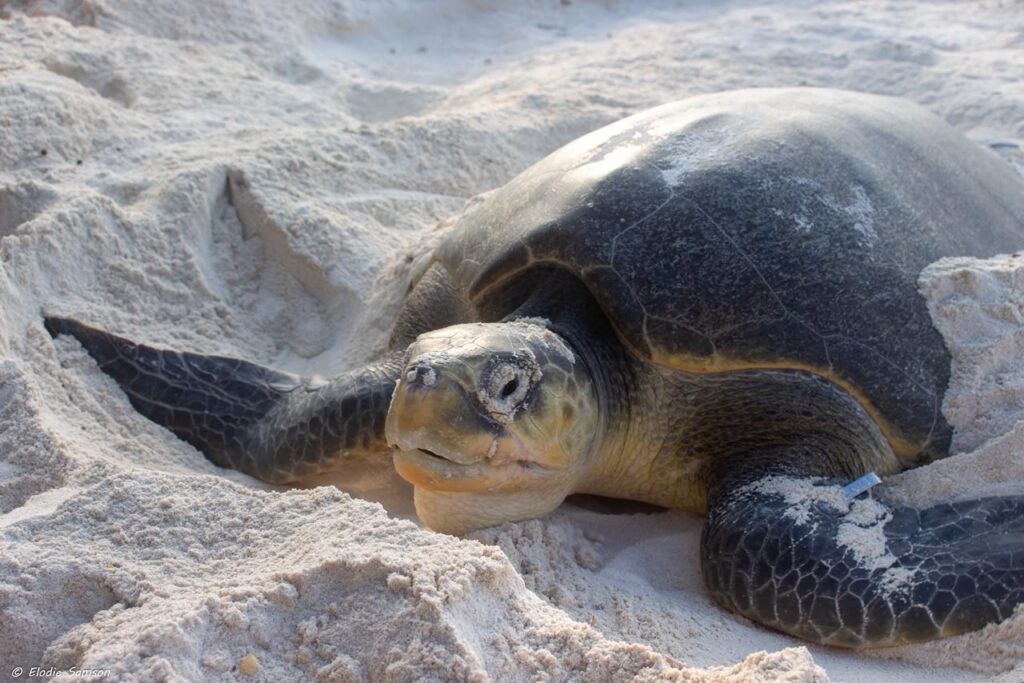
After emerging from the water, a female turtle moves across the sand using her flippers.
She then digs a nest chamber, deposits her eggs and covers them with sand.
The entire process may take several hours.
After nesting, the female returns to the ocean.
The eggs remain buried while the embryos develop.
Depending on the species and environmental conditions, hatching commonly occurs after approximately 45–70 days.
The hatchlings then emerge and move towards the sea.
Sea Turtle Species Found in Kenya and Tanzania
Several sea turtle species occur in East African waters.
However, green turtles and hawksbill turtles are particularly important nesting species along parts of the Tanzanian coastline.
Other species may occasionally be recorded in regional waters or nesting areas.
Common Sea Turtle Species
| Turtle species | Main characteristics | Habitat |
|---|---|---|
| Green turtle | Large body and relatively smooth shell | Seagrass habitats and coastal waters |
| Hawksbill turtle | Narrow beak and patterned shell | Coral reefs and coastal habitats |
| Loggerhead turtle | Large head and powerful jaws | Open ocean and coastal waters |
| Olive ridley turtle | Smaller body and rounded shell | Tropical marine environments |
| Leatherback turtle | Large body with a flexible, ridged shell | Mainly open ocean |
Species distribution and nesting frequency differ between individual locations.
Never assume every beach supports all these species.
Best Turtle Nesting Beaches in Kenya
Kenya’s coastline contains several beaches where sea turtle nesting has been recorded.
Conservation organisations monitor important nesting areas and work to reduce human disturbance.
1. Watamu Marine Protected Area
Watamu is one of Kenya’s established sea turtle conservation locations.
The area contains sandy beaches, coral reefs and seagrass habitats.
Local conservation programmes monitor nesting activity and protect vulnerable nests.
Visitors interested in sea turtles can learn about conservation work through authorised activities.
However, nesting observations should only take place where conservation teams permit them.
2. Diani Beach
Diani Beach is another important coastal area associated with turtle conservation.
The beach attracts visitors because of its white sand, warm waters and accommodation options.
Sea turtles may use suitable sections of the coastline for nesting.
However, beachfront development, artificial lighting and human activity can affect nesting success.
Travellers should avoid disturbing marked nesting areas.
3. Other Kenyan Coastal Beaches
Turtle nesting activity also occurs along other parts of Kenya’s coastline.
Local conservation groups monitor selected beaches and work with communities to protect nests.
Because turtle activity changes between seasons and locations, travellers should contact recognised conservation organisations before planning a viewing experience.
Turtle Nesting Beaches in Tanzania
Tanzania has important nesting habitats along its mainland coastline and offshore islands.
Some locations support established conservation programmes involving local communities.
1. Juani Island, Mafia Island
Juani Island is one of Tanzania’s most important green turtle nesting locations.
It forms part of the wider Mafia Island marine environment.
Conservation teams monitor nesting activity and protect vulnerable nests.
In suitable circumstances, visitors may participate in supervised conservation experiences.
However, hatching times cannot be guaranteed.
2. Kigamboni Coast
Kigamboni, south of Dar es Salaam, supports turtle nesting and conservation activities.
Local monitoring programmes work to identify nests and reduce threats.
Visitors should arrange any educational visit through recognised conservation organisations.
3. Pangani Coast
The Pangani coastline in northern Tanzania contains important marine habitats.
Community-based conservation activities have included sea turtle nest monitoring.
Travellers may learn about conservation efforts when suitable programmes are available.
4. Zanzibar and Pemba
Parts of Zanzibar and Pemba have recorded turtle nesting activity.
However, tourism development and artificial lighting create challenges for nesting habitats.
Visitors should distinguish genuine conservation activities from attractions involving captive turtles.
Responsible wildlife viewing should prioritise the welfare of wild animals.
Comparing Turtle Nesting Destinations
| Destination | Country | Main interest | Visitor considerations |
|---|---|---|---|
| Watamu | Kenya | Turtle conservation and marine habitats | Arrange authorised activities |
| Diani | Kenya | Coastal nesting habitats | Respect protected beach sections |
| Juani Island | Tanzania | Green turtle nesting | Supervised visits only |
| Kigamboni | Tanzania | Community conservation | Confirm programme availability |
| Pangani | Tanzania | Nest monitoring | Ask about conservation activities |
| Zanzibar | Tanzania | Marine turtles and coastal habitats | Choose responsible operators |
Nesting activity is seasonal and unpredictable. No destination can guarantee sightings.
Responsible Viewing Rules for Turtle Nesting Beaches
Watching turtles requires patience and careful behaviour.
The most important principle is to avoid interfering with natural nesting and hatching activities.
1. Maintain a Safe Distance
Never approach a nesting turtle without permission.
Your guide should determine where visitors can stand.
Keep well away from the turtle’s head and movement route.
If the animal stops moving or appears disturbed, withdraw quietly.
Different protected areas may have specific viewing distances.
Always follow the strictest applicable guidance.
2. Avoid Flash Photography
Camera flashes can disturb nesting turtles and hatchlings.
Do not use flash photography during nesting observations.
Bright phone screens can also create problems.
If photographs are permitted, follow your conservation guide’s instructions.
Sometimes the most responsible choice is to put your camera away.
3. Keep Beaches Dark
Artificial lighting is a major concern on turtle nesting beaches.
Hatchlings naturally use light cues from the horizon to find the ocean.
Bright hotel lights, torches and vehicle headlights can disorient them.
This may cause hatchlings to move inland instead of towards the sea.
Avoid using unnecessary lights near nesting areas.
4. Never Touch Turtles or Eggs
Do not touch nesting females, eggs or hatchlings.
Handling can cause injury, stress or unnecessary disturbance.
Even if a hatchling appears to be moving slowly, allow it to continue naturally.
Only authorised conservation personnel should intervene when necessary.
5. Keep Noise Levels Low
Loud conversations, music and sudden movements can disturb nesting turtles.
Remain quiet during observations.
Avoid gathering in large groups around an animal.
If several visitors are present, follow your guide’s instructions about group size and viewing positions.
What to Do When Hatchlings Emerge
Watching hatchlings move towards the ocean can be exciting.
However, visitors must avoid interfering with their journey.
Do not pick up hatchlings and carry them to the water.
Their movement across the beach is part of their natural development and orientation.
Keep their route clear.
Avoid standing between the nest and the sea.
Do not create artificial lighting to guide them.
If hatchlings move towards buildings or roads, contact an authorised conservation team.
Common Mistakes Visitors Should Avoid
| Mistake | Possible problem | Responsible alternative |
|---|---|---|
| Using camera flash | Disturbs turtles | Follow photography restrictions |
| Touching hatchlings | Causes unnecessary handling | Observe without contact |
| Standing near a nest | Risks damaging eggs | Remain outside protected areas |
| Shining torches | Disorients hatchlings | Keep lights switched off |
| Blocking turtle movement | Interferes with nesting | Keep movement routes clear |
| Leaving rubbish | Creates hazards | Remove your waste |
| Driving on nesting beaches | Can damage buried nests | Use authorised roads |
When Is Turtle Nesting Season?
Sea turtle nesting periods vary across East Africa.
In some Tanzanian locations, nesting activity increases during particular months, including parts of March, April and May.
However, breeding patterns differ between species and beaches.
Hatching usually occurs several weeks after eggs are laid.
Weather, sand temperature and nesting dates influence the timing.
Travellers should avoid booking holidays based on a guaranteed hatching event.
Instead, consider a broader marine conservation experience that remains worthwhile even when turtles are absent.
Choosing Responsible Turtle Conservation Tours
Before booking, ask whether the activity is organised with recognised conservation personnel.
A responsible programme should explain turtle biology, nesting threats and appropriate visitor behaviour.
Guides should establish clear rules before approaching nesting areas.
Avoid operators who promise that visitors can hold baby turtles, dig up nests or release hatchlings independently.
Such activities may interfere with conservation work.
Questions to Ask Your Operator
| Question | What to confirm |
|---|---|
| Is the activity authorised? | Permission from relevant authorities |
| Who supervises visitors? | Trained conservation personnel |
| Are sightings guaranteed? | Honest expectations |
| Can visitors touch turtles? | No unnecessary handling |
| Are photographs permitted? | Clear restrictions |
| How many people attend? | Suitable group size |
| How does the visit support conservation? | Genuine conservation involvement |
Protecting Nesting Beaches During Your Holiday
You can support turtle conservation even without seeing a nesting event.
Avoid leaving plastic bottles, food packaging and other rubbish on beaches.
Do not drive vehicles over sandy nesting areas.
Keep beach furniture away from protected nest locations.
If staying at a beachfront hotel, ask whether outdoor lighting is managed during nesting periods.
Choose accommodation providers that respect marine conservation rules.
Supporting responsible local businesses can also contribute to coastal conservation efforts.
Turtle Nesting and Family Travel
Turtle conservation activities can provide educational experiences for families.
Children can learn how marine animals reproduce and why coastal habitats need protection.
Before visiting, explain that turtle eggs must remain undisturbed.
Encourage children to observe quietly and follow instructions.
You can also introduce simple learning activities, such as identifying threats to nesting beaches.
However, nighttime viewing may be unsuitable for very young children.
Ask the programme organiser about age restrictions and supervision requirements.
Combining Turtle Conservation With Coastal Activities
Kenya and Tanzania offer several activities that can complement a turtle conservation visit.
In Watamu, you may combine educational marine experiences with authorised snorkelling excursions.
Around Mafia Island, visitors can explore coastal scenery and marine conservation programmes.
Zanzibar offers cultural attractions, beaches and guided marine activities.
When snorkelling or diving, maintain distance from turtles encountered underwater.
Never chase them or block their route to the surface.
Turtle nesting beaches in Tanzania and Kenya provide important habitats for marine wildlife.
Destinations such as Watamu, Diani, Juani Island and Kigamboni support conservation efforts that help protect nesting females, eggs and hatchlings.
Travellers can contribute by following responsible viewing rules, avoiding artificial lighting and respecting protected beach areas.
Choose authorised conservation experiences and remember that wildlife sightings are never guaranteed.
With patience and responsible behaviour, you can learn about sea turtle conservation while helping protect East Africa’s coastal environments.





No comment