
Ross’s and Great Blue Turacos: Telling Uganda’s Turacos Apart
Uganda is home to some of Africa’s most colourful forest birds, and Ross’s and Great Blue Turacos are among the most remarkable species visitors can encounter. These beautiful birds attract attention with their unusual crests, distinctive calls, colourful feathers and movements through tropical forest canopies. Although both belong to the turaco family, they differ considerably in size, appearance, behaviour and preferred habitats.
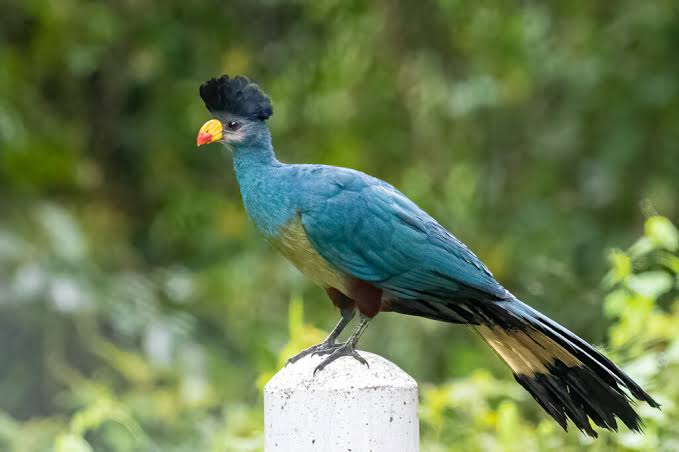
Ross’s Turaco is recognised by its deep purple-blue plumage, bright red crest and yellow bill, while the Great Blue Turaco stands out because of its enormous size, blue-grey feathers and tall, dark crest. Both species occur in Uganda’s forested landscapes, including Kibale National Park and several other important birdwatching destinations. Learning how to distinguish them can make your Uganda birdwatching safari more enjoyable, particularly when watching birds high in the trees.
What Are Turacos?
Turacos are African birds belonging to the family Musophagidae. They are primarily tree-dwelling species known for their colourful plumage, distinctive vocalisations and preference for fruit-rich habitats.
Most turacos spend considerable time moving between branches, searching for fruits, leaves and other plant materials. Their feet are well adapted for gripping branches, allowing them to move easily through dense vegetation.
Uganda supports several turaco species, including Ross’s Turaco, Great Blue Turaco, Black-billed Turaco, Rwenzori Turaco and White-crested Turaco.
Although many turacos have colourful feathers, each species has distinctive identification features.
Quick Facts About Ross’s and Great Blue Turacos
| Feature | Ross’s Turaco | Great Blue Turaco |
|---|---|---|
| Scientific name | Tauraco rossae | Corythaeola cristata |
| Alternative scientific name | Musophaga rossae | None commonly used |
| Family | Musophagidae | Musophagidae |
| Body length | Approximately 50–54 cm | Approximately 70–76 cm |
| Main colour | Purple-blue | Blue-grey and greenish |
| Crest | Crimson-red | Tall, blue-black |
| Bill | Bright yellow | Yellow with reddish tip |
| Flight feathers | Crimson-red | No crimson wing patches |
| Main food | Fruits and other plant material | Fruits, leaves and flowers |
| Preferred habitat | Forest edges, riverine woodland and mature gardens | Tropical forest and mature woodland |
| Conservation status | Least Concern | Least Concern |
Ross’s Turaco: Uganda’s Striking Purple Forest Bird
Ross’s Turaco, also called Lady Ross’s Turaco, is one of Uganda’s most distinctive birds. Its deep violet-blue feathers create a striking appearance, particularly when sunlight reaches the bird through the forest canopy.
The species has a bright crimson-red crest, a yellow bill and a conspicuous yellow facial area. Its wings contain crimson flight feathers that become visible during flight.
Ross’s Turaco is generally smaller and more lightly built than the Great Blue Turaco.
It occupies forest edges, riverine woodland, wooded savannah and mature gardens, where it searches for food among fruit-bearing trees.
How to Identify Ross’s Turaco
The easiest identification features include:
Deep violet-purple feathers covering most of the body.
Bright red crest on top of the head.
Large yellow bill and yellow facial markings.
Brilliant crimson-red feathers visible during flight.
Long tail and rounded wings.
Loud, rolling or bubbling calls.
Its red wing feathers are especially helpful for identification when the bird flies between trees.
Male and female Ross’s Turacos have similar appearances, making them difficult to distinguish during ordinary birdwatching.
Great Blue Turaco: Africa’s Largest Turaco
The Great Blue Turaco is the largest living member of the turaco family and one of Uganda’s most impressive forest birds.
Adults can reach approximately 70–76 centimetres in length, including their long tails. Their large bodies, broad wings and prominent crests make them relatively easy to recognise.
Unlike Ross’s Turaco, the Great Blue Turaco has predominantly blue-grey plumage with greenish tones across parts of its body.
Its tall, dark crest gives the head a distinctive appearance, while the substantial yellow bill adds another useful identification feature.
Great Blue Turacos usually occupy mature tropical forests and wooded areas with plentiful food.
How to Identify a Great Blue Turaco
Look for these characteristics:
Large body compared with other turacos.
Blue-grey upperparts and greenish lower body.
Tall, upright blue-black crest.
Large yellow bill with a reddish tip.
Broad wings and long tail.
Loud, rattling calls that carry through forest vegetation.
Unlike Ross’s Turaco and several other turaco species, the Great Blue Turaco does not display bright crimson-red flight feathers.
This difference is particularly useful when identifying birds in flight.
Ross’s Turaco vs Great Blue Turaco: Main Differences
Although both species belong to the same family, their physical differences make identification relatively straightforward when observers obtain a clear view.
Colour Differences
Ross’s Turaco has a deep purple-blue body, a red crest and a bright yellow bill.
The Great Blue Turaco has a larger blue-grey body, greenish lower plumage and a tall, dark crest.
The red crest of Ross’s Turaco is one of the easiest features to recognise.
Differences in Size
Great Blue Turacos are substantially larger than Ross’s Turacos.
Their heavier bodies and broad wings create a distinctive appearance when moving through trees.
Ross’s Turacos appear more compact and agile, particularly when moving among smaller branches.
Differences During Flight
When Ross’s Turaco takes flight, its crimson flight feathers can produce a bright red flash.
The Great Blue Turaco lacks this conspicuous red colouring.
Instead, its flight reveals large, broad wings and predominantly blue-grey feathering.
Quick Identification Table
| Identification clue | Ross’s Turaco | Great Blue Turaco |
|---|---|---|
| Bird appears very large | Less likely | More likely |
| Bright red crest | Yes | No |
| Tall dark crest | No | Yes |
| Purple-blue body | Yes | No |
| Blue-grey and greenish body | No | Yes |
| Bright red wing flashes | Yes | No |
| Large yellow bill | Yes | Yes |
| Loud forest calls | Yes | Yes |
Where to See Ross’s and Great Blue Turacos in Uganda
Uganda contains tropical forests, riverine woodlands and mature gardens that support different turaco species.
Some destinations provide opportunities to encounter both Ross’s and Great Blue Turacos during the same birdwatching excursion.
Best Birdwatching Destinations
| Destination | Ross’s Turaco | Great Blue Turaco |
|---|---|---|
| Kibale National Park | Possible | Possible |
| Mabira Forest | Possible in suitable areas | Possible |
| Entebbe Botanical Gardens | Recorded | Recorded |
| Budongo Forest | Possible | Possible |
| Semuliki National Park | Possible in suitable habitats | Possible |
| Forest edges in western Uganda | Possible | Depends on habitat |
Sightings depend on the exact location, forest conditions, food availability and local bird activity.
Kibale National Park
Kibale National Park is one of Uganda’s leading destinations for forest birdwatching.
Its tropical forest supports numerous bird species, including turacos, hornbills, barbets and forest flycatchers.
Visitors may encounter Great Blue Turacos moving through the canopy, particularly around fruiting trees.
Ross’s Turacos can also occur in suitable forest-edge and wooded habitats.
Birdwatching in Kibale can be combined with chimpanzee tracking and guided nature walks.
Mabira Forest
Mabira Forest lies along the Kampala–Jinja highway and provides accessible forest birdwatching opportunities.
The forest contains mature trees, secondary vegetation and woodland habitats supporting numerous bird species.
Great Blue Turacos are among the impressive forest birds visitors may encounter.
Birdwatchers should also watch suitable forest edges and nearby wooded habitats for other turaco species.
Entebbe Botanical Gardens
Entebbe Botanical Gardens provides a convenient birdwatching destination for travellers arriving through Entebbe International Airport.
The gardens contain mature trees, wooded paths and areas overlooking Lake Victoria.
Ross’s and Great Blue Turacos have both been recorded here.
Visitors can explore the gardens with a knowledgeable birding guide, particularly during the early morning when many birds are active.
What Do Ross’s and Great Blue Turacos Eat?
Both species feed primarily on plant materials, although their diets are not identical.
Ross’s Turaco eats various fruits and may also consume flowers and other available plant foods.
The Great Blue Turaco feeds on fruits, leaves and other vegetation, including foods available in mature forest canopies.
Comparing Their Feeding Habits
| Feeding behaviour | Ross’s Turaco | Great Blue Turaco |
|---|---|---|
| Fruits | Important food source | Important food source |
| Leaves | Sometimes consumed | Commonly consumed |
| Flowers | Occasionally consumed | Sometimes consumed |
| Main feeding habitat | Woodland and forest trees | Mature forest canopy |
| Feeding groups | Individuals, pairs or small groups | Pairs or groups |
Both species contribute to forest ecology through their feeding activities. Fruit-eating birds can disperse seeds, helping some forest plants reproduce and establish themselves in new locations.
How to Recognise Their Calls
Turacos are often heard before they are seen because they spend considerable time within dense vegetation.
Learning their calls can help you identify birds that remain hidden in the canopy.
Ross’s Turaco Calls
Ross’s Turaco produces deep, throaty calls that may develop into rolling, bubbling sequences.
Pairs sometimes call together, creating a distinctive chorus.
These sounds can carry considerable distances through wooded habitats.
Great Blue Turaco Calls
The Great Blue Turaco produces loud, hollow, rattling calls, often described as repeated knocking or gonk-gonk notes.
Several birds may call together, creating a noisy chorus within the forest canopy.
Its calls are particularly useful for locating groups high in trees.
When birdwatching, listen carefully and follow the direction of calls rather than moving quickly through the forest.
Breeding and Nesting Behaviour
Ross’s and Great Blue Turacos usually nest in trees, where foliage provides shelter for their eggs and chicks.
Their nests are relatively simple platforms constructed from twigs and branches.
This makes their nesting behaviour very different from birds such as the Hamerkop, which constructs enormous enclosed nests.
Both parents participate in caring for their young.
Ross’s Turaco Breeding
Ross’s Turacos generally lay a small clutch, commonly around two eggs.
The adults share incubation and feed the developing chicks.
Young birds remain dependent on their parents until they can move and feed independently.
Great Blue Turaco Breeding
Great Blue Turacos also construct twig-platform nests within trees.
Females commonly lay two eggs, and both adults participate in incubation and chick care.
Their chicks develop within the sheltered forest canopy before gradually becoming independent.
Breeding periods vary with geographical location and environmental conditions.
Best Time to See Turacos in Uganda
Ross’s and Great Blue Turacos are resident birds that can be observed throughout the year.
However, weather conditions, fruit availability and daily activity patterns affect sightings.
Early mornings often provide the best opportunities because birds may be actively calling and feeding.
Late afternoons can also be productive.
Seasonal Birdwatching Guide
| Period | Birdwatching conditions |
|---|---|
| January–February | Often relatively dry, with easier access to forest trails |
| March–May | Rainier conditions in many areas and lush forest vegetation |
| June–August | Generally favourable for forest walks in many destinations |
| September–November | Rainfall may increase and some trails become muddy |
| December | Variable weather with opportunities for forest birdwatching |
Rainfall patterns vary across Uganda, so visitors should check local conditions before arranging forest excursions.
Photography Tips for Ross’s and Great Blue Turacos
Photographing turacos can be challenging because they frequently remain high in trees.
Their movements through dense branches also make focusing difficult.
For Ross’s Turaco, try photographing the bird from an angle that captures its crimson crest and yellow bill.
A photograph taken during flight may reveal its bright red wing feathers.
For Great Blue Turacos, aim to capture the bird’s full body, including its tall crest and long tail.
A camera lens of approximately 300–600 mm is useful for forest bird photography.
A shutter speed around 1/1000 second may help freeze movement, although lower speeds can work for perched birds.
Avoid using flash close to nesting birds or disturbing vegetation to obtain a clearer photograph.
Conservation of Uganda’s Turacos
Both Ross’s Turaco and Great Blue Turaco are currently classified as Least Concern on the IUCN Red List.
However, the forests and woodlands supporting these birds face pressure from human activities.
Deforestation, agricultural expansion, settlement development and the removal of mature fruit-bearing trees can reduce suitable habitats.
Great Blue Turacos are particularly associated with forest environments, making the protection of mature woodland important.
Ross’s Turacos can use a wider range of wooded habitats, including some mature gardens and forest edges.
Responsible birdwatching tourism can encourage habitat conservation by providing economic opportunities connected to protected forests.
Visitors can support conservation by using recognised guides, respecting park regulations and avoiding disturbance around nesting birds.
Other Turaco Species Found in Uganda
Uganda supports several additional turaco species that birdwatchers may encounter.
These include:
| Species | Main identification feature | Typical habitat |
|---|---|---|
| Black-billed Turaco | Green plumage and dark bill | Tropical forest |
| Rwenzori Turaco | Green and blue plumage with colourful head markings | Montane forest |
| White-crested Turaco | Prominent white crest | Woodland and wooded savannah |
| Ross’s Turaco | Red crest and purple-blue body | Forest edges and woodland |
| Great Blue Turaco | Very large body and blue-black crest | Tropical forest |
Not every species occurs in every forest. Identifying the correct habitat is important when planning a specialist turaco birdwatching safari.
Planning a Uganda Turaco Birdwatching Safari
Travellers interested in observing Ross’s and Great Blue Turacos can include several forest destinations in a Uganda wildlife itinerary.
A short trip may begin with birdwatching in Entebbe Botanical Gardens before continuing to Mabira Forest or Kibale National Park.
A longer itinerary can include Budongo Forest and other western Uganda birdwatching destinations.
Suggested Five-Day Birdwatching Itinerary
| Day | Destination | Main activity |
|---|---|---|
| Day 1 | Entebbe | Birdwatching at the Botanical Gardens |
| Day 2 | Mabira Forest | Guided forest birdwatching |
| Day 3 | Kibale National Park | Transfer and afternoon forest-edge birdwatching |
| Day 4 | Kibale National Park | Full-day birdwatching and turaco identification |
| Day 5 | Kibale to Entebbe | Morning birdwatching and return journey |
A specialised birdwatching guide can help identify calls, locate feeding trees and distinguish turaco species.
For the best experience, carry binoculars, comfortable walking shoes, lightweight rain protection and a suitable bird field guide.
Why Ross’s and Great Blue Turacos Are Worth Seeing
Ross’s and Great Blue Turacos are among Uganda’s most remarkable forest birds.
Ross’s Turaco attracts attention with its purple-blue body, crimson crest and bright yellow bill. The Great Blue Turaco impresses visitors with its enormous size, blue-grey feathers and distinctive dark crest.
Both species offer excellent opportunities to observe the behaviour of African forest birds, particularly their feeding habits, vocalisations and movements through the canopy.
Whether you are exploring Kibale National Park, walking through Mabira Forest or enjoying birdwatching in Entebbe Botanical Gardens, learning to identify these two turacos can make your Uganda safari more rewarding.
Their presence also reflects the ecological value of Uganda’s forests and the importance of protecting these habitats for future generations.







No comment