
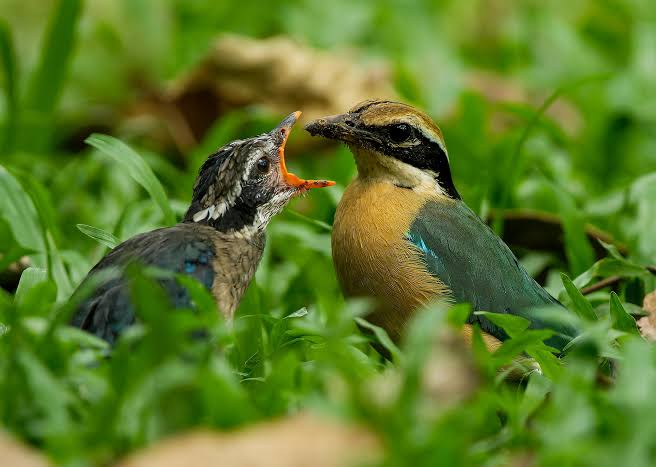
Green-Breasted Pitta in Budongo Forest
Green-Breasted Pitta in Budongo Forest: When and How Birders See It
The Green-breasted Pitta (Pitta reichenowi) is one of Uganda’s most colourful, secretive and sought-after forest birds. Its remarkable combination of emerald-green, bright red, electric-blue and black feathers makes it a prized sighting for birdwatchers exploring Uganda’s tropical forests. However, seeing this beautiful bird requires patience, careful timing and the assistance of an experienced local birdwatching guide.
Budongo Forest Reserve, located in western Uganda near Murchison Falls National Park, is among the forest destinations where birders may search for this elusive species. The Green-breasted Pitta spends much of its time on the shaded forest floor, moving quietly through fallen leaves while searching for insects and other small invertebrates. Its secretive behaviour makes sightings difficult, even in forests where the bird occurs.
For travellers planning a Uganda birdwatching safari, understanding when and how to search for the Green-breasted Pitta can improve the chances of a successful encounter.
What Is the Green-Breasted Pitta?
The Green-breasted Pitta is a small, colourful African forest bird belonging to the family Pittidae. Its scientific name is Pitta reichenowi, and it inhabits tropical forests across parts of Central Africa and western Uganda.
Unlike many forest birds that spend most of their time in the canopy, this species frequently searches for food on the ground.
Its short tail, strong legs and compact body allow it to move through dense undergrowth and leaf litter.
Despite its bright colours, the Green-breasted Pitta is surprisingly difficult to locate because the forest floor is often dark and covered with vegetation.
Quick Facts About the Green-Breasted Pitta
| Feature | Description |
|---|---|
| Common name | Green-breasted Pitta |
| Scientific name | Pitta reichenowi |
| Family | Pittidae |
| Average length | Approximately 16–18 cm |
| Main colours | Green, red, blue, black and buff |
| Habitat | Tropical lowland and medium-altitude forest |
| Main diet | Insects, earthworms and other invertebrates |
| Feeding location | Forest floor and leaf litter |
| Behaviour | Secretive and usually solitary |
| Best observation time | Early morning, especially during calling periods |
| Conservation status | Least Concern |
| Uganda destinations | Budongo Forest and Kibale National Park |
What Does the Green-Breasted Pitta Look Like?
The Green-breasted Pitta is one of the most attractive birds found in Uganda’s tropical forests.
Its colourful feathers make it unmistakable when visitors obtain a clear view.
The bird has a dark head with pale markings above the eyes, a bright green breast and vivid red colouring across its lower belly.
Its wings contain striking blue feathers that become particularly noticeable when the bird moves.
Although the species has beautiful plumage, its small size and preference for shaded environments make photography challenging.
Main Identification Features
Birdwatchers should look for the following characteristics:
Bright green feathers across the breast.
Vivid crimson-red lower belly.
Dark head with pale eyebrow markings.
Blue patches on the wings.
Compact body with a short tail.
Strong legs adapted for moving along the ground.
Quick hopping movements through fallen leaves.
When searching for the bird, pay particular attention to movement close to the forest floor rather than looking only into the canopy.
Why Is the Green-Breasted Pitta Difficult to See?
The Green-breasted Pitta is famous among birdwatchers because of its secretive behaviour.
Although its plumage contains brilliant colours, the bird spends much of its time among leaves, roots and low vegetation.
Its colours can be surprisingly difficult to distinguish in the dim light beneath a tropical forest canopy.
The bird also moves quietly, often disappearing behind vegetation before observers can focus their binoculars.
Another challenge is that its calling activity varies throughout the year.
During some periods, Green-breasted Pittas become more vocal and easier to locate. At other times, individuals may remain quiet for extended periods.
This means visitors can spend several hours searching suitable habitat without obtaining a sighting.
Green-Breasted Pitta in Budongo Forest Reserve
Budongo Forest Reserve is one of Uganda’s important tropical forest conservation areas.
Located near Masindi and Murchison Falls National Park, the forest supports numerous bird species associated with the Guinea-Congo forest region.
Budongo is particularly well known for its mature forest, tall trees, diverse birdlife and chimpanzee populations.
The Green-breasted Pitta has been reported from Budongo, although its occurrence should not be confused with guaranteed sightings.
Kibale National Park has a more established reputation for guided Green-breasted Pitta searches, and birders specifically targeting the species should consider both destinations.
Why Budongo Forest Is Important for Birdwatching
Budongo provides habitats for many specialist forest birds, including species that can be difficult to observe elsewhere in Uganda.
Its extensive tree cover, forest undergrowth and leaf litter create feeding environments for ground-dwelling birds.
Other notable birds recorded in Budongo include Chocolate-backed Kingfisher, White-thighed Hornbill, Yellow-footed Flycatcher, Puvel’s Illadopsis and Great Blue Turaco.
The forest also contains several established birdwatching areas.
Main Birdwatching Areas in Budongo
| Location | Main birdwatching interest |
|---|---|
| Royal Mile | Specialist forest birds and canopy species |
| Busingiro | Forest trails and diverse woodland birds |
| Kaniyo Pabidi | Forest birdwatching and chimpanzee tracking |
| Forest-edge habitats | Mixed woodland and edge-associated species |
Birders searching for the Green-breasted Pitta should first consult knowledgeable local guides about recent records rather than assuming it regularly appears along a particular trail.
When Is the Best Time to See the Green-Breasted Pitta?
Timing is one of the most important considerations when planning a Green-breasted Pitta birdwatching excursion.
The species is difficult to locate when it remains quiet, but calling and display activity can improve detection.
Field observations from Uganda, particularly Kibale Forest, suggest that January to March and June to August can be productive periods for searching.
However, these seasonal observations should not be treated as a confirmed breeding calendar for Budongo Forest specifically.
Seasonal Birdwatching Guide
| Period | Birdwatching expectations |
|---|---|
| January–March | Potential calling and display activity |
| April–May | Rainier conditions in Budongo and potentially muddy trails |
| June–August | Important period to investigate recent pitta activity |
| September–November | Variable calling activity and wetter forest conditions |
| December | Possible sightings, depending on local activity |
For a dedicated Green-breasted Pitta safari, ask your guide about recent calling birds and current access conditions before choosing travel dates.
Why Early Morning Is Important
Green-breasted Pittas are often easier to detect when the forest is relatively quiet.
Early morning provides opportunities to listen for territorial calls before the wider dawn chorus becomes too loud.
Birdwatchers sometimes begin their search around 6:00 am, depending on local sunrise times, forest access arrangements and guide recommendations.
Starting early can be particularly important when targeting a bird known for limited periods of vocal activity.
How Birders Find Green-Breasted Pittas in Budongo Forest
Finding a Green-breasted Pitta involves more than walking through the forest and hoping to encounter one.
Experienced birdwatching guides use knowledge of habitat, recent records and bird vocalisations to identify promising locations.
1. Search Suitable Forest Habitat
Green-breasted Pittas prefer forest environments with dense vegetation, shaded ground and substantial leaf litter.
Guides may concentrate on areas where birds have previously been recorded.
However, historical records do not guarantee that individuals will remain in the same location.
2. Listen Carefully for Calls
Listening is among the most effective techniques for finding a Green-breasted Pitta.
The species produces soft, distinctive calls that can reveal its location.
During display periods, birds may call repeatedly from particular positions.
A knowledgeable guide can recognise these sounds and help visitors approach suitable viewing points without disturbing the bird.
3. Watch the Forest Floor
Unlike hornbills and many turacos, Green-breasted Pittas frequently feed close to the ground.
Watch carefully for small movements among fallen leaves, roots and low vegetation.
A bird may remain motionless for several seconds before suddenly hopping into another patch of cover.
4. Remain Quiet and Patient
Excessive movement and noise can reduce the chances of observing secretive forest birds.
When a possible pitta is detected, remain still and allow your guide to assess the situation.
Avoid chasing birds through thick vegetation or approaching active nests.
5. Allow Enough Birdwatching Time
Some Green-breasted Pitta sightings happen quickly, while others require several hours of careful searching.
There is no reliable minimum amount of time needed to find the species.
Birders with a strong interest in seeing it should consider allocating more than one morning to suitable forest habitat.
What Does the Green-Breasted Pitta Eat?
The Green-breasted Pitta feeds primarily on small invertebrates found among fallen leaves and moist forest soil.
Its strong legs allow it to hop through the undergrowth, while its bill helps capture prey.
The bird often examines patches of leaf litter where insects and other small animals hide.
Common Foods
| Food | Typical feeding location |
|---|---|
| Beetles | Leaf litter and decaying vegetation |
| Ants | Forest floor |
| Earthworms | Moist soil |
| Caterpillars | Low vegetation and fallen leaves |
| Other small invertebrates | Shaded forest undergrowth |
These feeding habits explain why the species spends so much time near the ground.
They also make healthy forest-floor environments important for its survival.
Green-Breasted Pitta Breeding and Display Behaviour
Green-breasted Pittas become particularly interesting during periods of breeding and territorial activity.
Males may perform distinctive displays involving repeated calls and movements from elevated perches.
In some circumstances, a displaying bird becomes easier for birdwatchers to locate because it remains active within a relatively limited area.
Breeding observations in Uganda indicate that activity can vary seasonally.
However, the timing differs between individual territories and forest locations.
Birdwatchers should avoid disturbing displaying birds, nests or young chicks.
Green-Breasted Pitta Photography Tips
Photographing the Green-breasted Pitta requires patience and careful camera preparation.
The bird’s habitat is often dark, and dense vegetation can obstruct the view.
Photographers may need to balance shutter speed, aperture and ISO settings to obtain a clear image.
Recommended Camera Settings
| Setting | Practical recommendation |
|---|---|
| Lens | 300–600 mm telephoto |
| Shutter speed | 1/500–1/1000 second for moving birds |
| Aperture | Widest suitable aperture, often f/4–f/5.6 |
| ISO | Auto ISO or an appropriate higher setting |
| Focus | Small focus area directed towards the eye |
| Flash | Avoid around sensitive or breeding birds |
Use available natural light whenever possible.
Remain at a suitable distance and avoid cutting vegetation or repeatedly playing recorded calls to attract the bird.
A photograph of a naturally behaving Green-breasted Pitta is more rewarding than one obtained through unnecessary disturbance.
Other Birds to Watch in Budongo Forest
Even when the Green-breasted Pitta remains hidden, Budongo offers excellent opportunities to observe other remarkable forest birds.
The reserve supports a diverse mixture of canopy birds, understorey species and forest specialists.
Notable Budongo Forest Birds
| Bird species | Identification feature |
|---|---|
| Chocolate-backed Kingfisher | Rich brown back and colourful kingfisher plumage |
| Great Blue Turaco | Large body and tall dark crest |
| White-thighed Hornbill | Large forest hornbill with distinctive pale thighs |
| Yellow-footed Flycatcher | Small forest flycatcher with yellowish legs |
| Puvel’s Illadopsis | Secretive understorey bird |
| Chestnut-capped Flycatcher | Small bird with a chestnut-coloured crown |
| Ituri Batis | Small forest bird with contrasting plumage |
| African Dwarf Kingfisher | Tiny, colourful forest kingfisher |
A guided excursion can therefore remain productive even without a Green-breasted Pitta sighting.
What to Carry for Green-Breasted Pitta Birdwatching
Budongo is a tropical forest where visitors should prepare for humidity, insects and potentially muddy trails.
Comfortable equipment helps reduce distractions during early morning birdwatching.
Essential Birdwatching Equipment
| Item | Purpose |
|---|---|
| 8×42 binoculars | Observing birds in shaded forest conditions |
| Bird field guide | Identifying forest species |
| Waterproof walking shoes | Walking on muddy forest trails |
| Long trousers | Protection against vegetation and insects |
| Lightweight rain jacket | Protection during unexpected showers |
| Drinking water | Staying hydrated |
| Camera with telephoto lens | Photographing distant birds |
| Small torch or headlamp | Moving safely before sunrise where permitted |
Avoid wearing noisy clothing or carrying unnecessary equipment that makes movement difficult.
Combining Budongo Birdwatching With Murchison Falls National Park
Budongo Forest can be included in a wider safari itinerary covering Murchison Falls National Park.
The combination allows travellers to experience tropical forest birdwatching and open savannah wildlife viewing during one trip.
Visitors can search for forest specialists in Budongo before exploring the Nile River, savannah grasslands and woodland habitats of Murchison Falls.
Suggested Four-Day Safari Itinerary
| Day | Destination | Main activity |
|---|---|---|
| Day 1 | Kampala to Masindi | Transfer and birdwatching preparation |
| Day 2 | Budongo Forest | Early morning specialist forest birdwatching |
| Day 3 | Murchison Falls National Park | Game drive and Nile boat safari |
| Day 4 | Murchison Falls to Kampala | Morning wildlife viewing and return journey |
If the Green-breasted Pitta is your main target, additional forest birdwatching time may be worthwhile. Confirm recent sightings and whether Budongo or Kibale offers the better opportunity for your travel dates.
Conservation of the Green-Breasted Pitta
The Green-breasted Pitta is currently classified as Least Concern globally, but it remains dependent on suitable tropical forest habitat.
Deforestation, habitat fragmentation and degradation of forest undergrowth can affect areas used by ground-dwelling birds.
Conserving mature forests and their natural vegetation is therefore important for this species.
Responsible birdwatching tourism can support forest protection by creating economic opportunities for local guides and communities.
Visitors can contribute by respecting forest regulations, remaining on authorised trails and avoiding disturbance around nesting areas.
Why the Green-Breasted Pitta Is Worth Searching For
The Green-breasted Pitta is among the most rewarding birds to encounter during a Uganda forest birdwatching safari.
Its brilliant colours, secretive behaviour and distinctive calls make it particularly appealing to dedicated birdwatchers.
However, a successful search depends on realistic expectations. Even experienced guides cannot guarantee sightings, and travellers should plan around recent local records rather than historical reports alone.
Budongo Forest provides an impressive forest birdwatching experience, while Kibale National Park is another important destination for travellers specifically targeting the Green-breasted Pitta.
Whether the bird appears briefly among fallen leaves or reveals itself during a display, observing this elusive forest species can become one of the most memorable experiences of a Uganda birdwatching safari.






No comment