
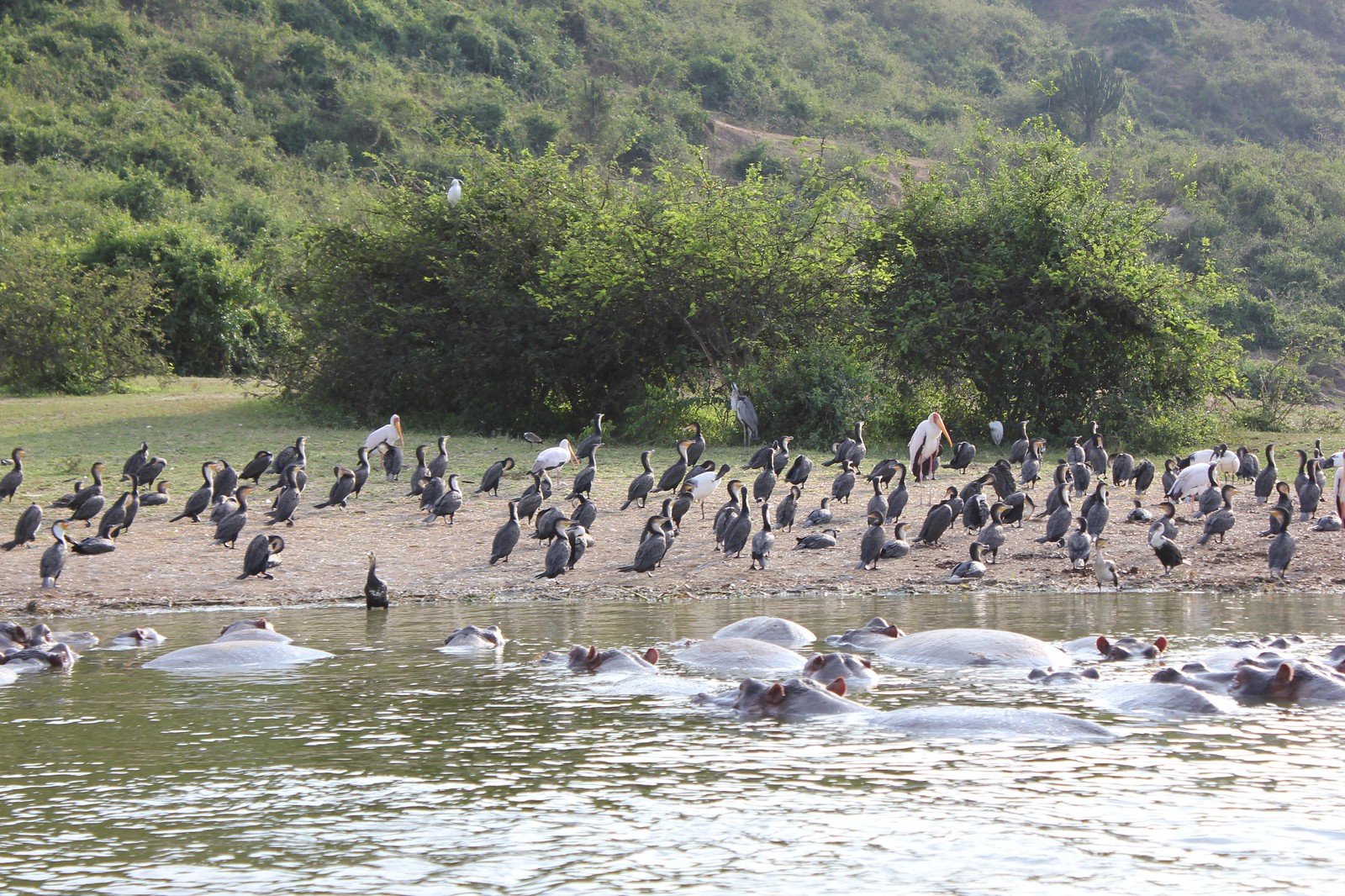
How to photograph kingfishers on the Kazinga Channel
The Kazinga Channel in Queen Elizabeth National Park is one of Uganda’s rewarding destinations for bird photography. This natural waterway connects Lake George and Lake Edward, attracting large numbers of waterbirds and other wildlife throughout the year. Among the most attractive birds to photograph are kingfishers, known for their colourful plumage, sharp hunting skills and rapid movements.
A boat cruise along the channel gives you opportunities to photograph kingfishers sitting on branches, hovering above the water, diving for fish and returning to their favourite hunting spots. The pied kingfisher is particularly noticeable because it often hunts over open water, while the colourful malachite kingfisher is usually found close to reeds and vegetation along the banks.
Photographing these birds requires preparation. Kingfishers are small, fast and sometimes difficult to locate against dense vegetation. Their sudden movements can make it challenging to achieve sharp photographs, especially when you are working from a moving boat. You need suitable camera settings, a good telephoto lens, patience and an understanding of bird behaviour.
Whether you use a professional camera or an entry-level mirrorless or DSLR system, the Kazinga Channel provides excellent opportunities to improve your wildlife photography skills. With careful observation and the right techniques, you can capture detailed portraits, feeding behaviour and action photographs of some of Uganda’s most beautiful birds.
Why the Kazinga Channel is good for kingfisher photography
The Kazinga Channel lies within Queen Elizabeth National Park in western Uganda. It passes through a landscape of open savanna, woodland, wetlands and lakeshore vegetation. These different habitats support a rich bird population, including several kingfisher species.
The channel is particularly productive because it provides a regular supply of fish and other aquatic prey. Kingfishers use exposed branches, reeds, dead trees and other suitable perches to watch the water. Some remain in one place for several minutes before diving, while others move frequently between hunting positions.
A boat cruise offers a useful photographic advantage because you can view birds from close to water level. This position often creates a more natural perspective than photographing birds from a raised vehicle or from a steep riverbank. It also allows you to photograph reflections, birds perched above the water and wildlife moving along the shoreline.
The channel is home to many other photographic subjects. African fish eagles, herons, pelicans, cormorants, African skimmers and waders are regularly of interest to birdwatchers. You may also encounter hippos, Nile crocodiles, elephants and buffaloes along the banks.
For photographers, this variety makes the boat cruise worthwhile even when kingfishers are not immediately visible. You can move between different subjects while waiting for the right opportunity to photograph a particular bird.
Which kingfishers can you photograph on the Kazinga Channel?
Several kingfisher species occur in Queen Elizabeth National Park. Some are more closely associated with the channel itself, while others are found in the surrounding woodland, grassland and wetland habitats. Knowing their appearance and behaviour will help you identify them and prepare your camera.
Pied kingfisher
The pied kingfisher (Ceryle rudis) is one of the most recognisable birds along the Kazinga Channel. It has distinctive black-and-white plumage, a pointed black bill and a prominent crest. Males usually have two black breast bands, while females generally have one complete band and a broken second band.
Pied kingfishers are particularly interesting to photograph because they frequently hover above open water before diving for fish. They can remain almost stationary in the air while rapidly beating their wings. This behaviour gives photographers an opportunity to prepare their composition before the bird makes its dive.
Look for pied kingfishers perched on branches, posts and other exposed positions along the channel. You may also see several birds hunting in the same general area. Their contrasting plumage makes them suitable subjects for both close-up portraits and action photography.
Malachite kingfisher
The malachite kingfisher (Corythornis cristatus) is a small, brightly coloured bird that attracts attention because of its vivid blue-green upperparts and reddish-orange underparts. It has a red bill, a short tail and a compact body.
Unlike the pied kingfisher, the malachite kingfisher usually hunts from a low perch close to the water. It may sit on a reed, thin branch or exposed piece of vegetation while watching for small fish and aquatic insects.
Its small size makes photography challenging. You need enough focal length to capture fine details, especially around the eye and bill. The bird’s bright colours can produce excellent photographs when the background is soft and uncluttered.
Watch the edges of the channel where reeds and low vegetation provide suitable hunting positions. When you locate one, avoid sudden movements and wait for it to turn its head or prepare to dive.
Giant kingfisher
The giant kingfisher (Megaceryle maxima) is Africa’s largest kingfisher. It has a large head, a powerful bill, a prominent crest and a heavily patterned body. Its size makes it easier to frame than the smaller malachite kingfisher, although it may remain far from the boat.
Giant kingfishers are associated with rivers, lakes and other freshwater habitats where fish are available. Along the Kazinga Channel, look around wooded banks and suitable waterside perches.
A photograph showing the bird’s large bill and patterned breast can help communicate its size and distinctive appearance. Try to capture it sitting naturally on a branch rather than photographing it only when it is flying away.
Woodland kingfisher
The woodland kingfisher (Halcyon senegalensis) has bright blue wings and back, a reddish bill and contrasting pale underparts. It is usually associated with woodland, wooded grassland and vegetation near water rather than depending on open water for fishing.
You may encounter this species in the wider Queen Elizabeth National Park landscape and around suitable vegetation near the channel. It often hunts insects and other small animals from a perch.
Its bright blue plumage stands out against green leaves and brown branches. Look for it sitting quietly before making a short flight to catch prey.
Other kingfishers in the wider park
Queen Elizabeth National Park supports additional kingfisher species, including grey-headed, African pygmy, blue-breasted and chocolate-backed kingfishers. Their distribution and preferred habitats differ, so you should not expect to photograph all of them during one boat cruise.
If your main objective is to build a wider kingfisher photographic collection, combine the Kazinga Channel cruise with birdwatching around Mweya Peninsula, Katunguru and suitable woodland areas. A local bird guide can help you identify the habitats where less frequently encountered species are most likely to occur.
Choose the right camera and lens
Kingfishers are relatively small birds, so a telephoto lens is one of the most important pieces of equipment for this type of photography. It allows you to fill more of the frame without disturbing the bird or asking the boat crew to approach too closely.
A 300mm lens can produce good results when birds are close to the boat. A 400mm or 500mm lens provides additional reach for smaller birds and distant perches. A 100-400mm zoom is also practical because it allows you to adjust the framing as the distance changes.
A 150-600mm lens can be useful for photographers who want extra reach, particularly when photographing malachite kingfishers on the far side of the channel. However, longer lenses can be heavier and more difficult to handle on a moving boat.
If you use a crop-sensor camera, the smaller sensor provides a narrower field of view with the same lens. This can help you frame distant birds, although it does not automatically improve the optical detail captured by the lens.
Image stabilisation is useful when photographing from a boat because small movements can affect sharpness. It helps reduce camera shake, but it cannot freeze the movement of a flying or diving kingfisher. You still need a fast shutter speed for action photography.
Recommended camera settings for kingfishers
Your camera settings should depend on the bird’s behaviour. A kingfisher sitting on a branch requires a different approach from one hovering above the water or diving for fish.
Photographing perched kingfishers
For a perched kingfisher, start with a shutter speed of around 1/1000 second. This can help reduce blur caused by slight boat movement and the bird’s small movements.
Use a wide aperture such as f/4, f/5.6 or f/6.3, depending on your lens. A wider aperture allows more light into the camera and helps separate the bird from the background.
Auto ISO is useful when light levels change during the cruise. It allows the camera to adjust sensitivity while maintaining your chosen shutter speed and aperture. Check your photographs regularly to ensure the ISO has not become unnecessarily high.
Use single-point autofocus or a small focus area when the bird is sitting among reeds and branches. Position the focus point over the eye or head. This reduces the risk of your camera focusing on vegetation in front of the bird.
Photographing kingfishers in flight
When photographing a kingfisher flying across the channel, increase your shutter speed to approximately 1/2000 second. This helps freeze wing movement and produces sharper action photographs.
Use continuous autofocus, commonly labelled AF-C on Nikon and Sony cameras or AI Servo on Canon cameras. This allows the camera to adjust focus as the bird moves towards, away from or across your position.
Select high-speed continuous shooting so you can capture several frames during a short flight. Start following the bird before pressing the shutter button. Try to keep it within the frame while leaving enough space in the direction it is travelling.
A shutter speed of 1/1600 second may work in good light for slower movements, but faster settings are useful when the bird is flying rapidly.
Photographing pied kingfishers hovering
Hovering pied kingfishers offer excellent opportunities for action photography. The bird may remain in one position above the water before folding its wings and diving.
Start with a shutter speed of at least 1/2000 second. Use continuous autofocus and a focus area that allows your camera to track the bird without being distracted by the water or background.
Try to capture different stages of the behaviour. A photograph showing the wings fully extended can be attractive, while an image taken just before the dive may reveal the bird’s concentration and hunting posture.
Do not wait until the bird begins diving before looking through your viewfinder. Track it while it is hovering and prepare to shoot as soon as its movement changes.
How to photograph a kingfisher diving
A kingfisher diving for fish is one of the most challenging photographs to capture. The movement is extremely fast, and the bird may disappear beneath the water before you have time to react.
The best approach is to study its behaviour before attempting the photograph. Pied kingfishers often hover over an area before diving. If you notice one repeatedly hunting in the same section of the channel, prepare your camera and keep the bird in focus.
Use a shutter speed of 1/2500 second or faster when the available light allows. This can help freeze the wings, body movement and water droplets. Set continuous autofocus and use high-speed burst shooting.
Keep following the bird as it dives. Continue shooting through the movement rather than taking a single photograph. You may capture the bird entering the water, emerging with a fish or returning to its perch.
You should also experiment with photographing the bird immediately after a successful dive. Water droplets on its feathers and a fish held in its bill can create an interesting wildlife photograph.
Your camera may not capture the exact moment of every dive. Do not become discouraged if the first few attempts are unsuccessful. Watch the bird’s routine and anticipate its next movement.
Position yourself correctly on the boat
Your position on the boat can influence the quality of your photographs. Ask the crew which side offers the clearest view of the shoreline and where the birds are most likely to be perched.
Sitting close to the side facing the bank can provide a better shooting angle. A lower position often produces a more natural photograph because you are closer to the bird’s eye level.
If you are on a shared boat, be considerate of other passengers. Avoid blocking their views or moving repeatedly while the boat is travelling. Prepare your camera and lens before reaching areas where birds are likely to appear.
A smaller private boat may offer more flexibility for photographers because it can provide additional space and allow the captain to adjust the viewing position where safe and permitted. A shared boat can still produce excellent photographs, particularly when you have a clear line of sight.
Remain seated or in the position approved by the crew. Do not lean dangerously over the water or stand in a way that affects the boat’s balance. The channel contains hippos and crocodiles, so following the crew’s safety instructions is essential.
Choose the best time for photography
Morning and afternoon boat cruises can both produce good photographs, but the quality of light changes throughout the day.
Morning light is often softer and can be useful for photographing birds feeding along the channel. Calm water may also provide attractive reflections. Cooler conditions can make the cruise more comfortable for extended photography.
Afternoon light can bring out the blue and green colours of kingfishers, especially when the sun is lower. However, strong sunlight can create harsh shadows and bright reflections on the water.
The direction of the sun is important. Whenever possible, position yourself so that the light falls on the front or side of the bird. Photographing directly towards the sun can leave the bird underexposed and hide its colours.
The Kazinga Channel boat cruises commonly operate in the afternoon, with morning arrangements depending on the operator and available schedule. Confirm the departure time when booking, particularly if you are planning your photography around a specific light condition.
If bird photography is your main interest, consider arranging more than one cruise. Different trips give you additional opportunities to observe bird behaviour and work with changing light.
Use light and backgrounds to improve your photographs
A colourful kingfisher can produce an excellent photograph, but the background plays an important role in the final result. Look for a position where the bird stands out clearly against the surroundings.
A malachite kingfisher against a soft green background can produce a clean portrait. A pied kingfisher hovering above open water may create a simple action photograph. A giant kingfisher sitting on a branch can make a strong portrait showing its large bill and patterned feathers.
Use a wide aperture to soften distracting vegetation. However, make sure enough of the bird remains in focus. If the bird is angled towards you, focusing on the eye is particularly important.
Try different compositions instead of filling every photograph with the bird. Include the branch, water, reeds or surrounding landscape when these elements help explain the bird’s habitat.
Pay attention to exposure when photographing black-and-white pied kingfishers. Bright white feathers can become overexposed while the black markings lose detail. Check your histogram and adjust exposure compensation when necessary.
How to keep your camera steady on a moving boat
Even when the boat moves slowly, small vibrations and changes in direction can affect image sharpness. This becomes more noticeable when using a long telephoto lens.
Hold the camera firmly with one hand supporting the lens and the other operating the controls. Keep your elbows close to your body. If the boat has a suitable padded rail, you may use it for support without resting the lens directly on a hard surface.
Image stabilisation can help reduce camera shake. However, use a sufficiently fast shutter speed because stabilisation cannot stop the bird from moving.
A beanbag may be useful on some private boats if the crew allows it and there is a safe place to position it. Avoid using a tripod on a crowded or moving boat because it can restrict movement and become unstable.
Keep your camera strap secure. Protect your equipment from splashes, dust and sudden rain with a suitable rain cover or protective bag.
Common mistakes when photographing kingfishers
One common mistake is using a shutter speed that is too slow. A photograph may look sharp on the camera screen but reveal blurred wings or a soft head when viewed at full size. Increase the shutter speed when photographing active birds.
Another problem is allowing the camera to focus on the background. This often happens when a kingfisher sits among reeds or thin branches. Use a smaller focus area for perched birds and check that the focus point is on the bird’s head.
Some photographers also wait too long before preparing their cameras. A kingfisher may appear for only a few seconds before flying away. Keep your camera switched on, use suitable exposure settings and scan the shoreline continuously.
Avoid excessive digital zoom or cropping when the original image lacks detail. A longer lens and accurate focus will usually produce better results than relying on heavy cropping.
Do not ask the boat captain to chase birds or approach them too closely. Disturbing a kingfisher can interrupt feeding and cause it to abandon a useful perch. Responsible wildlife photography allows the bird to behave naturally.
Protect your camera equipment during the boat cruise
The Kazinga Channel can be sunny, dusty and occasionally wet. Carry a protective camera bag, a rain cover and a clean microfibre cloth for your lens.
Keep spare batteries and memory cards somewhere dry and easy to reach. Continuous shooting and autofocus tracking can use battery power quickly, particularly during a long photography session.
Water reflections can make the camera’s exposure meter behave unpredictably. Check your histogram or image highlights when photographing white plumage, bright water or birds against a dark background.
A polarising filter can reduce reflections from the water in certain conditions, but it also reduces the amount of light reaching your sensor. This may force you to increase ISO or use a slower shutter speed. For fast-moving kingfishers, maintaining a high shutter speed is usually more important than removing every reflection.
If you use two camera bodies, keep the second one protected until you need it. Avoid changing lenses unnecessarily while the boat is exposed to dust, spray or wind.
A practical camera settings guide
The following settings provide a useful starting point for photographing kingfishers on the Kazinga Channel. You may need to adjust them according to available light, the movement of the bird and your camera equipment.
| Photography situation | Starting shutter speed | Autofocus | Shooting mode |
|---|---|---|---|
| Perched kingfisher | 1/1000 sec | Single-point or small area | Single or burst |
| Bird taking off | 1/1600 sec | Continuous AF | High-speed burst |
| Kingfisher in flight | 1/2000 sec | Continuous AF | High-speed burst |
| Pied kingfisher hovering | 1/2000 sec or faster | Continuous AF | High-speed burst |
| Diving kingfisher | 1/2500 sec or faster | Continuous AF | High-speed burst |
These are starting points rather than fixed rules. If the light becomes poor, you may need to increase ISO to maintain your selected shutter speed. Check your images regularly and adjust your exposure when necessary.
Combining kingfisher photography with other wildlife
One advantage of photographing the Kazinga Channel is that you can work on several subjects during the same boat cruise. When kingfishers are quiet, turn your attention to African fish eagles, herons, pelicans, cormorants and African skimmers.
The channel also provides opportunities to photograph hippos, crocodiles, elephants and buffaloes. A telephoto zoom can capture close details, while a wider lens is useful for showing animals within the landscape.
Try to create a varied collection of photographs. Include close-up portraits, birds in flight, feeding behaviour, reflections and environmental images. This approach gives you a more complete photographic record of the channel rather than a collection of similar bird portraits.
You can also photograph interactions between birds. A pair of pied kingfishers hunting near each other, a malachite kingfisher waiting on a reed or a bird returning with a fish can provide more interesting photographs than a simple record shot.
Planning a kingfisher photography trip to the Kazinga Channel
The Kazinga Channel is accessed through Queen Elizabeth National Park in western Uganda. Mweya Peninsula is a common starting point for boat cruises. Visitors can arrange trips through the relevant park facilities, lodges or tour operators.
If photography is your main interest, explain this when arranging your cruise. Ask whether a smaller private boat is available, whether the crew can accommodate photography stops and whether you can choose a seat with a clear view of the shoreline. Confirm the arrangements and departure time before travelling, as schedules and boat options can change.
Allow enough time in Queen Elizabeth National Park to combine the boat cruise with game drives and other birdwatching activities. The Kasenyi Plains, Mweya Peninsula and Katunguru area offer different photographic subjects and bird habitats.
Carry binoculars if you have them. They help you locate kingfishers before raising your camera, particularly when the birds are sitting far away or partly hidden by vegetation. A field guide or bird identification application can also help you confirm species after the cruise.
A successful kingfisher photograph depends on preparation, observation and timing. Learn the birds’ behaviour, use a fast shutter speed, focus carefully on the eye and be ready when the action begins. The Kazinga Channel provides an excellent setting to practise these skills while photographing some of Uganda’s most colourful waterbirds.



No comment