
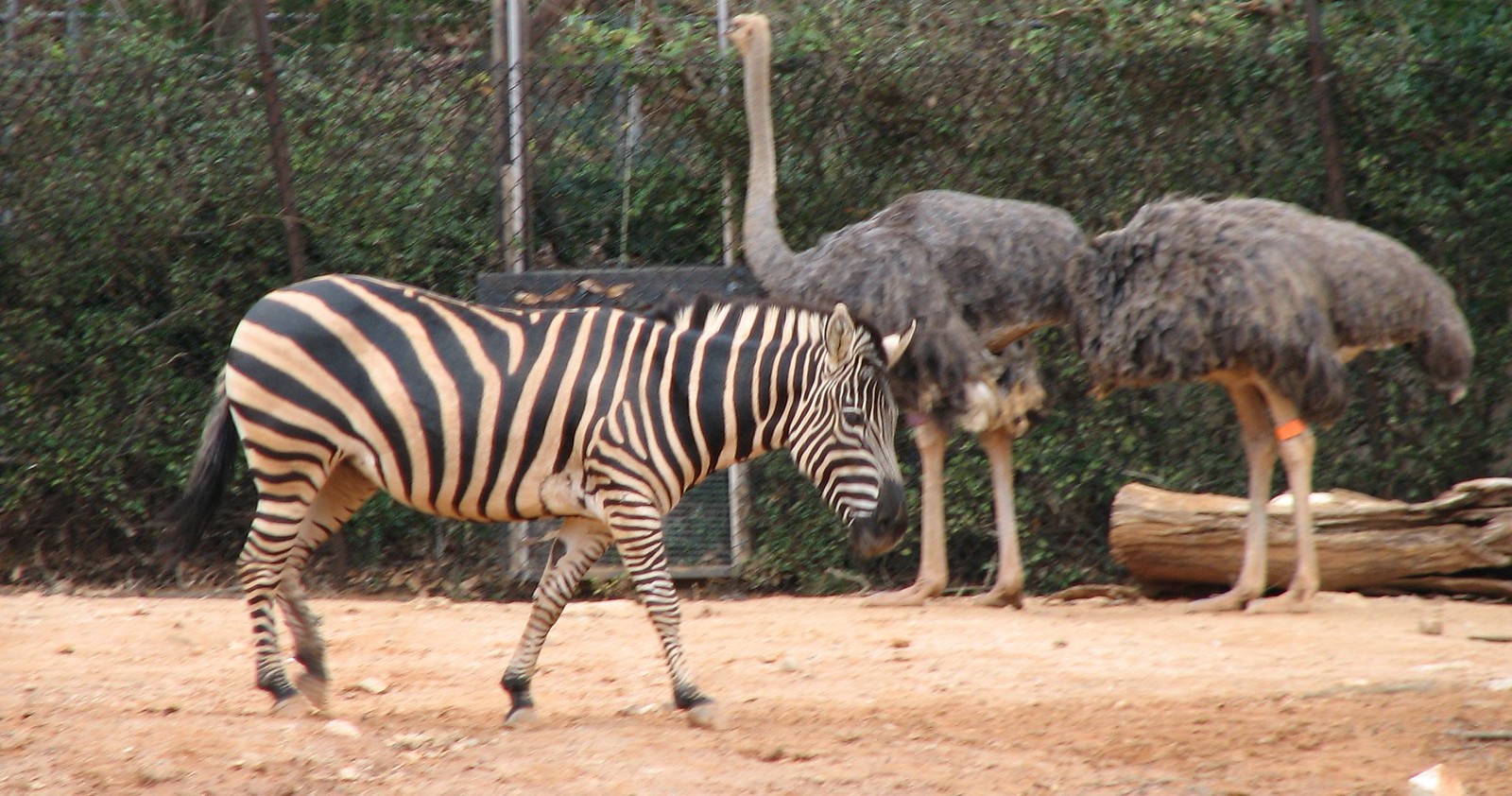
Ostriches in East Africa: Maasai vs Somali ostrich compared
Ostriches are among the most impressive birds you can encounter on an East African wildlife trip. Their enormous bodies, long necks, powerful legs and remarkable running speed make them easy to recognise across open grasslands and dry savannas. However, not every ostrich in East Africa belongs to the same type. The region is home to two distinctive forms: the Maasai ostrich and the Somali ostrich.
At first glance, these birds may appear almost identical. Both are flightless, both can grow to more than two metres tall, and both have the familiar black-and-white plumage of adult males. Their differences become clearer when you examine the colour of the neck and legs, the white markings around the neck, their preferred habitats and their geographical distribution.
The Maasai ostrich is associated mainly with the open savannas and grasslands of Kenya and Tanzania. The Somali ostrich occurs farther north and east, particularly in Somalia, Ethiopia and northeastern Kenya. Their ranges meet in parts of northern Kenya, making the country an interesting destination for birdwatchers hoping to compare them.
Understanding these differences helps you identify ostriches more accurately during game drives, especially when travelling through destinations such as the Maasai Mara, Amboseli, Tsavo, Samburu and northern Tanzania.
Are the Maasai and Somali ostriches different species?
The classification of these two ostriches has changed over time. Traditionally, both were treated as subspecies of the common ostrich, Struthio camelus.
Under that classification, the Maasai ostrich was called Struthio camelus massaicus, while the Somali ostrich was called Struthio camelus molybdophanes.
Modern bird taxonomy increasingly recognises the Somali ostrich as a separate species, Struthio molybdophanes. This classification reflects differences in its appearance, genetics, ecology and evolutionary history. Some references and field guides still use the older subspecies classification, so you may encounter both scientific names.
The Maasai ostrich remains classified as a subspecies of the common ostrich, Struthio camelus.
For practical birdwatching, the distinction is straightforward. You are comparing the Maasai form of the common ostrich with the Somali ostrich, which many modern taxonomic authorities recognise as a separate species.
What is the Maasai ostrich?
The Maasai ostrich is one of the most familiar large birds of East African savannas. Its scientific name is Struthio camelus massaicus. It occurs mainly in Kenya and Tanzania, particularly in open grasslands, wooded savannas and areas with scattered shrubs.
It is a very large bird, with adult males generally displaying black body feathers and white wing and tail feathers. Females have brownish-grey plumage that helps them blend into the surrounding vegetation. Young birds are also brown and lack the striking black-and-white appearance of mature males.
The neck and legs are important identification features. Outside the breeding season, the bare skin is generally pinkish-grey. During breeding, the male’s neck and legs become much brighter, often developing an intense pink or reddish colour.
The Maasai ostrich may have a partly feathered or partly bare crown. Its neck usually has a narrow white feathered ring near the base, although this feature can be difficult to see at a distance.
This ostrich is well adapted to open habitats. It feeds mainly on plant material, including leaves, seeds, flowers and other vegetation, but it also eats insects and small animals when available.
Its long legs allow it to travel considerable distances while searching for food. When threatened, it can run at high speed, using powerful strides to move across open ground.
What is the Somali ostrich?
The Somali ostrich, scientifically known as Struthio molybdophanes, is the northern and eastern counterpart of the Maasai ostrich in the wider East African region.
Its distribution includes Somalia, Ethiopia and northeastern Kenya. It prefers semi-arid and arid landscapes, including bushland, dry grassland and open woodland.
The most important identification feature is its blue-grey neck and legs. In adult males, these areas can become brighter blue during the breeding season. The bare skin creates a noticeable contrast with the bird’s dark body feathers.
Adult males have black body plumage with white wing and tail feathers. Females have darker brown plumage than female Maasai ostriches and often show a blue-grey colour around the neck and legs. Their eyes are also typically pale grey-brown or greyish rather than the brown tones associated with the Maasai form.
The Somali ostrich often has a more noticeable bare patch on the crown of the head. Its neck markings also differ from those of the Maasai ostrich. Older field descriptions distinguish it by a broader white neck ring, although the exact appearance can vary and the neck ring is not always easy to assess in the field.
Another behavioural difference is its preference for browsing vegetation in bushland. Somali ostriches often feed among shrubs and taller vegetation, while Maasai ostriches are more closely associated with open grazing habitats.
Maasai ostrich vs Somali ostrich: the main differences
The two forms share many characteristics, but several features help you separate them.
| Feature | Maasai ostrich | Somali ostrich |
|---|---|---|
| Scientific name | Struthio camelus massaicus | Struthio molybdophanes |
| Taxonomic status | Subspecies of common ostrich | Often recognised as a separate species |
| Adult male neck | Pinkish-grey, becoming red or pink during breeding | Blue-grey, becoming brighter blue during breeding |
| Leg colour | Pinkish-grey, brighter during breeding | Blue-grey, with brighter breeding colours |
| Female plumage | Brownish-grey | Generally darker brown |
| Neck marking | Usually a narrow white ring | Often described as a broader white ring |
| Main habitat | Open savanna and grassland | Dry bushland, scrub and semi-arid grassland |
| Main distribution | Kenya and Tanzania | Somalia, Ethiopia and northeastern Kenya |
The most reliable difference when observing adult males is the colour of the bare skin. A breeding male Maasai ostrich develops bright pink or reddish skin, while a Somali ostrich develops blue skin.
However, you should not rely on colour alone. Lighting, distance, age and breeding condition can affect what you see. Combining the neck colour with the habitat, geographical location and other physical features gives you a more reliable identification.
How to identify a Maasai ostrich on safari
The Maasai ostrich is relatively straightforward to identify in open savanna environments. Look for its tall body, long bare legs, long neck and the familiar black-and-white plumage of an adult male.
During the breeding season, the male’s pink or reddish neck and legs become particularly noticeable. This colour can be visible even when the bird is standing some distance away.
Females are less colourful, with brownish-grey feathers covering most of the body. Their plumage blends into dry grass and woodland vegetation, making them harder to notice when they are resting or feeding.
You may encounter Maasai ostriches in small groups, pairs or larger gatherings. Their social behaviour varies with the season and breeding activity.
The species is especially associated with open landscapes where it can see approaching predators. This is one reason why ostriches are often seen in the same broad grassland environments used by zebras, wildebeest and antelopes.
When driving through the Serengeti or Maasai Mara, scan open plains and grassland edges. In Tanzania, the Ngorongoro Conservation Area and Tarangire also offer suitable habitats.
How to identify a Somali ostrich on safari
The Somali ostrich is more closely associated with dry northern landscapes. It can occur in semi-arid grassland, thorn scrub and open bushland, where it feeds among shrubs and scattered trees.
An adult male’s blue-grey neck and legs are its most distinctive features. During breeding, the blue colour becomes brighter and can be particularly noticeable around the neck.
Females are darker than female Maasai ostriches, although separating them can be difficult without a clear view. Their habitat and location become important clues.
Somali ostriches are often encountered alone or in pairs rather than in the larger groups sometimes seen among common ostriches. This is a general behavioural tendency rather than an absolute rule.
When visiting northern Kenya, look carefully in suitable dry-country habitats around Samburu and other reserves in the region. The Somali ostrich is also associated with parts of northeastern Kenya beyond the main southern safari circuit.
A sighting in these landscapes can be particularly interesting because you may be observing a species that does not occur naturally across the same broad range as the Maasai ostrich.
Where can you see Maasai ostriches in Kenya?
Kenya is one of the best destinations for observing Maasai ostriches. Its extensive savannas and grasslands provide suitable habitats across several well-known wildlife areas.
The Maasai Mara National Reserve is an excellent place to look for them. Its open grasslands and scattered woodland support ostriches alongside large populations of grazing animals. You may see them walking across the plains or feeding near herds of zebra and antelope.
Amboseli National Park is another useful destination. The open plains around its seasonal wetlands provide suitable habitat, and ostriches can be seen during game drives. The views of Mount Kilimanjaro also make the landscape particularly attractive for wildlife photography.
Tsavo East and Tsavo West national parks offer additional opportunities. These large protected areas contain open grassland, bushland and woodland. Ostriches may be encountered while exploring the savanna, although sightings depend on the route and local conditions.
Nairobi National Park can also provide opportunities to see common ostriches. Its open grasslands support a variety of large mammals and birds despite the park’s proximity to the city.
Where can you see Somali ostriches in Kenya?
Northern Kenya is the most relevant part of the country for finding Somali ostriches. Its dry landscapes, thorn scrub and semi-arid grasslands provide suitable habitat.
Samburu National Reserve is one of the best-known destinations for northern Kenya’s wildlife. The reserve’s dry-country vegetation supports several species that are less commonly encountered in the southern safari circuit.
Nearby conservation areas and reserves can also offer opportunities to look for Somali ostriches. The wider Samburu region includes different habitat types, and local guides can help identify areas where the birds have been recorded.
The species also occurs in northeastern Kenya, where its distribution approaches that of the Maasai ostrich. This creates an area of geographical overlap, although the two forms are not equally common in every location.
If you are travelling specifically to see Somali ostriches, ask your guide about recent records rather than relying only on a reserve’s general wildlife list.
Where can you see Maasai ostriches in Tanzania?
Tanzania is an important destination for the Maasai ostrich. Its national parks and conservation areas contain large expanses of savanna, woodland and grassland.
The Serengeti National Park is one of the strongest places to look. Ostriches are part of the park’s open-plains birdlife and may be seen during game drives across the grasslands.
The Ngorongoro Conservation Area also offers suitable habitat. The crater floor contains open grassland, seasonal wetlands and woodland, creating opportunities to observe ostriches alongside other large animals.
Tarangire National Park has extensive savanna and scattered acacia woodland. Ostriches may be encountered in suitable open areas, particularly during game drives.
Lake Manyara National Park provides another possibility, although its habitats include substantial woodland and forest as well as open areas. The likelihood of seeing ostriches depends on where you explore.
A northern Tanzania itinerary combining Serengeti, Ngorongoro and Tarangire provides several opportunities to search for Maasai ostriches.
Can you see ostriches in Uganda?
Uganda is not one of the main destinations for regular wild ostrich sightings. Its savanna national parks support many large mammals and bird species, but ostriches are not a standard species to expect on a typical Ugandan wildlife itinerary.
The Maasai ostrich’s recognised range is concentrated farther south and east, particularly in Kenya and Tanzania. Some historical distribution accounts include broader areas of East Africa, but visitors should not assume that ostriches are regularly present in Uganda’s national parks.
If your main objective is to see wild ostriches, Kenya and Tanzania are more dependable choices. Uganda remains an excellent destination for other large birds, including the grey crowned crane, shoebill and several hornbill species.
How large are Maasai and Somali ostriches?
Both forms are enormous birds. Their height and body size are broadly comparable, and neither should be considered a small or medium-sized ostrich.
Adult ostriches can stand approximately 2.1 to 2.7 metres tall, depending on sex and individual variation. Males are generally taller and heavier than females in the Maasai form, although the size difference is not always obvious when birds are observed separately.
The Somali ostrich is also a large bird, with adult males and females showing considerable variation in body size. Some references describe Somali females as relatively large compared with males, so sex-based size assumptions should not be used as a reliable field identification method.
Both have powerful legs with two toes on each foot. Their legs are adapted for running rather than flying, and they can cover long distances while searching for food.
Their wings are relatively small compared with their body size, but they remain important for balance, courtship displays, shade and communication.
What do Maasai and Somali ostriches eat?
Both ostriches are omnivorous, although plant material makes up much of their diet.
They feed on leaves, seeds, flowers, fruits, roots and other vegetation. They also consume insects, lizards and other small animals when available.
The Maasai ostrich commonly feeds in open grassland and savanna. It can graze on vegetation while moving across the plains, often in areas where other herbivores are feeding.
The Somali ostrich is more closely associated with bushland and may browse leaves and other vegetation from shrubs. Its feeding habits are suited to landscapes where taller vegetation provides food that is less accessible to animals that mainly graze on grass.
Ostriches swallow small stones and grit, which help grind food in the muscular part of their digestive system. These stones are called gastroliths and play an important role in digestion.
They obtain much of their water from the food they eat, although they will drink when suitable water sources are available.
How fast can an ostrich run?
Ostriches are the fastest-running birds in the world. They can reach speeds of approximately 60 to 70 kilometres per hour over short distances, although actual speed depends on the individual and conditions.
Their long legs allow them to cover several metres with each stride. They can also maintain a fast running pace for longer than many other large animals.
Both the Maasai and Somali ostriches share this basic physical ability. There is no reliable reason to assume that one form is consistently faster than the other during an ordinary safari observation.
Their speed is an important defence against predators. Instead of relying entirely on hiding or fighting, they can escape across open ground.
An adult ostrich also has powerful legs and large claws. A kick can cause serious injuries, so people should never approach or attempt to handle wild ostriches.
How do ostriches reproduce?
Ostriches have an unusual breeding system. A dominant male may mate with a principal female and several other females within a breeding group.
The females lay their eggs in a shared nest, which is usually a shallow scrape in the ground. The dominant female’s eggs are generally positioned in the centre, while eggs from other females are arranged around them.
The male and principal female share incubation duties. The male often incubates at night, when his dark feathers help him blend into the surroundings, while the female commonly takes over during the day.
An ostrich egg is exceptionally large and has a thick shell. It can weigh around 1.4 to 1.8 kilograms, although individual eggs vary.
Incubation lasts approximately 42 days. Once the chicks hatch, the adults protect them and help them find food.
Ostrich chicks have striped brown, black and cream plumage. This colouring provides camouflage in dry grass and sandy environments.
The breeding behaviour of the Maasai and Somali ostriches follows the general pattern found among ostriches, although local timing and group behaviour vary with environmental conditions.
Which ostrich is easier to see on safari?
The answer depends on your destination.
If you are visiting the Maasai Mara, Amboseli, Tsavo or the northern Tanzania safari circuit, the Maasai ostrich is the form you should primarily expect to encounter.
If you are travelling through northern Kenya, particularly the Samburu region and suitable northeastern habitats, the Somali ostrich becomes a more important species to look for.
The Maasai ostrich is associated with many popular open-savana safari destinations, making it easier to include in a conventional Kenya or Tanzania wildlife itinerary. Somali ostrich sightings require more specific attention to location and habitat.
Neither species is guaranteed. Their presence depends on local distribution, habitat conditions and the route taken during your game drives.
How to photograph Maasai and Somali ostriches
Ostriches are excellent subjects for wildlife photography because of their size and distinctive appearance. You can photograph them standing in open grassland, walking across the plains, feeding or displaying during the breeding season.
A telephoto zoom lens between 100mm and 400mm is often sufficient for close or medium-distance sightings from a safari vehicle. A longer lens can help when the birds are far away or when you want detailed photographs of the head and neck.
Use a shutter speed of around 1/1000 second for standing or walking birds. Increase it to 1/2000 second or faster when photographing running ostriches.
For identification photographs, concentrate on the neck, legs and head. These areas provide important clues when separating the two forms.
A clear photograph of a male’s neck colour can be particularly useful. Pink or reddish skin suggests a Maasai ostrich, while blue-grey skin points towards a Somali ostrich. Also photograph the surrounding habitat and, if possible, the entire bird so that its proportions and plumage can be assessed.
Avoid asking your driver to approach too closely. Ostriches are large, powerful wild animals, and they need enough space to move naturally.
Conservation threats facing East Africa’s ostriches
Both Maasai and Somali ostriches face pressures associated with changes in land use and human activity.
Habitat loss is an important concern. Grasslands and bushlands are increasingly converted for agriculture, settlement and infrastructure. This reduces the natural areas available for feeding, nesting and movement.
Ostriches also face threats from hunting and the collection of eggs in some areas. Their feathers, skins and eggs have historically been used by people, while eggs may also be taken for food or trade.
Fences can create additional problems by restricting movement across open landscapes. Ostriches need large areas in which to feed and move, and poorly planned fencing can interfere with their natural movements.
Roads and vehicle traffic can also cause injuries and deaths, particularly where roads pass through wildlife habitats.
Conservation efforts include protecting natural grasslands and bushland, maintaining wildlife corridors and supporting community conservation programmes. Responsible tourism can contribute by giving local communities economic reasons to protect wildlife and natural habitats.
Planning an East African safari to see ostriches
If you want to see Maasai and Somali ostriches during the same trip, Kenya offers one of the most interesting possibilities because the country contains habitats associated with both forms.
A southern Kenya itinerary could include the Maasai Mara, Amboseli or Tsavo, where you can search for Maasai ostriches. Adding Samburu or another northern Kenya destination would give you an opportunity to look for Somali ostriches in their preferred dry-country habitats.
Tanzania is an excellent choice if your main interest is the Maasai ostrich. The Serengeti, Ngorongoro and Tarangire provide a combination of open plains and woodland where ostriches may be encountered during ordinary game drives.
For birdwatchers, a good pair of binoculars is useful even though ostriches are large. Their neck colour, facial details and other identifying features may be difficult to assess from a moving vehicle or across a wide plain.
A knowledgeable guide can also help you distinguish the two forms, particularly in northern Kenya where their distributions approach each other.
The Maasai and Somali ostriches demonstrate how two closely related forms can occupy different parts of the same region and adapt to different habitats. The pinkish or reddish neck of the Maasai ostrich and the blue-grey neck of the Somali ostrich provide the clearest visual distinction. Once you know what to look for, an ostrich sighting becomes an opportunity to identify more than just Africa’s largest living bird.



No comment