
Night Photography on Safari: What Is Possible and What Is Not
Night photography on safari gives you an opportunity to capture a different side of Africa’s wilderness. After sunset, nocturnal animals become active, the sky fills with stars, and familiar landscapes take on a completely different appearance. For photographers visiting Uganda, Kenya, Tanzania or Rwanda, these conditions can produce memorable images.
However, photographing wildlife at night presents challenges that daytime photography rarely involves. Limited light makes focusing difficult, moving animals can appear blurred, and many national parks restrict night game drives. Flash photography may also disturb wildlife, especially animals that depend on darkness for hunting and movement.
Understanding what is possible and what is prohibited will help you plan your photography activities responsibly. This guide explains suitable camera settings, night photography techniques, equipment requirements and important wildlife safety considerations.
What Makes Night Photography on Safari Different?
During daytime game drives, photographers depend mainly on natural sunlight. At night, available light may come from the moon, stars, vehicle lights or carefully controlled artificial lighting.
These conditions affect exposure, focusing and image quality.
Animals that remain hidden during the day may become active after sunset. Depending on your destination, you might encounter bushbabies, genets, civets, porcupines, hyenas and other nocturnal wildlife.
However, photographing these animals requires patience and suitable equipment.
A camera that produces excellent daytime photographs may struggle at night if the lens does not admit enough light.
Successful night photography therefore requires realistic expectations.
1. Are Night Game Drives Allowed in African National Parks?
Before planning night photography, confirm whether your destination permits game drives after dark.
Night game drives are not permitted everywhere. Rules differ between countries, national parks, private reserves and conservancies.
Night Game Drive Regulations
| Destination | Night photography opportunities | Important considerations |
|---|---|---|
| Uganda | Permitted night drives in designated areas | Approved guides and park arrangements may be required |
| Kenya | Available in some private conservancies | Usually restricted in national parks and reserves |
| Tanzania | Available in selected authorised areas | Many national parks restrict ordinary night drives |
| Rwanda | Limited and location-dependent | Confirm permission before booking |
These are general planning guidelines. Regulations and permissions can change.
For example, night drives have been offered in designated areas of Uganda’s Queen Elizabeth National Park and Lake Mburo National Park.
In Kenya, some private conservancies near the Maasai Mara offer guided night drives, while ordinary night driving inside the Maasai Mara National Reserve is generally restricted.
Always confirm current arrangements with your safari operator.
2. What Wildlife Can You Photograph at Night?
Night drives may introduce you to animals that are difficult to observe during daylight hours.
However, sightings are never guaranteed.
Nocturnal Mammals
Depending on your destination, possible subjects include:
Bushbabies moving through trees.
Genets travelling along branches or the ground.
Civets searching for food.
Porcupines feeding after dark.
Hyenas travelling or hunting.
Nocturnal antelopes and other mammals.
Some larger predators are also active at night.
Lions and leopards may move, hunt or rest after sunset.
However, their presence does not mean you will be able to photograph them clearly.
Your chances depend on lighting, viewing distance, animal behaviour and the restrictions at your destination.
3. Camera Equipment for Night Safari Photography
Night photography requires equipment capable of capturing images in low-light conditions.
A modern camera with good high-ISO performance can help, but lens choice is equally important.
Choosing the Right Lens
A lens with a wide maximum aperture allows more light to reach the camera sensor.
For example, an f/2.8 lens admits more light than an f/5.6 lens at the same shutter speed.
However, long telephoto lenses with wide apertures can be expensive and heavy.
For wildlife photography, a 70–200 mm f/2.8 lens can be useful when animals are within suitable viewing distances.
Longer lenses may be necessary for distant wildlife, although low-light photography becomes more challenging.
Useful Equipment
| Equipment | Purpose |
|---|---|
| Camera with strong high-ISO performance | Captures images in limited light |
| Wide-aperture lens | Allows faster shutter speeds |
| Monopod or stable support | Reduces camera movement |
| Spare batteries | Supports longer photography sessions |
| Lens cloth | Removes dust and moisture |
| Red-light torch | Helps with equipment handling where permitted |
| Weather-resistant camera bag | Protects equipment |
Avoid using bright personal lights towards wildlife.
Your guide should control any permitted spotlighting.
4. Best Camera Settings for Night Wildlife Photography
Low-light photography requires balancing shutter speed, aperture and ISO.
A slow shutter speed allows more light into the camera but increases the risk of motion blur.
A wide aperture helps collect light, while a higher ISO increases image brightness at the cost of potentially greater noise.
Suggested Starting Settings
| Subject | Shutter speed | Aperture | ISO |
|---|---|---|---|
| Resting lion | 1/250 second | f/2.8 | 3200–6400 |
| Walking hyena | 1/500 second | f/2.8 | 6400 or higher |
| Stationary bushbaby | 1/250 second | f/2.8 | 3200–12800 |
| Night landscape | 10–20 seconds | f/2.8 | 1600–3200 |
| Star photography | 10–20 seconds | f/1.8–f/2.8 | 1600–6400 |
These values are examples rather than guaranteed settings.
Actual exposure depends on available light, lens focal length and movement.
Modern cameras vary considerably in how well they handle high ISO.
Photographing RAW files gives you greater flexibility when adjusting exposure and noise afterwards.
5. Can You Use Flash Photography on a Night Safari?
Flash photography requires particular care around wildlife.
A sudden burst of bright light can disturb animals, especially species that depend on darkness for navigation and hunting.
Some parks, reserves and safari operators prohibit flash photography during night drives.
Even where it is technically allowed, your guide may advise against using it.
Better Alternatives to Flash
Use available natural light whenever possible.
If permitted, your guide may use a controlled spotlight to locate wildlife. Any lighting should follow local rules and avoid prolonged exposure, particularly around sensitive animals.
You can also increase ISO, use a wider aperture or wait until an animal becomes stationary.
Never use flash simply to force a photograph when lighting conditions are unsuitable.
Protecting wildlife should always take priority.
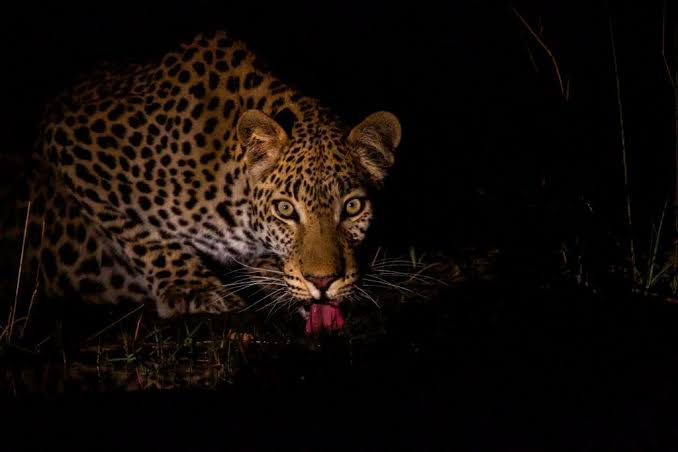
6. Photographing Lions and Leopards After Dark
Lions and leopards can be interesting subjects during authorised night drives.
However, photographing moving predators in low light is difficult.
Lions at Night
A resting lion may be easier to photograph than one walking through vegetation.
Focus on the nearest eye whenever possible.
Use continuous autofocus if the animal moves.
Avoid relying on very slow shutter speeds, as even small head movements can create blur.
Leopards at Night
Leopards may appear briefly before disappearing into vegetation.
A telephoto lens can help maintain a suitable distance.
Try capturing the animal’s face or body outline without forcing the vehicle closer.
Never request that a guide follow a predator aggressively or interfere with a hunt.
7. Photographing Stars and the Milky Way
Night photography on safari is not limited to animals.
Remote safari destinations may offer excellent opportunities for photographing the night sky, particularly where artificial lighting is limited.
The Milky Way can be visible under suitable conditions, although its appearance depends on the season, moonlight, weather and location.
Recommended Settings for Star Photography
Begin with:
Manual exposure mode.
A wide-angle lens.
An aperture around f/2.8 or wider.
ISO between 1600 and 6400.
A shutter speed of approximately 10–20 seconds.
A stable tripod.
Manual focus adjusted carefully on a bright star.
Check your images for star trails.
Longer exposures may cause stars to appear as streaks because of Earth’s rotation.
For the best results, photograph during clear weather and away from strong artificial lighting.
However, never leave your accommodation compound without permission.
8. Can You Photograph Wildlife Outside Your Safari Lodge at Night?
Wild animals sometimes move near safari lodges and camps after dark.
You may hear hyenas calling, see antelopes feeding or notice smaller nocturnal animals around vegetation.
However, walking outside your accommodation without an authorised escort can be dangerous.
Many safari camps require guests to request assistance when moving between tents and communal areas after sunset.
Follow these instructions carefully.
If wildlife approaches your accommodation, observe quietly from a safe position.
Avoid approaching animals or using bright lights to obtain photographs.
Your lodge staff can explain which photography activities are permitted.
9. Common Challenges in Night Safari Photography
Night photography presents several technical difficulties.
Blurred Photographs
Moving animals may appear blurred because of slow shutter speeds.
Increase your shutter speed when possible and compensate using aperture or ISO.
Difficulty Focusing
Autofocus systems may struggle in darkness.
Focus on areas with visible contrast, such as an illuminated eye or the edge of an animal’s face.
Excessive Image Noise
High ISO can introduce visible grain and reduce fine detail.
Moderate noise reduction during editing can improve image quality.
Avoid excessive processing that removes natural fur and skin textures.
Limited Visibility
Animals may disappear quickly into darkness.
Accept that some sightings are better experienced without taking photographs.
Not every wildlife encounter needs to produce an image.
10. Editing Night Safari Photographs
Night photographs often require careful editing.
Start by adjusting exposure and white balance.
Different artificial light sources can create unusual colour tones, so check that animal fur and surrounding vegetation remain natural.
Reduce excessive highlights caused by permitted spotlights.
Lift shadows carefully to reveal useful details.
Apply noise reduction moderately, especially around animal faces.
Avoid brightening the entire image until it resembles a daytime photograph.
Keeping some areas dark helps preserve the original night-time atmosphere.
11. Safety Rules for Night Photography on Safari
Night photography must follow the same wildlife safety principles as daytime photography, with additional care because visibility is limited.
Important precautions include:
Book night drives only where they are legally permitted.
Travel with an authorised guide.
Remain inside your safari vehicle unless instructed otherwise.
Avoid using personal spotlights towards wildlife.
Never approach animals on foot after dark.
Keep noise to a minimum.
Follow lodge instructions when moving around at night.
Respect restrictions on flash photography.
Never block wildlife movement or hunting behaviour.
A qualified guide understands the local environment and can assess situations that visitors may overlook.
Always follow their instructions.
12. Planning a Successful Night Photography Experience
Preparation can make your night photography session more enjoyable.
Before booking, ask your safari operator whether night drives are available and which photography restrictions apply.
Confirm the expected duration, vehicle arrangement and whether photography equipment can be supported safely.
Charge your batteries before departure and clear sufficient storage space.
Set your camera to suitable low-light settings before the drive begins.
Consider practising night photography at home so you understand how your camera performs at higher ISO values.
Most importantly, approach the experience with patience.
Wildlife sightings depend on natural animal behaviour, and some evenings may produce fewer photographic opportunities than others.
Conclusion
Night photography on safari offers opportunities to photograph nocturnal wildlife, dramatic landscapes and star-filled skies.
However, low light, animal movement and park regulations create important limitations.
Success depends on choosing authorised destinations, using appropriate camera settings and respecting wildlife.
A good camera and fast lens can help, but careful observation and guidance are equally important.
By preparing properly and accepting the challenges of photographing after dark, you can enjoy a different perspective on Africa’s wildlife while protecting the animals and yourself.


No comment