
Bigodi Wetland Sanctuary
Bigodi Wetland Sanctuary: Community-Run Walks Near Kibale
Bigodi Wetland Sanctuary near Kibale National Park is one of Uganda’s most rewarding destinations for birdwatching, primate viewing and community-based tourism. Located in Bigodi village in western Uganda, the sanctuary protects a beautiful wetland surrounded by tropical forest, papyrus vegetation, farmland and rural communities. Visitors explore the area on guided nature walks led by knowledgeable local residents.
Unlike conventional national park experiences, Bigodi is managed by a community organisation that uses tourism revenue to support conservation, education and local development. This approach allows visitors to enjoy Uganda’s wildlife while contributing directly to the wellbeing of people living near Kibale Forest.
The sanctuary is particularly famous for its Great Blue Turacos, colourful kingfishers, colobus monkeys and peaceful walking trails. For travellers visiting Kibale for chimpanzee tracking, a Bigodi wetland walk provides an excellent additional activity.
Where Is Bigodi Wetland Sanctuary Located?
Bigodi Wetland Sanctuary is situated approximately 40 kilometres from Fort Portal in western Uganda, near Kibale National Park.
The sanctuary protects part of the Magombe wetland, an important habitat for birds, primates and other wildlife.
Bigodi village is surrounded by cultivated gardens, forest patches and small community settlements.
This combination of natural and agricultural landscapes creates a distinctive environment where visitors can observe wildlife and learn about local livelihoods.
Quick Facts About Bigodi Wetland Sanctuary
| Feature | Description |
|---|---|
| Country | Uganda |
| Region | Western Uganda |
| Nearest major town | Fort Portal |
| Nearby park | Kibale National Park |
| Main habitat | Papyrus wetland and forest edge |
| Management | KAFRED community organisation |
| Main activity | Guided nature walks |
| Walking distance | Approximately 4.5 kilometres |
| Walking duration | Approximately 2–3 hours |
| Bird species | More than 200 recorded |
| Main attraction | Great Blue Turaco and primates |
1. The Community Behind Bigodi Wetland Sanctuary
Bigodi Wetland Sanctuary is managed by the Kibale Association for Rural and Environmental Development, commonly known as KAFRED.
The organisation was established in 1992 by local residents interested in protecting natural resources while improving community livelihoods.
Before community conservation became established, wetlands faced pressure from activities such as vegetation clearance and agricultural expansion.
Local residents recognised that protecting the wetland could create opportunities for tourism and long-term community development.
How KAFRED Supports Local People
KAFRED uses revenue from tourism to support community activities.
These have included educational initiatives, clean water projects, sanitation improvements and employment opportunities.
Local guides earn income by leading visitors through the sanctuary.
Other residents benefit through accommodation, food production, handicrafts and related tourism services.
This model demonstrates how conservation can provide practical economic benefits.
2. What Happens During a Bigodi Wetland Walk?
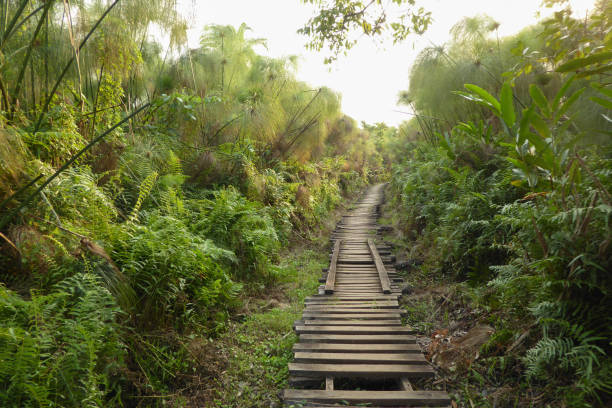
A typical Bigodi nature walk follows a guided route through wetland vegetation, forest edges and surrounding habitats.
The complete circuit covers approximately 4.5 kilometres and commonly takes two to three hours.
Visitors move along established footpaths and raised wooden boardwalks.
The boardwalks allow people to cross wet sections without walking directly through sensitive vegetation.
Walking With a Local Guide
Every sanctuary nature walk is accompanied by a trained local guide.
Guides explain the different habitats, identify birds and point out animals that may otherwise remain unnoticed.
Their familiarity with wildlife calls is especially useful.
A guide may recognise a Great Blue Turaco calling from a distant tree or locate monkeys moving through dense branches.
The experience is educational rather than physically demanding, although visitors should be comfortable walking outdoors for several hours.
3. Birdwatching at Bigodi Wetland Sanctuary
Birdwatching is one of the sanctuary’s most important attractions.
More than 200 bird species have been recorded in and around the wetland.
The combination of papyrus, forest edges, gardens and open areas supports different bird communities.
Some species remain concealed within vegetation, while others are easily observed along the walking trails.
Great Blue Turaco
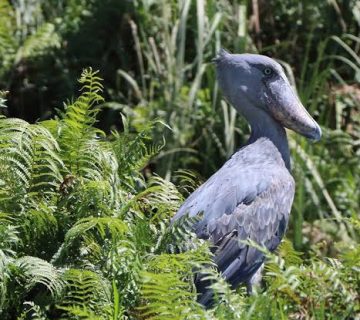
The Great Blue Turaco is among Bigodi’s most famous birds.
It has blue-grey plumage, a prominent crest and distinctive colours visible during flight.
These large birds often move through the forest canopy, feeding on fruits and other plant material.
Their calls can help guides locate them.
Other Birds to Look For
Visitors may encounter Ross’s Turacos, African Grey Parrots, hornbills, kingfishers and different weaver species.
Wetland areas also support herons and other water-associated birds.
Sightings depend on weather, season and individual bird movements.
For dedicated birdwatchers, carrying binoculars and allowing additional observation time can make the walk particularly rewarding.
4. Primates You May Encounter Near Bigodi
The sanctuary’s forest-edge habitats provide opportunities to observe several primate species.
Monkeys move between trees and surrounding vegetation while searching for food.
They may be encountered during ordinary nature walks, although sightings are not guaranteed.
Black-and-White Colobus Monkeys
These striking monkeys have black fur with contrasting white markings.
They are frequently associated with forest habitats and spend much of their time in trees.
Visitors may observe them feeding or resting among branches.
Red Colobus Monkeys
Red colobus monkeys are another important species associated with the Kibale landscape.
They often move in groups through suitable forest habitats.
Their distinctive colouring and social behaviour make them interesting photography subjects.
Red-Tailed Monkeys
Red-tailed monkeys are smaller, active primates commonly associated with tropical forest environments.
They move quickly through vegetation and may feed on fruits, insects and other available food.
Grey-Cheeked Mangabeys
Grey-cheeked mangabeys are known for their vocal communication and active movement through forest habitats.
Their calls may be heard before the animals become visible.
Olive baboons, blue monkeys and other primates may also occur around the sanctuary.
5. Other Wildlife in Bigodi Wetland
Although birds and monkeys attract considerable attention, Bigodi supports additional wildlife.
The wetland provides habitat for small mammals, amphibians, reptiles and aquatic organisms.
Sitatunga, a wetland-adapted antelope, may inhabit suitable vegetation, although sightings are uncommon.
Bushbucks can also occur in surrounding habitats.
Butterflies and insects contribute to the sanctuary’s biodiversity.
These smaller organisms play important roles in pollination, decomposition and the wider food web.
6. How Bigodi Supports Kibale Forest Conservation
Wetlands and forest edges provide valuable habitat around national parks.
Bigodi contributes to the wider landscape by protecting vegetation outside Kibale National Park.
This habitat supports wildlife and helps maintain ecological connections between different natural areas.
The wetland also performs important environmental functions.
Why Wetlands Matter
Wetlands can help retain water, store carbon and support plants adapted to saturated soils.
They provide breeding and feeding habitats for numerous animals.
Vegetation can also slow water movement and help trap sediments.
Protecting Bigodi therefore provides benefits beyond tourism.
It supports biodiversity and helps maintain important natural processes within the surrounding landscape.
7. Bigodi Community Cultural Walks
Visitors can combine the nature walk with a separate guided cultural experience in Bigodi village.
Community walks introduce travellers to local traditions, farming practices and everyday life.
Activities vary according to the guide, participating households and available arrangements.
What You May Experience
A cultural walk may include visits to local homes, gardens and community facilities.
Visitors can learn about banana cultivation, traditional foods and local crafts.
Some programmes include discussions about herbal knowledge, community history and cultural practices.
These experiences should be approached respectfully.
Always request permission before photographing residents or entering private spaces.
8. Why Community Tourism Makes Bigodi Different
Community tourism provides opportunities for local residents to benefit from protecting wildlife habitats.
At Bigodi, income from guided activities helps support employment and development initiatives.
This creates an incentive to maintain natural vegetation rather than converting all available land to other uses.
The project is also known for supporting local education.
KAFRED’s community development work has included investment in Bigodi Secondary School.
Community Conservation Benefits
| Activity | Community benefit |
|---|---|
| Guided wetland walks | Employment for local guides |
| Cultural village visits | Income for participating households |
| Handicraft sales | Opportunities for local artisans |
| Conservation management | Protection of wetland habitat |
| Tourism revenue | Support for community projects |
| Visitor education | Greater awareness of environmental protection |
9. Best Time to Visit Bigodi Wetland Sanctuary
Bigodi can be visited throughout the year.
However, weather conditions influence walking comfort and wildlife activity.
Western Uganda experiences wetter and relatively drier periods, although rainfall can occur in any month.
The periods from June to August and December to February are often convenient for travellers who prefer relatively drier walking conditions.
Is the Rainy Season Worth Visiting?
Yes.
The wetland remains biologically active throughout the year.
Rainfall may increase vegetation growth and create attractive green landscapes.
However, walking paths can become muddy, and some birds may be more difficult to observe in heavy rain.
Visitors should carry suitable footwear and waterproof protection when necessary.
10. Morning or Afternoon: Which Walk Is Better?
Early morning is generally attractive for birdwatching because many birds are actively calling and feeding.
The sanctuary’s published visitor guidance identifies early morning and mid-afternoon as suitable starting periods.
Morning walks may also provide cooler temperatures.
Afternoon visits can be rewarding for travellers combining Bigodi with other Kibale activities.
However, sightings depend on wildlife behaviour and cannot be guaranteed.
11. Combining Bigodi With Chimpanzee Tracking
Kibale National Park is particularly famous for chimpanzee tracking.
Many visitors travel to the region primarily to observe these primates in their natural forest habitat.
Bigodi offers a complementary experience focused on wetland wildlife and community conservation.
Suggested Two-Day Kibale Itinerary
Day 1: Kibale Chimpanzee Tracking
Begin with an organised chimpanzee tracking experience in Kibale National Park.
Afterwards, enjoy time at your accommodation or explore suitable surrounding areas.
Day 2: Bigodi Wetland and Cultural Walk
Take an early morning guided walk through Bigodi Wetland Sanctuary.
Spend time observing birds, monkeys and wetland vegetation.
In the afternoon, consider a cultural community walk if arrangements permit.
This itinerary allows visitors to appreciate both forest wildlife and community-managed conservation.
12. What to Bring for a Bigodi Nature Walk
You do not need specialist trekking equipment for an ordinary Bigodi walk.
However, suitable clothing and basic wildlife viewing equipment can improve comfort.
Recommended items include:
Comfortable walking shoes with good grip.
Binoculars for birdwatching.
A reusable drinking water bottle.
Lightweight clothing.
A rain jacket.
Insect repellent.
A camera with a suitable zoom lens.
Avoid wearing footwear that becomes slippery on damp wooden boardwalks.
13. Photography Tips for Bigodi Wildlife
Bigodi offers opportunities for photographing colourful birds, primates and wetland scenery.
A telephoto lens of approximately 100–400 mm can help capture animals resting in trees.
Forest-edge photography may involve changing light conditions.
Using a suitable ISO setting and continuous autofocus can help when photographing moving monkeys.
For birds, patience is especially important.
Avoid playing bird calls excessively or approaching nesting animals too closely.
Photography should always take place without disturbing wildlife.
14. Entrance Fees and Booking Arrangements
Bigodi operates as a community-managed tourism attraction, with guided nature walks and cultural walks offered as separate activities.
Fees may vary according to visitor category and the selected experience.
Published price lists have included older rates, so travellers should confirm current charges directly with the sanctuary before visiting.
The guided nature walk generally takes approximately two to three hours.
Advance arrangements can be helpful during busy travel periods, particularly for groups or visitors with limited time.
A Kibale chimpanzee tracking permit is separate from any Bigodi wetland walk fee.
15. Responsible Tourism at Bigodi
Visitors should follow the instructions of local guides throughout the walk.
Remain on established paths and boardwalks.
Avoid removing plants or disturbing animals.
Do not feed monkeys or other wildlife.
Carry rubbish back to the appropriate collection point.
When participating in community visits, respect residents’ privacy and local customs.
Purchasing locally made products can provide additional support for community livelihoods.
Why Bigodi Wetland Sanctuary Is Worth Visiting
Bigodi Wetland Sanctuary provides a distinctive wildlife experience near Kibale National Park.
Its guided walks allow travellers to explore papyrus wetlands, forest edges and habitats supporting numerous birds and primates.
The sanctuary is especially attractive for birdwatchers hoping to observe Great Blue Turacos and other colourful forest species.
However, its importance extends beyond wildlife sightings.
Through KAFRED, local residents have developed a tourism model that connects environmental protection with employment, education and community development.
For travellers planning a western Uganda safari, combining Bigodi with Kibale chimpanzee tracking offers an opportunity to experience both protected forest habitats and community-based conservation.
The result is a rewarding introduction to Uganda’s natural heritage and the people working to protect it.




No comment