
Ndutu Calving Season
Ndutu Calving Season: Predators Around Newborn Wildebeest
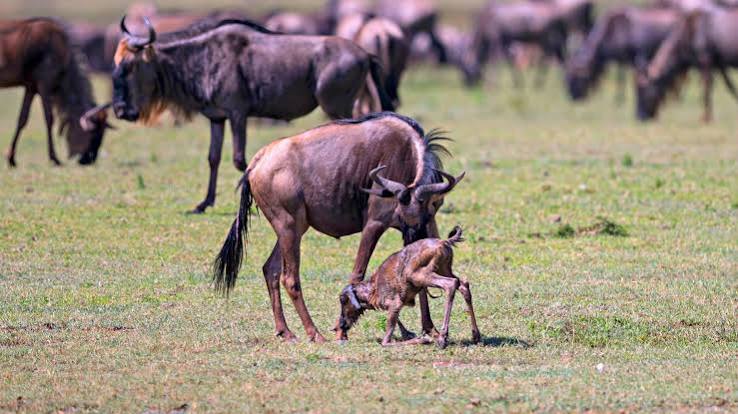
The Ndutu calving season is one of the most remarkable wildlife events in Tanzania’s Serengeti ecosystem. Every year, enormous herds of wildebeest gather on the southern short-grass plains, where hundreds of thousands of calves are born within a relatively short period. As newborn wildebeest take their first steps, lions, cheetahs, spotted hyenas and other predators search the surrounding grasslands for hunting opportunities.
Between January and March, the Ndutu area becomes an important destination for travellers interested in witnessing the early stages of the Great Wildebeest Migration. During the busiest weeks, thousands of calves may be born daily. Many can stand within minutes and begin following their mothers shortly afterwards, an essential survival ability in a landscape shared with large carnivores.
For visitors planning a Tanzania wildlife safari, the calving season provides an opportunity to observe newborn animals, maternal behaviour, predator hunting strategies and interactions between different species. Unlike the Mara River crossings, which take place later in the migration cycle, Ndutu offers extensive wildlife activity across open grasslands where animals feed, give birth and raise their young.
What Is the Ndutu Calving Season?
The Ndutu calving season is the annual period when large numbers of migrating wildebeest give birth on the short-grass plains of southern Serengeti and the adjoining Ngorongoro Conservation Area.
Ndutu is located around Lake Ndutu and Lake Masek, close to the boundary between these two major protected landscapes.
The area contains open grassland, seasonal wetlands, acacia woodland and nutrient-rich soils influenced by ancient volcanic activity.
Seasonal rainfall encourages fresh grass growth, providing valuable nutrition for pregnant and nursing wildebeest.
Quick Facts About the Ndutu Calving Season
| Feature | Description |
|---|---|
| Main destination | Ndutu, northern Tanzania |
| Wildlife area | Southern Serengeti and Ngorongoro Conservation Area |
| Main calving months | January to March |
| Typical peak | February |
| Main animal | Blue Wildebeest |
| Scientific name | Connochaetes taurinus |
| Estimated calves born | Approximately 400,000–500,000 in a major season |
| Major predators | Lions, cheetahs and spotted hyenas |
| Other predators | Leopards and jackals |
| Main attraction | Newborn wildebeest and predator activity |
| Recommended safari stay | 3–4 nights in the Ndutu area |
The numbers are estimates, and actual births vary between years according to herd populations and environmental conditions.
Why Do Wildebeest Give Birth Around Ndutu?
The short-grass plains around Ndutu provide favourable conditions for wildebeest during calving.
The region’s volcanic soils contain minerals that support nutritious grass growth when sufficient rain falls.
Pregnant females require substantial energy and nutrients during the final stages of pregnancy.
After giving birth, mothers also need suitable grazing to support milk production.
The open grasslands provide another potential advantage. Wildebeest can observe approaching predators across considerable distances, although visibility does not eliminate the risk of an attack.
Why the Calving Grounds Are Important
The combination of fresh grass, open habitats and seasonal rainfall makes southern Serengeti particularly attractive to migrating wildebeest.
However, the timing is not determined by the calendar alone.
If rainfall arrives earlier or later than expected, herd movements and calving concentrations may shift.
This is why safari visitors should consider seasonal conditions when choosing travel dates.
How Many Wildebeest Calves Are Born During the Season?
The Serengeti migration is famous for the enormous number of wildebeest calves born within a relatively short period.
Widely reported estimates suggest that approximately 400,000–500,000 calves may be born during a major calving season, with a substantial proportion arriving within a few weeks.
During peak activity, estimates commonly reach several thousand births each day, sometimes described as approximately 8,000 daily.
These figures illustrate the scale of the event rather than representing an exact count for every year.
Why So Many Calves Are Born Together
Wildebeest have a highly synchronised breeding cycle.
Most females become pregnant during a concentrated mating period, resulting in large numbers giving birth around the same season.
This synchronisation may reduce the proportion of newborns lost to predators.
Although lions, hyenas and other carnivores can capture many calves, their hunting capacity is limited.
When enormous numbers of calves are born close together, many survive because predators cannot capture them all.
This phenomenon is commonly described as predator saturation.
Why Predators Gather Around Newborn Wildebeest
The calving season provides predators with increased opportunities to capture vulnerable prey.
Newborn wildebeest are smaller, less experienced and initially less coordinated than adults.
Although they develop mobility quickly, they remain vulnerable during their earliest days.
Predators respond to prey availability, habitat conditions and opportunities to hunt.
However, not every predator moves into Ndutu specifically for the calving season. Many lions, cheetahs and hyenas already occupy territories within the southern Serengeti ecosystem.
The arrival of large herds changes the availability and distribution of potential prey.
1. Lions: Powerful Hunters of the Calving Plains
Lions are among the most impressive predators visitors may encounter during the Ndutu calving season.
They occupy grasslands, woodland edges and other habitats where prey is available.
Lions may hunt adult wildebeest, calves and other herbivores.
How Lions Hunt During Calving
Lions often rely on concealment, careful positioning and short bursts of speed.
A pride may use patches of vegetation, shallow depressions or uneven ground to approach prey.
Individual lions may also hunt independently.
During calving, vulnerable wildebeest calves can provide feeding opportunities, although adult animals remain important prey.
Lions may rest for long periods between hunting attempts.
For safari visitors, observing a pride near grazing herds can reveal interesting behaviour even when no hunt takes place.
Do Lions Always Target Newborn Calves?
No. Lions take prey according to availability, hunting conditions and individual opportunities.
A calf separated from its mother may be vulnerable, but lions can also capture adult wildebeest.
Large prey provides substantial food, particularly when several pride members are feeding.
2. Cheetahs: Speed and Precision on Open Grasslands
Cheetahs are particularly well adapted to hunting across the open plains around Ndutu.
Their slender bodies, long legs and remarkable acceleration allow them to pursue fast-moving prey over short distances.
Unlike lions, cheetahs generally depend on speed rather than overwhelming strength.
How Cheetahs Hunt Wildebeest Calves
A cheetah may observe a herd from a distance before selecting a vulnerable animal.
It approaches carefully, attempting to reduce the distance before beginning a chase.
Young wildebeest can be suitable prey because they are smaller than adults.
However, cheetahs also hunt gazelles and other animals that may be easier to capture.
Female cheetahs raising cubs require regular food and may use the productive hunting conditions created by the seasonal herbivore concentrations.
Best Time to Observe Cheetahs
Early morning and late afternoon can provide rewarding cheetah sightings.
Cheetahs may also hunt during other daylight hours, particularly when conditions are suitable.
Their preference for open terrain makes them easier to observe in some parts of Ndutu than in heavily wooded landscapes.
3. Spotted Hyenas: Skilled Hunters and Scavengers
Spotted hyenas are among the most important carnivores in the Serengeti ecosystem.
Although they are frequently associated with scavenging, spotted hyenas are highly capable hunters.
They can pursue wildebeest, zebras, gazelles and other herbivores.
During the calving season, newborn wildebeest provide additional hunting opportunities.
How Hyenas Find Vulnerable Calves
Hyenas use their strong sense of smell, hearing and observation to locate potential prey.
They may travel considerable distances while searching for food.
An isolated calf can be vulnerable, particularly if its mother is absent or unable to defend it effectively.
Hyenas sometimes hunt alone, while others cooperate in groups.
Their social organisation is complex, with individuals belonging to clans that occupy established territories.
Hyenas and Lions Around Carcasses
Lions and hyenas may compete for access to carcasses.
These interactions can produce aggressive encounters, particularly when food is valuable.
The outcome often depends on the number of animals present, their size and the circumstances.
Such interactions are a natural part of predator competition in the Serengeti.
4. Leopards: Secretive Predators Around Ndutu
Leopards are generally more difficult to observe on open plains because they often prefer habitats offering concealment.
Around Ndutu, suitable woodland and trees provide resting locations and opportunities for ambush hunting.
Leopards feed on different animals, including small antelopes, birds and young mammals.
A vulnerable wildebeest calf may occasionally become prey, although leopards do not depend exclusively on newborn wildebeest.
Where to Look for Leopards
Areas containing acacia trees and thicker vegetation may provide opportunities to observe leopards.
Guides often examine large branches and shaded resting locations.
Sightings remain unpredictable, and visitors should avoid expecting a leopard encounter on every game drive.
5. Jackals: Smaller Predators on the Calving Plains
Jackals are another interesting group of carnivores associated with the Serengeti ecosystem.
Black-backed jackals are particularly relevant to open savannah environments.
They feed on rodents, insects, birds, carrion and small mammals.
During calving, jackals may take advantage of vulnerable newborn animals or available remains.
However, adult wildebeest are far too large for a jackal to hunt under normal circumstances.
Jackals frequently occur in pairs and may defend territories together.
Their feeding behaviour provides additional opportunities to observe smaller predators during a Ndutu safari.
How Newborn Wildebeest Avoid Predators
Newborn wildebeest face danger almost immediately after birth.
Unlike many animals that remain hidden for extended periods, wildebeest calves develop mobility remarkably quickly.
A healthy calf may begin standing within minutes of birth.
It can often walk and follow its mother shortly afterwards.
This rapid development is essential because wildebeest herds remain mobile and may need to respond quickly to disturbances.
Survival Strategies of Newborn Wildebeest
Standing soon after birth.
Following the mother closely.
Remaining near other herd members.
Responding to movement and alarm behaviour.
Developing stronger coordination during the first days.
Feeding frequently to support rapid growth.
These adaptations improve survival prospects but cannot eliminate predation risk.
How Wildebeest Mothers Protect Their Calves
Female wildebeest form strong associations with their newborn calves.
Shortly after birth, the mother may lick the calf, helping clean it and encouraging movement.
Mothers recognise their offspring through a combination of scent, appearance and vocal communication.
When threatened, a female may remain near her calf and attempt to discourage smaller predators.
However, wildebeest cannot defend themselves successfully against every attacker.
A mother may flee when the danger becomes too great, particularly when a powerful predator approaches.
Why Predators Cannot Capture Every Calf
Even during periods of intense predator activity, most calves are not captured immediately after birth.
The enormous number of births creates more potential prey than local predators can consume.
Predators also face limitations.
Hunting requires energy, and unsuccessful pursuits can be costly.
After feeding, carnivores often rest before attempting another hunt.
Large predators must also avoid injuries that could reduce their ability to survive.
The combination of synchronised births, herd behaviour and rapid calf development helps many young wildebeest survive.
Best Time to Visit Ndutu for Calving and Predator Sightings
The calving season generally takes place between January and March.
February is usually considered the most favourable month for observing concentrated births and associated predator activity.
However, environmental conditions vary annually.
Ndutu Calving Season Calendar
| Month | Typical wildlife experience |
|---|---|
| December | Migrating herds begin gathering as seasonal rains influence grass growth |
| January | Increasing numbers of wildebeest and early calving |
| February | Usually the busiest calving period, with excellent predator-viewing opportunities |
| March | Calving may continue while herds begin responding to changing grazing conditions |
| April | Many herds gradually move away from the southern plains |
A safari during February offers particularly good opportunities to observe newborn calves, although no specific birth or predator hunt can be guaranteed.
Where to See Predators Around Ndutu
Ndutu contains different habitats supporting predators and grazing animals.
Lake Ndutu Plains
The open grasslands around Lake Ndutu provide opportunities to observe wildebeest herds and other herbivores.
Lions, cheetahs and hyenas may also be encountered in suitable areas.
Lake Masek Surroundings
The Lake Masek area contains grassland and woodland habitats.
These different environments can support a variety of predators and other wildlife.
Southern Serengeti Short-Grass Plains
The southern Serengeti plains are especially important during the calving season.
Large migrating herds gather where fresh grass provides suitable feeding conditions.
Cheetahs, lions and hyenas may be observed across these open landscapes.
How Many Days Should You Spend in Ndutu?
Travellers interested in newborn wildebeest and predator behaviour should consider spending at least three or four nights in the Ndutu area.
This allows several morning and afternoon game drives.
A longer stay also provides flexibility if heavy rainfall or unusual herd movements affect wildlife viewing.
Suggested Four-Day Ndutu Safari
Day 1: Arrival and Afternoon Game Drive
Travel to Ndutu and explore nearby grassland habitats.
Look for wildebeest herds, zebras, gazelles and resident predators.
Day 2: Full-Day Calving Safari
Spend the day exploring areas where newborn wildebeest are concentrated.
Observe maternal behaviour, calf development and predator activity.
Day 3: Predator-Focused Game Drives
Search suitable habitats for cheetahs, lions, hyenas and leopards.
Allow time for patient observation rather than travelling continuously between sightings.
Day 4: Morning Wildlife Viewing and Departure
Enjoy an early game drive before continuing to another Serengeti destination or returning towards Ngorongoro.
Photography Tips for the Ndutu Calving Season
Ndutu provides excellent opportunities for photographing newborn wildebeest and predators.
Open grasslands often provide relatively clear views, while seasonal green vegetation creates attractive natural backgrounds.
A camera with a 100–400 mm telephoto zoom lens is useful for photographing animals from a safari vehicle.
For running animals, a shutter speed of approximately 1/1000–1/2000 second can help capture sharp images.
Early morning and late afternoon generally provide favourable lighting.
Photographers should avoid pressuring guides to approach newborn calves or hunting predators too closely.
Natural behaviour is best observed when animals are not disturbed by vehicles.
Responsible Wildlife Viewing During Calving Season
The calving season is a sensitive period for wildebeest and their young.
Safari vehicles should maintain suitable distances from animals giving birth or nursing calves.
Visitors must avoid blocking movement between mothers and their offspring.
Never ask a driver to separate a calf from its herd to obtain photographs.
It is also important to avoid surrounding predators during hunts.
Follow protected-area regulations and respect the instructions of experienced guides.
Responsible observation helps protect wildlife while allowing visitors to enjoy authentic safari experiences.
Why the Ndutu Calving Season Is Worth Experiencing
The Ndutu calving season offers a fascinating opportunity to observe the beginning of a new generation of migrating wildebeest.
Thousands of calves enter the world during a relatively short period, while predators respond to the increased availability of prey.
Lions demonstrate strength and patience, cheetahs rely on speed, spotted hyenas use endurance and opportunistic hunting, and jackals search for smaller feeding opportunities.
However, the calving season involves more than predator encounters.
Visitors can also observe newborn wildebeest taking their first steps, mothers protecting their young and large grazing herds moving across green grasslands.
For travellers planning a Tanzania safari, Ndutu provides one of the best opportunities to understand the relationship between reproduction, predator behaviour and seasonal migration in the Serengeti ecosystem.


No comment